Air Fryer Brands, Compared
Every brand in this category is chasing a different thing. Once you know which, choosing between them stops being guesswork.
Disclosure:Watt & Whisk is reader-supported. When you buy through links on this page we may earn an Amazon Associates commission, at no extra cost to you. Prices are pulled live from Amazon and shown with the date checked. How this works.
The short version: Ninja competes on format and reliability — it invented the dual-basket category and its machines just keep working. Cosori competes on materials and warranty — PFAS-free ceramic listed as a spec, and two years of cover where one is normal. Instant competes on function count and interface. Dash competes on size and price alone. Chefman and Philips are dual-basket alternatives to Ninja, and Typhuris the premium outlier chasing crisping area. None of them is "best" — they are aiming at different buyers.
The short answer
Quick picks
| # | Product | Best for | Score | Price |
|---|---|---|---|---|
| 01 | 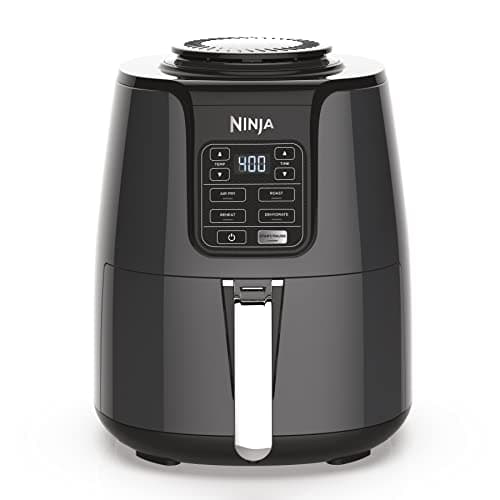 Ninja AF101 The 4-quart Ninja AF101 is the one we point most people to: a genuinely simple dial-and-button air fryer with a ceramic-coated basket, a 105–400°F range, and a footprint that fits a normal counter. It has been the reliable default since 2018 for good reason. 4 QT · 1550W | Best overall on value | 4.6★★★★★ | $104.99Amazon |
| 02 | 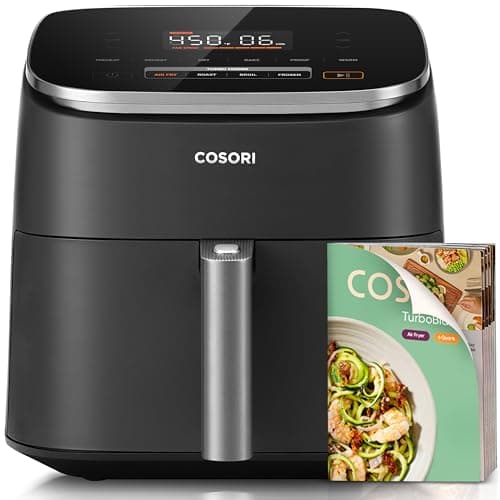 Cosori TurboBlaze Cosori's TurboBlaze pairs a 6-quart square basket with a genuinely PFAS-free ceramic coating and a faster 3,600-rpm fan. It's the pick if you want a modern, roomier air fryer without stepping up to a dual-basket footprint — and the coating claim is on the spec sheet, not marketing. 6QT | Best for most kitchens | 4.5★★★★★ | $99.99Amazon |
| 03 | 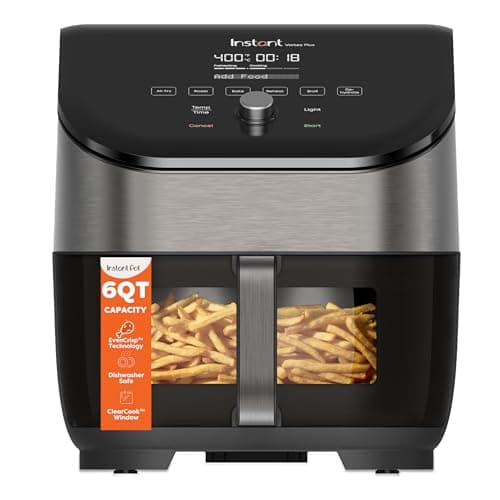 Instant Vortex Plus The 6-quart Vortex Plus draws a stated 1,700 W, runs six functions, and adds a ClearCook window and interior light so you can watch food crisp without pulling the basket. It's the most feature-complete pick under most sale prices. 6 Qt · 1700W | Best with a cook window | 4.4★★★★★ | $119.95Amazon |
#ad · Live prices from the Amazon Product API, as of October 16, 2026. Where we have no verified live price, we show none — a gap beats a number that has rotted.
The picks, in detail
Ninja AF101
spec score /5
$119.9913% off
Price as of October 16, 2026. Prices change — Amazon's is the one that counts.
#ad · we may earn a commission from this link to Ninja AF101
The 4-quart Ninja AF101 is the one we point most people to: a genuinely simple dial-and-button air fryer with a ceramic-coated basket, a 105–400°F range, and a footprint that fits a normal counter. It has been the reliable default since 2018 for good reason.
- Capacity
- 4 QT
- Footprint (W×D×H)
- 12.25 × 15.1 × 15.25 in
- Power
- 1550 W
- Weight
- 10.58 lb
- Cost per use*
- ≈9¢
- Est. per year*
- ≈$18
- Warranty
- 1 Year Manufacturers
- Ceramic-coated aluminum basket — no PTFE nonstick
- Dead-simple controls; nothing to learn
- Small enough for a normal counter (12 × 15 in)
- 4 qt is tight for a family of 4+
- No preset buttons or window
- Dial isn't the most precise
*Cost-to-run computed from the manufacturer's stated 1550W at $0.17/kWh (US average), 20-min sessions, 4×/week. Your rate and use will vary.
Cosori TurboBlaze
spec score /5
$119.9917% off
Price as of October 16, 2026. Prices change — Amazon's is the one that counts.
#ad · we may earn a commission from this link to Cosori TurboBlaze
Cosori's TurboBlaze pairs a 6-quart square basket with a genuinely PFAS-free ceramic coating and a faster 3,600-rpm fan. It's the pick if you want a modern, roomier air fryer without stepping up to a dual-basket footprint — and the coating claim is on the spec sheet, not marketing.
- Capacity
- 6QT
- Footprint (W×D×H)
- 11.8 × 14.4 × 11.9 in
- Weight
- 13.2 lb
- Warranty
- 2 Year Manufacturer
- PFAS-free ceramic basket (per spec sheet)
- 6-qt square basket fits more than round baskets
- Quieter, faster fan; 2-year warranty
- Pricier than a basic basket fryer
- Taller than a compact model
- Digital panel is a small learning curve
Instant Vortex Plus
spec score /5
$159.9925% off
Price as of October 16, 2026. Prices change — Amazon's is the one that counts.
#ad · we may earn a commission from this link to Instant Vortex Plus
The 6-quart Vortex Plus draws a stated 1,700 W, runs six functions, and adds a ClearCook window and interior light so you can watch food crisp without pulling the basket. It's the most feature-complete pick under most sale prices.
- Capacity
- 6 Qt
- Footprint (W×D×H)
- 11.8 × 12.8 × 14.9 in
- Power
- 1700 W
- Cost per use*
- ≈10¢
- Est. per year*
- ≈$20
- ClearCook window + interior light
- 6 functions incl. broil, bake, dehydrate
- Frequently the best-value 6-qt on sale
- Basket coating is standard nonstick
- 1,700 W is thirstier than most (see cost math)
- Odor filter is a consumable
*Cost-to-run computed from the manufacturer's stated 1700W at $0.17/kWh (US average), 20-min sessions, 4×/week. Your rate and use will vary.
Brand comparisons in this category are usually a list of specs with no thesis. That is not much use, because every air fryer at every price is the same two components — a heating element and a fan — and they all crisp food. What separates the brands is what they chose to spend money on beyond that. Here is what each one is actually competing on, drawn from the published specifications of the machines we track.
Ninja — format innovation and a reliability record
Ninja (made by SharkNinja) is the default in this category for two reasons. First, it created the format that solved the real problem: the DualZone two-basket machine, where two independent cooking zones each have their own fan and heater. The 8-quart DZ201 runs two 4-quart zones; Smart Finish cooks two foods two ways and lands them at the same moment, and Match Cook mirrors settings across both. No single-basket machine at any price can do that. The 10-quart DZ401 is the same idea, larger.
Second, the AF101 has been in the market since 2018 and is still worth recommending, which says something. Four quarts, 1,550 watts, a 105–400°F range, and a ceramic-coated aluminum basket rather than a conventional PTFE one — at the lowest price of anything we track. Ninja rates that basket at 2 lb of French fries.
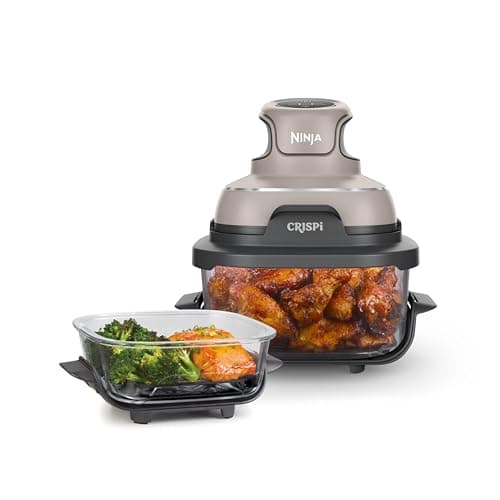
Ninja also has the most interesting outlier in the category, the Crispi: a palm-sized heating pod that clamps onto borosilicate glass containers Ninja lists as free of PFAS, PTFE and nonstick coatings. It is the only mainstream way to air fry with no coating at all — see best glass air fryers.
The weakness: warranty. Ninja ships one-year cover across the range, and its machines run tall — the AF101 is 15.25 inches high, which is close to the limit under a standard 18-inch cabinet gap once you allow for venting.
Cosori — materials and warranty
Cosori decided to compete on the things you cannot see, and it is the clearest brand thesis in the category. The TurboBlaze (CAF-DC601-KUS) lists a PFAS-free ceramic coating on both the basket and the crisper tray as a published specification rather than an implication, runs a 90–450°F range that is wider at both ends than nearly anything else, and uses a 3,600 rpm five-speed fan. The 5-quart Pro LE (CAF-L501-KUS) carries the same ceramic approach with seven presets, preheat and keep-warm, and 450°F top heat.
Both come with a two-year warranty. In a category where the fan bearing and the heating element are the two things that fail and one year is the norm, doubling the cover is the most meaningful signal a manufacturer can send about expected life.
Cosori also uses square baskets, which matters more than it sounds: air frying needs food in a single layer, so usable floor area decides your meal, and a square basket turns the corners into cooking space a round one wastes.
The weakness: depth. Both are 14.4 inches deep, a real commitment on a standard 24-inch counter. And there is no Cosori answer to the dual-basket problem.
Instant — functions and interface
Instant Brands came to air fryers from the Instant Pot, and it shows in the approach: count the functions, put a touchscreen on it, connect an app. The Vortex Plus 4-Qt runs six functions — air fry, bake, roast, broil, dehydrate, reheat — across a 95–400°F range, and Instant rates it for up to four servings inside a 10.2-inch-wide body. Its EvenCrisp technology is quoted at 95% less oil than deep frying.
The 6-quart Vortex Plus is the bigger sibling at 1,700 watts, the highest draw of anything we track — which buys fast recovery and costs about a penny more per batch.
The 95°F floor is the underrated spec here. It is low enough to dehydrate properly, which a machine that stops at 120°F cannot do regardless of what its dehydrate button claims.
The weakness: Instant does not make a materials claim the way Cosori does, and its warranty terms are the least clearly published of the major brands.
Dash — one job, done cheaply
Dash is not trying to compete with the others and is better for it. The Compact is a 2-quart analog machine — one temperature dial, one timer, a cool-touch handle, auto shut-off, a nonstick basket — measuring 8.1 × 10.2 × 11.4 inches and weighing 5.8 lb. It is the smallest real air fryer we track and it is aimed squarely at one person, a dorm, an RV or a studio counter with nothing to spare.
The weakness: it is 2 quarts. That is a snack for two or dinner for one, and no amount of enthusiasm changes it. One-year warranty.
Chefman and Philips — the dual-basket alternatives
Both chase Ninja's two-drawer format from different angles. The Chefman TurboFry Touch Dual is 9 quarts total at 1,500 watts, with a Sync Finish function that calculates offsets so both baskets land together, a shake reminder, and a one-year warranty. It is 20 inches wide — the widest thing on this page — but only 10 deep, which suits some counters much better than a square footprint.
The Philips 3000 Series (NA351) takes a different tack: 9.5 quarts split into unequal drawers, a 6.3-quart main and a smaller one for sides. That asymmetry is smarter than Ninja's two matched 4-quart zones for the common case of a big main and a small side, though it is less flexible if you want two equal portions. Philips quotes 90% less fat and pairs it with the HomeID recipe app.
Typhur — the premium outlier
The Typhur Dome 2 is the only machine here competing on cooking geometry. Instead of a deep basket, it uses a wide flat one — a 5.6-quart cooking surface with an interior height of just 2.36 inches, sized to fit a 12-inch pizza — with dual top and bottom heating so food browns on both sides with less flipping. It specifies a PFAS-free ceramic basket, runs 15 functions, has a self-cleaning cycle for the top cavity, and Typhur quotes 51 dBoperation, which almost nobody else in this category publishes at all. It is recommended by America's Test Kitchen and Consumer Reports in their 2026 write-ups.
The weakness: footprint and price. At 15.6 × 19.7 inches and 20.5 lb it is the largest countertop commitment on this page, and it is the most expensive. One-year warranty.
How to choose between them
Work backwards from your actual constraint rather than from the brand:
- Counter space is tight → Dash (2 qt, 8.1 in) or Instant Vortex Plus 4-Qt (10.2 in).
- You care about coatings → Cosori TurboBlaze or Typhur Dome 2 for PFAS-free ceramic; Ninja Crispi for no coating at all.
- You want a main and a side finishing together → Ninja DualZone, Chefman TurboFry Dual, or Philips 3000.
- You want the most machine for the least money → Ninja AF101.
- You want it to last → Cosori, on the two-year warranty.
If your shortlist has come down to the two biggest names, Ninja vs. Cosori goes head to head on the specific models. For the cross-category view of appliance brands beyond air fryers, see the best kitchen appliance brands.
Frequently asked questions
What is the best air fryer brand?
There is no single best — each brand competes on something different. Ninja leads on format (it created the dual-basket category) and reliability. Cosori leads on materials and a two-year warranty. Instant leads on function count and interface. Dash owns the tiny end. Pick the brand whose priority matches your constraint.
Is Ninja or Cosori better?
Ninja if you want a dual-basket machine or the cheapest reliable option; Cosori if you want PFAS-free ceramic listed as a specification, a square basket, and two years of warranty instead of one. They are genuinely competing on different things rather than the same thing at different quality levels.
Which air fryer brands are PFAS-free?
Cosori publishes PFAS-free ceramic on the TurboBlaze basket and crisper tray, and Typhur specifies a PFAS-free ceramic basket on the Dome 2. Ninja's Crispi goes further with borosilicate glass containers listed as free of PFAS, PTFE and nonstick coatings entirely.
Which brand has the best warranty?
Cosori, at two years on the TurboBlaze and Pro LE. One year is the norm across Ninja, Dash, Chefman and Typhur. Since the fan bearing and heating element are the parts that fail, warranty length is the most honest signal you get about expected life.
Are expensive air fryers actually better?
They crisp food the same way — every air fryer is an element and a fan. What more money buys is materials, warranty, basket geometry and noise. The Typhur Dome 2's flat 12-inch cooking surface and 51 dB operation are real differences, but they are refinements rather than a different result.
Who makes Ninja air fryers?
SharkNinja, the same company behind Shark vacuums. That matters mainly because it explains the reliability record and the parts availability — the AF101 has been in continuous production since 2018.
Sources
Keep reading
Air Fryers
The Best Air Fryers of 2026
Our ranked air-fryer picks, compared on capacity, footprint, materials and running cost — with live Amazon prices.
Comparison
Ninja vs. Cosori: Which Air Fryer Brand Is Better?
Ninja vs Cosori on basket materials, capacity, footprint, controls and warranty — and which one suits your kitchen.
Roundup
The Best Non-Toxic Air Fryers of 2026
Glass and PFAS-free ceramic air fryers, ranked — with an honest take on coatings.
Roundup
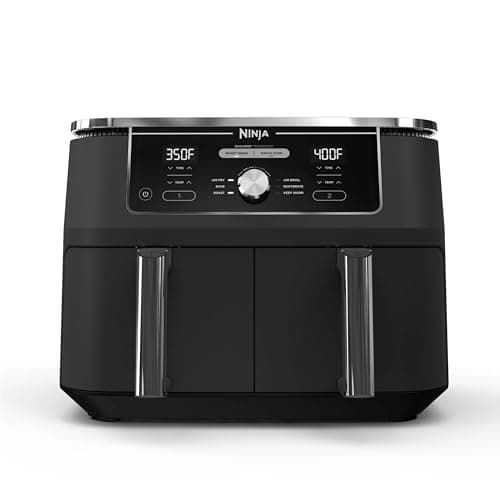
The Best Dual-Basket Air Fryers
Four double-drawer air fryers ranked on per-basket capacity, footprint and sync cooking — and when one basket is smarter.
Roundup
The Best Glass Air Fryers of 2026
The one true borosilicate-glass air fryer, what it trades away, and the PFAS-free ceramic alternatives worth cross-shopping.
Brands
The Best Kitchen Appliance Brands, Explained
An honest, spec-based look at what each major countertop appliance brand does best.
https://wattandwhisk.com/air-fryers/air-fryer-brands-compared