Air Fryer Not Crisping? Here Is Why
Soggy air fryer food is almost never a broken machine. It is one of eight things, and the first two account for most of them.
Disclosure:Watt & Whisk is reader-supported. When you buy through links on this page we may earn an Amazon Associates commission, at no extra cost to you. Prices are pulled live from Amazon and shown with the date checked. How this works.
In order of likelihood: the basket is overcrowded, the food is wet, there is no oil at all, the machine wasn't preheated, the temperature is too low, the fan guard is clogged with grease, the food was frozen and released water, or the machine has no clearance behind it. Overcrowding alone explains most cases — air frying is convection, and convection needs air moving around every surface.
The short answer
Quick picks
| # | Product | Best for | Score | Price |
|---|---|---|---|---|
| 01 | 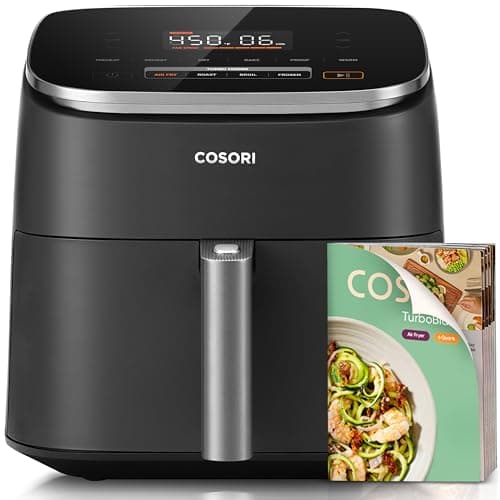 Cosori TurboBlaze Cosori's TurboBlaze pairs a 6-quart square basket with a genuinely PFAS-free ceramic coating and a faster 3,600-rpm fan. It's the pick if you want a modern, roomier air fryer without stepping up to a dual-basket footprint — and the coating claim is on the spec sheet, not marketing. 6QT | Best for most kitchens | 4.5★★★★★ | $99.99Amazon |
| 02 | 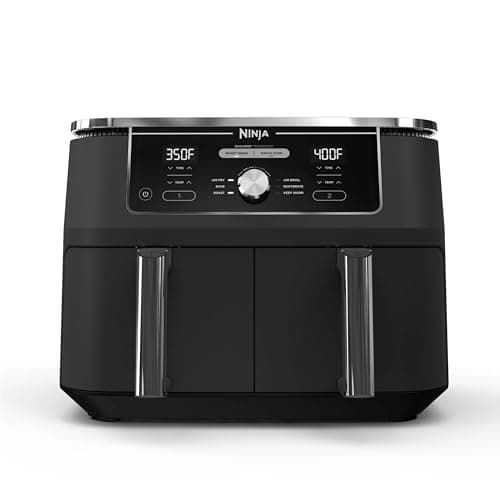 Ninja Foodi DualZone XL DZ401 The DZ401 is the 10-quart version of the dual-basket idea: two independent 5-quart drawers, Smart Finish to make two foods land together, Match Cook to run both the same, and a nonstick surface Ninja lists as 100% PFAS-free. It's the two-basket fryer to buy if a family meal is the actual job. 10 Quart | Best dual-basket overall | 4.5★★★★★ | $199.99Amazon |
#ad · Live prices from the Amazon Product API, as of October 17, 2026. Where we have no verified live price, we show none — a gap beats a number that has rotted.
The picks, in detail
Cosori TurboBlaze
spec score /5
$119.9917% off
Price as of October 17, 2026. Prices change — Amazon's is the one that counts.
#ad · we may earn a commission from this link to Cosori TurboBlaze
Cosori's TurboBlaze pairs a 6-quart square basket with a genuinely PFAS-free ceramic coating and a faster 3,600-rpm fan. It's the pick if you want a modern, roomier air fryer without stepping up to a dual-basket footprint — and the coating claim is on the spec sheet, not marketing.
- Capacity
- 6QT
- Footprint (W×D×H)
- 11.8 × 14.4 × 11.9 in
- Weight
- 13.2 lb
- Warranty
- 2 Year Manufacturer
- PFAS-free ceramic basket (per spec sheet)
- 6-qt square basket fits more than round baskets
- Quieter, faster fan; 2-year warranty
- Pricier than a basic basket fryer
- Taller than a compact model
- Digital panel is a small learning curve
Ninja Foodi DualZone XL DZ401
spec score /5
$229.9913% off
Price as of October 17, 2026. Prices change — Amazon's is the one that counts.
#ad · we may earn a commission from this link to Ninja Foodi DualZone XL DZ401
The DZ401 is the 10-quart version of the dual-basket idea: two independent 5-quart drawers, Smart Finish to make two foods land together, Match Cook to run both the same, and a nonstick surface Ninja lists as 100% PFAS-free. It's the two-basket fryer to buy if a family meal is the actual job.
- Capacity
- 10 Quart
- Footprint (W×D×H)
- 13.9 × 17.1 × 12.8 in
- Weight
- 19.8 lb
- Warranty
- 1 Year Limited Warranty
- 10 qt across two independent baskets — a whole meal at once
- Cooking surface listed as 100% PFAS-free
- Smart Finish syncs two different foods to the same finish time
- Deep 17.1-in footprint eats counter depth
- 19.8 lb — not a lift-and-store machine
- Overkill for one or two people
"My air fryer isn't crisping any more" is the most common problem people bring us, and it is almost never a fault. An air fryer is a small convection oven: a heating element and a fan that moves hot, dry air fast enough to drive moisture off the surface of food and let it brown. Anything that interrupts that airflow, or keeps adding moisture faster than it leaves, produces steamed food instead of crisp food.
So here are the eight causes in the order we would check them. Work down the list and you will find yours in the first two or three.
1. The basket is overcrowded
This is the answer most of the time, and it is the one people resist because it means cooking in two batches.
Air frying works by moving hot air around every surface of the food. When you pile chips two or three deep, the pieces in the middle never meet moving air — they sit in a pocket of humidity created by the water evaporating from their neighbors. The result is browned edges and a soggy middle, from a machine that is working perfectly.
The fix:a single layer, with visible gaps. If you can't see the crisper plate between pieces, there is too much in there. Two half-full batches genuinely take less total time than one crowded batch you have to keep extending — and this is the real argument for a dual-basket machine, which gives you two single layers rather than one deep pile.
2. The food is wet when it goes in
Surface moisture has to boil off before browning can start. Every drop of water on the food is heat being spent on evaporation instead of on the Maillard reaction, and while that water is leaving, the food is steaming itself.
This bites hardest with washed potatoes, marinated meat, rinsed vegetables and anything brined. The fix: pat food properly dry with kitchen paper before it goes in. For chips specifically, rinsing off surface starch and then drying thoroughly is the single biggest improvement most people can make.
3. There is no oil at all
Air fryers are marketed on using up to 95% less oil than deep frying, and people reasonably hear that as "no oil." Less is not none. A light coating of oil does two things heat alone cannot: it conducts heat into the surface evenly, and it enables browning chemistry across the whole surface rather than only where the food touches metal.
The fix: half to one teaspoon of oil tossed through a full basket. Note the important qualifier — brush or toss oil onto the food, do not spray it into the basket. Aerosol cooking sprays contain propellants and lecithin that polymerize onto coatings at air-fryer temperatures, building an invisible sticky film that makes everything stick and cannot be washed off. That is covered properly in how to clean an air fryer.
Also check your oil's smoke point. Extra-virgin olive oil smokes around 375°F, below most air-frying temperatures. Use avocado, refined sunflower or light olive oil for high-heat cooks.
4. You didn't preheat
Food put into a cold air fryer spends the first several minutes warming up alongside the machine — and during those minutes it is releasing moisture into a cavity that is not yet hot enough to drive it off. You have effectively steamed the food before you started crisping it.
The fix: three minutes at your target temperature before the food goes in. It costs almost nothing — a fraction of a penny — and it also stops protein sticking to a cold basket.
5. The temperature is too low
Browning needs heat above what a low setting delivers. If you are cooking chips at 320°F because a recipe written for a different machine said so, you will cook them through without ever crisping the outside.
The fix: for anything you want crisp, work in the 380–400°F range and above. Machines with a genuinely high ceiling help here — the Cosori TurboBlaze reaches 450°F. And treat recipe times as approximate: air fryers vary enough that the same setting gives different results in different machines, which is exactly why a machine with a window shortens the learning curve so much.
6. The fan guard is clogged with grease
This is the one that explains "it used to crisp and now it doesn't." Every fatty cook aerosolizes grease that lands on the element and the fan guard in the roof of the cavity. Over months it bakes into a layer that restricts airflow — and airflow is the entire cooking mechanism.
The symptoms are specific: cook times creeping up, browning going patchy, and often a smell or light smoke. The fix: unplug the machine, let it cool, turn it upside down or on its back, and clean the element and fan guard with a soft brush and a barely damp cloth. Monthly. The full routine is in how to clean an air fryer.
7. Frozen food released too much water
Frozen food carries surface ice that becomes water in the basket, and a lot of it. Cooking a large frozen load in a small basket floods the cavity with steam faster than the fan can clear it.
The fix:cook frozen food in smaller batches than fresh, do not thaw it first — thawing produces a wet surface, which is worse — and add three to five minutes rather than raising the temperature. If you cook a lot of frozen food, that is a genuine argument for a machine with a "frozen" program; the TurboBlaze has one among its nine functions.
8. There is no clearance behind the machine
Air fryers exhaust hot, humid air from the back or top. Pushed against a wall or a splashback, that exhaust has nowhere to go and some of it is drawn straight back in — so the machine is recirculating the moisture it just removed.
The fix: pull it forward when it runs. Manufacturers specify clearance for this reason, and it also stops the moisture condensing on the cabinet above.
The four foods people most often get wrong
Chips and roast potatoes. The most-attempted and most-disappointing air fryer food. Rinse the cut potatoes to remove surface starch, dry them properly, toss with half a teaspoon of oil, and cook at 400°F in a single layer, shaking once. Skipping the rinse-and-dry step is why home air fryer chips are usually worse than the frozen ones.
Chicken thighs and wings. These render a lot of fat, which pools under the crisper plate and smokes. A tablespoon of water in the drawer solves it. Start skin-side down and turn once — the skin crisps against the moving air, not against the plate.
Breaded food. Loose breadcrumbs get blown onto the element and burn, which is both a smoke source and why home-breaded food looks patchy. Press the coating on firmly, chill it for ten minutes before cooking so it sets, and spray or brush the coating itself with oil — dry breadcrumbs do not brown.
Vegetables. The commonest overcrowding victim, because a large volume of vegetables looks like it will shrink. It does, eventually — but during the shrinking it is releasing water into a packed basket. Cook in a single layer at 380–400°F, and accept two batches.
When it is actually the machine
Rare, but worth naming so you are not chasing technique forever. Two genuine hardware causes: a failing fan, which usually announces itself with a change in noise, and a damaged basket coating, where a scratched or flaking surface holds moisture and food sticks regardless of what you do.
There is also a real capability difference between machines. Fan speed is the closest thing to a meaningful performance spec in this category — Cosori publishes 3,600 rpm across five speeds — and a cheap fryer with a weak fan will genuinely never crisp like a better one. If you have worked through this whole list and your food is still disappointing, that may simply be the machine, and our best air fryers guide is the place to start again.
The 30-second checklist
Single layer with visible gaps. Food patted dry. Half a teaspoon of oil tossed through, not sprayed. Three-minute preheat. 380–400°F or above. Element and fan cleaned this month. Smaller batches for frozen. Pulled forward from the wall.
Do all eight and an air fryer crisps as well on day 400 as it did on day one. If yours still doesn't, read how air fryers work for the mechanism, or air fryer vs. convection oven to sanity-check whether the appliance was ever right for what you are cooking.
One cause not on the list above, because it only applies to a narrow set of cooks: starting cold. Reheating anything you want crisp, or searing something that cooks in under ten minutes, genuinely benefits from two or three minutes of preheat — food put into a cold cavity steams before it crisps. Which cooks need it, and which do not, is in do air fryers need preheating.
Frequently asked questions
Why is my air fryer food soggy?
Most often the basket is overcrowded. Air frying is convection, so every surface needs moving air around it — piled food sits in a pocket of humidity from its neighbors and steams. Cook in a single layer with visible gaps, and use two batches rather than one deep one.
Do you need oil in an air fryer?
A little, yes. 'Up to 95% less oil' is not none — half to one teaspoon tossed through a basket helps conduct heat evenly and enables browning across the whole surface. Brush or toss it onto the food rather than spraying the basket, because aerosol sprays polymerize onto coatings and cause sticking.
Should you preheat an air fryer?
Yes, about three minutes. Food put into a cold machine releases moisture into a cavity that is not yet hot enough to drive it off, so it steams before it crisps. Preheating also stops protein sticking to a cold basket, and costs a fraction of a penny.
Why did my air fryer stop crisping like it used to?
Almost always grease baked onto the heating element and fan guard, which restricts airflow — and airflow is the whole cooking mechanism. The giveaway symptoms are cook times creeping up and patchy browning. Unplug it, invert it, and clean the element and fan guard monthly.
What temperature should you air fry at for crispy food?
380 to 400°F and above for anything you want crisp. Lower settings cook food through without browning the outside. Treat recipe temperatures written for other machines as approximate, since air fryers vary enough that the same setting gives different results.
Should you thaw frozen food before air frying?
No — thawing gives you a wet surface, which is worse. Cook frozen food straight from the freezer in smaller batches than you would use for fresh, and add three to five minutes rather than raising the temperature.
Sources
Keep reading
Air Fryers
The Best Air Fryers of 2026
Our ranked air-fryer picks, compared on capacity, footprint, materials and running cost — with live Amazon prices.
Guide
How to Clean an Air Fryer
The five-minute routine, the monthly deep clean, and how to fix a smoking or smelly air fryer for good.
Guide
How Air Fryers Work — and What a Batch Really Costs
Convection heat, a fast fan, Maillard browning — and the real watts-to-cents cost of a batch.
Review
Cosori TurboBlaze Review
The Cosori TurboBlaze on materials, fan speed, temperature range and footprint — and the two reasons to buy something else.
Guide
Where to Buy an Air Fryer
Amazon, Walmart, Target, Costco and Best Buy compared on return windows, model-number traps and warranty — the things that actually differ.
https://wattandwhisk.com/air-fryers/air-fryer-not-crisping