Air Fryer vs. Convection Oven: Which One Should You Buy?
They cook the same way — the difference is size, speed, and what it costs to run one tray of food.
Disclosure:Watt & Whisk is reader-supported. When you buy through links on this page we may earn an Amazon Associates commission, at no extra cost to you. Prices are pulled live from Amazon and shown with the date checked. How this works.
An air fryer is a small convection oven: both cook by blowing hot air around food with a fan and a heating element. An air fryer heats a tiny basket fast and crisps hard with almost no preheat, so it wins for one-to-two-person batches and costs only about 9–10 cents of electricity per batch. A full convection oven wins on capacity — multiple racks, whole roasts, several dishes at once. Most kitchens use both.
The short answer
Quick picks
| # | Product | Best for | Score | Price |
|---|---|---|---|---|
| 01 | 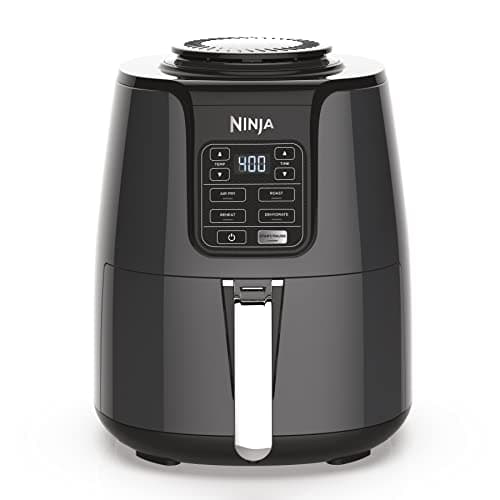 Ninja AF101 The 4-quart Ninja AF101 is the one we point most people to: a genuinely simple dial-and-button air fryer with a ceramic-coated basket, a 105–400°F range, and a footprint that fits a normal counter. It has been the reliable default since 2018 for good reason. 4 QT · 1550W | Best overall on value | 4.6★★★★★ | $104.99Amazon |
| 02 | 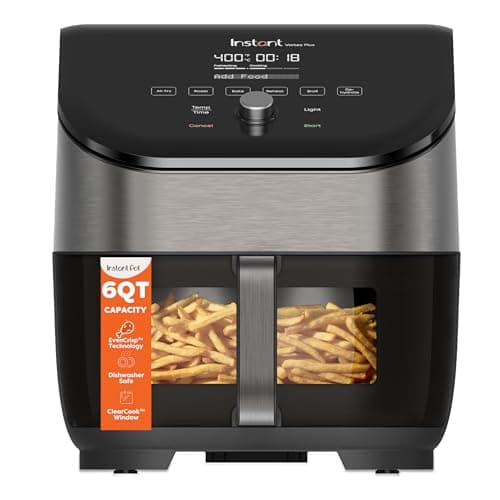 Instant Vortex Plus The 6-quart Vortex Plus draws a stated 1,700 W, runs six functions, and adds a ClearCook window and interior light so you can watch food crisp without pulling the basket. It's the most feature-complete pick under most sale prices. 6 Qt · 1700W | Best with a cook window | 4.4★★★★★ | $119.95Amazon |
#ad · Live prices from the Amazon Product API, as of October 17, 2026. Where we have no verified live price, we show none — a gap beats a number that has rotted.
The picks, in detail
Ninja AF101
spec score /5
$119.9913% off
Price as of October 17, 2026. Prices change — Amazon's is the one that counts.
#ad · we may earn a commission from this link to Ninja AF101
The 4-quart Ninja AF101 is the one we point most people to: a genuinely simple dial-and-button air fryer with a ceramic-coated basket, a 105–400°F range, and a footprint that fits a normal counter. It has been the reliable default since 2018 for good reason.
- Capacity
- 4 QT
- Footprint (W×D×H)
- 12.25 × 15.1 × 15.25 in
- Power
- 1550 W
- Weight
- 10.58 lb
- Cost per use*
- ≈9¢
- Est. per year*
- ≈$18
- Warranty
- 1 Year Manufacturers
- Ceramic-coated aluminum basket — no PTFE nonstick
- Dead-simple controls; nothing to learn
- Small enough for a normal counter (12 × 15 in)
- 4 qt is tight for a family of 4+
- No preset buttons or window
- Dial isn't the most precise
*Cost-to-run computed from the manufacturer's stated 1550W at $0.17/kWh (US average), 20-min sessions, 4×/week. Your rate and use will vary.
Instant Vortex Plus
spec score /5
$159.9925% off
Price as of October 17, 2026. Prices change — Amazon's is the one that counts.
#ad · we may earn a commission from this link to Instant Vortex Plus
The 6-quart Vortex Plus draws a stated 1,700 W, runs six functions, and adds a ClearCook window and interior light so you can watch food crisp without pulling the basket. It's the most feature-complete pick under most sale prices.
- Capacity
- 6 Qt
- Footprint (W×D×H)
- 11.8 × 12.8 × 14.9 in
- Power
- 1700 W
- Cost per use*
- ≈10¢
- Est. per year*
- ≈$20
- ClearCook window + interior light
- 6 functions incl. broil, bake, dehydrate
- Frequently the best-value 6-qt on sale
- Basket coating is standard nonstick
- 1,700 W is thirstier than most (see cost math)
- Odor filter is a consumable
*Cost-to-run computed from the manufacturer's stated 1700W at $0.17/kWh (US average), 20-min sessions, 4×/week. Your rate and use will vary.
Here is the twist that settles most of this debate before it starts: an air fryer is a convection oven. Both cook by moving hot air around your food with a fan and a heating element — the method is identical. The difference is size and speed. An air fryer is a small, tightly sealed convection oven with an aggressive fan and a basket that sits close to the element, so it heats up fast and crisps hard. A full convection oven does the same thing in a much bigger cavity. Once you see it that way, choosing between them comes down to four practical questions: how fast, how much food, how much counter, and how much it costs to run.
Air fryer vs. convection oven at a glance
The specs below are the ones that actually change your daily experience. Air-fryer figures are the manufacturer-stated ranges for the models we track; oven figures describe a typical full-size electric oven.
| Factor | Air fryer | Convection oven |
|---|---|---|
| How it cooks | Fan-forced hot air (convection) | Fan-forced hot air (convection) |
| Preheat | 2–3 minutes, often none | 10–15 minutes |
| Typical capacity | 2–8 qt basket, single layer | Large cavity, multiple racks |
| Power draw | ~1,400–1,800 W | Several thousand watts |
| Energy per batch | ~9–10¢ (20-min run) | More — heats a big cavity, longer |
| Best at | Crisping small-to-medium batches fast | Baking, roasting, several dishes at once |
| Cleanup | Small basket, often dishwasher-safe | Larger surfaces to wipe down |
Speed and preheat
This is the air fryer's headline advantage. Because the cavity is tiny and the fan is fast, most air fryers reach 400°F in two to three minutes, and many foods do not need a preheat at all — you load the basket and start. A convection oven has to bring a large, mostly empty box up to temperature first, which typically takes 10 to 15 minutes before the food even goes in. For a weeknight tray of fries or frozen dumplings, the air fryer can be finished before the oven has done preheating.
Capacity and what fits
Here the oven wins, and it is not close. A single-basket air fryer holds roughly 2 to 6 quarts — enough for a couple of servings in one layer, because air frying works best in a single layer where air can reach every surface. A convection oven gives you multiple racks and can roast a whole chicken, a sheet pan of vegetables, and a tray of potatoes at the same time. If you routinely cook for four or more, or you bake, the oven's cavity is the deciding factor. Two-basket air fryers narrow the gap by giving you about 8 quarts across two zones, but they still cannot match a full oven for a holiday meal.
Footprint and counter space
An air fryer lives on the counter or comes out of a cabinet; a basket model is about a foot wide but can be surprisingly tall, so measure your under-cabinet clearance before buying. A convection oven is either built into your range — no extra counter cost — or a large countertop unit that eats significantly more space. If your kitchen is small, this is often the real deciding factor; our best small air fryers are the most counter-friendly picks.
Running cost: the real difference
Air fryers draw a lot of watts for their size — the 4-quart Ninja AF101 is rated at 1,550 watts and the 6-quart Instant Vortex Plus at 1,700 watts — but they only run for 15 to 25 minutes, and they heat a basket instead of a big empty box. Run that 1,550-watt Ninja for 20 minutes and you use about 0.52 kWh; at the U.S. average residential rate of roughly 17 cents per kWh (per the U.S. Energy Information Administration), that is about 9 cents of electricity per batch. The 1,700-watt Vortex Plus works out to about 10 cents for the same 20 minutes. A full-size oven pulls several times the wattage to heat a much larger space, and usually wants a 10-to-15-minute preheat on top of the cook — so for one tray of food, the air fryer almost always wins on energy. We break the full formula down in how air fryers work and what an air fryer costs to run.
How the food actually turns out
For crisping — fries, wings, tots, breaded cutlets, reheated pizza — the air fryer usually gives a crunchier result faster, because the food sits close to the element in a small, fast-moving stream of hot air. For baking and gentle roasting — cakes, cookies, a large roast, casseroles — the oven's steadier, larger environment is more forgiving and holds more. Neither actually "fries" in oil; both are really just convection cooking, so the difference comes down to how concentrated the airflow is and how close the food sits to the heat.
There are limits in both directions. Because an air fryer's heat comes mostly from above and the food sits close to it, delicate items — a sponge cake, a custard, anything that needs to rise gently and set evenly — can brown too fast on top before the middle cooks through, so those belong in the oven. Conversely, the oven's larger, slower environment is worse at the quick, hard sear an air fryer gives a batch of wings or a tray of Brussels sprouts. Match the tool to the texture you want: fast and crunchy points to the air fryer; even, structured baking points to the oven.
Cleanup, noise, and upkeep
Day to day, the air fryer is the lower-effort machine. Its basket and crisper plate are small, usually nonstick, and most are dishwasher-safe, so cleanup is a quick job you will actually do after every use. A full oven is more of a chore — bigger surfaces, splatter on the walls of the cavity, and racks that are awkward to scrub — which is why oven cleaning is a task people put off for months. The trade-offs run the other way on noise and lifespan: an air fryer's fan is loud while it runs, and these are relatively inexpensive appliances that may need replacing after a few years, whereas a built-in oven is quiet and lasts a decade or more.
Countertop convection ovens: the middle ground
There is a third option that blurs the choice on purpose: the countertop convection oven, often sold as an "air fryer oven" or a toaster oven with an air-fry mode. These give you oven-style racks and a see-inside door with a fan strong enough to do a respectable job of crisping, in a body smaller than a full oven. They are a sensible pick if you want one machine that bakes, toasts, and air fries and you have the counter space — the trade-off is that a dedicated basket, with food sitting closer to the element, still crisps a little harder and preheats faster. We compare that shape directly in air fryer vs. toaster oven, and rank the machines themselves in best air fryer toaster ovens.
Is an air fryer or an oven safer to cook with?
People search for "air fryer vs oven cancer," so it is worth addressing head on. There is nothing about air frying that a convection oven does not also do — again, an air fryer is just a small convection oven. Any browning-related compound, like acrylamide, which the FDA notes forms in starchy foods cooked at high, dry heat, forms in a regular oven too. The honest guidance is the same for both: cook to a light golden color rather than a dark brown or char, and you have handled the only real chemistry worth worrying about. Basket coatings are a separate question — we cover PTFE, PFAS, and ceramic options in depth in are air fryers toxic?
The verdict
If you cook for one or two, reheat and crisp a lot, and want speed with almost no preheat, the air fryer is the better daily tool — and it costs pennies a batch. If you regularly bake, roast a whole chicken, or cook several dishes at once for a family, a convection oven's capacity wins and the air fryer becomes a nice-to-have sidekick. Most kitchens end up using both: the oven for big jobs, the air fryer for the weeknight tray of fries, wings, or salmon.
If you decide an air fryer earns the counter space, the two we point people to first are the 4-quart Ninja AF101 for value and the 6-quart Instant Vortex Plus when you want a cook window and more room. Both are below with live Amazon prices. For the full lineup, see our best air fryers of 2026 roundup.
Weighing the air fryer against a different machine? The rest of the set is air fryer vs. toaster oven, air fryer vs. microwave and air fryer vs. Instant Pot, which covers the one appliance here that cannot brown anything at all.
Frequently asked questions
Is an air fryer the same as a convection oven?
Essentially, yes. An air fryer is a small convection oven — it cooks by circulating hot air with a fan and a heating element. The difference is that the air fryer's cavity is small and the fan is fast, so it heats up quickly and crisps aggressively, while a full convection oven trades that speed for much larger capacity.
Does an air fryer use less electricity than an oven?
For a single tray of food, usually yes. A 1,550-watt air fryer running 20 minutes uses about 0.52 kWh — roughly 9 cents at the US average rate — and needs little or no preheat. A full-size oven draws several times the wattage to heat a much larger cavity and often wants a 10-to-15-minute preheat, so it costs more for the same small job.
Can an air fryer replace my oven?
Only partly. It replaces the oven for crisping and small-batch roasting, but it can't match an oven's capacity for baking, whole roasts, or cooking several dishes at once. Most people keep both and use the air fryer for quick weeknight jobs.
Do air fryers or ovens cause cancer?
Neither adds any special risk. An air fryer is a small convection oven, so any browning compound like acrylamide forms the same way in both. The practical advice is identical: cook foods to a light golden color rather than charring them dark, and don't worry about the method itself.
Sources
Keep reading
Comparison
Air Fryer vs. Toaster Oven: Which One Fits Your Kitchen?
Basket-style crisping vs. an oven-style box that toasts and bakes — compared on shape, capacity and cost.
Comparison
Air Fryer vs. Instant Pot: Which One Do You Actually Need?
Crisping vs. pressure cooking, compared on real specs — and an honest look at the Duo Crisp combo.
Roundup
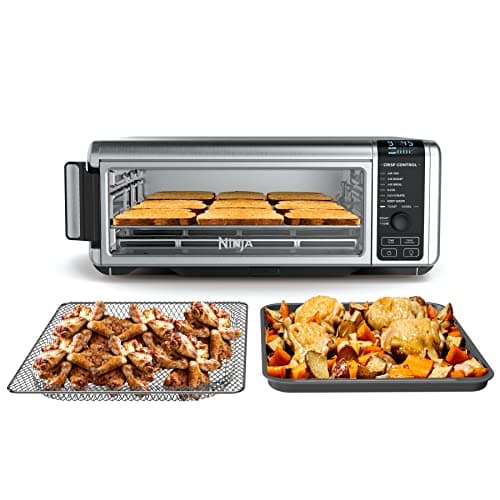
The Best Air Fryer Toaster Ovens of 2026
Oven-style air fryers ranked on interior height, real footprint and warranty — plus when a basket is the better buy.
Comparison
Air Fryer vs. Deep Fryer: Which One Belongs on Your Counter?
Air fryer vs deep fryer on batter, oil cost, electricity, footprint, cleanup and safety — including what an air fryer genuinely cannot do.
Guide
How Air Fryers Work — and What a Batch Really Costs
Convection heat, a fast fan, Maillard browning — and the real watts-to-cents cost of a batch.
Guide
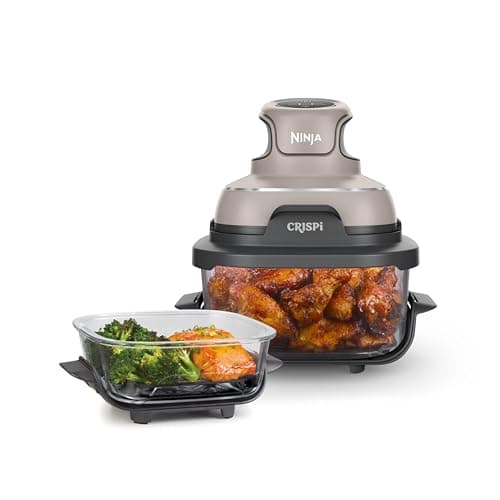
Are Air Fryers Toxic? The Honest, Sourced Answer
PTFE, PFOA, PFAS and acrylamide explained plainly — plus how ceramic and glass baskets avoid coatings.
https://wattandwhisk.com/air-fryers/air-fryer-vs-convection-oven