Are Air Fryers Toxic? The Honest, Sourced Answer
Mostly no — but the coating and how hot you cook do matter. Here's what's real and what isn't.
Disclosure:Watt & Whisk is reader-supported. When you buy through links on this page we may earn an Amazon Associates commission, at no extra cost to you. Prices are pulled live from Amazon and shown with the date checked. How this works.
For most people, no — an air fryer is not toxic in normal use. The concern is really about the nonstick basket coating and, separately, about acrylamide from the food itself. Modern nonstick (PTFE) is stable at air-frying temperatures, and the chemical people fear most, PFOA, was phased out of U.S. cookware years ago. If coatings still worry you, ceramic or borosilicate-glass baskets remove them from the equation entirely.
The short answer
Quick picks
| # | Product | Best for | Score | Price |
|---|---|---|---|---|
| 01 | 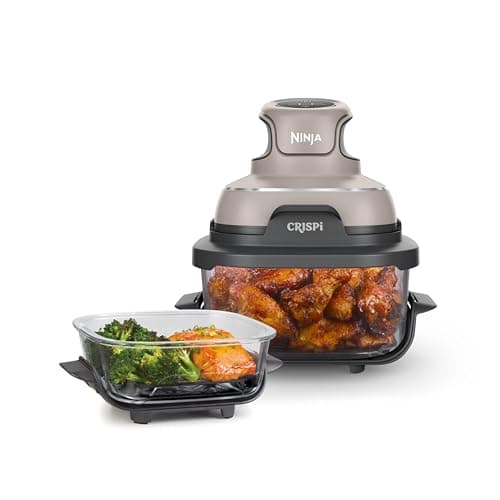 Ninja Crispi The Crispi is the cleanest materials story in air frying: you cook directly in borosilicate glass containers that Ninja lists as PFAS- and PTFE-free — no nonstick coating touching your food at all. A pod-style heater clips on top, and it stores nested. 4 QT | Best non-toxic / glass | 4.3★★★★★ | $152.99Amazon |
| 02 | 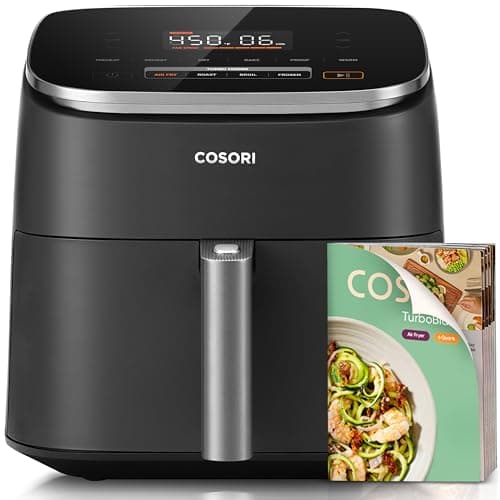 Cosori TurboBlaze Cosori's TurboBlaze pairs a 6-quart square basket with a genuinely PFAS-free ceramic coating and a faster 3,600-rpm fan. It's the pick if you want a modern, roomier air fryer without stepping up to a dual-basket footprint — and the coating claim is on the spec sheet, not marketing. 6QT | Best for most kitchens | 4.5★★★★★ | $99.99Amazon |
#ad · Live prices from the Amazon Product API, as of October 17, 2026. Where we have no verified live price, we show none — a gap beats a number that has rotted.
The picks, in detail
Ninja Crispi
spec score /5
$179.9915% off
Price as of October 17, 2026. Prices change — Amazon's is the one that counts.
#ad · we may earn a commission from this link to Ninja Crispi
The Crispi is the cleanest materials story in air frying: you cook directly in borosilicate glass containers that Ninja lists as PFAS- and PTFE-free — no nonstick coating touching your food at all. A pod-style heater clips on top, and it stores nested.
- Capacity
- 4 QT
- Footprint (W×D×H)
- 11.96 × 13.38 × 13.58 in
- Warranty
- 1 year limited warranty
- Cooks in PFAS/PTFE-free borosilicate glass
- Nests to store; pod is tiny
- Glass containers double as meal prep
- Newer design, shorter track record
- Glass adds weight
- Not the cheapest per quart
Cosori TurboBlaze
spec score /5
$119.9917% off
Price as of October 17, 2026. Prices change — Amazon's is the one that counts.
#ad · we may earn a commission from this link to Cosori TurboBlaze
Cosori's TurboBlaze pairs a 6-quart square basket with a genuinely PFAS-free ceramic coating and a faster 3,600-rpm fan. It's the pick if you want a modern, roomier air fryer without stepping up to a dual-basket footprint — and the coating claim is on the spec sheet, not marketing.
- Capacity
- 6QT
- Footprint (W×D×H)
- 11.8 × 14.4 × 11.9 in
- Weight
- 13.2 lb
- Warranty
- 2 Year Manufacturer
- PFAS-free ceramic basket (per spec sheet)
- 6-qt square basket fits more than round baskets
- Quieter, faster fan; 2-year warranty
- Pricier than a basic basket fryer
- Taller than a compact model
- Digital panel is a small learning curve
"Are air fryers toxic?" is one of the most-searched questions about them, and the honest answer is reassuring but not a flat "no" — there is real nuance worth understanding. Two separate worries get tangled together: the coating on the basket, and acrylamide, a compound that forms in the food. Let us take them one at a time, with sources, and without the scaremongering that fills a lot of the results you will find.
The short answer
In normal use, an air fryer is not going to poison you. The materials used in mainstream air fryers are the same food-contact materials used across the cookware industry, and they are regulated. The legitimate questions are narrow: is the nonstick coating safe at the temperatures an air fryer reaches, are the chemicals of past concern still in use, and is there anything about the cooking method itself worth managing? Here is each one.
The real question is the coating
Most air fryer baskets are aluminum with a nonstick coating, and that coating is where nearly all the worry comes from. The coating is almost always PTFE — the material branded as Teflon — or a ceramic alternative. It helps to separate what PTFE actually is from the chemicals that used to be involved in making it, because the internet routinely blends them into one scary word.
PTFE (Teflon) nonstick
PTFE is a large, extremely stable fluoropolymer. At normal cooking and air-frying temperatures it is inert — it does not react with food and is not absorbed if a flake is accidentally swallowed. The genuine caution with PTFE is overheating: if a nonstick surface is heated well above roughly 500°F (around 260°C), the coating can begin to degrade and release fumes. That threshold matters because air fryers generally top out at 400–450°F, comfortably below it, and — unlike an empty nonstick pan forgotten on a burner — they are not run bone-dry at extreme heat. Keep an air fryer within its rated temperature range and do not run it empty, and PTFE breakdown is not a realistic everyday concern. If the coating becomes badly scratched or flaking, replace the basket.
It is worth being clear about what "degrade" actually means, because the language online is often lurid. The concern is fumes from a coating overheated far past its rating — the classic example is an empty nonstick pan left on a high burner, not a loaded air-fryer basket working at 400°F with food and moisture in it. In normal air-frying you are nowhere near that territory. The everyday habit that protects the coating is avoiding metal utensils and abrasive scrubbers, which scratch it; scratches are cosmetic rather than dangerous, but a badly worn basket is worth replacing simply because it stops releasing food cleanly.
PFOA — already phased out
The chemical most people are actually afraid of is PFOA, a processing aid once used to manufacture PTFE and linked to health concerns. The important update is that PFOA is no longer used to make U.S. cookware: under the EPA's stewardship program, major manufacturers eliminated PFOA from their processes years ago, and nonstick cookware made today is manufactured PFOA-free. So the specific compound at the center of the "Teflon is dangerous" story has already been removed from the products you can buy now.
PFAS more broadly
PFOA belongs to a much larger family called PFAS— thousands of "forever chemicals" that persist in the environment and are an active area of regulation. Technically, PTFE itself is a fluoropolymer within the broad PFAS definition, but it is a large, stable, non-mobile polymer, chemically very different from the small, mobile PFAS (like PFOA and PFOS) that drive the health and drinking-water concerns you read about. Both the EPA and the FDA are tightening oversight of PFAS in water and food-contact materials. If you would rather avoid the category entirely, that is a completely reasonable preference — and it is exactly what ceramic and glass baskets let you do.
Are the ceramic coatings themselves safe?
"Ceramic" nonstick is usually a silica-based (sol-gel) coating, not a fluoropolymer, which is why brands can market it as PFAS-free — and for anyone who wants to skip the whole PFAS conversation, that is its appeal. It is stable and inert at cooking temperatures. The one honest caveat is durability, not toxicity: ceramic coatings tend to lose their nonstick quality faster than PTFE over years of use, so you may end up replacing a ceramic basket sooner. That is a longevity trade-off, not a safety one. Whichever coating you pick, the safety rules are identical — stay within the rated temperature range and retire a basket once the surface is visibly worn.
Acrylamide comes from the food, not the fryer
The second, separate worry is acrylamide. This one has nothing to do with coatings — it forms in the food. When starchy foods like potatoes and bread are cooked at high, dry heat, a natural chemical reaction (the same Maillard browning that makes food golden) can produce acrylamide, which the FDA lists as a process contaminant to reduce. Crucially, this happens in anyhigh-heat dry cooking — baking, roasting, toasting, deep frying, and air frying alike — so it is not unique to air fryers. The FDA's practical advice is simple and effective: cook starchy foods to a golden yellow rather than a dark brown, avoid charring, and soak cut potatoes before cooking. Do that and you have addressed the only food-chemistry issue that actually applies here.
It is also worth keeping the risk in proportion. Acrylamide mainly forms in starchy plant foods — potatoes, bread, and other grains — not in meat, fish, eggs, or most vegetables, so a lot of what you cook in an air fryer never raises the question at all. The point is not to fear the appliance but to cook the way you probably already prefer to eat: French fries and roast potatoes a deep gold rather than mahogany, toast tan rather than blackened. That single habit does more than switching machines ever would.
Ceramic and glass sidestep coatings entirely
If the coating question bothers you no matter how small the risk, you can simply remove it from the equation. Two kinds of baskets do that:
- PFAS-free ceramic:models like the Cosori TurboBlaze use a ceramic nonstick coating that the manufacturer lists as PFAS-free — you get easy release without a fluoropolymer coating. Which machines actually publish that claim, and which only say "ceramic," is sorted out in the best ceramic air fryers.
- Borosilicate glass: the Ninja Crispi cooks directly in glass containers that Ninja lists as free of PTFE and PFAS, so there is no coating touching your food at all. It is close to the only machine that does this, and we lay out what it gives up to get there in the best glass air fryers.
We round up the best of these in the best non-toxic air fryers. They cost a little more, but for anyone who wants total peace of mind on materials, they are the clean answer. Worth noting: glass and bare ceramic have no nonstick layer to scratch or wear out, so the "replace it when the coating goes" worry drops away — you are cooking on the vessel itself, which is one reason these designs are gaining ground with buyers who plan to keep an appliance for years.
What about the plastic parts and the "new fryer" smell?
Two smaller questions come up a lot. First, the plastic: the housing, handle, and control panel are built from heat-resistant plastics rated for the appliance, and they sit outside the hot cooking chamber — your food only ever touches the metal, ceramic, or glass basket, not the plastic shell, so there is no plastic leaching into the food. Second, the smell: many air fryers give off a faint plastic or chemical odor the first few times you run them. That is normal off-gassing of manufacturing residues and oils burning off new components, not a sign the machine is unsafe. Run it empty at a high temperature for 15–20 minutes with good ventilation before the first real use, and the smell fades and does not return. If a strong, acrid smell appears later in a machine that was previously fine, stop and check for melting or a failed part — but the initial break-in odor is expected and harmless.
How to use any air fryer safely
Whatever basket you choose, a few habits keep things simple: stay within the rated temperature range, do not preheat an empty machine for long stretches at maximum heat, use wood or silicone tools instead of metal so you do not scratch the coating, replace a basket once the coating is visibly worn, and cook starchy foods to golden rather than dark. None of this is unusual — it is the same care you would give any nonstick cookware.
The bottom line
Used as intended, an air fryer is not toxic. Modern nonstick is stable at the temperatures these machines reach, the PFOA that anchored the old "Teflon" scare has been phased out of U.S. cookware, and acrylamide is a food-cooking issue you manage by not charring your food — in an oven just as much as an air fryer. If you still prefer to avoid coatings, choose a PFAS-free ceramic or a glass model like the ones in our non-toxic roundup. For how the cooking itself affects nutrition, see are air fryers healthy?
One practical companion to all of the above: what PFAS-free actually meansdecodes the exact wording on the listings — PFAS, PTFE, PFOA, "ceramic" and BPA are five different claims, not synonyms — and shows which of the machines we track publish which. It is the page to read with a product listing open in another tab.
A common response to all of the above is to line the basket rather than change the machine, and it is worth knowing why that only half works: a liner covers the flat base while food still touches the walls and the crisper plate edges, and a solid one blocks the airflow the appliance runs on. The honest read on parchment, silicone and foil — and on when a machine with no coating is the better answer — is are air fryer liners safe.
Frequently asked questions
Are air fryers toxic to your health?
In normal use, no. Mainstream air fryers use the same regulated food-contact materials as other cookware. The nonstick coating (PTFE) is stable at air-frying temperatures, and PFOA — the chemical behind the old Teflon scare — has been phased out of US cookware. If you'd rather avoid coatings altogether, ceramic or glass-basket models remove them entirely.
Do air fryers still contain PFOA or Teflon?
Nonstick air fryer baskets still use PTFE (Teflon), which is stable and safe at normal air-frying temperatures. They no longer use PFOA, the processing chemical of concern, which US manufacturers phased out years ago under an EPA stewardship program. Ceramic and glass baskets use no PTFE at all.
Does air frying cause acrylamide?
It can, but so does any high-heat dry cooking. Acrylamide forms in starchy foods like potatoes when they're browned at high heat, whether by baking, roasting, deep frying, or air frying. The FDA's advice is to cook to a golden yellow rather than dark brown and avoid charring, which keeps acrylamide low.
What is the least toxic air fryer?
Models that avoid nonstick coatings entirely. The Ninja Crispi cooks in coating-free borosilicate glass, and the Cosori TurboBlaze uses a ceramic coating the maker lists as PFAS-free. Both are covered in our best non-toxic air fryers guide.
Sources
Keep reading
Guide
What Does PFAS-Free Actually Mean?
PFAS, PTFE, PFOA, ceramic, BPA and food-safe decoded — what each claim commits a maker to, and which of our 72 appliances publish which.
Roundup
The Best Non-Toxic Air Fryers of 2026
Glass and PFAS-free ceramic air fryers, ranked — with an honest take on coatings.
Roundup
The Best Ceramic Air Fryers of 2026
The air fryers with a genuine published ceramic coating, what each maker does and does not claim, and how to make ceramic last.
Roundup
The Best Glass Air Fryers of 2026
The one true borosilicate-glass air fryer, what it trades away, and the PFAS-free ceramic alternatives worth cross-shopping.
Guide
Are Air Fryers Healthy? An Honest Look
Less oil than deep frying, the acrylamide nuance, and why the food you choose matters most.
Guide
How to Clean an Air Fryer
The five-minute routine, the monthly deep clean, and how to fix a smoking or smelly air fryer for good.
Guide
Are Air Fryer Liners Safe?
The three rules for parchment, silicone and foil in an air fryer, checked against each machine's published maximum temperature.
https://wattandwhisk.com/air-fryers/are-air-fryers-toxic