How Air Fryers Work — and What a Batch Really Costs
It's a small convection oven: one heating element, one fast fan, and the same browning chemistry that crisps a roast.
Disclosure:Watt & Whisk is reader-supported. When you buy through links on this page we may earn an Amazon Associates commission, at no extra cost to you. Prices are pulled live from Amazon and shown with the date checked. How this works.
An air fryer works like a tiny, fast convection oven: a heating element warms the air and a powerful fan whips it around a perforated basket at high speed. That fast-moving hot air dries and browns the surface of the food through the Maillard reaction — the same chemistry that crisps a roast — so you get a crunchy exterior with little or no added oil. Because the cavity is small and only runs 15–25 minutes, a batch costs only about 9–10 cents of electricity.
The short answer
Quick picks
| # | Product | Best for | Score | Price |
|---|---|---|---|---|
| 01 | 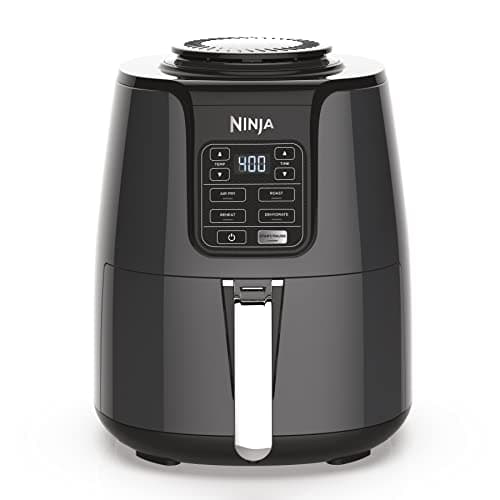 Ninja AF101 The 4-quart Ninja AF101 is the one we point most people to: a genuinely simple dial-and-button air fryer with a ceramic-coated basket, a 105–400°F range, and a footprint that fits a normal counter. It has been the reliable default since 2018 for good reason. 4 QT · 1550W | Best overall on value | 4.6★★★★★ | $104.99Amazon |
| 02 | 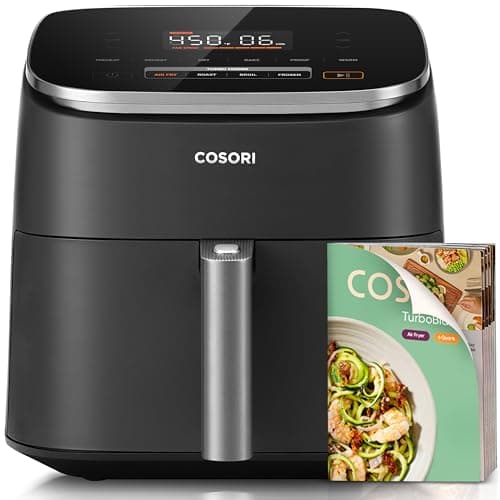 Cosori TurboBlaze Cosori's TurboBlaze pairs a 6-quart square basket with a genuinely PFAS-free ceramic coating and a faster 3,600-rpm fan. It's the pick if you want a modern, roomier air fryer without stepping up to a dual-basket footprint — and the coating claim is on the spec sheet, not marketing. 6QT | Best for most kitchens | 4.5★★★★★ | $99.99Amazon |
#ad · Live prices from the Amazon Product API, as of October 17, 2026. Where we have no verified live price, we show none — a gap beats a number that has rotted.
The picks, in detail
Ninja AF101
spec score /5
$119.9913% off
Price as of October 17, 2026. Prices change — Amazon's is the one that counts.
#ad · we may earn a commission from this link to Ninja AF101
The 4-quart Ninja AF101 is the one we point most people to: a genuinely simple dial-and-button air fryer with a ceramic-coated basket, a 105–400°F range, and a footprint that fits a normal counter. It has been the reliable default since 2018 for good reason.
- Capacity
- 4 QT
- Footprint (W×D×H)
- 12.25 × 15.1 × 15.25 in
- Power
- 1550 W
- Weight
- 10.58 lb
- Cost per use*
- ≈9¢
- Est. per year*
- ≈$18
- Warranty
- 1 Year Manufacturers
- Ceramic-coated aluminum basket — no PTFE nonstick
- Dead-simple controls; nothing to learn
- Small enough for a normal counter (12 × 15 in)
- 4 qt is tight for a family of 4+
- No preset buttons or window
- Dial isn't the most precise
*Cost-to-run computed from the manufacturer's stated 1550W at $0.17/kWh (US average), 20-min sessions, 4×/week. Your rate and use will vary.
Cosori TurboBlaze
spec score /5
$119.9917% off
Price as of October 17, 2026. Prices change — Amazon's is the one that counts.
#ad · we may earn a commission from this link to Cosori TurboBlaze
Cosori's TurboBlaze pairs a 6-quart square basket with a genuinely PFAS-free ceramic coating and a faster 3,600-rpm fan. It's the pick if you want a modern, roomier air fryer without stepping up to a dual-basket footprint — and the coating claim is on the spec sheet, not marketing.
- Capacity
- 6QT
- Footprint (W×D×H)
- 11.8 × 14.4 × 11.9 in
- Weight
- 13.2 lb
- Warranty
- 2 Year Manufacturer
- PFAS-free ceramic basket (per spec sheet)
- 6-qt square basket fits more than round baskets
- Quieter, faster fan; 2-year warranty
- Pricier than a basic basket fryer
- Taller than a compact model
- Digital panel is a small learning curve
An air fryer is not frying anything. There is no oil bath and nothing new about the physics — it is a small, tightly packed convection oven. Strip away the marketing and every air fryer comes down to two parts doing one job: heat the air, then move it fast. Understanding that makes it much easier to buy the right one and to cook well with it, so here is exactly what is happening inside the basket.
The two parts that do all the work
Open any air fryer and you will find a coiled heating element near the top and a fanjust above or beside it. The element gets hot; the fan blows that heat down and around the food in a fast, swirling stream. That is the entire mechanism. Everything else — presets, digital screens, dual baskets, windows — is convenience layered on top of those two components. It is genuinely the same setup as the "convection" setting on a full-size oven, just shrunk down so the air moves faster and has less empty space to heat.
Why moving air cooks so fast
Still air is a poor conductor of heat — it is why you can put your hand in a hot oven for a second without harm, but not touch the rack. The moment you move that air, it carries heat to the food's surface far more efficiently. This is convection, and it is why a fan-forced oven cooks faster than a conventional one. An air fryer takes the idea to its limit: a small cavity so there is almost no wasted space to heat, and a strong fan so the air is always moving quickly over every exposed surface. The food heats from the outside in, and the surface dries out rapidly — which is the first step to getting crispy.
Browning: the Maillard reaction
Once the surface is hot and dry, the browning chemistry kicks in. The Maillard reactionis the reaction between amino acids and sugars that happens on food above roughly 285°F, producing the golden-brown color and savory, toasted flavor of seared steak, roasted coffee, and crusty bread. An air fryer is very good at reaching and holding that temperature at the food's surface, which is why air-fried foods taste roasted and browned rather than steamed. It is the exact same reaction that browns food in an oven or a skillet — the air fryer just delivers the dry, concentrated heat that drives it quickly.
Why food crisps with little or no oil
Deep frying crisps food by surrounding it with 350°F oil, which flashes surface moisture to steam and hardens the exterior. An air fryer reaches a similar surface result with hot air instead of hot oil: the fast airflow evaporates surface moisture and the Maillard reaction firms and browns the outside. A light coating of oil helps — it conducts heat evenly across the surface and improves browning — but you use a teaspoon or a spray, not a quart. That is the whole "healthier" pitch: you get a crisp, browned exterior with a fraction of the added fat. We dig into what that does and does not mean for nutrition in are air fryers healthy?, and where the two methods genuinely part company — including the wet-batter foods hot air cannot cook at all — in air fryer vs. deep fryer.
The oil you use matters less for the science and more for practicality. A light spray of a high-smoke-point oil (avocado, refined canola, or a neutral vegetable oil) coats the surface evenly and browns well; heavy or low-smoke-point oils can smoke in the hot cavity and are not needed anyway. Foods that already contain fat — chicken thighs, salmon, well-marbled meat — often need no added oil at all, because the fat they render does the surface-crisping job on its own. This is why "how much oil" is not really a spec of the machine; it is a choice you make per food.
Why the basket is shaped the way it is
The perforated basket and crisper plate are not arbitrary. The holes let hot air reach thebottom of the food, not just the top, so it crisps on all sides without you flipping everything — and they let rendered fat and moisture drain away instead of pooling and steaming the food soft. This is also why every air fryer works best with food in a single layer: pile the basket high and the pieces in the middle are shielded from the airflow, so they steam instead of crisp. It is the single biggest reason a batch comes out disappointing, and the reason capacity matters — covered in our best air fryers of 2026 roundup.
What the "roast," "bake," and "dehydrate" modes really are
A modern air fryer's menu of programs — air fry, roast, bake, reheat, broil, dehydrate — can look like six different technologies. It is really one machine changing two dials: how hot the element runs and how fast the fan spins. "Air fry" is high heat with a fast fan for maximum crisp. "Roast" and "bake" use similar heat with a gentler fan so food browns without being blasted dry, which suits vegetables and small baked goods. "Dehydrate" is the opposite extreme — very low heat and a slow fan for hours, to dry fruit or make jerky without cooking it. "Reheat" is just moderate heat and airflow. Understanding that the presets are variations on a single mechanism makes an unfamiliar air fryer far less intimidating: if you know your food wants hot-and-crisp or gentle-and-even, you can set it manually and get the same result.
Why preheating and shaking matter
Two habits do more for results than any spec on the box. Preheating for two to three minutes gets the element and cavity hot before the food goes in, so crisping starts immediately instead of after the machine catches up — the difference between a golden fry and a pale, slightly dried-out one. Shaking or flipping partway through matters because, even with airflow all around, the pieces resting against the tray and each other are partly shielded; turning them exposes new surfaces to the moving air so everything crisps evenly. Neither is strictly required, but skipping them is the most common reason a batch comes out unevenly cooked. Many machines add a shake reminder for exactly this reason.
What an air fryer costs to run
This is the number almost no one publishes, and it is the one people actually worry about. An air fryer draws a lot of watts — commonly 1,400 to 1,800 — which sounds alarming until you remember it only runs for 15 to 25 minutes and heats a tiny space. To turn watts into money, you convert to kilowatt-hours (kWh), the unit your utility bills, and multiply by your rate.
The math, step by step
Here it is for the 1,550-watt Ninja AF101 running a 20-minute batch:
- 1,550 watts ÷ 1,000 = 1.55 kilowatts (kW).
- 20 minutes is one-third of an hour, so 1.55 kW × 0.33 h ≈ 0.52 kWh.
- At the U.S. average residential rate of about 17 cents per kWh, 0.52 kWh × $0.17 ≈ 9 cents.
So a full basket of fries costs you roughly 9 cents of electricity. A thirstier 1,700-watt model works out to about 10 centsfor the same 20 minutes. Even running the air fryer every day for a month lands at only a few dollars — which is why "do air fryers use a lot of electricity?" has a genuinely reassuring answer: no. That U.S. average rate comes from the U.S. Energy Information Administration; plug in your own rate (it is on your power bill) and the arithmetic is the same. We keep a running breakdown in what an air fryer costs to run.
Why it beats the oven on energy
The reason an air fryer is cheaper to run than your oven for a small job is not that it uses less power in the moment — it is that it heats far less empty space and skips the long preheat. A full-size oven warms a large cavity to temperature and holds it there, usually with a 10-to- 15-minute preheat before the food goes in. The air fryer heats a space barely bigger than the food itself and is often ready in two or three minutes. For one tray of food, that efficiency is the whole ballgame — a fuller comparison is in air fryer vs. convection oven.
What actually matters when you buy
Since the core mechanism is the same across brands, the things worth paying for are practical: a capacity that matches your household, a footprint that fits your counter, a basket material you are comfortable with, and controls you will actually use. Wattage barely changes the running cost, so do not overthink it. For a simple, durable first air fryer most people are well served by the 4-quart Ninja AF101; if you want more room and a faster, PFAS-free ceramic basket, the 6-quart Cosori TurboBlaze is our step-up. Both are below with live Amazon prices, and the best air fryers for beginners guide walks through the controls in more detail.
The one spec people fixate on that barely matters is wattage. A higher-wattage model may heat a shade faster, but as the math above shows it changes the per-batch cost by a penny at most, and it does not make the food meaningfully crispier — that comes from airflow, a single layer, and your own preheat-and-shake habits. Buy for the capacity, footprint, and materials that fit your kitchen, and let the physics you now understand do the rest.
One direct consequence of the convection mechanism above is worth stating, because it saves people a couple of minutes every cook: because the cavity is tiny and the element is the same size a full oven uses, the machine is at temperature within the first minute or two of the cook itself. Two manufacturers say so outright on their listings. The full answer is in do air fryers need preheating.
Frequently asked questions
How does an air fryer work without oil?
It crisps with hot air instead of hot oil. A heating element warms the air and a fast fan drives it around a perforated basket, drying the food's surface and browning it through the Maillard reaction. A light spray of oil improves browning, but you don't need the oil bath that deep frying requires.
Is an air fryer just a small convection oven?
Yes, essentially. Both use a heating element and a fan to circulate hot air. The air fryer's cavity is much smaller and its fan is faster, so it heats up quickly and crisps aggressively, but the cooking method is identical to a convection oven's.
How much electricity does an air fryer use?
Very little per batch. A 1,550-watt air fryer running 20 minutes uses about 0.52 kWh, which is roughly 9 cents at the US average rate of about 17 cents per kWh. A 1,700-watt model is about 10 cents. Even daily use adds only a few dollars a month.
Why does food need to be in a single layer?
Because the crisping depends on hot air reaching every surface. If you overfill the basket, the pieces in the middle are shielded from the airflow and steam instead of crisping. A single layer lets the air circulate all the way around each piece.
Sources
Keep reading
Comparison
Air Fryer vs. Convection Oven: Which One Should You Buy?
An air fryer is a small convection oven. We compare speed, capacity, footprint and running cost.
Comparison
Air Fryer vs. Deep Fryer: Which One Belongs on Your Counter?
Air fryer vs deep fryer on batter, oil cost, electricity, footprint, cleanup and safety — including what an air fryer genuinely cannot do.
Guide
Are Air Fryers Healthy? An Honest Look
Less oil than deep frying, the acrylamide nuance, and why the food you choose matters most.
Guide
Are Air Fryers Toxic? The Honest, Sourced Answer
PTFE, PFOA, PFAS and acrylamide explained plainly — plus how ceramic and glass baskets avoid coatings.
Running costs
How Much Does an Air Fryer Cost to Run?
A typical air fryer costs about 9 to 10 cents of electricity per batch. Here is exactly how that is calculated.
https://wattandwhisk.com/air-fryers/how-air-fryers-work