How Much Does an Air Fryer Cost to Run?
The watts-to-cents math nobody else publishes — worked out for real air fryers at the US average electricity rate.
An air fryer costs roughly 9 to 10 cents of electricity per batch to run — not per hour, per batch. It draws a lot of power (about 1,400 to 1,800 watts) but only for the 15 to 25 minutes it takes to crisp your food, so the actual energy behind a cook is tiny. At the US average rate you would have to run one most days for a year before the electricity added up to the price of a couple of coffees.
The short answer
An air fryer is one of the cheapest things in your kitchen to run. The 1,500-watt number on the box looks alarming, but wattage is only half of the story — what you pay is watts multiplied by time, and an air fryer's time is short. A single batch works out to about a dime of electricity, which is why almost no one who worries about it before buying ever thinks about it again afterward.
The trouble is that almost no roundup bothers to publish the number, so the worry sticks around. The rest of this post shows exactly how it is calculated — the same formula we use for every pick in our air fryer rankings — and how it stacks up against the full-size oven an air fryer usually replaces.
The formula
Every appliance's running cost comes from the same three numbers: how many watts it draws, how long it runs, and what your utility charges per kilowatt-hour. Put together:
watts ÷ 1,000 × hours × rate = cost
Dividing the wattage by 1,000 converts watts to kilowatts. Multiply by the time in hours and you have kilowatt-hours (kWh) — the unit your electric bill is measured in. Multiply that by your rate and you have the cost of the cook. For the rate we use about 17 cents per kWh, the recent US residential average reported by the EIA; drop in your own rate from your bill for an exact figure.
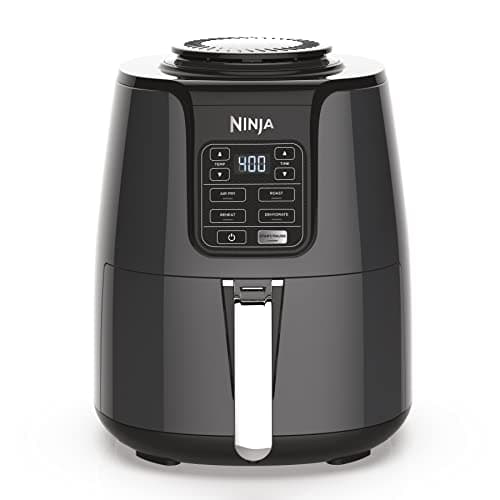
Work an example with the Ninja AF101, rated at 1,550 watts. A 20-minute batch is one-third of an hour:
1,550 ÷ 1,000 = 1.55 kW × 0.33 h = 0.52 kWh × $0.17 = about 9 cents.
That is it — no lab, no meter, just the wattage on the manufacturer's spec sheet and a little arithmetic. Real draw actually dips below the rated wattage once the fryer reaches temperature and the element starts cycling on and off, so 9 cents is the ceiling, not the average.
What real air fryers cost per batch
Here is the same math run for three air fryers whose wattage the manufacturers actually publish. All three assume a 20-minute batch at 17 cents per kWh.
| Air fryer | Stated wattage | Energy per 20-min batch | Cost per batch | Est. per year (4 batches/week) |
|---|---|---|---|---|
| Chefman TurboFry Touch Dual | 1,500 W | 0.50 kWh | ~9¢ (8.5¢) | ~$18 |
| Ninja AF101 | 1,550 W | 0.52 kWh | ~9¢ | ~$18 |
| Instant Vortex Plus | 1,700 W | 0.57 kWh | ~10¢ | ~$20 |
The pattern is clear: the gap between the thirstiest and thriftiest fryer here is about a penny a batch. Wattage barely moves the needle because the run time is so short — which is the whole reason air fryers are cheap to run, and the point we keep coming back to.
Over a year the totals stay small. Cook four batches a week and the Ninja's ~9 cents adds up to roughly $18 a year; the thirstier 1,700-watt Instant Vortex Plus lands near $20. Lighter users — a couple of batches a week — sit closer to $9 to $10 a year, and even someone running it almost daily only reaches the low $30s. However you use it, this is rounding-error money next to most households' energy bills.
Do air fryers use a lot of electricity?
This is the question that sends people searching, and the honest answer is: a lot per minute, very little per meal. A 1,500-to-1,800-watt rating looks huge next to a 60-watt lightbulb, and it is true that while the element is on, an air fryer is one of the higher-draw things you will plug into a kitchen outlet. But a device's cost is watts times time, and an air fryer's time is tiny. A 1,500-watt fryer running 20 minutes uses less energy than a 150-watt television left on for three hours.
If you want the mechanics of why a small, well-sealed chamber crisps food so quickly — and therefore so cheaply — we walk through it in how air fryers work.
Air fryer vs. the oven it replaces
The real saving is not against a lightbulb; it is against your oven. A full-size electric oven does two things that cost far more energy than an air fryer: it heats a large, mostly empty cavity, and it makes you sit through a 10-to-15-minute preheat before the food even goes in. An air fryer's chamber is a fraction of the volume and, for most foods, needs little or no preheat.
Put it this way: even if your oven drew no more power than the air fryer — and it almost certainly draws more — the preheat alone means it runs two to three times as long to cook the same tray of fries. Longer run time at equal-or-higher wattage is simply more kilowatt-hours. That is why reaching for the air fryer on a small, fast job is the cheaper move nearly every time. If you are weighing the two appliances head to head, we compare them in air fryer vs. convection oven.
What actually moves your bill
Three things change the number, in order of how much they matter:
- Your electricity rate. This is the biggest lever, and the one you already know. At 12 cents per kWh that Ninja batch is nearer 6 cents; in a high-cost region at 30 cents it is closer to 16. Pull your own rate off your bill and multiply.
- How long you cook, not how big the fryer is. Run time drives cost, so a 40-minute roast costs about twice a 20-minute batch of fries in the same machine. The wattage gap between models is a rounding error by comparison.
- Preheating out of habit. Many foods do not need it. Skipping an unnecessary 3-to-5-minute preheat trims a little off every single cook.
How to spend even less
You are already saving by not firing up the oven, but a few habits shave the number further: cook full batches so you are not paying to heat air, skip the preheat when a recipe allows, and lean on higher heat for less time rather than low and slow when you have the choice. None of this is going to change your life financially — which is exactly the point. The running cost of an air fryer is small enough to ignore, so buy on capacity, footprint, and basket materials instead. Our air fryer buying guide walks through those.
Does leaving it plugged in cost anything?
Practically nothing. A digital air fryer with a clock or a standby light draws on the order of a watt or two when idle — a few cents a month, if that. Older analog models with a mechanical dial draw essentially zero when not cooking. It is not worth unplugging the thing between uses to chase that saving; if the outlet is awkward to reach, leave it plugged in and do not give it a second thought. The energy that matters is the energy while it is cooking, and we have already seen that is a dime a batch.
How we work these numbers out
Every figure here comes from two inputs: the wattage the manufacturer prints on the appliance or its listing, and a published electricity rate. We are countertop-cooking enthusiasts, not a lab — we have not clamped a power meter on these machines and we do not claim to have. What we have done is the same arithmetic any owner can check against their own bill, using specs anyone can look up. When a manufacturer does not publish a wattage — some list only a model number — we leave the cost blank rather than guess. You can read more about how we score and source everything on how we review.
The bigger lever is not the electricity
If a dime a batch is the running cost, the thing actually worth your attention is keeping the machine working properly — because a clogged fan guard restricts airflow, and airflow is the entire cooking mechanism in an air fryer. Cook times creeping up and browning going patchy is not the appliance aging; it is grease. How to clean an air fryer covers the monthly element-and-fan clean that almost nobody does, and it will do more for your results than any wattage figure on this page.
The other efficiency lever is cooking two things at once rather than in sequence, which is what the two-drawer machines in our best dual-basket air fryersguide are for. Two zones sharing one housing do not double the draw — the machine's total rating is what is on the plate — so a synced main-and-side costs roughly what one batch used to.
If you want to see this arithmetic applied to one specific machine, our Instant Vortex Plus review works through it in full: at a published 1,700 watts it is the thirstiest air fryer we track, which comes out at roughly 10 cents a batch and near $20 a year at four batches a week. That is the worst case in the category, and it is still less than a conventional oven costs for the same food.
A closing note on the same wattage figures, because they answer a second question people ask straight after this one. Divide the wattage by 120 and you get amps: an 1,800-watt oven draws 15 A, which is the full rating of a typical 15-amp kitchen circuit and of a typical power strip. That is why these machines belong in a wall outlet and why two of them on one circuit trips a breaker — can you plug an air fryer into a power strip works it through.
Frequently asked questions
How much does it cost to run an air fryer per hour?
Most people never run an air fryer for a full hour, but the math is simple: a 1,500-watt fryer running a solid hour uses 1.5 kWh, which is about 26 cents at the US average rate of roughly 17 cents per kWh. A normal 20-minute batch is about a third of that — around 9 to 10 cents.
Do air fryers use a lot of electricity?
No. An air fryer draws a high 1,400 to 1,800 watts, but only for 15 to 25 minutes, so a single batch costs roughly 9 to 10 cents of electricity at the US average rate — usually less than heating a full-size oven for the same food.
Is an air fryer cheaper to run than an oven?
Yes, for small and medium jobs. An air fryer heats a much smaller chamber and needs little or no preheat, so even if your oven drew the same wattage it would run two to three times as long to cook the same food — and it usually draws more. For a full Thanksgiving turkey the oven still wins; for a tray of fries the air fryer is far cheaper.
How do I calculate my own air fryer running cost?
Use watts divided by 1,000, times hours, times your rate. Take the wattage from the box, divide by 1,000 to get kilowatts, multiply by the fraction of an hour you cook, then multiply by your cost per kWh from your electric bill. A 1,550-watt fryer for 20 minutes at 17 cents per kWh is 1.55 times 0.33 times 0.17, or about 9 cents.
Sources
Keep reading
Guide
How Air Fryers Work — and What a Batch Really Costs
Convection heat, a fast fan, Maillard browning — and the real watts-to-cents cost of a batch.
Buying guide
Air Fryer Buying Guide: How to Choose
The five things worth deciding before you buy an air fryer — none of which need a lab test to judge.
Air Fryers
The Best Air Fryers of 2026
Our ranked air-fryer picks, compared on capacity, footprint, materials and running cost — with live Amazon prices.
https://wattandwhisk.com/blog/air-fryer-electricity-cost