Are Plastic Blender Jars Safe?
The short answer is yes, with one variable worth taking seriously: heat. Here is what the jars are made of and who commits to a claim in writing.
Disclosure:Watt & Whisk is reader-supported. When you buy through links on this page we may earn an Amazon Associates commission, at no extra cost to you. Prices are pulled live from Amazon and shown with the date checked. How this works.
Yes, with one caveat about heat. Modern jug-blender jars are typically a BPA-free copolyester — Tritan is the trade name you will see most often — rather than the polycarbonate that made BPA a conversation in the first place, and the FDA's published position is that BPA is safe at the levels currently occurring in foods. The variable worth thinking about is temperature: a lot of people blend hot soup, and heat is what moves any plastics question from theoretical to practical. If you want it off the table entirely, the answer is a glass jar — the Hamilton Beach Power Elite is the only one we stock. If a written BPA-free claim is enough, the Vitamix 5200 and the Ninja BN701 both publish one. Prices below are pulled live from Amazon.
The short answer
Quick picks
| # | Product | Best for | Score | Price |
|---|---|---|---|---|
| 01 | 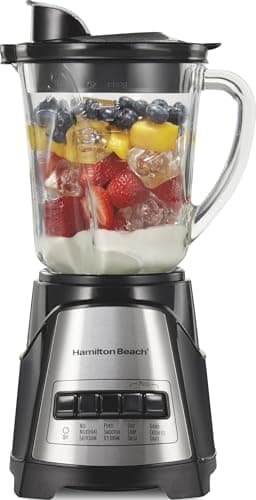 Hamilton Beach Power Elite 700 peak watts, a 40-ounce dishwasher-safe glass jar, and 12 functions on five buttons. The glass jar is the real argument: it doesn't scratch or hold odors the way plastic does, and at this price almost nothing else gives you one. 40 Oz · 700W | Best under $50 | 3.9★★★★★ | $39.95Amazon |
| 02 | 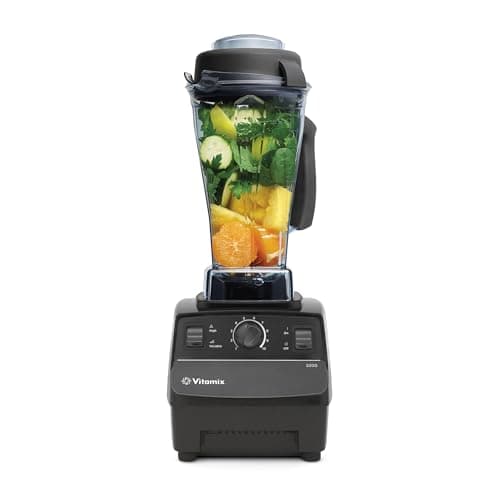 Vitamix 5200 The 5200 is the workhorse Vitamix — a tall 64-oz jar, an aircraft-grade blade, and a variable dial that takes it from a silky smoothie to hot soup by friction. Expensive, but it's the one people keep for 15 years. Self-Cleaning 64 oz | Best overall blender | 4.6★★★★★ | $344.95Amazon |
| 03 | 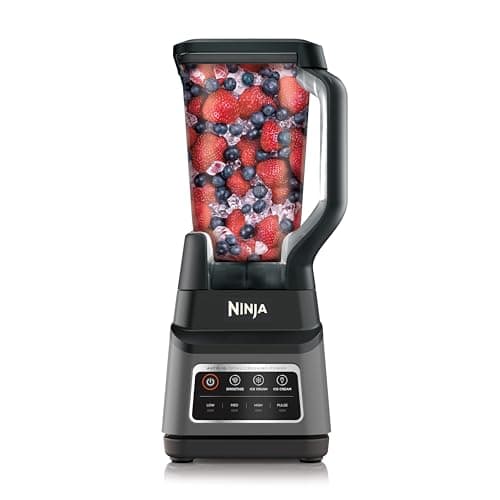 Ninja Professional Plus BN701 The BN701 is the value champion: strong ice-crushing power, Auto-iQ programs, and a big pitcher for a fraction of a Vitamix. It won't self-clean or make hot soup, but for daily smoothies it's plenty. Professional Plus Blender · 1400W | Best value blender | 4.3★★★★★ | $89.99Amazon |
#ad · Live prices from the Amazon Product API, as of October 4, 2026. Where we have no verified live price, we show none — a gap beats a number that has rotted.
The picks, in detail
Hamilton Beach Power Elite
spec score /5
Price as of October 4, 2026. Prices change — Amazon's is the one that counts.
#ad · we may earn a commission from this link to Hamilton Beach Power Elite
700 peak watts, a 40-ounce dishwasher-safe glass jar, and 12 functions on five buttons. The glass jar is the real argument: it doesn't scratch or hold odors the way plastic does, and at this price almost nothing else gives you one.
- Capacity
- 40 Oz
- Footprint (W×D×H)
- 6.5 × 8.66 × 14.69 in
- Power
- 700 W
- Weight
- 5.62 lb
- Cost per use*
- ≈4¢
- Est. per year*
- ≈$8
- Warranty
- Three(3) Year Warranty
- Dishwasher-safe 40-oz glass jar
- Pour spout — no drips down the side
- Three-year warranty at a sub-$50 price
- 700 peak watts is the weakest full-size pick here
- Glass jar adds weight
- 40 oz is small for a full-size blender
*Cost-to-run computed from the manufacturer's stated 700W at $0.17/kWh (US average), 20-min sessions, 4×/week. Your rate and use will vary.
Vitamix 5200
spec score /5
$499.9531% off
Price as of October 4, 2026. Prices change — Amazon's is the one that counts.
#ad · we may earn a commission from this link to Vitamix 5200
The 5200 is the workhorse Vitamix — a tall 64-oz jar, an aircraft-grade blade, and a variable dial that takes it from a silky smoothie to hot soup by friction. Expensive, but it's the one people keep for 15 years.
- Capacity
- Self-Cleaning 64 oz
- Footprint (W×D×H)
- 7.25 × 8.75 × 20.5 in
- Weight
- 10.9 lb
- Warranty
- 7-Year Limited Warranty
- Blends anything to a genuinely smooth texture
- Runs for years; 7-year warranty class
- Self-cleans with soap and warm water
- Premium price
- Tall — may not fit under cabinets
- Loud at full speed
Ninja Professional Plus BN701
spec score /5
$119.9925% off
Price as of October 4, 2026. Prices change — Amazon's is the one that counts.
#ad · we may earn a commission from this link to Ninja Professional Plus BN701
The BN701 is the value champion: strong ice-crushing power, Auto-iQ programs, and a big pitcher for a fraction of a Vitamix. It won't self-clean or make hot soup, but for daily smoothies it's plenty.
- Capacity
- Professional Plus Blender
- Footprint (W×D×H)
- 9 × 6.75 × 17.5 in
- Power
- 1400 W
- Weight
- 8.1 lb
- Cost per use*
- ≈8¢
- Est. per year*
- ≈$17
- Warranty
- 1 year limited warranty
- Crushes ice easily
- Auto-iQ preset programs
- A quarter of a Vitamix's price
- Stacked blades are fiddly to clean
- Plastic build vs premium blenders
- Not for hot blending
*Cost-to-run computed from the manufacturer's stated 1400W at $0.17/kWh (US average), 20-min sessions, 4×/week. Your rate and use will vary.
What a blender jar is actually made of
Jug-blender jars come in three materials, and knowing which one you own answers most of the question.
- Copolyester (often sold as Tritan). The standard on modern mainstream and premium blenders. It is clear, tough, dishwasher-tolerant and made without bisphenol A, which is why so many listings can print a BPA-free statement. This is what you most likely have if your blender was bought in the last decade.
- Polycarbonate. The older clear plastic, some grades of which are made using BPA. This is the material the entire BPA conversation grew out of. It has largely been displaced in blender jars by copolyester.
- Glass. No plastic at all. Heavier, breakable, and a minority format for exactly those reasons.
The blades are stainless steel on every blender we track, and stainless is inert — so the blade is never the question. Neither is a coating: unlike an air fryer, a blender has no coating anywhere in the food path. If you have arrived here from the air-fryer side of the materials question, that is the single most useful difference to internalise, and the label vocabulary is decoded in what PFAS-free actually means.
What the FDA publishes about BPA
We report the regulator's position rather than adjudicate the wider scientific debate, because the latter is not something a shopping site can settle. The FDA's published current perspective is that BPA is safe at the levels currently occurring in foods. Its amendment removing BPA-based polycarbonate and epoxy resins from baby bottles, sippy cups and infant-formula packaging reflected the fact that industry had already abandoned those uses, rather than a new safety finding against the compound.
Two things follow. First, a BPA-free claim is a real and useful piece of information — it tells you a maker has committed to not using one specific compound — but it is not the difference between safe and unsafe equipment. Second, "BPA-free" is not "plastic-free", and it says nothing about other additives. A manufacturer that prints it has told you something specific and limited. That is worth preferring and worth not over-reading.
Heat is the variable that actually matters
This is the part most pages on this topic skip. Migration of anything out of a plastic into food is driven largely by temperature, time and fat content — which is why the same jar is a different proposition for a cold smoothie and for a pan of soup straight off the stove.
Blender makers do sanction hot use: Vitamix explicitly markets the 5200's BPA-free 64-ounce container as making hot dishes, and the machine's friction heating is a headline feature. So this is not a case of people misusing equipment. It is a case where, if you are the sort of person who cares about the question at all, the glass jar genuinely changes something and the cold-smoothie user is choosing between two near-identical propositions.
Three practical habits, if you keep a plastic jar:
- Follow the maker's fill and venting instructions for hot liquids.This is a scalding and pressure issue before it is a materials one — a sealed jar of hot liquid can blow its lid.
- Do not store food in the jar. Time at temperature is the other half of the equation, and a jar is a blending vessel, not a container.
- Let very hot food cool for a few minutes first, or use an immersion blender directly in the pan — a stick blender has no jar at all, so the only parts touching food are a stainless shaft and guard. That whole class is in best immersion blenders, and soup specifically is best blenders for hot soup.
Scratched and cloudy jars: when to replace
A blender jar has a harder life than almost any other food-contact plastic in a kitchen: it is scoured by ice, frozen fruit and nut fragments at speed, several times a week. A clouded, finely scratched jar is the normal end state of a well-used plastic container, and most of that cloudiness is detergent etching from the dishwasher rather than damage from use.
Cloudiness on its own is cosmetic. Replace a jar when there is a crack, because a cracked jar can fail under load and because a crack is a crevice that cannot be cleaned properly. Hand-washing visibly slows the clouding, and it is worth knowing that most makers sell replacement jars — Vitamix in particular sells containers for its machines rather than obsoleting them, which is part of what the price buys. Our cleaning routine is how to clean a blender, and what actually fails first on these machines is how long blenders last.
If you are buying with this in mind
Having read the above, three machines in our catalog answer the question three different ways:
- Hamilton Beach Power Elite — a 40-ounce glass jar, 700 peak watts, stainless Ice Sabre blades, a published three-year warranty, 14.69 in tall so it fits under a cabinet. The only glass jar we stock, and the cheapest blender here. You are trading power for the material.
- Vitamix 5200 — a BPA-free 64-ounce container with a seven-year limited warranty, laser-cut stainless blades, and explicit maker sanction for hot dishes. 20.5 in tall, so check your cabinet clearance. Detail in our Vitamix 5200 review.
- Ninja Professional Plus BN701 — a BPA-free pitcher and stacked blade assembly, dishwasher safe on the top rack, 1,400 peak watts, 17.5 in tall, one-year limited warranty. The mainstream-priced version of the written claim; see our BN701 review.
The full ranked field on material grounds is best non-toxic blenders, and the cross-category version is best non-toxic kitchen appliances. If you are still deciding which blender to buy at all, start with the blender buying guide.
The bottom line
Plastic blender jars are safe to use, modern ones are typically a BPA-free copolyester rather than polycarbonate, and the FDA's published position is that BPA is safe at the levels currently occurring in foods. If you blend hot food often and you would rather not think about it, buy glass — that is what the format is for. If you blend cold, the written BPA-free claim is the sensible thing to shop on, and eight of the blenders we track publish one.
Frequently asked questions
Are plastic blender jars safe to use?
Yes. Modern jug-blender jars are typically a BPA-free copolyester such as Tritan rather than the polycarbonate the BPA conversation grew out of, and the FDA's published position is that BPA is safe at the levels currently occurring in foods. The one variable worth taking seriously is heat, which is why a glass jar is a genuinely different proposition for soup.
What are blender jars made of?
Three materials. Copolyester, usually branded Tritan, which is the modern standard and is made without bisphenol A. Polycarbonate, the older clear plastic, some grades of which use BPA. And glass, which contains no plastic at all. Blades are stainless steel on every blender we track.
Is Tritan BPA-free?
Tritan is a copolyester made without bisphenol A, which is why blenders using it can print a BPA-free statement. It is worth noting that BPA-free is a claim about one specific compound, not a claim that a jar contains no plastic and no other additives.
Can you put hot soup in a plastic blender jar?
Makers sanction it — Vitamix explicitly markets the 5200's BPA-free container as making hot dishes. Follow the fill and venting instructions, because a sealed jar of hot liquid is a pressure and scalding risk before it is a materials one. If heat plus plastic is specifically what you want to avoid, use a glass jar or an immersion blender in the pan.
Should I replace a cloudy blender jar?
Not for cloudiness alone. Most of that haze is detergent etching from dishwasher cycles and it is cosmetic. Replace a jar when it is cracked, because a crack can fail under load and cannot be cleaned properly. Hand-washing noticeably slows the clouding, and most makers sell replacement jars.
Do blenders contain PFAS or nonstick coatings?
No. A blender has no coating in the food path at all — just the jar and stainless steel blades. The PFAS and PTFE question that dominates air fryers simply does not apply to this category, which is the most useful thing to know when you move from one to the other.
Sources
Keep reading
Blenders
The Best Blenders of 2026
Vitamix, Ninja and personal blenders compared on motor class, jar size, footprint and cleanup.
Roundup
The Best Non-Toxic Blenders of 2026
Ranked on published jar material: the one glass jar we stock, then the blenders that state in writing that their plastic is BPA-free.
Guide
What Does PFAS-Free Actually Mean?
PFAS, PTFE, PFOA, ceramic, BPA and food-safe decoded — what each claim commits a maker to, and which of our 72 appliances publish which.
Roundup
The Best Blenders for Hot Soup
Which blenders are genuinely rated for hot contents, why sealing hot soup builds pressure, and the immersion-blender shortcut.
Guide
How to Clean a Blender
The 30-second self-clean, the gasket that causes smells, cloudy jars, and what should never go in the dishwasher.
Guide
How Long Do Blenders Last?
The published warranty table for every blender we track, what actually fails first, and which parts you can replace instead of the machine.
https://wattandwhisk.com/blenders/are-plastic-blender-jars-safe