What Does PFAS-Free Actually Mean?
Five label claims that get used as synonyms and are not. Here is what each one commits a manufacturer to, and who on our shelves says which.
Disclosure:Watt & Whisk is reader-supported. When you buy through links on this page we may earn an Amazon Associates commission, at no extra cost to you. Prices are pulled live from Amazon and shown with the date checked. How this works.
PFAS-free means the maker states the product contains no per- and polyfluoroalkyl substances — the whole chemical family, of which PTFE is one member and PFOA another. It is the broadest of the five claims you will see on a kitchen appliance. PTFE-free is narrower: it rules out one specific fluoropolymer. PFOA-free is almost meaningless in 2026, because PFOA was phased out of US nonstick manufacturing years ago, so every modern pan can claim it. "Ceramic" is not a chemical claim at all — it describes the type of coating, and a ceramic coating can be sold with or without a PFAS statement. BPA-free is about plastic, not coatings, and belongs to blenders and food processors rather than air fryers. Of the twenty air fryers we track, five publish an explicit PFAS-free claim.
The short answer
Quick picks
| # | Product | Best for | Score | Price |
|---|---|---|---|---|
| 01 | 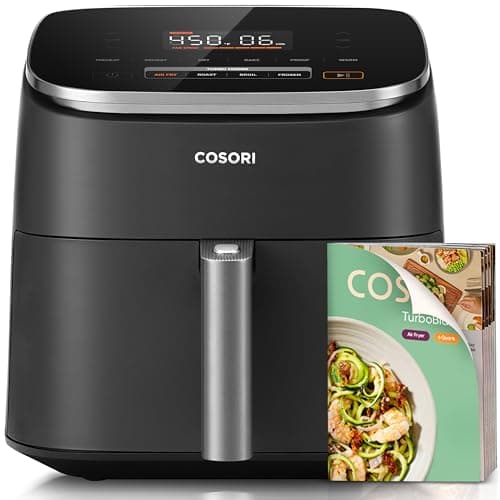 Cosori TurboBlaze Cosori's TurboBlaze pairs a 6-quart square basket with a genuinely PFAS-free ceramic coating and a faster 3,600-rpm fan. It's the pick if you want a modern, roomier air fryer without stepping up to a dual-basket footprint — and the coating claim is on the spec sheet, not marketing. 6QT | Best for most kitchens | 4.5★★★★★ | $89.99Amazon |
| 02 | 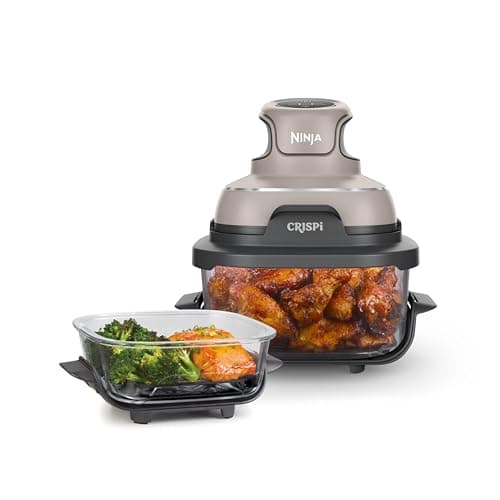 Ninja Crispi The Crispi is the cleanest materials story in air frying: you cook directly in borosilicate glass containers that Ninja lists as PFAS- and PTFE-free — no nonstick coating touching your food at all. A pod-style heater clips on top, and it stores nested. 4 QT | Best non-toxic / glass | 4.3★★★★★ | $152.99Amazon |
| 03 | 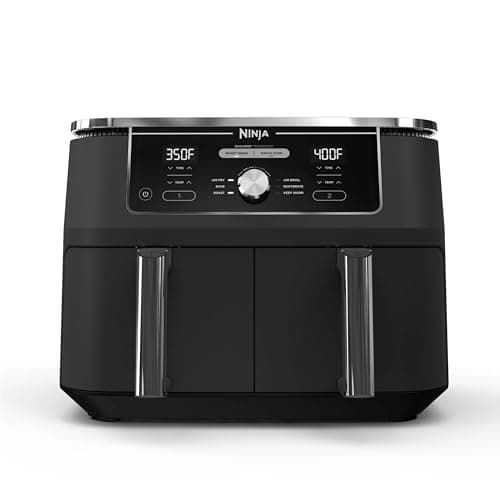 Ninja Foodi DualZone XL DZ401 The DZ401 is the 10-quart version of the dual-basket idea: two independent 5-quart drawers, Smart Finish to make two foods land together, Match Cook to run both the same, and a nonstick surface Ninja lists as 100% PFAS-free. It's the two-basket fryer to buy if a family meal is the actual job. 10 Quart | Best dual-basket overall | 4.5★★★★★ | $199.99Amazon |
#ad · Live prices from the Amazon Product API, as of October 4, 2026. Where we have no verified live price, we show none — a gap beats a number that has rotted.
The picks, in detail
Cosori TurboBlaze
spec score /5
$119.9925% off
Price as of October 4, 2026. Prices change — Amazon's is the one that counts.
#ad · we may earn a commission from this link to Cosori TurboBlaze
Cosori's TurboBlaze pairs a 6-quart square basket with a genuinely PFAS-free ceramic coating and a faster 3,600-rpm fan. It's the pick if you want a modern, roomier air fryer without stepping up to a dual-basket footprint — and the coating claim is on the spec sheet, not marketing.
- Capacity
- 6QT
- Footprint (W×D×H)
- 11.8 × 14.4 × 11.9 in
- Weight
- 13.2 lb
- Warranty
- 2 Year Manufacturer
- PFAS-free ceramic basket (per spec sheet)
- 6-qt square basket fits more than round baskets
- Quieter, faster fan; 2-year warranty
- Pricier than a basic basket fryer
- Taller than a compact model
- Digital panel is a small learning curve
Ninja Crispi
spec score /5
$179.9915% off
Price as of October 4, 2026. Prices change — Amazon's is the one that counts.
#ad · we may earn a commission from this link to Ninja Crispi
The Crispi is the cleanest materials story in air frying: you cook directly in borosilicate glass containers that Ninja lists as PFAS- and PTFE-free — no nonstick coating touching your food at all. A pod-style heater clips on top, and it stores nested.
- Capacity
- 4 QT
- Footprint (W×D×H)
- 11.96 × 13.38 × 13.58 in
- Warranty
- 1 year limited warranty
- Cooks in PFAS/PTFE-free borosilicate glass
- Nests to store; pod is tiny
- Glass containers double as meal prep
- Newer design, shorter track record
- Glass adds weight
- Not the cheapest per quart
Ninja Foodi DualZone XL DZ401
spec score /5
$229.9913% off
Price as of October 4, 2026. Prices change — Amazon's is the one that counts.
#ad · we may earn a commission from this link to Ninja Foodi DualZone XL DZ401
The DZ401 is the 10-quart version of the dual-basket idea: two independent 5-quart drawers, Smart Finish to make two foods land together, Match Cook to run both the same, and a nonstick surface Ninja lists as 100% PFAS-free. It's the two-basket fryer to buy if a family meal is the actual job.
- Capacity
- 10 Quart
- Footprint (W×D×H)
- 13.9 × 17.1 × 12.8 in
- Weight
- 19.8 lb
- Warranty
- 1 Year Limited Warranty
- 10 qt across two independent baskets — a whole meal at once
- Cooking surface listed as 100% PFAS-free
- Smart Finish syncs two different foods to the same finish time
- Deep 17.1-in footprint eats counter depth
- 19.8 lb — not a lift-and-store machine
- Overkill for one or two people
Why the wording matters more than the vibe
"Non-toxic" is not a regulated term for kitchen appliances. Neither is "clean", "healthy" or "safe". What is meaningful is a specific, written claim about a specific substance, because that is a statement a manufacturer can be held to.
The practical problem is that the five common claims get printed on packaging as though they were interchangeable, and they are not. One of them is broad, one is narrow, one is effectively free to claim, one is about a coating type rather than a chemical, and one is about a different material entirely. Shopping well in this category is mostly a reading exercise, so here is the reading key.
The five claims, from broadest to narrowest
1. PFAS-free — the broad one
PFAS stands for per- and polyfluoroalkyl substances: a large family of synthetic fluorinated compounds used for non-stick, water-repellent and grease-resistant surfaces. The FDA maintains a page on them in food contact. A PFAS-free claim covers the whole family, which makes it the most useful of the five — if a maker publishes it, the narrower claims are implied.
2. PTFE-free — one member of the family
PTFE (polytetrafluoroethylene, sold under trade names including Teflon) is the fluoropolymer used in conventional nonstick. It is a PFAS. So "PTFE-free" is a real claim but a narrower one than PFAS-free: a surface could in principle avoid PTFE and still involve other fluorinated compounds. In practice, on countertop appliances, most makers that avoid PTFE avoid the family and say so.
3. PFOA-free — true, and almost meaningless now
PFOA was a processing aid historically used in making PTFE. It was phased out of US nonstick manufacturing years ago, which means essentially every nonstick product sold today can legitimately claim to be PFOA-free. Treat it as a baseline, not a differentiator. If PFOA-free is the only claim on a box, the box has told you nothing.
4. "Ceramic" — a coating type, not a chemical promise
This is the one that trips up most buyers. "Ceramic" describes what the coating is made of — typically a silica-based sol-gel layer baked onto aluminum — rather than what it is free of. A ceramic coating is not a fluoropolymer, which is why the two conversations get merged, but the word itself is not a PFAS statement.
The proof is on our own shelves. The Cosori TurboBlaze, the Cosori TWINFRY and the Typhur Dome 2 each publish an explicit PFAS-free statement about their ceramic coating. The Ninja AF101 and the Cosori Pro LE describe ceramic coatings and publish no PFAS claim at all. All five are ceramic; only three have committed to the claim. If the claim is what you want, buy from the group that makes it.
5. BPA-free — a plastics claim, not a coatings claim
Bisphenol A is used in some polycarbonate plastics and resins, not in nonstick coatings. So a BPA-free claim belongs to a blender jar, a food processor bowl or a sous vide bag — not to an air fryer basket. The FDA's published position is that BPA is safe at the levels currently occurring in foods; its amendment removing BPA-based polycarbonate from baby bottles, sippy cups and infant-formula packaging reflected industry abandonment of those uses rather than a new safety finding. We are reporting the regulator's position, not adjudicating the wider scientific debate.
What to look for on a listing
Four habits that will get you the right machine faster than any amount of brand research.
- Read the claim, then check what part it applies to."Stainless steel air fryer" usually describes the housing, not the basket. "All removable parts are BPA-free" covers the lid and pusher; a bowl-only statement does not.
- Prefer the broad claim. PFAS-free over PTFE-free over PFOA-free. If a product only claims the narrowest one, assume that is deliberate.
- Treat silence as silence. No published claim is not evidence of a problem — these are all legal food-contact products — but it is the absence of a commitment, and it is a legitimate reason to pick a competitor that made one.
- Match the claim to the category. Looking for PFAS-free on a stand mixer is a category error: there is no coating in the food path. Looking for BPA-free on an air fryer basket is the same mistake in reverse.
Three machines whose labels say what you want them to say
Having read the above, these are the three in our catalog whose published wording is strongest, one per approach:
- Cosori TurboBlaze — a ceramic coating with an explicit PFAS-free statement on basket and crisper tray, a 6-quart square basket, 11.8 × 14.4 in and a two-year warranty. The practical default.
- Ninja Crispi — borosilicate glass containers stated free of PFAS, PTFE and nonstick chemical coatings. The only approach where the claim is structural rather than a property of a layer.
- Ninja DZ401 — a nonstick surface Ninja states is 100% PFAS-free, across two 5-quart baskets. The claim applied to a conventional coating at family capacity.
Picks appear here because of what their listings publish, and the prices next to them are pulled live from Amazon. The three formats are compared properly in glass vs. ceramic air fryers, the ranked field is best non-toxic air fryers, and the cross-category version is best non-toxic kitchen appliances.
The bottom line
PFAS-free is the claim worth paying attention to; PFOA-free is a baseline; "ceramic" is a material, not a promise; BPA-free is about plastic and belongs to a different set of appliances. Read which part of the machine a claim covers, prefer the broad claim over the narrow one, and do not read a claim into silence.
For the science and the regulator's position on the coatings themselves, our longer answer is are air fryers toxic. If a coating is already failing on a machine you own, that is a different and more urgent question — what to do when an air fryer coating comes off. And the plastics version of this page, for blender jars specifically, is are plastic blender jars safe.
Frequently asked questions
What does PFAS-free mean on an air fryer?
It means the maker states the product contains no per- and polyfluoroalkyl substances — the whole family of synthetic fluorinated compounds used for nonstick and grease-resistant surfaces. It is the broadest of the common claims, so it implies PTFE-free and PFOA-free as well.
Is PTFE the same as PFAS?
PTFE is one member of the PFAS family, not a synonym for it. So PFAS-free is the broader claim and PTFE-free is the narrower one: a product could avoid PTFE specifically while still involving other fluorinated compounds. If a maker publishes PFAS-free, you do not need the narrower claim as well.
Does PFOA-free mean anything in 2026?
Very little. PFOA was a processing aid historically used in making PTFE and was phased out of US nonstick manufacturing years ago, so essentially every nonstick product on sale today can claim it. If PFOA-free is the only claim on a box, the box has not told you anything useful.
Does a ceramic coating mean PFAS-free?
No. Ceramic describes what the coating is made of — usually a silica-based sol-gel on aluminum — not what it is free of. On our own shelves the Cosori TurboBlaze, Cosori TWINFRY and Typhur Dome 2 publish an explicit PFAS-free statement; the Ninja AF101 and Cosori Pro LE describe ceramic coatings and publish no PFAS claim at all.
Is BPA-free the same as PFAS-free?
No, and they apply to different appliances. BPA is used in some polycarbonate plastics and resins, so a BPA-free claim belongs to a blender jar, a food processor bowl or a sous vide bag. PFAS claims apply to coatings, which in a countertop kitchen means air fryers. Looking for one on the wrong category is a common mistake.
What does food-safe mean on a kitchen appliance?
It means the materials are approved for contact with food, which every legally sold appliance in the US already is. It is a floor, not a differentiator — and it is the reason this page ranks specific substance claims instead, because those are the statements that actually distinguish one machine from another.
How many air fryers publish a PFAS-free claim?
Five of the twenty air fryers in our catalog: the Cosori TurboBlaze, the Cosori TWINFRY, the Typhur Dome 2, the Ninja DZ401, and the Ninja Crispi, whose glass containers are stated free of PFAS, PTFE and nonstick coatings. The rest either describe a ceramic coating without a PFAS statement or publish nothing about the surface at all.
Sources
Keep reading
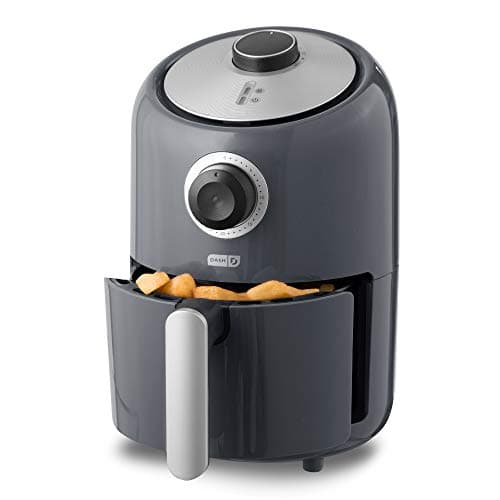
Small Kitchen
Best Appliances for Small Kitchens & Apartments
The most compact air fryer, blender, food processor and sous vide, chosen footprint-first for tight kitchens.
Roundup
The Best Non-Toxic Kitchen Appliances
One pick per category — air fryer, blender, mixer, processor, sous vide — ranked on published material claims rather than marketing language.
Guide
Are Air Fryers Toxic? The Honest, Sourced Answer
PTFE, PFOA, PFAS and acrylamide explained plainly — plus how ceramic and glass baskets avoid coatings.
Comparison
Glass vs. Ceramic Air Fryers
Glass, ceramic coating and stainless steel compared on what the makers actually publish about the cooking surface.
Guide
Air Fryer Coating Coming Off: What To Do
What the FDA publishes about ingesting nonstick flakes, the five things that destroy a basket coating, and when to replace basket vs. machine.
Guide
Are Plastic Blender Jars Safe?
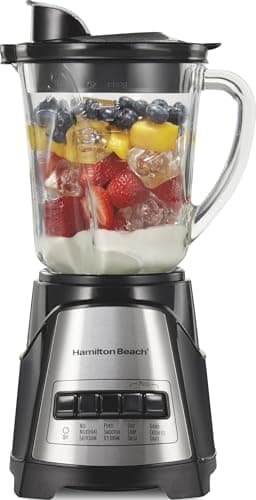
Polycarbonate vs. Tritan copolyester, the FDA's published BPA position, why hot soup is the case that matters, and which jars carry a written claim.
https://wattandwhisk.com/small-kitchen/what-does-pfas-free-mean