Anova Precision Cooker 3.0 Review
The circulator that made sous vide a home technique, and still the one we recommend to people who do not want to cook from a phone.
Disclosure:Watt & Whisk is reader-supported. When you buy through links on this page we may earn an Amazon Associates commission, at no extra cost to you. Prices are pulled live from Amazon and shown with the date checked. How this works.
The Anova Precision Cooker 3.0 is the safest recommendation in sous vide: 1,100 watts, Wi-Fi, a display and controls on the unit so it works with a dead phone, an adjustable clamp that fits almost any deep pot, and a 2-year warranty. It is the machine to buy if you cook in large containers. For two portions in a stockpot, the cheaper Nano does the same job.
The short answer
Quick picks
| # | Product | Best for | Score | Price |
|---|---|---|---|---|
| 01 | 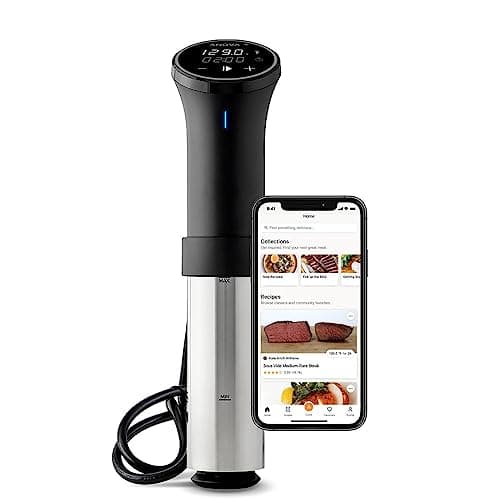 Anova Precision Cooker Anova's Precision Cooker is the category default: a 1,100-watt immersion circulator with a clip, a clear display, and a mature app. It clamps to any pot and holds temperature tightly, which is the entire job. 1100 watts · 1100W | Best overall sous vide | 4.4★★★★★ | $169.99Amazon |
| 02 | 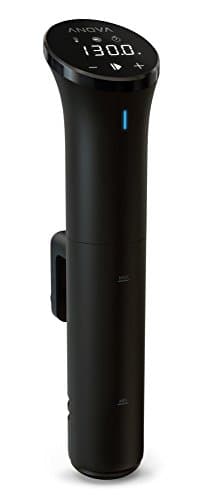 Anova Precision Cooker Nano 2.0 The Nano is the sensible middle: a 12.8-inch, 1.7 lb wand that stows in a kitchen drawer, runs from the unit itself or the free app, and carries Anova's 2-year warranty. It costs a fraction of the flagship and holds temperature just as tightly for a home-sized pot. 12.8" x 2.2" x 4.1" | Best value sous vide | 4.3★★★★★ | $71.99Amazon |
| 03 | 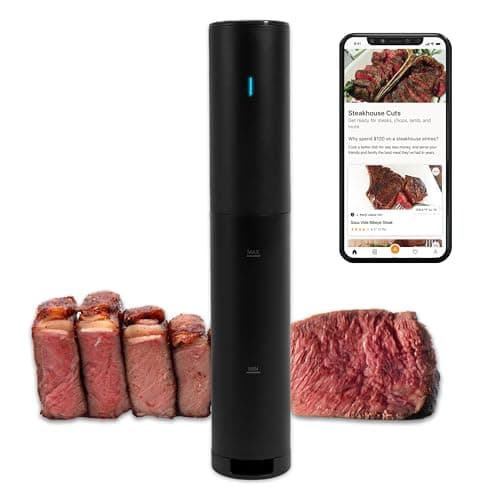 Anova Precision Cooker Mini Anova's most affordable circulator: 850 watts, 1.83 lb, Bluetooth control from the free app. It is the low-stakes way to find out whether you'll actually cook this way twice a month, and it costs less than the steak you'd ruin learning on the hob. Mini · 850W | Best cheapest way to try sous vide | 4.0★★★★★ | $26.99Amazon |
#ad · Live prices from the Amazon Product API, as of October 16, 2026. Where we have no verified live price, we show none — a gap beats a number that has rotted.
The picks, in detail
Anova Precision Cooker
spec score /5
$229.0026% off
Price as of October 16, 2026. Prices change — Amazon's is the one that counts.
#ad · we may earn a commission from this link to Anova Precision Cooker
Anova's Precision Cooker is the category default: a 1,100-watt immersion circulator with a clip, a clear display, and a mature app. It clamps to any pot and holds temperature tightly, which is the entire job.
- Capacity
- 1100 watts
- Footprint (W×D×H)
- 3.07 × 12.79 × 5.51 in
- Power
- 1100 W
- Weight
- 1.92 lb
- Cost per use*
- ≈6¢
- Est. per year*
- ≈$13
- Warranty
- 2 year manufacturer
- Holds temperature precisely
- 1,100 W heats water quickly
- Mature, reliable app
- Needs a container and a bag/clip
- App-dependent for some features
- Not silent
*Cost-to-run computed from the manufacturer's stated 1100W at $0.17/kWh (US average), 20-min sessions, 4×/week. Your rate and use will vary.
Anova Precision Cooker Nano 2.0
spec score /5
$149.0052% off
Price as of October 16, 2026. Prices change — Amazon's is the one that counts.
#ad · we may earn a commission from this link to Anova Precision Cooker Nano 2.0
The Nano is the sensible middle: a 12.8-inch, 1.7 lb wand that stows in a kitchen drawer, runs from the unit itself or the free app, and carries Anova's 2-year warranty. It costs a fraction of the flagship and holds temperature just as tightly for a home-sized pot.
- Capacity
- 12.8" x 2.2" x 4.1"
- Footprint (W×D×H)
- 2.2 × 4.1 × 12.8 in
- Weight
- 1.7 lb
- Warranty
- 2 year warranty
- Fits in a drawer — 12.8 in, 1.7 lb
- 2-year warranty
- Full control on the unit; app is optional
- Slower than 1,100 W wands on a big pot
- Best suited to smaller containers
- Some app content sits behind a subscription
Anova Precision Cooker Mini
spec score /5
$29.007% off
Price as of October 16, 2026. Prices change — Amazon's is the one that counts.
#ad · we may earn a commission from this link to Anova Precision Cooker Mini
Anova's most affordable circulator: 850 watts, 1.83 lb, Bluetooth control from the free app. It is the low-stakes way to find out whether you'll actually cook this way twice a month, and it costs less than the steak you'd ruin learning on the hob.
- Capacity
- Mini
- Footprint (W×D×H)
- 2.2 × 4.13 × 12.2 in
- Power
- 850 W
- Weight
- 1.83 lb
- Cost per use*
- ≈5¢
- Est. per year*
- ≈$10
- Cheapest circulator we'd actually recommend
- 850 W is plenty for a stockpot
- 1.83 lb — stores anywhere
- Bluetooth only on the free app; Wi-Fi needs a subscription
- Slowest to bring a big bath up to temperature
- No published warranty on the listing
*Cost-to-run computed from the manufacturer's stated 850W at $0.17/kWh (US average), 20-min sessions, 4×/week. Your rate and use will vary.
The first Anova Precision Cooker launched in 2014 and effectively created home sous vide as a category. The 3.0 is the current version of that machine, and reviewing it is mostly an exercise in working out whether the flagship is the one you need — because Anova also sells two cheaper circulators that cook identically in a normal pot.
Standard disclosure: a specification review from Anova's published listing for the exact unit we link to, not a lab test. Method on how we review.
The specification
| Spec | Anova Precision Cooker 3.0 |
|---|---|
| Power | 1,100 W |
| Connectivity | Wi-Fi |
| On-unit control | Yes — display and controls |
| Mounting | Adjustable clamp |
| Dimensions | 3.07 W × 12.79 D × 5.51 H in |
| Weight | 1.92 lb |
| App | Free for time and temperature control |
| Subscription | Optional — $1.99/month or $9.99/year for recipe content |
| Warranty | 2-year manufacturer |
The reason to buy it: it works without your phone
This is the whole argument, and it is a bigger deal than it sounds. Anova's listing is explicit that you control time and temperature on the app or directly on the cooker itself. There is a display. There are buttons. You clip it to a pot, dial 133°F and three hours, and press start.
The contrast is with the Breville Joule Turbo, which is designed around its app and offers only minimal control on the device. When the Joule's software works it is the better experience; when your phone is at 3% in another room, it is a stainless tube.
So the honest question is simply what kind of person you are. If an appliance requiring a phone would irritate you, buy Anova and the rest of the comparison is noise. We put the two head to head in Anova vs. Joule.
1,100 watts: what it actually buys
The highest figure among the circulators we track, and it is worth being precise about what wattage does in this category — because it is easy to over-value.
Wattage determines how fast a cold pot reaches temperature, and very little else. Once a bath is at temperature, holding it there takes very little energy, because the water is insulated by the pot and, if you are sensible, a lid. The food is cooked by the water, and the water does not know what heated it.
The practical consequence: against the 850-watt Anova Mini, the difference on a normal stockpot is roughly fifteen minutes at the start of a multi-hour cook — and starting with hot tap water instead of cold closes most of that gap for free.
Where 1,100 watts genuinely matters is large containers. A 12-quart insulated tub full of short ribs for 48 hours is a volume of water that a lower-wattage wand will struggle to bring up and hold against losses. If you batch-cook or entertain, that is the case for the flagship. If you cook two steaks in a saucepan, it is capability you are paying for and will not use.
The adjustable clamp is underrated
Anova specifically calls out an adjustable clamp that fits nearly any pot deep enough to meet the minimum water depth. This sounds trivial and is the thing most likely to cause a return on a circulator you buy without checking.
Every wand has minimum and maximum water lines marked on the shaft. If your pot is too shallow, the machine cannot sit low enough to reach the minimum line; if the wall is too thick for the clamp, it will not mount securely. An adjustable screw clamp handles a much wider range of pot walls than a fixed clip or a magnetic base.
Check this before you buy any circulator: take the pot you actually intend to use and compare its depth against the wand's stated minimum water line.
What the subscription does and does not gate
A common source of confusion, so let us be exact. On this model, controlling the cook is free— on the unit or through the app. Anova's optional subscription, listed at $1.99 a month or $9.99 a year, covers its wider educational and recipe content.
Worth knowing that this differs by model: on the cheaper Anova Mini, the free tier is Bluetooth-only and Wi-Fi connectivity comes with the subscription. On this flagship, Wi-Fi is included. That is one of the real differences between the two machines and it is easy to miss when comparing prices.
Neither brand charges you to cook. Breville does not gate Joule's cooking functions either, and includes guided recipes — so if recipe content matters to you, that quietly narrows the price gap in Breville's favor.
Is Wi-Fi worth it?
For most people, honestly, no — and for a specific minority, absolutely.
Sous vide is forgiving by design. Because food cannot exceed the bath temperature, there is nothing to check and nothing to adjust once a cook is running. Remote monitoring answers a question the technique mostly removes.
Where it earns its money is long cooks you leave. A 24-to-72-hour short rib is a cook you sleep through and go to work during, and knowing remotely that the bath is still at temperature — rather than that it shut off six hours ago because the water evaporated below the minimum line — is genuinely valuable. If long cooks are why you want a circulator, Wi-Fi is worth having.
The rest of the Anova range, and why it matters
Anova is unusual in this category for selling a coherent range rather than one machine, and that is worth factoring in because the accessories are built to work together.
Alongside the circulators, Anova makes vacuum sealers — the slim Precision Vacuum Sealer and the Pro with its wet mode for marinades — designed around the same bag ecosystem. If you later decide you want to seal properly for long cooks, staying in one range means one bag type and one set of consumables rather than two.
You do not need any of it to start. Zip-top bags and the water displacement method handle most home sous vide, which we set out honestly in do you need a vacuum sealer. But it is a reason to weigh the ecosystem alongside the individual machine, in the same way the KitchenAid attachment hub matters for mixers.
The honest cons
It is the bulkiest of the three Anovas at 3.07 inches across, against 2.2 for the Nano. Still drawer-storable, but a chunkier object.
You are paying for heat-up speed you may not need. If your cooking is home-sized, the Nano is the same experience for meaningfully less.
It does not come with a container or a lid, and long cooks need one — an uncovered bath evaporates below the minimum line and shuts off. Budget for that.
The app's recipe library sits behind a subscription, where Breville's guided recipes do not.
It cannot brown anything — which is true of all sous vide, and means you still need a hot cast-iron pan for the finish. See what is sous vide.
The track record argument
One thing that does not show on a spec sheet. Anova's listing notes that the first Precision Cooker launched in 2014, and that lineage is worth something in a category full of newer entrants.
It means a decade of firmware and app maturity, a very large installed base, and — the practical part — an enormous body of community recipes, times and troubleshooting written specifically for these machines. When something behaves oddly, someone has already asked about it.
It also means the app is unlikely to be abandoned, which is a genuine risk with app-dependent appliances from smaller brands. That risk is lower here than almost anywhere else in the category, and it is a quiet argument for the incumbent even where a rival's software is more impressive today.
Verdict
Buy the Precision Cooker 3.0 if you cook in large containers, batch-prep proteins, or simply want the safest recommendation in the category — a real appliance with buttons, two years of warranty and the most mature app in sous vide.
Buy the Anova Nano if your cooking is two steaks and a chicken breast; it has the same on-unit controls and the same 2-year warranty for much less. Buy the Anova Mini if you are finding out whether you like the technique at all. Both are in best budget sous vide, and if software rather than hardware appeals, read the Joule Turbo review.
Frequently asked questions
Is the Anova Precision Cooker 3.0 worth it?
It is if you cook in large containers or batch-prep proteins — 1,100 watts, Wi-Fi, on-unit controls and a 2-year warranty make it the safest recommendation in the category. For two portions in a stockpot, the cheaper Anova Nano cooks identically.
Can you use an Anova Precision Cooker without the app?
Yes. Anova's listing is explicit that you can control time and temperature directly on the cooker itself as well as through the free app. That is the main practical difference from the Breville Joule, which is designed around its app.
Does Anova charge a subscription to use the cooker?
Not for cooking. Controlling time and temperature is free on the unit and in the app. The optional subscription at $1.99 a month or $9.99 a year covers recipe and educational content. Note that on the cheaper Anova Mini, Wi-Fi itself requires the subscription.
How many watts do you need in a sous vide circulator?
Wattage determines how fast a cold pot reaches temperature and very little else — holding a bath at temperature takes almost no energy. The gap between 1,100 and 850 watts is about fifteen minutes at the start of a multi-hour cook, and starting with hot tap water closes most of it.
Will an Anova Precision Cooker fit my pot?
It uses an adjustable clamp that Anova says fits nearly any pot deep enough to meet the minimum water depth. Check your pot's depth against the wand's stated minimum water line before buying — a pot too shallow to reach that line is the most common reason circulators get returned.
Anova Precision Cooker or Anova Nano?
The Nano for most people — same on-unit controls, same 2-year warranty, lighter at 1.7 lb, and it cooks identically in a home-sized pot. Choose the Precision Cooker 3.0 if you use large insulated containers, where its 1,100 watts genuinely matters.
Sources
Keep reading
Sous Vide
The Best Sous Vide Machines of 2026
Anova and Inkbird immersion circulators compared on wattage, precision, app and running cost.
Comparison
Anova vs. Joule: Which Sous Vide Circulator Should You Buy?
Anova vs Breville Joule on standalone control, size, speed, app dependence and warranty — and who each one suits.
Review
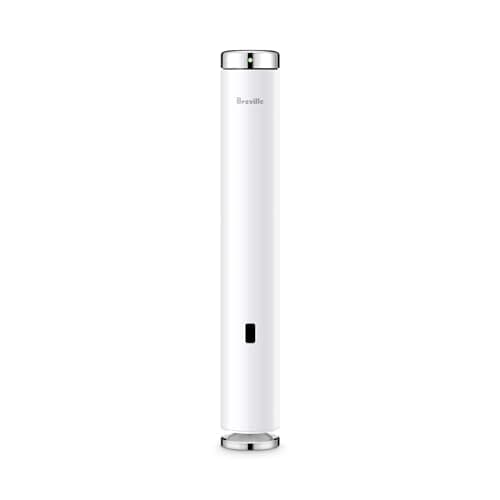
Breville Joule Turbo Review
The Joule Turbo on Turbo mode, Visual Doneness, Prime Time, its 1.65-inch body and the app-dependence trade-off.
Roundup
The Best Budget Sous Vide Machines
Four budget circulators ranked on power, app access, size and warranty — and the three things extra money actually buys.
https://wattandwhisk.com/sous-vide/anova-precision-cooker-review