The Best Budget Sous Vide Machines
Sous vide is the rare category where the cheap machines do the same job as the expensive ones. Here is exactly where that stops being true.
Disclosure:Watt & Whisk is reader-supported. When you buy through links on this page we may earn an Amazon Associates commission, at no extra cost to you. Prices are pulled live from Amazon and shown with the date checked. How this works.
The Anova Precision Cooker Mini is the cheapest circulator we would actually recommend — 850 watts, 1.83 lb, and Bluetooth control from the free app. Step up to the Anova Nano 2.0 for a 2-year warranty and full on-unit controls, or the Inkbird ISV-100W if you want Wi-Fi without a subscription at a budget price. The full-size Anova Precision Cooker at 1,100 watts is the step up worth making only if you cook in large containers.
The short answer
Quick picks
| # | Product | Best for | Score | Price |
|---|---|---|---|---|
| 01 | 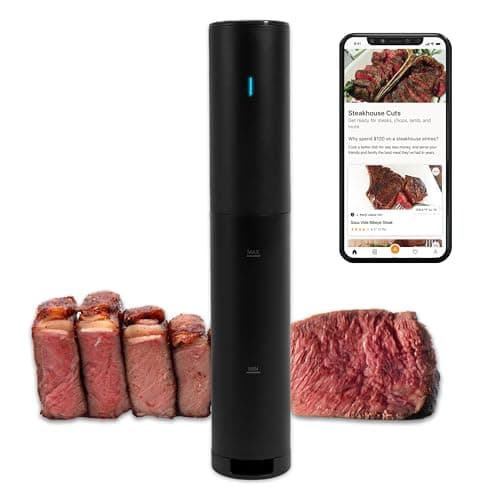 Anova Precision Cooker Mini Anova's most affordable circulator: 850 watts, 1.83 lb, Bluetooth control from the free app. It is the low-stakes way to find out whether you'll actually cook this way twice a month, and it costs less than the steak you'd ruin learning on the hob. Mini · 850W | Best cheapest way to try sous vide | 4.0★★★★★ | $26.99Amazon |
| 02 | 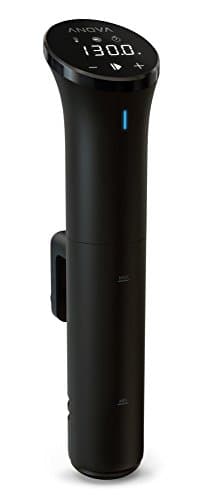 Anova Precision Cooker Nano 2.0 The Nano is the sensible middle: a 12.8-inch, 1.7 lb wand that stows in a kitchen drawer, runs from the unit itself or the free app, and carries Anova's 2-year warranty. It costs a fraction of the flagship and holds temperature just as tightly for a home-sized pot. 12.8" x 2.2" x 4.1" | Best value sous vide | 4.3★★★★★ | $71.99Amazon |
| 03 | 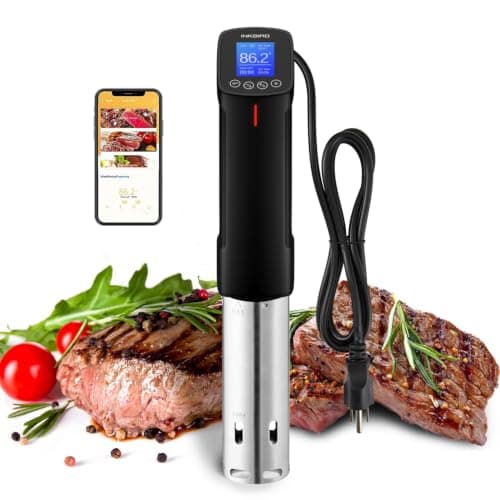 Inkbird ISV-100W The Inkbird undercuts the name brands while still giving you Wi-Fi and tight temperature control in a slim wand. It's the low-risk way to find out whether sous vide earns a place in your kitchen. 1 WIFI Sous Vide Machine · 100W | Best budget sous vide | 4.0★★★★★ | $95.99Amazon |
| 04 | 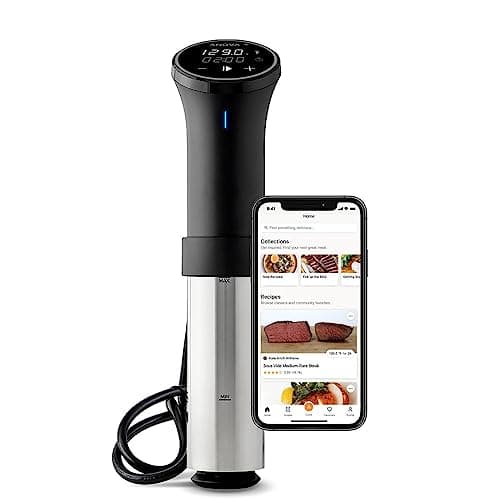 Anova Precision Cooker Anova's Precision Cooker is the category default: a 1,100-watt immersion circulator with a clip, a clear display, and a mature app. It clamps to any pot and holds temperature tightly, which is the entire job. 1100 watts · 1100W | Best overall sous vide | 4.4★★★★★ | $169.79Amazon |
#ad · Live prices from the Amazon Product API, as of October 17, 2026. Where we have no verified live price, we show none — a gap beats a number that has rotted.
The picks, in detail
Anova Precision Cooker Mini
spec score /5
$29.007% off
Price as of October 17, 2026. Prices change — Amazon's is the one that counts.
#ad · we may earn a commission from this link to Anova Precision Cooker Mini
Anova's most affordable circulator: 850 watts, 1.83 lb, Bluetooth control from the free app. It is the low-stakes way to find out whether you'll actually cook this way twice a month, and it costs less than the steak you'd ruin learning on the hob.
- Capacity
- Mini
- Footprint (W×D×H)
- 2.2 × 4.13 × 12.2 in
- Power
- 850 W
- Weight
- 1.83 lb
- Cost per use*
- ≈5¢
- Est. per year*
- ≈$10
- Cheapest circulator we'd actually recommend
- 850 W is plenty for a stockpot
- 1.83 lb — stores anywhere
- Bluetooth only on the free app; Wi-Fi needs a subscription
- Slowest to bring a big bath up to temperature
- No published warranty on the listing
*Cost-to-run computed from the manufacturer's stated 850W at $0.17/kWh (US average), 20-min sessions, 4×/week. Your rate and use will vary.
Anova Precision Cooker Nano 2.0
spec score /5
$149.0052% off
Price as of October 17, 2026. Prices change — Amazon's is the one that counts.
#ad · we may earn a commission from this link to Anova Precision Cooker Nano 2.0
The Nano is the sensible middle: a 12.8-inch, 1.7 lb wand that stows in a kitchen drawer, runs from the unit itself or the free app, and carries Anova's 2-year warranty. It costs a fraction of the flagship and holds temperature just as tightly for a home-sized pot.
- Capacity
- 12.8" x 2.2" x 4.1"
- Footprint (W×D×H)
- 2.2 × 4.1 × 12.8 in
- Weight
- 1.7 lb
- Warranty
- 2 year warranty
- Fits in a drawer — 12.8 in, 1.7 lb
- 2-year warranty
- Full control on the unit; app is optional
- Slower than 1,100 W wands on a big pot
- Best suited to smaller containers
- Some app content sits behind a subscription
Inkbird ISV-100W
spec score /5
Price as of October 17, 2026. Prices change — Amazon's is the one that counts.
#ad · we may earn a commission from this link to Inkbird ISV-100W
The Inkbird undercuts the name brands while still giving you Wi-Fi and tight temperature control in a slim wand. It's the low-risk way to find out whether sous vide earns a place in your kitchen.
- Capacity
- 1 WIFI Sous Vide Machine
- Footprint (W×D×H)
- 2.362204722 × 2.362204722 × 16.141732267 in
- Power
- 100 W
- Cost per use*
- ≈1¢
- Est. per year*
- ≈$1
- Warranty
- 365
- Much cheaper than premium wands
- Wi-Fi with a usable app
- Slim, easy to store
- Slower to heat large pots
- Less polished app
- Shorter brand track record
*Cost-to-run computed from the manufacturer's stated 100W at $0.17/kWh (US average), 20-min sessions, 4×/week. Your rate and use will vary.
Anova Precision Cooker
spec score /5
$229.0026% off
Price as of October 17, 2026. Prices change — Amazon's is the one that counts.
#ad · we may earn a commission from this link to Anova Precision Cooker
Anova's Precision Cooker is the category default: a 1,100-watt immersion circulator with a clip, a clear display, and a mature app. It clamps to any pot and holds temperature tightly, which is the entire job.
- Capacity
- 1100 watts
- Footprint (W×D×H)
- 3.07 × 12.79 × 5.51 in
- Power
- 1100 W
- Weight
- 1.92 lb
- Cost per use*
- ≈6¢
- Est. per year*
- ≈$13
- Warranty
- 2 year manufacturer
- Holds temperature precisely
- 1,100 W heats water quickly
- Mature, reliable app
- Needs a container and a bag/clip
- App-dependent for some features
- Not silent
*Cost-to-run computed from the manufacturer's stated 1100W at $0.17/kWh (US average), 20-min sessions, 4×/week. Your rate and use will vary.
Sous vide is unusual among kitchen appliances: the budget machines are not compromised versions of the expensive ones, because the core job is simple. A circulator heats water, moves it around, and holds a set temperature. A $30 machine that holds 133°F within a fraction of a degree produces a steak indistinguishable from one cooked by a $300 machine holding 133°F, because the water does the cooking and the water does not know what it cost.
That makes this a genuinely good category to buy cheap in. But there are three specific places where money buys something real, and this guide is mostly about naming them honestly. All specs come from each machine's current listing — see how we review.
What extra money actually buys
- Heat-up speed. Wattage determines how fast a cold pot reaches temperature and nothing else. On a big container that is a real wait; on a normal pot started with hot tap water it is close to irrelevant.
- Container size you can drive. A lower-wattage wand in a 12-quart insulated container will struggle to reach and hold temperature. In a stockpot it is fine.
- Software and connectivity.Wi-Fi versus Bluetooth, remote monitoring, recipe libraries, and features like Breville's Turbo mode that shorten the cook itself.
Notice what is not on that list: temperature accuracy. Every machine here holds temperature well enough that the difference will not appear on a plate. Anyone selling you a budget circulator upgrade on precision grounds is selling you a spec-sheet difference you cannot taste.
The picks
Anova Precision Cooker Mini — cheapest worth buying
Anova's own listing calls this its most affordable cooker ever, and positions it as costing about the same as one night out at a steakhouse. That framing is fair. You get 850 watts in a 1.83 lb wand 12.2 inches long, and the three-step routine the whole category runs on: clip to a pot of water, set time and temperature, drop in the sealed bag.
The honest limits are two. The free app tier is Bluetooth only— Wi-Fi connectivity comes with Anova's optional subscription, listed at $1.99 a month or $9.99 a year — so out of the box you need to be within range rather than checking on it from work. And 850 watts is the slowest here to bring a large bath up to temperature. For a normal pot and someone finding out whether they like this way of cooking, neither is a real problem. The listing does not publish a warranty.
Anova Nano 2.0 — the value sweet spot
If you are fairly sure you will keep using it, this is the one to buy. The Nano is a 12.8-inch, 1.7 lb wand — the lightest here — with full controls on the unit, so you never depend on a phone, and Anova lists a 2-year warranty against the Mini's unpublished one and the Joule Turbo's single year.
Anova pitches it as stowing away in a kitchen drawer next to the whisk and ladle, which is accurate and matters more than it sounds — an appliance in a drawer gets used, an appliance in the garage does not. Cons: it is slower than the 1,100-watt flagship on a big pot, it is genuinely best matched to home-sized containers, and some of the app's content sits behind the same optional subscription. For two steaks and a chicken breast, it does exactly what the flagship does.
Inkbird ISV-100W — Wi-Fi without the premium
The value outsider, and the pick if remote monitoring matters to you but flagship money does not appeal. The ISV-100W is a slim wand — 2.36 inches across and 16.14 inches long, the tallest here — rated at 1,000 watts on its listing, with Wi-Fi and a free app, and a 365-day warranty.
A thousand watts is close to the full-size Anova's 1,100, so heat-up on a large container is genuinely competitive rather than a compromise, which is the surprising part of this machine at the price. The cons are the ones you would expect from a challenger brand: the app is less polished than Anova's or Breville's, the warranty is one year against Anova's two, and the track record is shorter. Its extra length also means it needs a deeper pot than the others to submerge properly — check the minimum water line.
Anova Precision Cooker 3.0 — when to spend up
Not a budget machine, included so you know where the ceiling is. You get 1,100 watts, Wi-Fi, on-unit controls, a 2-year warranty and the most mature app in the category. What that buys in practice is the ability to drive a large insulated container — a 12-quart tub of short ribs for 48 hours — without the machine fighting the volume.
If your cooking is two portions at a time, this is money spent on capability you will not use, and the Nano is the smarter purchase. If you batch-cook proteins for the week or entertain, it is the right machine. We compare it against the other flagship in Anova vs. Joule.
The costs nobody mentions
A circulator is not the whole purchase, and budgeting for only the wand is the most common mistake here. You also need a container — a stockpot works perfectly well to start, and a dedicated polycarbonate tub with a lid is better for long cooks because it insulates and stops evaporation. You need a way to seal the food, and this is where people over-spend: a vacuum sealer is not required. Zip-top bags and the water-displacement method — lower the bag into the water so pressure pushes the air out, then seal the last corner — works for the vast majority of home cooks.
And you need a way to finish. Sous vide cooks the inside perfectly and browns nothing, so a hot cast-iron pan or a torch is not optional if you are cooking meat. Factor a pan you can get properly hot into the plan. We go through the whole workflow in what is sous vide.
Building the rest of the setup cheaply
The wand is usually the smallest part of the total spend if you follow the standard advice, and almost all of that advice is avoidable. Here is what you actually need and what you can skip.
Container: use the pot you own. A stockpot works from day one. When you outgrow it, the upgrade that matters is not a branded sous vide tub but any deep polycarbonate food container with a lid — the lid is doing the real work, because it stops evaporation and halves how hard the element has to run. Cutting a notch in a cheap lid for the wand costs nothing.
Bags: skip the vacuum sealer initially. Zip-top freezer bags plus the water-displacement method handle the overwhelming majority of home cooks. Seal all but one corner, lower the bag into the water so pressure forces the air out, then close the corner. A vacuum sealer earns its place if you batch-freeze proteins or do multi-day cooks where a slow leak would matter; it is not an entry requirement, and buying one at the same time as the circulator is the most common way people over-spend on this hobby.
Weighting and racks: improvise first. Bags float, and floating food cooks unevenly. A dinner plate on top, a heavy spoon in the bag, or a couple of butter knives clipped to the bottom edge solve this for nothing. Buy a proper rack only if you routinely cook four or more bags at once and they keep touching, which genuinely does cause uneven results.
Searing: this is where to spend. If you are going to buy one thing alongside the circulator, buy a cast-iron skillet you can get properly hot. The finish is half the result and it is the half a cheap circulator does not compromise.
Is Wi-Fi worth paying for?
It is the feature that separates most of the price tiers here, so it deserves a direct answer: for most people, no — and for a specific minority, yes.
Sous vide is forgiving by design. Because food cannot exceed the bath temperature, there is nothing to check and nothing to adjust once the cook is running. Remote monitoring answers a question — "is it still going?" — that the technique mostly removes. For a one-hour steak while you are in the house, Bluetooth or on-unit controls are entirely sufficient, which is why the Anova Mini is not compromised by its Bluetooth-only free tier.
Where Wi-Fi earns its money is long cooks you leave. A 24-to-72-hour short rib is a cook you sleep through and go to work during, and knowing remotely that the bath is still at temperature — rather than that it shut off six hours ago because the water evaporated below the minimum line — is genuinely valuable. If long cooks are why you want a circulator, the Inkbird's free Wi-Fi at a budget price is the standout value here.
Two budget mistakes to avoid
Buying a wand too short for your pot. Every circulator has a minimum and maximum water line marked on it, and if the pot is too deep or too shallow the machine either cannot reach the water or cannot be clipped low enough. The Inkbird at 16.14 inches long needs more depth than the 12-inch Anovas. Check your pot before you check the price.
Skipping the lid. Over a long cook, an uncovered bath loses water to evaporation and can drop below the minimum line, at which point the machine shuts off and your dinner stops cooking. A lid, some foil, or a layer of ping-pong balls fixes it for almost nothing, and it also cuts running cost by reducing how often the element fires.
What to cook while you decide if you like it
A budget circulator is a trial, so spend the trial well. These four cooks tell you within a fortnight whether the technique fits your life, and they are ordered from most to least convincing.
A thick steak. The demonstration cook. An hour at your target, then dried thoroughly and seared hard. If the edge-to-edge result does not impress you, nothing else here will, and you have learned something cheaply.
Chicken breast. The one that changes weekly eating rather than special occasions, and the biggest quality gap versus any other method. If you eat a lot of chicken and have accepted that it is dull, this is the cook that justifies the machine.
Eggs.Cheap, fast by this technique's standards, and impossible to replicate on a hob because no other method holds a precise temperature for long enough. Good for finding out whether you enjoy the precision or find it fussy.
A tough cut, over a weekend. Short rib or pork shoulder for 24 hours. This is the cook that shows what a long hold does, and it is also the one that tests whether you will tolerate the planning — which is the real question a trial should answer.
If after those four you have reached for it a third time unprompted, buy the container and the lid. If you have not, you have spent very little to find out, which is the whole argument for starting at this end of the market.
The verdict
Trying it out: the Anova Mini. Committing to it: the Anova Nano, for the warranty and the on-unit controls. Want Wi-Fi and near-flagship wattage cheaply: the Inkbird ISV-100W. Cooking in big containers: the full-size Anova. The category overview is on our best sous vide machines page, and if you are still weighing whether the technique fits how you cook, is sous vide worth it is the honest version of that question.
The two machines most people end up choosing between at this end of the market have their own head-to-head: Anova vs. Inkbird puts them side by side on published accuracy, calibration and wattage — the only comparison where one of the two publishes a tolerance figure at all.
Frequently asked questions
What is the cheapest sous vide machine worth buying?
The Anova Precision Cooker Mini — 850 watts in a 1.83 lb wand, controlled from the free app over Bluetooth. Anova positions it as costing about the same as one night out at a steakhouse, and it produces the same result as a flagship on a normal home-sized pot.
Do cheap sous vide machines cook as well as expensive ones?
Yes, for normal home cooking. The water does the cooking, and every machine here holds temperature closely enough that the difference will not show on a plate. What extra money buys is heat-up speed, the ability to drive a large container, and better software.
Do you need a vacuum sealer for sous vide?
No. Zip-top bags and the water-displacement method work for the vast majority of home cooks — lower the bag into the water so pressure pushes the air out, then seal the last corner. A vacuum sealer is useful for long cooks and freezer storage, not a requirement.
How many watts does a sous vide cooker need?
Wattage decides how fast a cold pot reaches temperature, not the quality of the result. Around 850 to 1,000 watts is ample for a normal stockpot, especially if you start with hot tap water. Go to 1,100 watts if you cook in large insulated containers.
Why did my sous vide machine shut off mid-cook?
Almost always evaporation. Over a long cook an uncovered bath loses water and drops below the machine's minimum water line, which triggers a shutoff. A lid, foil, or a layer of ping-pong balls prevents it and also reduces running cost.
Sources
Keep reading
Sous Vide
The Best Sous Vide Machines of 2026
Anova and Inkbird immersion circulators compared on wattage, precision, app and running cost.
Comparison
Anova vs. Joule: Which Sous Vide Circulator Should You Buy?
Anova vs Breville Joule on standalone control, size, speed, app dependence and warranty — and who each one suits.
Guide
What Is Sous Vide?
How sous vide works, what you need to start, the temperatures that matter, and what the technique genuinely cannot do.
Guide
Is Sous Vide Worth It?
What sous vide genuinely transforms, what it does not, and the three types of cook who should skip it.
Review
Anova Precision Cooker 3.0 Review
The Anova Precision Cooker 3.0 on power, on-unit control, the clamp, Wi-Fi and what the optional subscription covers.
Guide
Sous Vide Times and Temperatures Explained
Why temperature sets doneness and time sets texture, how thickness drives timing, and where to get safe pasteurization tables.
https://wattandwhisk.com/sous-vide/best-budget-sous-vide