The Best Budget Food Processors
The gap between a $70 processor and a $280 one is narrower than it looks — except in three specific places. Here they are.
Disclosure:Watt & Whisk is reader-supported. When you buy through links on this page we may earn an Amazon Associates commission, at no extra cost to you. Prices are pulled live from Amazon and shown with the date checked. How this works.
The Hamilton Beach 10-cup is the best budget full-size processor: a 450-watt motor, two speeds plus pulse, and a built-in bowl scraper nothing else at this price offers. The Cuisinart 8-cup FP-8 is the better-built alternative with a reversible slicing disc and a 2-year warranty, the Ninja Professional Plus BN601 is the pick if dough matters, and the Cuisinart Mini-Prep or BLACK+DECKER 3-cup cover small jobs for very little.
The short answer
Quick picks
| # | Product | Best for | Score | Price |
|---|---|---|---|---|
| 01 | 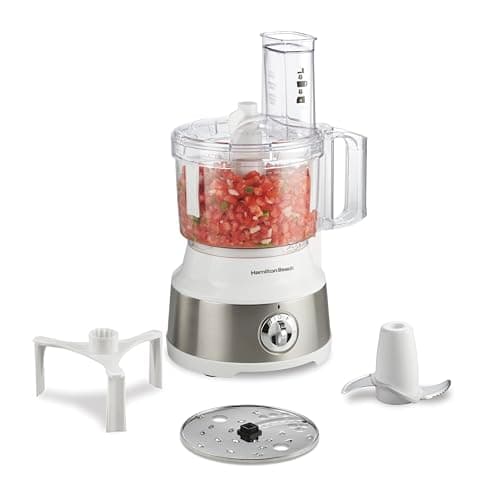 Hamilton Beach 10-Cup A 450-watt, 10-cup processor with the one feature nobody else at this price bothers with: a built-in bowl scraper you sweep side to side without stopping the machine or reaching for a spatula. Two speeds, pulse, suction feet, everything dishwasher-safe. 10 Cup · 450W | Best budget full-size | 4.1★★★★★ | $69.95Amazon |
| 02 | 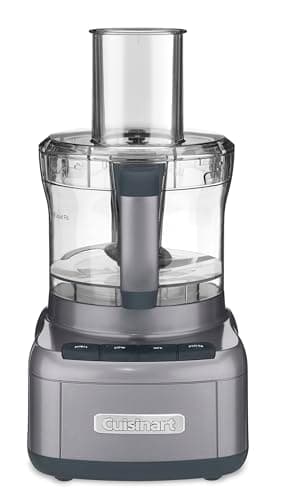 Cuisinart 8-Cup FP-8 The sensible middle of the Cuisinart line: an 8-cup bowl with measurement markings, a 350-watt motor, and a reversible shredding and slicing disc included — so unlike every mini here, it actually does the knife work, not just the chopping. 8 Cup · 350W | Best mid-size with discs | 4.2★★★★★ | $129.95Amazon |
| 03 | 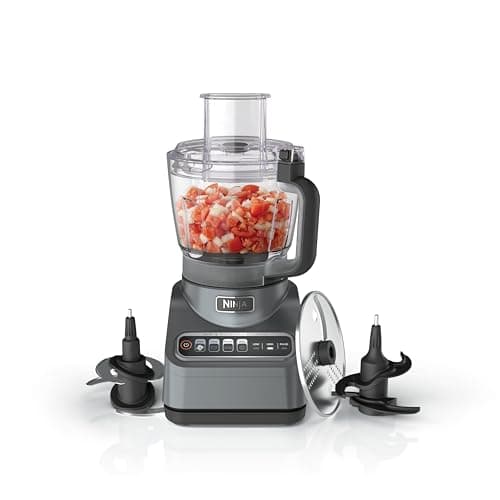 Ninja Professional Plus BN601 A 1,000-peak-watt motor under a 9-cup (72-ounce) bowl with four Auto-iQ programs and a dough blade in the box. It's the processor for people who want to press one button — and the only one here that ships with a dedicated dough blade as standard. 72 Oz · 1000W | Best for dough and presets | 4.3★★★★★ | $129.99Amazon |
| 04 | 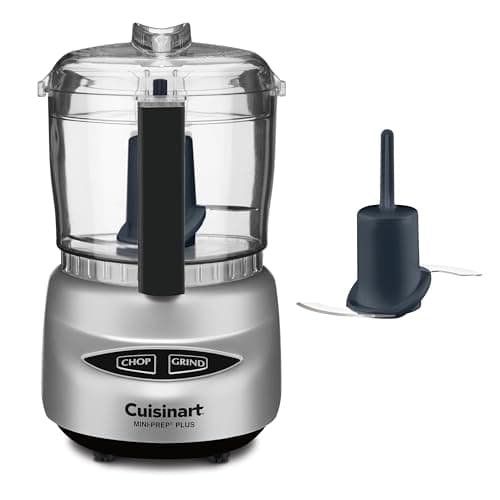 Cuisinart Mini-Prep Plus A 3-cup, 250-watt chopper that lives in a cabinet and comes out for pesto, dressings, nuts, and a single onion. For small kitchens that don't need a 14-cup monster, it does 80% of the jobs at a fraction of the size. 3 Cup · 250W | Best mini / small kitchen | 4.1★★★★★ | $29.29Amazon |
| 05 | 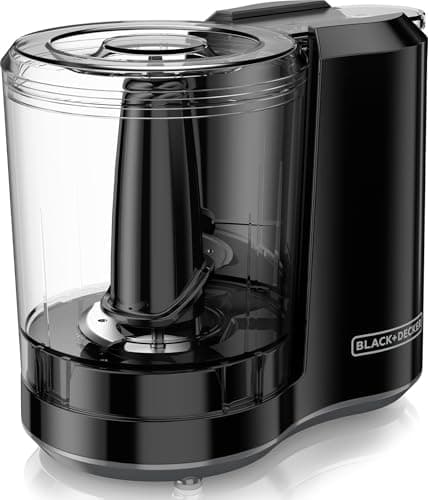 BLACK+DECKER 3-Cup Chopper A one-touch, 3-cup chopper with bi-level stainless blades and oil holes in the lid so you can stream oil into a vinaigrette or hummus while it runs. At 1.8 lb and 7 inches tall it costs about as much as a decent chef's knife and does the boring 80% of prep. 3 cup | Cheapest useful chopper | 3.8★★★★★ | $23.57Amazon |
#ad · Live prices from the Amazon Product API, as of October 17, 2026. Where we have no verified live price, we show none — a gap beats a number that has rotted.
The picks, in detail
Hamilton Beach 10-Cup
spec score /5
Price as of October 17, 2026. Prices change — Amazon's is the one that counts.
#ad · we may earn a commission from this link to Hamilton Beach 10-Cup
A 450-watt, 10-cup processor with the one feature nobody else at this price bothers with: a built-in bowl scraper you sweep side to side without stopping the machine or reaching for a spatula. Two speeds, pulse, suction feet, everything dishwasher-safe.
- Capacity
- 10 Cup
- Footprint (W×D×H)
- 10.25 × 8.43 × 15.47 in
- Power
- 450 W
- Weight
- 4.7 lb
- Cost per use*
- ≈3¢
- Est. per year*
- ≈$5
- Built-in bowl scraper — genuinely useful
- 10-cup bowl at a budget price
- Suction feet stop it walking on the counter
- 450 W is modest for stiff dough
- Two speeds only
- One-year limited warranty
*Cost-to-run computed from the manufacturer's stated 450W at $0.17/kWh (US average), 20-min sessions, 4×/week. Your rate and use will vary.
Cuisinart 8-Cup FP-8
spec score /5
Price as of October 17, 2026. Prices change — Amazon's is the one that counts.
#ad · we may earn a commission from this link to Cuisinart 8-Cup FP-8
The sensible middle of the Cuisinart line: an 8-cup bowl with measurement markings, a 350-watt motor, and a reversible shredding and slicing disc included — so unlike every mini here, it actually does the knife work, not just the chopping.
- Capacity
- 8 Cup
- Footprint (W×D×H)
- 9.58 × 7.6 × 15.19 in
- Power
- 350 W
- Weight
- 6 lb
- Cost per use*
- ≈2¢
- Est. per year*
- ≈$4
- Warranty
- Limited 2-year
- Reversible slicing/shredding disc in the box
- 8-cup bowl with measurement markings
- 2-year limited warranty
- 350 W is half the 14-cup DFP-14's motor
- Not for stiff bread dough
- Fewer discs than the KitchenAid 13-cup
*Cost-to-run computed from the manufacturer's stated 350W at $0.17/kWh (US average), 20-min sessions, 4×/week. Your rate and use will vary.
Ninja Professional Plus BN601
spec score /5
Price as of October 17, 2026. Prices change — Amazon's is the one that counts.
#ad · we may earn a commission from this link to Ninja Professional Plus BN601
A 1,000-peak-watt motor under a 9-cup (72-ounce) bowl with four Auto-iQ programs and a dough blade in the box. It's the processor for people who want to press one button — and the only one here that ships with a dedicated dough blade as standard.
- Capacity
- 72 Oz
- Footprint (W×D×H)
- 7.76 × 9.88 × 16.02 in
- Power
- 1000 W
- Weight
- 7.65 lb
- Cost per use*
- ≈6¢
- Est. per year*
- ≈$12
- Warranty
- 1
- Dough blade included, not an upsell
- 4 Auto-iQ presets — chop, puree, dough, more
- All removable parts BPA-free and dishwasher-safe
- 9 cups is smaller than the 13–14-cup benchmarks
- 16 in tall assembled
- Presets can over-process if you walk away
*Cost-to-run computed from the manufacturer's stated 1000W at $0.17/kWh (US average), 20-min sessions, 4×/week. Your rate and use will vary.
Cuisinart Mini-Prep Plus
spec score /5
$39.9527% off
Price as of October 17, 2026. Prices change — Amazon's is the one that counts.
#ad · we may earn a commission from this link to Cuisinart Mini-Prep Plus
A 3-cup, 250-watt chopper that lives in a cabinet and comes out for pesto, dressings, nuts, and a single onion. For small kitchens that don't need a 14-cup monster, it does 80% of the jobs at a fraction of the size.
- Capacity
- 3 Cup
- Footprint (W×D×H)
- 7 × 5 × 9.25 in
- Power
- 250 W
- Weight
- 2.2 lb
- Cost per use*
- ≈1¢
- Est. per year*
- ≈$3
- Warranty
- 18 months
- Tiny — stores in a cabinet
- Perfect for herbs, nuts, dressings
- Very inexpensive
- 3 cups is small
- Chop/grind only — no slicing disc
- Not for big batches
*Cost-to-run computed from the manufacturer's stated 250W at $0.17/kWh (US average), 20-min sessions, 4×/week. Your rate and use will vary.
BLACK+DECKER 3-Cup Chopper
spec score /5
$25.999% off
Price as of October 17, 2026. Prices change — Amazon's is the one that counts.
#ad · we may earn a commission from this link to BLACK+DECKER 3-Cup Chopper
A one-touch, 3-cup chopper with bi-level stainless blades and oil holes in the lid so you can stream oil into a vinaigrette or hummus while it runs. At 1.8 lb and 7 inches tall it costs about as much as a decent chef's knife and does the boring 80% of prep.
- Capacity
- 3 cup
- Footprint (W×D×H)
- 5 × 6.5 × 7 in
- Weight
- 1.8 lb
- Oil holes for emulsifying dressings and hummus
- 1.8 lb, 7 in tall — genuinely pocket-sized for a cabinet
- Cheapest pick in this guide
- One-touch only — no speed or pulse control
- 3-cup bowl fills fast
- No published warranty on the listing
Food processors are a good category to buy cheap in, because the fundamental design — a flat blade sweeping a wide bowl — was solved decades ago and is not patent-protected. A $70 machine and a $280 machine chop an onion identically. What changes is how they behave when you ask for something hard, how many attachments come in the box, and how long they last.
This guide names those differences precisely rather than gesturing at "build quality." All specs are from each machine's current listing; see how we review.
The three places cheap processors genuinely fall short
- Hard, sustained loads.A full bowl of carrots, a block of parmesan, stiff pastry dough. Budget motors of 350 to 450 watts manage these in smaller quantities and labor on large ones. The Cuisinart DFP-14's 720 watts is the reference point, and it is roughly double what this tier offers.
- Disc variety. Budget machines include one disc, or none. The premium tier includes adjustable slicers and dicing kits. If you want the machine to do knife work, that is where the money goes.
- Stability and lifespan. Mass is what stops a processor hopping when the blade catches something hard. A 4.7 lb machine moves; an 18 lb one does not.
What you do not give up is chopping, puréeing, breadcrumbs, dips, pesto, or the basic slicing that a single included disc handles. For most home cooking, that is the whole job.
The picks
Hamilton Beach 10-cup — best budget full-size
The value pick, and it has one feature we have not seen at this price anywhere else: a built-in bowl scraper. Food processors throw everything to the walls of the bowl, and the normal routine is stop, unlock the lid, scrape with a spatula, reassemble, continue — three or four times per job. The Hamilton Beach has an arm you sweep from side to side without stopping the machine or opening anything. It sounds like a gimmick and it removes the single most annoying part of using a processor.
The rest is solid: a 10-cup bowl, a 450-watt motor, two speeds plus pulse, a large feed chute that reduces pre-cutting, suction feet to stop it walking, and everything removable going in the dishwasher with BPA-free food-contact zones. It is 10.25 × 8.43 × 15.47 inches and 4.7 lb.
Cons: 450 watts is modest for stiff dough, two speeds is fewer than the mid-tier machines, the light weight means it can move under a hard load despite the suction feet, and the warranty is one year limited. For chopping, slicing, shredding and dips at a fraction of flagship money, it is very hard to beat.
Cuisinart 8-cup FP-8 — best built at the price
If you would rather have fewer features and a better machine, this is the choice. An 8-cup bowl with measurement markings molded in, a 350-watt motor, rubberized high/low/off/pulse controls, an integrated feed tube, and a reversible shredding and slicing disc included. The 2-year limited warrantyis double the Hamilton Beach's and matches machines several times the price.
At 6 lb and 9.58 × 7.6 × 15.19 inchesit is compact enough to store rather than display, which is a genuine advantage over a 14-cup machine. Cons: 350 watts is the lowest full-size motor here and it is explicitly not for stiff bread dough, 8 cups caps batch size, and there is only the one disc against the KitchenAid 13-cup's adjustable slicer and dicing kit — a comparison we make in Cuisinart vs. KitchenAid.
Ninja Professional Plus BN601 — best for dough and presets
The most powerful machine in this guide by published figures: a 1,000-peak-watt motor under a 9-cup (72-ounce) bowl, with four Auto-iQ preset programs and — the distinguishing feature — a dough blade included in the box rather than sold separately.
That makes it the pick if pizza dough, pastry or bread bases are a regular job, because it is the only processor we track that treats dough as a first-class function. Ninja rates it for large batches, and all removable parts are BPA-free and dishwasher-safe. Cons: 9 cups is smaller than the 13-to-14-cup benchmarks, it is 16.02 inches tall assembled which is close to a standard cabinet gap, and the Auto-iQ presets can over-process if you press one and walk away — pulse gives you better texture control.
Cuisinart Mini-Prep Plus and BLACK+DECKER 3-cup — the small route
Worth naming because a lot of people buying a budget full-size processor would be better served by a mini and the money saved. The Cuisinart Mini-Prep Plus is a 3-cup, 250-watt chopper with a reversible blade — sharp edge for chopping, blunt for grinding hard things — that stores in a cabinet at 7 × 5 × 9.25 inches and 2.2 lb. The BLACK+DECKER 3-cup is cheaper still, at 5 × 6.5 × 7 inches and 1.8 lb, with oil holes in the lid for emulsifying dressings while it runs.
Neither slices or shreds — that is the hard limit of the mini class. But if your honest use is herbs, garlic, dips and one onion, they do that better than a big machine because you will actually get them out. The full class is in best mini food processors.
The disc question, which decides more than the motor
If you are buying at this price, the specification that will determine your satisfaction is not wattage — it is what comes in the box. A food processor with only an S-blade chops and purées. A food processor with discs also slices and shreds, and slicing and shredding are the jobs that save the most time.
Three disc types matter, in descending order of usefulness. A reversible shred/slice disc — one disc, flipped over, doing both jobs — is what the Cuisinart FP-8 includes and it covers the vast majority of home use. A fixed-thickness slicing disc does one thickness well and nothing else; fine if that thickness suits you. An adjustable slicing disc, where you dial the thickness, is a premium feature and genuinely useful for gratins and crisps — you will not find one at this price, and that is the main thing the flagships buy you, as we set out in Cuisinart vs. KitchenAid.
The practical advice: before comparing two budget processors on power, compare them on discs. A 350-watt machine with a reversible disc will do more for you than a 450-watt machine with none.
Ten jobs to test a new processor on
If you buy one of these, run it through this list in the first fortnight. It is the fastest way to learn what your specific machine is good at, and to catch a problem while it is still returnable.
- Breadcrumbs from stale bread — pulses, tests the S-blade.
- Chopped onion — four to six pulses; tests your pulse control more than the machine.
- Pesto — tests whether the blade reaches a small quantity at the bottom.
- Hummus — tests sustained running and whether the motor heats.
- Shredded cheese — tests the disc and the feed tube.
- Sliced potatoes for a gratin — tests slicing consistency under load.
- Coleslaw cabbage — tests the feed chute on something bulky.
- Pastry, rubbing butter into flour — tests short pulses on a stiff mixture.
- Nut butter — the hardest sustained test; expect to stop and scrape.
- Salsa — tests whether you can stop before it becomes sauce.
If the machine struggles at numbers 6, 8 or 9, that is the motor and the tier telling you the truth about themselves. If it struggles at 3, the bowl is too big for the job and a mini would serve you better.
What to check on any budget processor
Is the bowl BPA-free and dishwasher-safe? Standard on everything here, not guaranteed at the very bottom of the market. Does it include a disc? A processor with only a chopping blade is a large mini chopper — fine, but know what you are buying. How tall is it assembled? Several of these approach the standard 18-inch counter-to-cabinet gap, and you need clearance above to lift the lid. Does the lid interlock? Every machine here will not run unless the lid is locked, which is a safety feature you should not compromise on.
Making a budget processor last
The gap in expected lifespan between this tier and the flagships is real, and most of it is closable with habits rather than money.
Do not use it as a blender. The most common way people kill a budget processor is running it continuously for two or three minutes chasing a smooth purée. These motors are rated for bursts. If something needs to be genuinely smooth, that is a blenderjob and forcing it here shortens the machine's life for a worse result.
Respect the max-fill line. Every bowl has one and it is well below the rim, because the blade needs headroom to move the load. Overfilling makes the motor work against a packed mass, which is exactly the sustained-torque condition these motors handle worst.
Cut hard things down first. Dropping a whole raw beetroot or a frozen block into a 350-watt machine is an impact load on the blade, the drive coupling and the bowl. Quarter it. The drive coupling — the plastic part that connects motor to blade — is the usual casualty and is often the cheapest part to replace, so it is worth knowing that is what failed.
Hand wash the bowl. Dishwasher heat over time is what cracks and clouds processor bowls, and the bowl is the part you cannot easily source for a budget machine. Blades and lids can go through; give the bowl two minutes at the sink.
Running cost
Negligible, and worth stating so it does not enter your decision. Even the 1,000-peak-watt Ninja running for a full minute uses about 0.017 kWh — a fraction of a penny at the U.S. average residential rate of roughly 17 cents per kilowatt-hour. Processors run in bursts of seconds, not hours. Buy on capability and durability; power consumption is not a differentiator in this category.
The feed tube decides how much prep you still do
An under-rated spec, and one that varies more at this price than anywhere else in the machine. The feed tube is the chute you drop food down onto a slicing or shredding disc, and its width determines how much cutting you have to do before the machine does the cutting.
A narrow tube means halving or quartering every potato, carrot and courgette first, which eats into the time the processor was supposed to save. A wide chute — Hamilton Beach makes a point of its large feed chute on the 10-cup — takes whole or barely-trimmed vegetables. Over a batch of gratin potatoes that is the difference between a two-minute job and a ten-minute one.
Check the pusher too. It is the plastic plunger that presses food onto the disc, and a badly designed one is the most-complained-about part of any processor: too loose and food skids rather than slicing, too tight and it binds. There is no spec for this, but a pusher that is a snug sliding fit with a flat face is what you want, and it is worth handling one in a shop if you get the chance.
The verdict
Hamilton Beach 10-cup for the most capability per dollar and the bowl scraper. Cuisinart FP-8 if you would rather have a better-built 8-cup with a 2-year warranty. Ninja BN601 if dough is on the list. Cuisinart Mini-Prep or BLACK+DECKER if you have been honest with yourself about only ever chopping small amounts.
If you want to see what the extra money buys before deciding, our best food processors hub covers the flagships, and blender vs. food processor is the right first read if you are not certain a processor is the machine you need at all.
Frequently asked questions
What is the best budget food processor?
The Hamilton Beach 10-cup. It has a 450-watt motor, a 10-cup bowl, two speeds plus pulse, and a built-in bowl scraper that lets you clear the bowl walls without stopping the machine — a feature nothing else at this price offers.
Are cheap food processors any good?
For chopping, puréeing, breadcrumbs, dips, pesto and basic slicing — yes. A $70 machine and a $280 machine chop an onion identically. Cheap processors fall short on hard sustained loads like a full bowl of carrots or stiff dough, disc variety, and long-term durability.
How many watts does a food processor need?
350 to 450 watts covers normal home use. Wattage matters more here than in blenders because a processor grinds slowly against resistance rather than spinning against liquid. Step up toward 700 watts if you regularly process hard vegetables in full bowls or make stiff dough.
Which budget food processor is best for dough?
The Ninja Professional Plus BN601. It has a 1,000-peak-watt motor — the highest published figure in this tier — and includes a dedicated dough blade in the box rather than as a separate purchase, which no other budget processor does.
Do budget food processors come with slicing discs?
Some do, some do not, and it is the first thing to check. The Cuisinart 8-cup includes a reversible shredding and slicing disc; the mini choppers include no discs at all and cannot take them. A processor with only a chopping blade is effectively a large mini chopper.
Do food processors use much electricity?
No. Even a 1,000-peak-watt machine running for a full minute uses about 0.017 kWh — a fraction of a penny at the 17-cent US average residential rate. These run in bursts of seconds, so power consumption should not factor into your decision.
Sources
Keep reading
Food Processors
The Best Food Processors of 2026
Cuisinart 14-cup, KitchenAid 13-cup and a 3-cup mini compared on bowl size, power and discs.
Roundup
The Best Mini Food Processors
Four mini choppers ranked on bowl size, footprint, warranty and capability — plus what a mini genuinely cannot do.
Comparison
Cuisinart vs. KitchenAid: Which Food Processor Wins?
Cuisinart vs KitchenAid food processors on bowl size, motor, included discs, dicing and footprint — and who each suits.
Comparison
Blender vs. Food Processor: Which Do You Actually Need?
The honest line between a blender and a food processor, which to buy first, and when a combo machine is the right answer.
Review
Cuisinart DFP-14 Review
The Cuisinart DFP-14 on its 720 W motor, 14-cup bowl, warranty split and the discs it deliberately does not adjust.
Review
Ninja Professional Plus BN601 Review
The Ninja BN601 on its 1,000-peak-watt motor, 9-cup bowl, Auto-iQ presets and the included dough blade.
https://wattandwhisk.com/food-processors/best-budget-food-processors