Cuisinart DFP-14 Review
The most-recommended food processor in the world, with the strongest published motor we track and an interface of three buttons.
Disclosure:Watt & Whisk is reader-supported. When you buy through links on this page we may earn an Amazon Associates commission, at no extra cost to you. Prices are pulled live from Amazon and shown with the date checked. How this works.
The Cuisinart DFP-14BCNY is the benchmark full-size food processor: a 14-cup bowl, a 720-watt motor — the highest published figure we track — an extra-large feed tube, and an interface of three buttons that has not needed changing in decades. The warranty is unusually structured: 3 years on the unit and 5 on the motor. Its discs are deliberately not adjustable, which is the main reason to choose a KitchenAid instead.
The short answer
Quick picks
| # | Product | Best for | Score | Price |
|---|---|---|---|---|
| 01 | 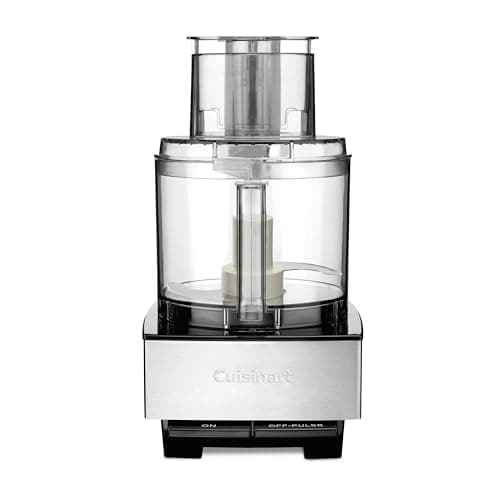 Cuisinart DFP-14BCNY (14-Cup) The 14-cup, 720-watt DFP-14 is the long-running benchmark: a big bowl, a strong motor, and a simple three-button interface that just works. It's the food processor most test kitchens keep on the counter. 14-Cup · 720W | Best overall food processor | 4.6★★★★★ | $229.95Amazon |
| 02 | 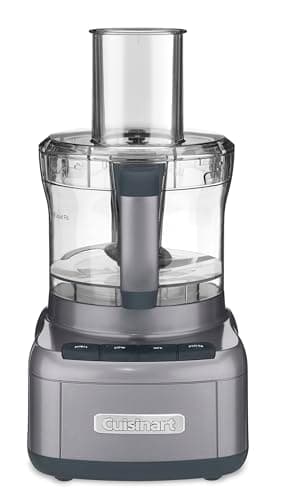 Cuisinart 8-Cup FP-8 The sensible middle of the Cuisinart line: an 8-cup bowl with measurement markings, a 350-watt motor, and a reversible shredding and slicing disc included — so unlike every mini here, it actually does the knife work, not just the chopping. 8 Cup · 350W | Best mid-size with discs | 4.2★★★★★ | $129.95Amazon |
| 03 | 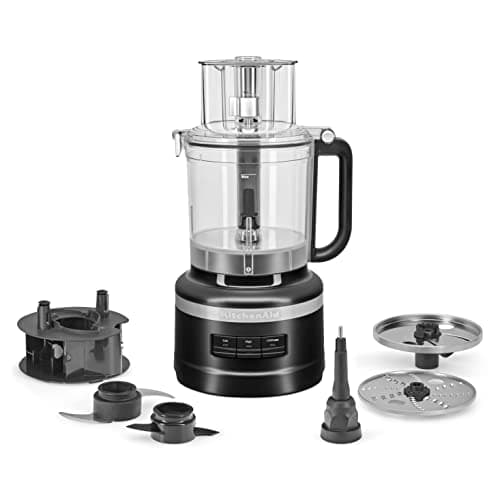 KitchenAid 13-Cup KitchenAid's 13-cup adds an adjustable slicing disc and a dicing kit that most rivals leave out, plus a 3-in-1 feed tube. If you want the machine to do more of the knife work, this is the pick. 13 Cup | Best for dicing | 4.3★★★★★ | Check price → |
#ad · Live prices from the Amazon Product API, as of October 17, 2026. Where we have no verified live price, we show none — a gap beats a number that has rotted.
The picks, in detail
Cuisinart DFP-14BCNY (14-Cup)
spec score /5
$299.9523% off
Price as of October 17, 2026. Prices change — Amazon's is the one that counts.
#ad · we may earn a commission from this link to Cuisinart DFP-14BCNY (14-Cup)
The 14-cup, 720-watt DFP-14 is the long-running benchmark: a big bowl, a strong motor, and a simple three-button interface that just works. It's the food processor most test kitchens keep on the counter.
- Capacity
- 14-Cup
- Footprint (W×D×H)
- 7.9 × 11 × 14.8 in
- Power
- 720 W
- Weight
- 18 lb
- Cost per use*
- ≈4¢
- Est. per year*
- ≈$8
- Warranty
- Warranty
- Big 14-cup bowl for batch prep
- 720 W handles dough and hard veg
- Simple, durable, long track record
- Large to store
- Only slicing/shredding + chopping blades included
- Feed tube pusher can be fiddly
*Cost-to-run computed from the manufacturer's stated 720W at $0.17/kWh (US average), 20-min sessions, 4×/week. Your rate and use will vary.
Cuisinart 8-Cup FP-8
spec score /5
Price as of October 17, 2026. Prices change — Amazon's is the one that counts.
#ad · we may earn a commission from this link to Cuisinart 8-Cup FP-8
The sensible middle of the Cuisinart line: an 8-cup bowl with measurement markings, a 350-watt motor, and a reversible shredding and slicing disc included — so unlike every mini here, it actually does the knife work, not just the chopping.
- Capacity
- 8 Cup
- Footprint (W×D×H)
- 9.58 × 7.6 × 15.19 in
- Power
- 350 W
- Weight
- 6 lb
- Cost per use*
- ≈2¢
- Est. per year*
- ≈$4
- Warranty
- Limited 2-year
- Reversible slicing/shredding disc in the box
- 8-cup bowl with measurement markings
- 2-year limited warranty
- 350 W is half the 14-cup DFP-14's motor
- Not for stiff bread dough
- Fewer discs than the KitchenAid 13-cup
*Cost-to-run computed from the manufacturer's stated 350W at $0.17/kWh (US average), 20-min sessions, 4×/week. Your rate and use will vary.
KitchenAid 13-Cup
spec score /5
No buyable offer at the last price check (October 17, 2026). We show nothing rather than a stale number.
#ad · we may earn a commission from this link to KitchenAid 13-Cup
KitchenAid's 13-cup adds an adjustable slicing disc and a dicing kit that most rivals leave out, plus a 3-in-1 feed tube. If you want the machine to do more of the knife work, this is the pick.
- Capacity
- 13 Cup
- Footprint (W×D×H)
- 10.25 × 8.7 × 17.43 in
- Weight
- 9.7 lb
- Warranty
- 1 Year
- Dicing kit and adjustable slicer included
- 3-in-1 feed tube
- Big 13-cup work bowl
- More parts to wash and store
- Pricier than a basic model
- Dicing kit takes practice
Some appliances are recommended because they are new. The DFP-14 is recommended because it has been the right answer for a very long time, and reviewing it is largely a matter of explaining why a design that has barely changed keeps winning.
Standard disclosure: a specification review from Cuisinart's published listing for the exact unit we link to, not a lab test. Method on how we review.
The specification
| Spec | Cuisinart DFP-14BCNY |
|---|---|
| Bowl | 14 cups |
| Motor | 720 W |
| Controls | On, and Off/Pulse |
| Feed tube | Extra-large, with bowl sleeve |
| Discs | Stainless slicing and shredding — not adjustable |
| Footprint (W × D) | 7.9 × 11 in |
| Height | 14.8 in |
| Weight | 18 lb |
| Warranty | Limited 3-year unit, full 5-year motor |
| Dishwasher-safe | Parts and accessories |
720 watts, and why wattage matters here
We spend a lot of time on this site telling people to ignore wattage. Food processors are the genuine exception, and it is worth explaining why.
A blender spins fast against liquid. A food processor grinds slowly against resistance — a bowl packed with hard carrots, a block of parmesan, a stiff pastry dough. That is a torque-at-low-speed problem, and it is exactly the load that stalls under-powered machines. Wattage is a reasonable proxy for it in a way it simply is not for blenders.
At 720 watts the DFP-14 has the highest published motor figure of any processor we track — roughly double the 350-watt machines in the budget tier and well clear of the 450-watt mid-range. Where you feel it is a full bowl of hard vegetables and stiff dough, not chopping an onion, which any processor manages.
The 18 lb weight is part of the same story. Mass is what stops a processor hopping when the blade catches something hard, and this is the heaviest machine in our guides by a wide margin. It is the least portable and the most planted.
Three buttons, and why that is the right number
On, and Off/Pulse. That is the whole interface.
It looks austere next to machines with speed dials and preset programs, and it is correct. Most food processing is done on pulse, because pulse is what gives you control over texture — the difference between chopped onion and onion purée is about four pulses. A responsive pulse button matters far more than a speed selector, and adding speeds to a processor mostly adds ways to get the wrong result.
The practical technique that follows: pulse in short bursts and look. Four one-second pulses give you chopped onion; ten seconds of continuous run gives you onion water, and there is no way back.
The warranty is structured unusually — and well
Cuisinart lists a limited 3-year warranty on the entire unit and a full 5-year warranty on the motor.
That split is more informative than a single figure. Bowls, lids and discs are the parts that get cracked, lost and worn, and three years is a fair term for them. The motor is the expensive, non-replaceable component, and five years — as a full warranty rather than a limited one — is the manufacturer stating what it expects the machine to survive.
For context, the KitchenAid 13-cup carries one year. That gap is a large part of why this machine has the reputation it does.
The discs are not adjustable, and that is a real limitation
The most important thing to know before buying, and Cuisinart states it plainly on the listing: the shredding and slicing blades are not adjustable. You get a stainless slicing disc and a shredding disc, each cutting at one fixed thickness.
For most cooking that is fine — you rarely need a specific millimeter. Where it bites is gratins, crisps and anything where slice thickness is the point of the dish. KitchenAid's 13-cup includes an adjustable slicing disc plus a dicing kit and a 3-in-1 feed tube, and if that knife work is why you want a processor at all, that is the machine — the full comparison is in Cuisinart vs. KitchenAid.
The counter-argument is that fewer parts means fewer things to wash, store and lose, and the DFP-14's simplicity is genuinely part of its longevity.
The extra-large feed tube saves the prep you bought it for
An under-rated spec. The feed tube is the chute you drop food down onto a disc, and its width determines how much cutting you have to do before the machine does the cutting. A narrow tube means halving and quartering every potato first, which eats into the time the processor was supposed to save.
The DFP-14's tube is extra-large with a bowl sleeve, taking whole or barely-trimmed vegetables. Over a batch of gratin potatoes that is the difference between a two-minute job and a ten-minute one.
Footprint: smaller than you would expect
A pleasant surprise, and counter-intuitive. Despite having the largest bowl here, the DFP-14 is 7.9 inches wide by 11 deep and 14.8 tall — narrower and shorter than the 13-cup KitchenAid, which is 10.25 × 8.7 and 17.43 inches tall.
That 14.8-inch height clears a standard 18-inch counter-to-cabinet gap with room to lift the lid, which the KitchenAid does not comfortably do. If your processor is going to live under a cabinet, this is a genuine advantage.
What it is not is storable. At 18 lb, this machine lives where you put it.
What a 14-cup machine is actually for
Worth being concrete, because "batch cooking" is vague and this is a big machine to buy on a vague premise.
Prep-day cooking.Slicing a bag of potatoes for a gratin, shredding a block of cheese, chopping a week's worth of onions, mirepoix for several batches of stock. Jobs where the bowl is genuinely full and a smaller machine means three goes.
Pastry in quantity. Rubbing butter into flour is the classic processor job — a few pulses does what fingertips take ten minutes to do, and does it better because the butter stays cold. A 14-cup bowl handles pastry for several pies at once.
Large-batch dips and spreads. Hummus, tapenade, nut butters and pesto for a crowd. The 720-watt motor and the mass matter here because nut butters in particular are a long, heavy, sustained load.
What it is notfor is a single onion. Using a 14-cup bowl for a small quantity gives you an uneven chop, because the food sits outside the blade's sweep — processors work best between about a third and two-thirds full. That is a genuine argument for owning a mini alongside rather than instead, and our mini food processor guide covers that class.
The honest cons
Non-adjustable discs — the main functional limitation, and the reason to consider a KitchenAid. Only two discs included, no dicing kit. 18 lb, so it is a permanent counter resident. A 14-cup bowl is oversized for small jobs— using it for one onion means the food sits outside the blade's sweep and comes out unevenly; that is a mini chopper job. The feed tube pusher can be fiddly until you get used to the pressure it wants. It is not a stand mixer — it will bring dough together but it develops gluten by shear rather than stretch, which suits pizza and pastry and not open-crumb bread.
Why this design has lasted
The DFP-14 is a genuinely old design still being sold, which in most categories would be a warning. Here it is the point.
Three things explain it. The interface has nothing to break — two mechanical buttons rather than a membrane panel or a touchscreen, and touchscreens are a common failure point on appliances that live near steam and wet hands. The parts are still made, because the design has not changed, so a cracked bowl or a lost disc after eight years is a purchase rather than a write-off. And the motor is over-specified for what most people ask of it, which is the simplest route to longevity there is.
That combination is why this machine turns up in professional-adjacent kitchens and why second-hand ones sell readily. It is also the honest counter-argument to buying the feature-rich alternative: more functions means more to go wrong, and this has almost nothing to go wrong.
Verdict
Buy the DFP-14 if you batch-cook, work with hard vegetables and stiff doughs, and want the machine most likely to still be running in fifteen years. The 720-watt motor, the 5-year motor warranty and the sheer mass are what a serious processor is, and the three-button interface is a feature rather than an omission.
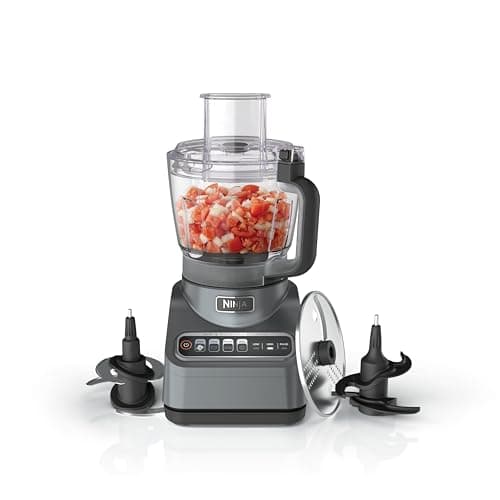
Buy the KitchenAid 13-cup if adjustable slicing and dicing are the reason you want a processor. Buy the Cuisinart 8-cup FP-8 if you cook for two to four and would rather have something storable with a reversible disc — it is our pick in best budget food processors. And if dough is a primary use, the Ninja BN601 includes a dedicated dough blade.
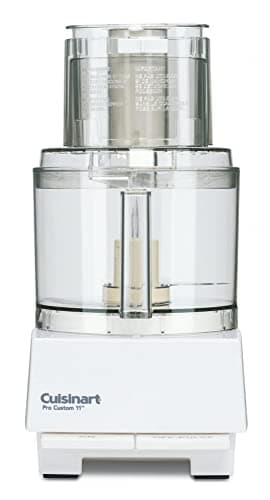
Staying inside the Cuisinart range, the closest thing to this machine is the 11-cup Pro Custom: 625 watts against the DFP-14's 720, on a footprint that differs by under an inch and a weight that differs by a single pound. Cuisinart food processors compared sets that trade out in full, along with the rest of the current line down to the 3-cup Mini-Prep.
One job worth calling out separately, because the listing buries it in a long feature string: the DFP-14 is the largest-bowl machine we track whose own listing names kneading dough as a designed function. If that is part of why you are buying, best food processors for dough puts it against the only two other processors we track that ship a dough blade.
Two details of this machine matter more than its cup rating if slicing is what you bought it for: the extra-large feed tube with both a large and a small pusher, which is what keeps a single carrot vertical instead of slicing on the diagonal, and the fact that Cuisinart's own listing states the 4mm slicing disc does not adjust. We rank it against the rest of the field on exactly those points in best food processors for slicing vegetables.
If you are weighing this against the rest of the big-bowl field rather than against a smaller Cuisinart, the comparison worth reading is best large food processors — which also covers why anyone searching for a 13-cup machine should buy 14 instead: the only 13-cup processor in the category has no buyable offer right now.
Frequently asked questions
Is the Cuisinart DFP-14 worth buying?
Yes, if you batch-cook or work with hard vegetables and stiff dough. Its 720-watt motor is the highest published figure we track, its 18 lb mass keeps it planted, and the warranty runs 3 years on the unit and a full 5 years on the motor.
Does food processor wattage actually matter?
More than it does for blenders, yes. A processor grinds slowly against resistance — hard carrots, parmesan, stiff pastry — which is a torque-at-low-speed problem, and that is the load that stalls under-powered machines. The DFP-14's 720 W is roughly double the budget tier.
Are the Cuisinart DFP-14 discs adjustable?
No — Cuisinart states plainly that the shredding and slicing blades are not adjustable. Each cuts at one fixed thickness. If you want to dial in slice thickness for gratins or crisps, KitchenAid's 13-cup includes an adjustable slicer and a dicing kit.
What is the Cuisinart DFP-14 warranty?
A limited 3-year warranty on the entire unit and a full 5-year warranty on the motor. That split is informative — three years covers the bowls, lids and discs that get worn or broken, while five years on the motor is the maker's statement about expected life.
Will the Cuisinart DFP-14 fit under my cabinets?
Probably, and better than you would expect for a 14-cup machine. It is 14.8 inches tall against a standard 18-inch counter-to-cabinet gap, leaving room to lift the lid — where the 13-cup KitchenAid at 17.43 inches does not comfortably.
Can the Cuisinart DFP-14 make bread dough?
It will bring dough together, and its 720-watt motor handles stiff mixtures better than lighter machines. But a processor develops gluten by shear in about a minute rather than by stretching over ten, so it suits pizza and pastry rather than open-crumb bread.
Sources
Keep reading
Food Processors
The Best Food Processors of 2026
Cuisinart 14-cup, KitchenAid 13-cup and a 3-cup mini compared on bowl size, power and discs.
Comparison
Cuisinart Food Processors Compared
The current Cuisinart line decoded — 14, 11, 8, 5 and 3 cups compared on motor, footprint, discs and warranty.
Comparison
Cuisinart vs. KitchenAid: Which Food Processor Wins?
Cuisinart vs KitchenAid food processors on bowl size, motor, included discs, dicing and footprint — and who each suits.
Review
Ninja Professional Plus BN601 Review
The Ninja BN601 on its 1,000-peak-watt motor, 9-cup bowl, Auto-iQ presets and the included dough blade.
Guide
How to Clean a Food Processor
The 60-second routine, safe blade handling, the parts people forget, and the habits that make a processor last.
Roundup
The Best Food Processors for Slicing Vegetables
Which processors ship a slicing disc, what thickness it cuts, and which feed tubes take a vegetable whole. Four picks, with the honest limits of each.
https://wattandwhisk.com/food-processors/cuisinart-dfp14-review