The Best Food Processors for Slicing Vegetables
The S-blade cannot slice anything. What decides this is the disc in the box, the one thickness it cuts, and whether a potato fits down the feed tube whole.
Disclosure:Watt & Whisk is reader-supported. When you buy through links on this page we may earn an Amazon Associates commission, at no extra cost to you. Prices are pulled live from Amazon and shown with the date checked. How this works.
A food processor slices with a disc that spins flat under the lid, never with the S-shaped blade in the bottom of the bowl, so the first question is whether a slicing disc is in the box at all — on several machines sold as food processors, it is not. Our pick is the Cuisinart DFP-14BCNY: a 4mm stainless slicing disc, an extra-large feed tube that takes whole produce with two pushers, a 720-watt motor and the largest bowl here at 14 cups. The Pro Custom 11 is the same extra-large tube and a 4mm medium slicing disc in a smaller, cheaper body; the Hamilton Beach 10-Cup is the least expensive machine here that genuinely slices; and the Cuisinart FP-8 is the only one with two slice grades on a reversible disc. One honest caveat up front: none of these discs adjusts. Prices below are pulled live from Amazon.
The short answer
Quick picks
| # | Product | Best for | Score | Price |
|---|---|---|---|---|
| 01 | 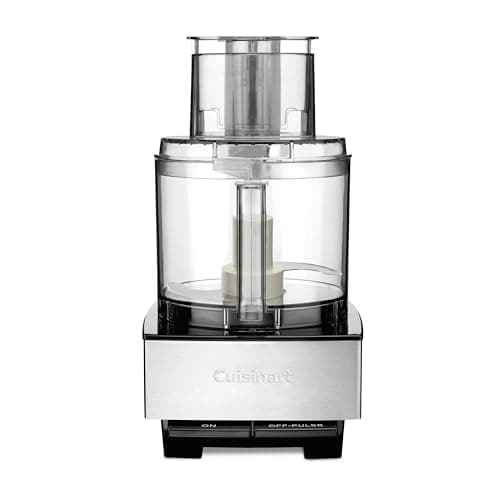 Cuisinart DFP-14BCNY (14-Cup) The 14-cup, 720-watt DFP-14 is the long-running benchmark: a big bowl, a strong motor, and a simple three-button interface that just works. It's the food processor most test kitchens keep on the counter. 14-Cup · 720W | Best overall food processor | 4.6★★★★★ | $229.95Amazon |
| 02 | 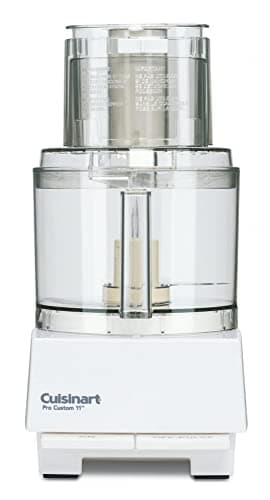 Cuisinart Pro Custom 11 (DLC-8SY) An 11-cup bowl on a 625-watt motor, with the chopping/mixing/dough blade, a medium shredding disc and a 4mm slicing disc all in the box — the closest thing Cuisinart makes to the 14-cup benchmark, for less money and, honestly, barely any less counter. 11 Cup · 625W | Best value full-size | 4.5★★★★★ | $199.95Amazon |
| 03 | 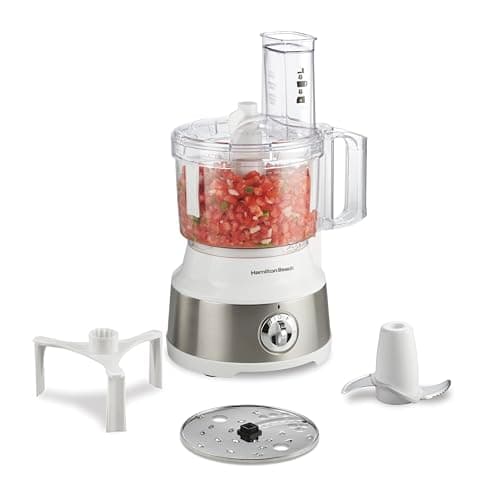 Hamilton Beach 10-Cup A 450-watt, 10-cup processor with the one feature nobody else at this price bothers with: a built-in bowl scraper you sweep side to side without stopping the machine or reaching for a spatula. Two speeds, pulse, suction feet, everything dishwasher-safe. 10 Cup · 450W | Best budget full-size | 4.1★★★★★ | $69.95Amazon |
| 04 | 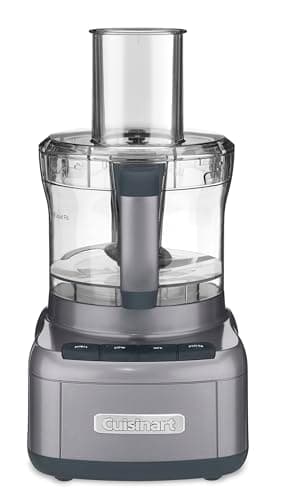 Cuisinart 8-Cup FP-8 The sensible middle of the Cuisinart line: an 8-cup bowl with measurement markings, a 350-watt motor, and a reversible shredding and slicing disc included — so unlike every mini here, it actually does the knife work, not just the chopping. 8 Cup · 350W | Best mid-size with discs | 4.2★★★★★ | $127.99Amazon |
#ad · Live prices from the Amazon Product API, as of October 13, 2026. Where we have no verified live price, we show none — a gap beats a number that has rotted.
Side by side
What each box actually contains
Read from each machine's own Amazon listing. Where a maker does not name a slicing disc, the cell says so rather than assuming one is included, and no feed-tube measurement is quoted because no maker publishes one.
| Model | Key specs | Slicing disc and feed tube, as published | Best for | Price |
|---|---|---|---|---|
| Cuisinart DFP-14BCNY (14-Cup) | 14-Cup720 W7.9 × 11 × 14.8 in | Stainless standard slicing disc at 4mm, plus a medium shredding disc and a detachable disc stem. Extra-large feed tube with a bowl sleeve and both a small and a large pusher. The listing states the discs are not adjustable. | Whole produce, biggest bowl | $229.95Check Price |
| Cuisinart Pro Custom 11 (DLC-8SY) | 11 Cup625 W11.25 × 7 × 14.5 in1-yr warranty | Medium slicing disc at 4mm, plus a stainless medium shredding disc, a detachable disc stem and small and large pushers. Extra-large feed tube the listing says holds whole fruits and vegetables. | Same tube, smaller footprint | $199.95Check Price |
| Hamilton Beach 10-Cup70733J | 10 Cup450 W10.25 × 8.43 × 15.47 in | One reversible slicing and shredding disc plus a stainless chopping blade. Large feed chute the listing credits with reducing the need to pre-cut, and a bowl scraper usable while the motor runs. | The cheapest machine that really slices | $69.95Check Price |
| Cuisinart 8-Cup FP-8FP-8GMP1 | 8 Cup350 W9.58 × 7.6 × 15.19 in2-yr warranty | Reversible shredding and slicing discs described as medium to fine, so two slice grades rather than one. Integrated feed tube for adding ingredients while it runs. | Two slice thicknesses, small body | $127.99Check Price |
#ad · we may earn a commission · Specs read from each manufacturer's Amazon listing; prices pulled live from the Amazon Product API, as of October 13, 2026. Where a maker publishes no figure (wattage, warranty term) we leave the cell empty rather than estimate one.
The picks, in detail
Cuisinart DFP-14BCNY (14-Cup)
spec score /5
$299.9523% off
Price as of October 13, 2026. Prices change — Amazon's is the one that counts.
#ad · we may earn a commission from this link to Cuisinart DFP-14BCNY (14-Cup)
The 14-cup, 720-watt DFP-14 is the long-running benchmark: a big bowl, a strong motor, and a simple three-button interface that just works. It's the food processor most test kitchens keep on the counter.
- Capacity
- 14-Cup
- Footprint (W×D×H)
- 7.9 × 11 × 14.8 in
- Power
- 720 W
- Weight
- 18 lb
- Cost per use*
- ≈4¢
- Est. per year*
- ≈$8
- Warranty
- Warranty
- Big 14-cup bowl for batch prep
- 720 W handles dough and hard veg
- Simple, durable, long track record
- Large to store
- Only slicing/shredding + chopping blades included
- Feed tube pusher can be fiddly
*Cost-to-run computed from the manufacturer's stated 720W at $0.17/kWh (US average), 20-min sessions, 4×/week. Your rate and use will vary.
Cuisinart Pro Custom 11 (DLC-8SY)
spec score /5
$219.959% off
Price as of October 13, 2026. Prices change — Amazon's is the one that counts.
#ad · we may earn a commission from this link to Cuisinart Pro Custom 11 (DLC-8SY)
An 11-cup bowl on a 625-watt motor, with the chopping/mixing/dough blade, a medium shredding disc and a 4mm slicing disc all in the box — the closest thing Cuisinart makes to the 14-cup benchmark, for less money and, honestly, barely any less counter.
- Capacity
- 11 Cup
- Footprint (W×D×H)
- 11.25 × 7 × 14.5 in
- Power
- 625 W
- Weight
- 17 lb
- Cost per use*
- ≈4¢
- Est. per year*
- ≈$7
- Warranty
- 1 Year Manufacturer
- 625 W — nearly the 14-cup's motor, well under its price
- Dough blade plus slicing and shredding discs included
- Extra-large feed tube takes whole fruit and vegetables
- Only ~1 lb and 0.3 in smaller than the 14-cup — it saves no shelf
- 4mm slicing disc is fixed, not adjustable
- Amazon's warranty field says 1 year; Cuisinart's own bullet on the same listing says 3-year limited plus 5-year motor
*Cost-to-run computed from the manufacturer's stated 625W at $0.17/kWh (US average), 20-min sessions, 4×/week. Your rate and use will vary.
Hamilton Beach 10-Cup
spec score /5
Price as of October 13, 2026. Prices change — Amazon's is the one that counts.
#ad · we may earn a commission from this link to Hamilton Beach 10-Cup
A 450-watt, 10-cup processor with the one feature nobody else at this price bothers with: a built-in bowl scraper you sweep side to side without stopping the machine or reaching for a spatula. Two speeds, pulse, suction feet, everything dishwasher-safe.
- Capacity
- 10 Cup
- Footprint (W×D×H)
- 10.25 × 8.43 × 15.47 in
- Power
- 450 W
- Weight
- 4.7 lb
- Cost per use*
- ≈3¢
- Est. per year*
- ≈$5
- Built-in bowl scraper — genuinely useful
- 10-cup bowl at a budget price
- Suction feet stop it walking on the counter
- 450 W is modest for stiff dough
- Two speeds only
- One-year limited warranty
*Cost-to-run computed from the manufacturer's stated 450W at $0.17/kWh (US average), 20-min sessions, 4×/week. Your rate and use will vary.
Cuisinart 8-Cup FP-8
spec score /5
Price as of October 13, 2026. Prices change — Amazon's is the one that counts.
#ad · we may earn a commission from this link to Cuisinart 8-Cup FP-8
The sensible middle of the Cuisinart line: an 8-cup bowl with measurement markings, a 350-watt motor, and a reversible shredding and slicing disc included — so unlike every mini here, it actually does the knife work, not just the chopping.
- Capacity
- 8 Cup
- Footprint (W×D×H)
- 9.58 × 7.6 × 15.19 in
- Power
- 350 W
- Weight
- 6 lb
- Cost per use*
- ≈2¢
- Est. per year*
- ≈$4
- Warranty
- Limited 2-year
- Reversible slicing/shredding disc in the box
- 8-cup bowl with measurement markings
- 2-year limited warranty
- 350 W is half the 14-cup DFP-14's motor
- Not for stiff bread dough
- Fewer discs than the KitchenAid 13-cup
*Cost-to-run computed from the manufacturer's stated 350W at $0.17/kWh (US average), 20-min sessions, 4×/week. Your rate and use will vary.
The blade in the bowl cannot slice
Every food processor ships with an S-shaped blade that sits over the drive shaft at the bottom of the bowl. That blade chops: it throws food around a closed bowl and cuts it on every pass, which is why processor-chopped onion comes out in irregular pieces and why a long run turns it to paste. It cannot produce a slice, because a slice requires food to pass a fixed cutting edge exactly once.
Slicing is done by a different part. A flat disc mounts high in the bowl, just under the lid, with a raised blade across its face and an opening beside it. Food is pressed down the feed tube onto the spinning disc, the blade shaves one slice off the bottom of it, and the slice falls through the opening into the bowl below. The thickness of the slice is the height of that blade above the disc face. Nothing else in the machine changes it — not the speed, not the motor, not how hard you press.
That single mechanical fact decides this whole page. The question is not which processor is most powerful; it is which one ships a slicing disc, what height that blade is set at, and how big a piece of food you can get down the tube to meet it.
A lot of machines sold as food processors cannot slice at all
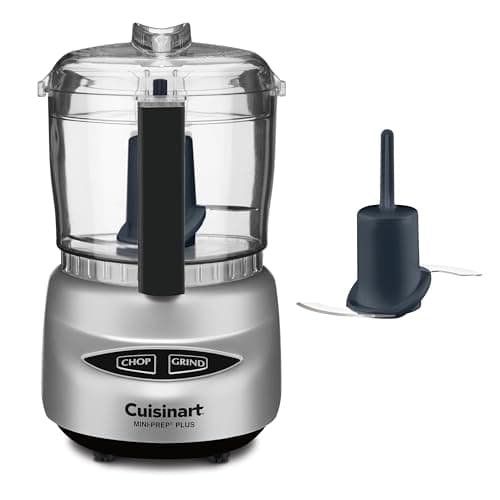
Of the nine food processors in our catalog, three are choppers with no disc of any kind: the Cuisinart Mini-Prep Plus, the BLACK+DECKER 3-Cup and the KitchenAid 3.5-Cup. They have a blade, a lid and no feed tube, so there is no path for food to reach a cutting edge one piece at a time. They are excellent at chopping herbs and grinding hard cheese and they are the right buy for a lot of people — just not for this. The format difference is the whole subject of food processor vs. chopper.
One more machine is a near miss and worth naming, because its listing makes it look like a contender. The Cuisinart 5-Cup Chop & Shred (FP-5) does have a wide-mouth feed tube and a reversible disc, but that disc switches between fine and medium shredding only. It will not slice. The name says so, and it is still the kind of detail that gets missed at checkout.
The Ninja Professional Plus BN601 is the other one we are not crediting. Its listing names slicing among its Auto-iQ preset programs and describes precision blades for chopping, slicing and pureeing, but the what-is-included list does not enumerate a slicing disc, and we do not assume a part that is not published. If you own one, check the box contents before you plan a gratin around it. The same caution applied in our food processors for shredding cheese roundup, which is the sibling question to this one: that page turns on the shredding disc, this one on the slicing disc, and they are genuinely different parts even when one reversible disc carries both.
Thickness is fixed, and that is the real limitation
Here is the thing nobody tells you before you buy. On almost every processor at this price, the slicing disc cuts one thickness, and that thickness is set in the metal.
- Cuisinart DFP-14BCNY— a 4mm standard slicing disc. Cuisinart's own listing carries an explicit note to the consumer that the shredding and slicing blades on this machine are not adjustable.
- Cuisinart Pro Custom 11 — a medium slicing disc, also 4mm.
- Cuisinart FP-8 — a reversible disc the listing describes as medium to fine, which is the only machine on this page offering two slice grades without buying another disc.
- Hamilton Beach 10-Cup — a reversible slicing and shredding disc. The listing names the two jobs rather than a measurement, so we do not print one.
Four millimeters is a useful, forgiving thickness. It is about right for potatoes for a gratin, for onions for a braise, for cabbage for slaw, for carrots and zucchini in bulk. It is noticeably thicker than you want for cucumber in a salad, for potato chips, for fennel you intend to eat raw, or for anything where translucency is the point. If those are the slices you are shopping for, read the next two sections before you spend anything.
The machine that solves this has no buyable offer right now
There is exactly one processor in our catalog with an externally adjustable slicing disc: the KitchenAid 13-Cup (KFP1318), whose listing names an Exact Slice disc adjustable from thick to thin with an external lever, plus a 3-in-1 feed tube sized for different ingredient shapes and an in-bowl caddy that stores the discs. On the spec sheet it is the right answer to this exact query.
We are not featuring it, because at the time of this check its listing had no buyable offer — no price returned through the retail API we use for every price on this site. We do not rank a machine you cannot put in a basket today, and we are not going to quote you a number for it. It is also worth knowing, if you do find one elsewhere, that KitchenAid publishes one yearof warranty on it and no wattage at all, against Cuisinart's limited 3-year with a full 5-year on the motor. The full lineup comparison is in Cuisinart vs. KitchenAid.
The honest consequence: if adjustable thickness is non-negotiable, the processors you can buy today from this list will not give it to you, and the next section is the cheaper answer.
The cheaper answer, said plainly
For thin, adjustable, visually perfect slices of one or two vegetables, a mandoline costs a fraction of any machine on this page and does it better. It has a dial, it goes thinner than 4mm, and there is no bowl, lid, disc stem or pusher to wash afterward. We would rather say that than sell you a 14-cup processor for a cucumber.
What a mandoline cannot do is volume. Five pounds of potatoes is minutes of careful, finger-risky work on a mandoline and well under a minute on any of the four machines below, with a pusher between your hand and the blade the whole time. That is the real trade: a mandoline is better per slice, a processor is better per pound. Buy the processor if you batch-cook, meal-prep, make slaw and gratins for a household, or prep vegetables for a freezer; buy the mandoline if you are making a salad.
The feed tube decides whether the slices are round
A slice can only be as wide as the opening it came down. Put a whole potato down a wide tube and you get full round slices. Put the same potato down a narrow tube and you have to halve or quarter it first, so you get half-moons and wedges instead — fine for a stew, wrong for a gratin or a potato bake where the slices sit in overlapping rows.
No manufacturer in this category publishes a feed-tube measurement, which we found when building the shredding roundup and is still true here. What they publish is adjectives, so adjectives are what we quote: Cuisinart calls the tube on both the DFP-14 and the Pro Custom 11 extra-large, and says the Pro Custom 11's holds whole fruits and vegetables. Hamilton Beach calls its chute largeand credits it with reducing the need to pre-cut. Cuisinart describes the FP-8's as an integrated feed tube for adding ingredients during processing, which is a different and smaller thing — it is sized for feeding, not for loading a whole vegetable.
Both big Cuisinarts also ship two pushers, a large one for the full tube and a small one that drops inside it. That small pusher is what keeps a single carrot upright and vertical instead of toppling and slicing on the diagonal. It is a small part that makes a visible difference to the result, and it is the reason the two extra-large-tube machines take the top two slots here.
Bowl size matters more for slicing than for anything else
Chopping is a batch job: you put food in, you run it, you take it out. Slicing is continuous — food goes in the top and keeps coming out into the bowl until the bowl is full, and then you stop, unlock the lid, lift the disc out, empty the bowl and reassemble. Every one of those stops is the real time cost of slicing five pounds of anything.
So the capacity ladder here is a stops-per-job ladder: DFP-14 at 14 cups, Pro Custom 11 at 11, Hamilton Beach at 10, FP-8 at 8. Sliced vegetables are also loose and airy in a way chopped ones are not, so a bowl fills faster with slices than its cup rating suggests. If you are buying for volume, buy the bowl. If you are not, the smaller machines are easier to store and faster to wash, which is the argument what size food processor do I need works through in full.
Why wattage barely matters on this job
Slicing is the lightest load a food processor ever handles. The disc is shaving a few millimeters off a vegetable at a time, which is nothing next to kneading a stiff dough or grinding hard cheese. The published figures across the picks are 720 W on the DFP-14, 625 W on the Pro Custom 11, 450 W on the Hamilton Beach and 350 W on the FP-8, and every one of them is comfortably more than this job needs.
Per cup of bowl that works out at roughly 51, 57, 45 and 44 watts, and we are showing the math mainly to make the point that the ranking it produces is not the ranking on this page. Wattage is the spec that decides food processors for dough, where only three machines we track even ship a dough blade. For slicing, the disc and the tube decide it and the motor is a non-issue.
Two things worth knowing before the first run
- Never push food with your hand.The pusher is not a convenience. The disc is a blade spinning an inch below the top of the tube, and it does not stop when the lid is open on every model. Use the pusher every time, including for the last inch of a carrot, and accept that the final stub is a cook's snack rather than a slice.
- The disc stem is the part people lose. On both big Cuisinarts the slicing disc mounts on a detachable stem, which is a genuine cleaning advantage and also a small separate component that goes missing in a drawer. Store it inside the bowl. If it does disappear, it is a stocked spare part rather than a dead machine — which is the broader point of how long do food processors last.
Who should buy which
Buy the Cuisinart DFP-14BCNY if you slice in quantity and want whole produce to go down the tube: the biggest bowl here, both pushers, and the longest motor cover of any machine on the page. Buy the Pro Custom 11 if you want that same extra-large tube and the same disc thickness in a smaller, cheaper body and can live with three fewer cups — our Cuisinart lineup comparison sets the two side by side, including the warranty wording Cuisinart and Amazon state differently on the 11-cup.
Buy the Hamilton Beach 10-Cup if you want the cheapest machine that honestly slices; it gives up the second pusher and publishes no warranty term, but it has a large chute, a bowl scraper you can work while it runs, and 10 cups for a budget price. Buy the Cuisinart FP-8 if two slice grades matter more to you than bowl size — it is the only machine here that gives you a second thickness without buying a disc, and it has the smallest footprint of the four.
If you are not yet sure a processor is the machine you need at all, are food processors worth it is the honest version of that question, and blender vs. food processor settles the one substitution people most often try to make — and best blenders for nut butter is the one recipe where the wide flat bowl beats a tall jar, which is the same geometry argument this page makes about slicing. When the slicing is done, how to clean a food processor covers the disc and the lid, which are the two parts that actually take the time.
Frequently asked questions
Can every food processor slice vegetables?
No. Slicing needs a flat disc that mounts under the lid and a feed tube to press food onto it, and plenty of machines sold as food processors have neither. Of the nine we track, three are choppers with a blade and no disc at all, and one more ships a reversible disc that only shreds. Check the what-is-included list for a slicing disc before you buy for this job.
Can you adjust the slice thickness on a food processor?
On most of them, no. The thickness is the height of the blade above the disc face, so it is fixed in the metal: both big Cuisinarts cut at 4mm and Cuisinart's own listing states the discs are not adjustable. The Cuisinart FP-8's reversible disc gives two grades, medium and fine. The only externally adjustable disc in our catalog is KitchenAid's Exact Slice on the 13-cup, which had no buyable offer at our last check.
What thickness does a standard slicing disc cut?
4mm on the Cuisinart machines we track, which both list a 4mm slicing disc. That is a good general-purpose thickness for potatoes, onions, cabbage, carrots and zucchini, and it is thicker than most people want for cucumber, raw fennel or potato chips. Makers who do not publish a figure, like Hamilton Beach, describe the disc by job instead, so we quote the job rather than invent a measurement.
Is a mandoline better than a food processor for slicing?
Per slice, yes: a mandoline adjusts, goes thinner, and has nothing to wash afterward. Per pound, no: five pounds of potatoes is slow and finger-risky on a mandoline and under a minute in a processor, with a pusher between your hand and the blade the whole time. Buy the mandoline for a salad, the processor for batch cooking.
Does a bigger food processor slice better?
It slices longer before you have to stop. Slicing is continuous rather than batched, so the bowl fills while the machine runs and every emptying is a full disassembly. Sliced vegetables are also loose and airy, so bowls fill faster than their cup rating suggests. A 14-cup bowl is fewer stops per job than an 8-cup, which is the main practical difference.
Why are my food processor slices not round?
Almost always the feed tube. A slice can only be as wide as the opening it came down, so a vegetable you had to halve or quarter to fit comes out as half-moons or wedges. The fix is a machine with an extra-large tube that takes produce whole, plus the small inner pusher that keeps a single carrot vertical instead of letting it topple and slice on the diagonal.
Do you need a powerful motor to slice vegetables?
No. Slicing is the lightest load a processor handles, since the disc shaves a few millimeters at a time. Our picks publish 720, 625, 450 and 350 watts and all four are more than sufficient. Wattage matters for dough and hard cheese, not for slicing, so pick on the disc and the feed tube instead.
Keep reading
Food Processors
The Best Food Processors of 2026
Cuisinart 14-cup, KitchenAid 13-cup and a 3-cup mini compared on bowl size, power and discs.
Roundup
Best Food Processors for Shredding Cheese
Shredding needs a disc, not a chopping blade. The machines that publish a shredding disc in the box, ranked, with the one honest exception.
Guide
What Size Food Processor Do I Need?
3 to 14 cups mapped to real jobs, why minis can't slice, and the footprint and weight each size costs.
Comparison
Food Processor vs. Chopper
The feed tube and the discs are the real dividing line — plus which one fits in a cupboard and which one lives on the counter.
Comparison
Cuisinart Food Processors Compared
The current Cuisinart line decoded — 14, 11, 8, 5 and 3 cups compared on motor, footprint, discs and warranty.
Roundup
The Best Food Processors for Dough
Pizza, bread and pastry dough in a processor: which machines ship a dough blade, and how much flour each bowl really takes.
Review
Cuisinart DFP-14 Review
The Cuisinart DFP-14 on its 720 W motor, 14-cup bowl, warranty split and the discs it deliberately does not adjust.
https://wattandwhisk.com/food-processors/best-food-processors-for-slicing-vegetables