Food Processor vs. Chopper
It is not a size difference. A chopper cannot slice or shred at any price, and a full-size processor cannot chop a tablespoon of garlic.
Disclosure:Watt & Whisk is reader-supported. When you buy through links on this page we may earn an Amazon Associates commission, at no extra cost to you. Prices are pulled live from Amazon and shown with the date checked. How this works.
A chopper is a bowl, one blade and a lid: it chops, and that is the whole job. A food processor adds a feed tube and slicing and shredding discs, which is a capability a chopper does not have at any size or price. If you want herbs, garlic, nuts and small batches of salsa, buy a 3-cup chopper like the Cuisinart Mini-Prep Plus and keep it in a cupboard. If you want to shred a block of cheese or slice a cucumber evenly, you need a processor with discs — the 8-cup Cuisinart FP-8 is the smallest machine here that does it. Prices below are pulled live from Amazon.
The short answer
Quick picks
| # | Product | Best for | Score | Price |
|---|---|---|---|---|
| 01 | 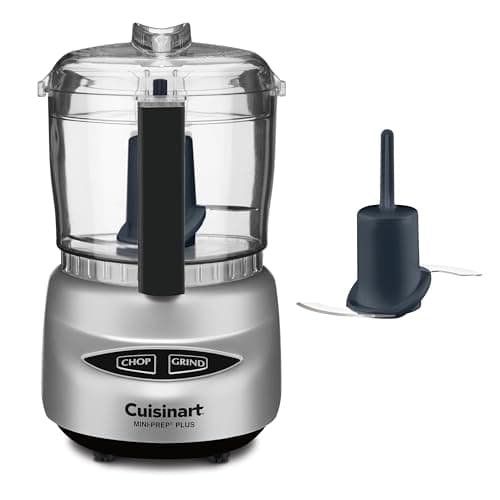 Cuisinart Mini-Prep Plus A 3-cup, 250-watt chopper that lives in a cabinet and comes out for pesto, dressings, nuts, and a single onion. For small kitchens that don't need a 14-cup monster, it does 80% of the jobs at a fraction of the size. 3 Cup · 250W | Best mini / small kitchen | 4.1★★★★★ | $39.95Amazon |
| 02 | 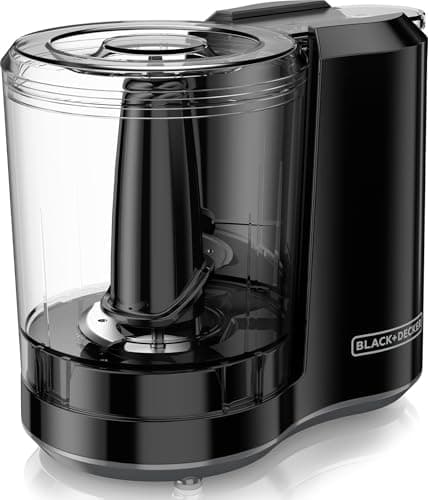 BLACK+DECKER 3-Cup Chopper A one-touch, 3-cup chopper with bi-level stainless blades and oil holes in the lid so you can stream oil into a vinaigrette or hummus while it runs. At 1.8 lb and 7 inches tall it costs about as much as a decent chef's knife and does the boring 80% of prep. 3 cup | Cheapest useful chopper | 3.8★★★★★ | $25.99Amazon |
| 03 | 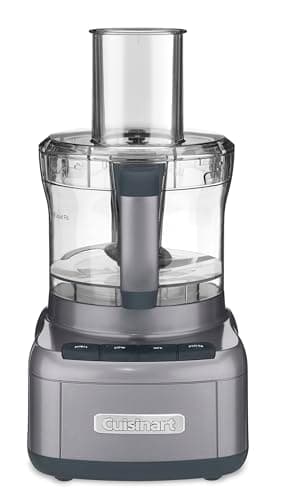 Cuisinart 8-Cup FP-8 The sensible middle of the Cuisinart line: an 8-cup bowl with measurement markings, a 350-watt motor, and a reversible shredding and slicing disc included — so unlike every mini here, it actually does the knife work, not just the chopping. 8 Cup · 350W | Best mid-size with discs | 4.2★★★★★ | $124.95Amazon |
| 04 | 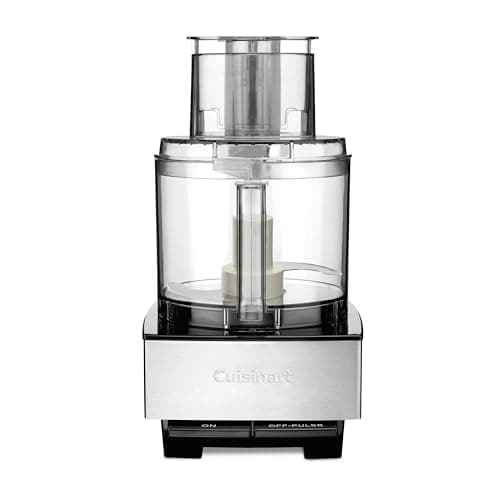 Cuisinart DFP-14BCNY (14-Cup) The 14-cup, 720-watt DFP-14 is the long-running benchmark: a big bowl, a strong motor, and a simple three-button interface that just works. It's the food processor most test kitchens keep on the counter. 14-Cup · 720W | Best overall food processor | 4.6★★★★★ | $249.95Amazon |
#ad · Live prices from the Amazon Product API, as of Sep 17, 2026. Where we have no verified live price, we show none — a gap beats a number that has rotted.
The picks, in detail
Cuisinart Mini-Prep Plus
spec score /5
Price as of Sep 17, 2026. Prices change — Amazon's is the one that counts.
#ad · we may earn a commission from this link to Cuisinart Mini-Prep Plus
A 3-cup, 250-watt chopper that lives in a cabinet and comes out for pesto, dressings, nuts, and a single onion. For small kitchens that don't need a 14-cup monster, it does 80% of the jobs at a fraction of the size.
- Capacity
- 3 Cup
- Footprint (W×D×H)
- 7 × 5 × 9.25 in
- Power
- 250 W
- Weight
- 2.2 lb
- Cost per use*
- ≈1¢
- Est. per year*
- ≈$3
- Warranty
- 18 months
- Tiny — stores in a cabinet
- Perfect for herbs, nuts, dressings
- Very inexpensive
- 3 cups is small
- Chop/grind only — no slicing disc
- Not for big batches
*Cost-to-run computed from the manufacturer's stated 250W at $0.17/kWh (US average), 20-min sessions, 4×/week. Your rate and use will vary.
BLACK+DECKER 3-Cup Chopper
spec score /5
Price as of Sep 17, 2026. Prices change — Amazon's is the one that counts.
#ad · we may earn a commission from this link to BLACK+DECKER 3-Cup Chopper
A one-touch, 3-cup chopper with bi-level stainless blades and oil holes in the lid so you can stream oil into a vinaigrette or hummus while it runs. At 1.8 lb and 7 inches tall it costs about as much as a decent chef's knife and does the boring 80% of prep.
- Capacity
- 3 cup
- Footprint (W×D×H)
- 5 × 6.5 × 7 in
- Weight
- 1.8 lb
- Oil holes for emulsifying dressings and hummus
- 1.8 lb, 7 in tall — genuinely pocket-sized for a cabinet
- Cheapest pick in this guide
- One-touch only — no speed or pulse control
- 3-cup bowl fills fast
- No published warranty on the listing
Cuisinart 8-Cup FP-8
spec score /5
Price as of Sep 17, 2026. Prices change — Amazon's is the one that counts.
#ad · we may earn a commission from this link to Cuisinart 8-Cup FP-8
The sensible middle of the Cuisinart line: an 8-cup bowl with measurement markings, a 350-watt motor, and a reversible shredding and slicing disc included — so unlike every mini here, it actually does the knife work, not just the chopping.
- Capacity
- 8 Cup
- Footprint (W×D×H)
- 9.58 × 7.6 × 15.19 in
- Power
- 350 W
- Weight
- 6 lb
- Cost per use*
- ≈2¢
- Est. per year*
- ≈$4
- Warranty
- Limited 2-year
- Reversible slicing/shredding disc in the box
- 8-cup bowl with measurement markings
- 2-year limited warranty
- 350 W is half the 14-cup DFP-14's motor
- Not for stiff bread dough
- Fewer discs than the KitchenAid 13-cup
*Cost-to-run computed from the manufacturer's stated 350W at $0.17/kWh (US average), 20-min sessions, 4×/week. Your rate and use will vary.
Cuisinart DFP-14BCNY (14-Cup)
spec score /5
$299.9517% off
Price as of Sep 17, 2026. Prices change — Amazon's is the one that counts.
#ad · we may earn a commission from this link to Cuisinart DFP-14BCNY (14-Cup)
The 14-cup, 720-watt DFP-14 is the long-running benchmark: a big bowl, a strong motor, and a simple three-button interface that just works. It's the food processor most test kitchens keep on the counter.
- Capacity
- 14-Cup
- Footprint (W×D×H)
- 7.9 × 11 × 14.8 in
- Power
- 720 W
- Weight
- 18 lb
- Cost per use*
- ≈4¢
- Est. per year*
- ≈$8
- Warranty
- Warranty
- Big 14-cup bowl for batch prep
- 720 W handles dough and hard veg
- Simple, durable, long track record
- Large to store
- Only slicing/shredding + chopping blades included
- Feed tube pusher can be fiddly
*Cost-to-run computed from the manufacturer's stated 720W at $0.17/kWh (US average), 20-min sessions, 4×/week. Your rate and use will vary.
The real difference is the feed tube, not the bowl
Almost every comparison of these two machines frames it as big versus small. That is the least useful way to think about it, because it implies a chopper is a processor with less room — as though buying a bigger chopper would eventually get you a processor. It would not.
Look at what actually comes in each box. The BLACK+DECKER HC300B ships a 3-cup bowl and bi-level stainless blades. The Cuisinart Mini-Prep Plus ships a 24-ounce work bowl and one reversible stainless blade with a sharp edge on one side and a blunt edge on the other. In both cases the lid is a lid. Now look at the Cuisinart FP-8: an 8-cup bowl, an integrated feed tube, and reversible shredding and slicing discs, medium to fine. The Cuisinart DFP-14 adds an extra-large feed tube with a bowl sleeve and both small and large pushers, a 4 mm slicing disc and a medium shredding disc.
That feed tube is the whole architecture. Discs sit at the top of the bowl and spin under an opening you push food through, so the machine processes a continuous stream and stacks the output underneath. A chopper has no opening and nowhere for a disc to sit, so it can only work on what you put in before you close the lid. A chopper will never slice a potato, shred a carrot or grate a block of cheddar. That is the line, and it does not move.
What a chopper genuinely does better
This is not a page arguing you should buy the bigger machine. On its own jobs a chopper is the better tool, and a 14-cup processor is actively bad at them.
A large bowl needs a certain volume of food for the blade to catch anything. Put two garlic cloves and a handful of parsley in a 14-cup bowl and centrifugal force pins them to the wall, above the blade, where they sit untouched while you pulse and scrape and pulse again. In a 3-cup bowl the same ingredients stay in the blade's path. If most of your prep is aromatics, nuts, breadcrumbs, a small pesto or a single-jar salsa, the small machine is simply correct.
The Mini-Prep Plus adds one detail worth knowing about: its blade is auto-reversing, with a sharp edge for chopping and a blunt edge for grinding. That is a genuine answer to hard cheese and spices, which a single sharp blade handles poorly. The BLACK+DECKER answers a different problem — its lid has oil holes, so you can stream oil into a hummus or a vinaigrette while it runs without stopping to lift the lid. Neither feature exists on the full-size machines.
Where the chopper hits its wall
Three jobs, and you will hit all three eventually if you cook a lot:
- Anything sliced or shredded. Covered above. No disc, no feed tube, no chance.
- Volume. A 3-cup bowl is about 24 ounces of total space and realistically half that of food. Coleslaw for six, a batch of soup base or a family quantity of salsa means three or four rounds of load, pulse, empty, scrape.
- Dough. No chopper ships a dough blade and none has the bowl for it. If that is on your list, start at best food processors for dough instead — only three of the machines we track can do it at all.
Height decides where each one lives, and that decides whether you use it
The single most reliable predictor of whether a countertop appliance gets used is whether it has a home. Published heights make the split obvious:
- BLACK+DECKER HC300B — 5 × 6.5 in footprint, 7 in tall, 1.8 lb
- Cuisinart Mini-Prep Plus — 7 × 5 in footprint, 9.25 in tall, 2.2 lb
- Cuisinart FP-8 — 9.58 × 7.6 in footprint, 15.19 in tall, 6 lb
- Cuisinart DFP-14 — 7.9 × 11 in footprint, 14.8 in tall, 18 lb
Both choppers fit in a cupboard and weigh about as much as a bag of sugar, so getting one out is not a decision. Both processors are counter residents: 15 inches is tall enough to matter under a standard cabinet, and 18 lb of Cuisinart is not something you lift down for one onion. Note also that the 8-cup machine is taller than the 14-cup one, which is the opposite of what the cup counts suggest — the same quirk we found across the Cuisinart line in Cuisinart food processors compared.
Power: what 250 watts is and is not
The Mini-Prep Plus publishes 250 watts, the FP-8 publishes 350 and the DFP-14 publishes 720. Read those against bowl size rather than in isolation and the small machine looks different: 250 watts across 3 cups is about 83 watts per cup, the highest ratio of any machine we track, against 44 for the 8-cup and 51 for the 14-cup. A chopper is not underpowered for its bowl. It is the most densely powered thing in the category.
BLACK+DECKER publishes no wattage for the HC300B at all, and we are not going to estimate one. What its listing does publish is the blade design and the 3-cup capacity, and at this price that is the honest basis for a decision.
Warranty is the real tiebreaker at the bottom
When two machines do the same job for under fifty dollars, the length of cover is the clearest signal the maker gives you about expected life. Cuisinart publishes a limited 18-month warranty on the Mini-Prep Plus and states it is BPA-free. BLACK+DECKER publishes no warranty term on the HC300B listing. Up the range, Cuisinart publishes a limited 2-year on the FP-8 and 3 years on the unit with 5 years on the motor for the DFP-14. That ladder — 18 months, 2 years, 3 plus 5 — tracks the price ladder closely, and it is the most honest thing on any of these listings.
If you can only buy one
Buy the processor, but buy it knowing what you are giving up. A mid-size processor does every chopper job badly-but-adequately and every processor job properly; a chopper does a narrow set of jobs well and the rest not at all. The 8-cup FP-8 is the smallest machine that gets you discs and a feed tube, and at 15.19 inches it is the one most likely to fit under a cabinet.
The pairing most serious home cooks end up with is a full-size processor for prep plus a 3-cup chopper for aromatics, because the two do not overlap much in practice. That is two machines and two homes for them, which is exactly the counter-space question we work through in the small-kitchen hub. If you are still deciding between a processor and a blender rather than a processor and a chopper, that is a different and more common mix-up — see blender vs. food processor.
Who should buy what
Buy the Cuisinart Mini-Prep Plus if you chop herbs, garlic, nuts and hard cheese and want it done in a machine you can rinse in ten seconds. The reversing sharp/blunt blade is the feature that justifies the price over the cheapest choppers, and 18 months of cover is more than the category norm at this money.
Buy the BLACK+DECKER HC300B if you want the cheapest genuinely useful version of that. Three cups, 7 inches tall, one touch, and oil holes for dressings — with no published wattage or warranty term, which is what you accept at this price.
Buy the Cuisinart FP-8 if shredding cheese or slicing vegetables is on the list and you want the smallest machine that does it. Buy the Cuisinart DFP-14 if you cook in family quantities, want the extra-large feed tube, or want dough capability as well. Sizing across the whole range is laid out in what size food processor do I need, and the smallest end of the field is ranked head-to-head in best mini food processors.
Frequently asked questions
What is the difference between a food processor and a chopper?
A chopper is a bowl, one blade and a sealed lid, so it can only chop what you load before you close it. A food processor adds a feed tube and slicing and shredding discs, which lets it process a continuous stream of food. A chopper cannot slice or shred at any size or price.
Can a food processor replace a mini chopper?
Functionally yes, practically not well. A large bowl needs volume for the blade to catch anything, so two garlic cloves in a 14-cup bowl get flung against the wall above the blade. Many cooks keep both, because the jobs barely overlap.
Is a 3-cup chopper big enough?
For herbs, garlic, nuts, breadcrumbs, a small pesto or one jar of salsa, yes. For coleslaw for six, a soup base or family-sized batches it means three or four rounds of load, pulse and empty. Three cups is about 24 ounces of space and realistically half that of food.
Are mini choppers underpowered?
Not for their bowl. The Cuisinart Mini-Prep Plus publishes 250 watts across 3 cups, about 83 watts per cup — the highest ratio of any machine we track, against 44 for an 8-cup and 51 for a 14-cup. Power per cup is what matters, not the raw number.
Which is better for hummus, a chopper or a food processor?
Either works. A chopper with oil holes in the lid, like the BLACK+DECKER HC300B, lets you stream oil in while it runs, which is the part that matters for texture. Choose on batch size: one jar suits a 3-cup chopper, a party quantity suits an 8-cup processor or larger.
Do choppers come with slicing discs?
No. Discs need a feed tube to push food through and a place to sit at the top of the bowl, and choppers have neither. If you want to shred cheese or slice vegetables, you need a food processor.
Sources
Keep reading
Food Processors
The Best Food Processors of 2026
Cuisinart 14-cup, KitchenAid 13-cup and a 3-cup mini compared on bowl size, power and discs.
Roundup
The Best Mini Food Processors
Four mini choppers ranked on bowl size, footprint, warranty and capability — plus what a mini genuinely cannot do.
Guide
What Size Food Processor Do I Need?
3 to 14 cups mapped to real jobs, why minis can't slice, and the footprint and weight each size costs.
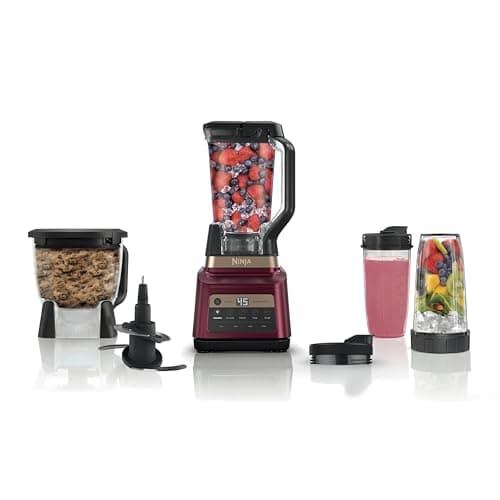
Comparison
Blender vs. Food Processor: Which Do You Actually Need?
The honest line between a blender and a food processor, which to buy first, and when a combo machine is the right answer.
Roundup
The Best Food Processors for Dough
Pizza, bread and pastry dough in a processor: which machines ship a dough blade, and how much flour each bowl really takes.
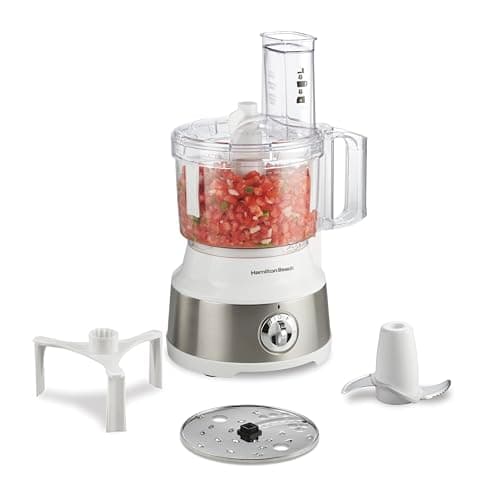
Guide
Are Food Processors Worth It?
What a food processor does that nothing else can, the real cleaning cost, and who genuinely should not buy one.
https://wattandwhisk.com/food-processors/food-processor-vs-chopper