Are Food Processors Worth It?
The most capable and least used appliance in most kitchens. The reason is washing up, and it is worth understanding before you buy.
Disclosure:Watt & Whisk is reader-supported. When you buy through links on this page we may earn an Amazon Associates commission, at no extra cost to you. Prices are pulled live from Amazon and shown with the date checked. How this works.
Worth it if you regularly slice, shred or make dough — a machine turns twenty minutes of knife work into thirty seconds, and no blender or mixer can do those jobs at all. Genuinely not worth it if you cook for one or two, chop small quantities, or hate washing up: a full-size processor has a bowl, lid, plunger, blade and disc to clean every time, and that friction is why so many end up unused. For small jobs a 3-cup mini at under 3 lb is the better buy.
The short answer
Quick picks
| # | Product | Best for | Score | Price |
|---|---|---|---|---|
| 01 | 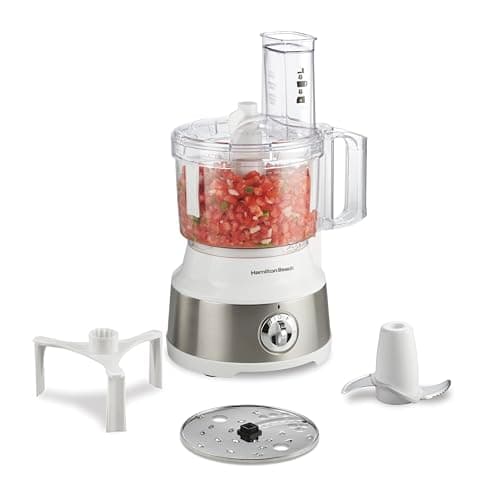 Hamilton Beach 10-Cup A 450-watt, 10-cup processor with the one feature nobody else at this price bothers with: a built-in bowl scraper you sweep side to side without stopping the machine or reaching for a spatula. Two speeds, pulse, suction feet, everything dishwasher-safe. 10 Cup · 450W | Best budget full-size | 4.1★★★★★ | $69.95Amazon |
| 02 | 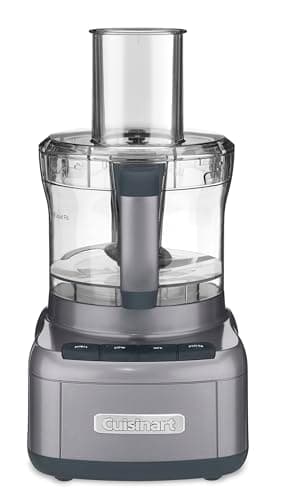 Cuisinart 8-Cup FP-8 The sensible middle of the Cuisinart line: an 8-cup bowl with measurement markings, a 350-watt motor, and a reversible shredding and slicing disc included — so unlike every mini here, it actually does the knife work, not just the chopping. 8 Cup · 350W | Best mid-size with discs | 4.2★★★★★ | $129.95Amazon |
| 03 | 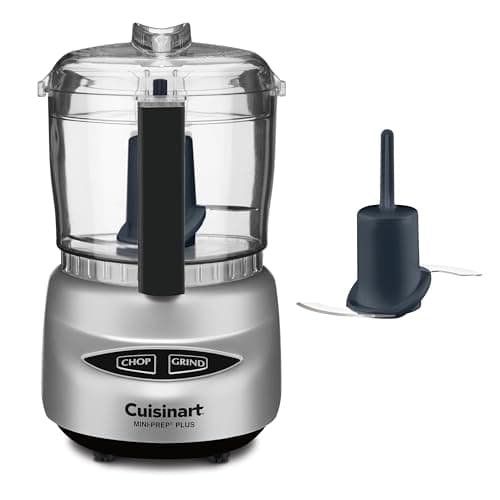 Cuisinart Mini-Prep Plus A 3-cup, 250-watt chopper that lives in a cabinet and comes out for pesto, dressings, nuts, and a single onion. For small kitchens that don't need a 14-cup monster, it does 80% of the jobs at a fraction of the size. 3 Cup · 250W | Best mini / small kitchen | 4.1★★★★★ | $29.29Amazon |
#ad · Live prices from the Amazon Product API, as of October 17, 2026. Where we have no verified live price, we show none — a gap beats a number that has rotted.
The picks, in detail
Hamilton Beach 10-Cup
spec score /5
Price as of October 17, 2026. Prices change — Amazon's is the one that counts.
#ad · we may earn a commission from this link to Hamilton Beach 10-Cup
A 450-watt, 10-cup processor with the one feature nobody else at this price bothers with: a built-in bowl scraper you sweep side to side without stopping the machine or reaching for a spatula. Two speeds, pulse, suction feet, everything dishwasher-safe.
- Capacity
- 10 Cup
- Footprint (W×D×H)
- 10.25 × 8.43 × 15.47 in
- Power
- 450 W
- Weight
- 4.7 lb
- Cost per use*
- ≈3¢
- Est. per year*
- ≈$5
- Built-in bowl scraper — genuinely useful
- 10-cup bowl at a budget price
- Suction feet stop it walking on the counter
- 450 W is modest for stiff dough
- Two speeds only
- One-year limited warranty
*Cost-to-run computed from the manufacturer's stated 450W at $0.17/kWh (US average), 20-min sessions, 4×/week. Your rate and use will vary.
Cuisinart 8-Cup FP-8
spec score /5
Price as of October 17, 2026. Prices change — Amazon's is the one that counts.
#ad · we may earn a commission from this link to Cuisinart 8-Cup FP-8
The sensible middle of the Cuisinart line: an 8-cup bowl with measurement markings, a 350-watt motor, and a reversible shredding and slicing disc included — so unlike every mini here, it actually does the knife work, not just the chopping.
- Capacity
- 8 Cup
- Footprint (W×D×H)
- 9.58 × 7.6 × 15.19 in
- Power
- 350 W
- Weight
- 6 lb
- Cost per use*
- ≈2¢
- Est. per year*
- ≈$4
- Warranty
- Limited 2-year
- Reversible slicing/shredding disc in the box
- 8-cup bowl with measurement markings
- 2-year limited warranty
- 350 W is half the 14-cup DFP-14's motor
- Not for stiff bread dough
- Fewer discs than the KitchenAid 13-cup
*Cost-to-run computed from the manufacturer's stated 350W at $0.17/kWh (US average), 20-min sessions, 4×/week. Your rate and use will vary.
Cuisinart Mini-Prep Plus
spec score /5
$39.9527% off
Price as of October 17, 2026. Prices change — Amazon's is the one that counts.
#ad · we may earn a commission from this link to Cuisinart Mini-Prep Plus
A 3-cup, 250-watt chopper that lives in a cabinet and comes out for pesto, dressings, nuts, and a single onion. For small kitchens that don't need a 14-cup monster, it does 80% of the jobs at a fraction of the size.
- Capacity
- 3 Cup
- Footprint (W×D×H)
- 7 × 5 × 9.25 in
- Power
- 250 W
- Weight
- 2.2 lb
- Cost per use*
- ≈1¢
- Est. per year*
- ≈$3
- Warranty
- 18 months
- Tiny — stores in a cabinet
- Perfect for herbs, nuts, dressings
- Very inexpensive
- 3 cups is small
- Chop/grind only — no slicing disc
- Not for big batches
*Cost-to-run computed from the manufacturer's stated 250W at $0.17/kWh (US average), 20-min sessions, 4×/week. Your rate and use will vary.
The food processor has an odd reputation: universally recommended, widely owned, and conspicuously under-used. Almost everyone who has one can name a drawer or cupboard where it lives most of the year. That is not because the machine is bad — it is because the gap between what it does brilliantly and what people actually cook is wider than the marketing suggests. So this is an honest assessment of both sides.
What only a food processor does
These jobs have no alternative in a normal kitchen except a knife and time:
- Uniform slicing.Potatoes for a gratin, cucumbers, apples for a tart. A disc produces slices of a consistency no home cook matches by hand — the Cuisinart DFP-14 uses a 4 mm disc, and KitchenAid's KFP1318 has an externally adjustable one you can dial from thick to thin.
- Shredding. A block of cheese, a cabbage for coleslaw, carrots. Thirty seconds against ten minutes and grazed knuckles.
- Pastry and dough. Rubbing butter into flour without warming it with your hands is the classic case, and it is genuinely better by machine.
- Chopping in bulk. Onions, mirepoix, herbs — by the bowlful rather than the handful.
- Nut butters, hummus and thick pastes. Too thick to circulate in a blender jar; a wide flat bowl handles them.
Note what is not on that list: smoothies, soups and anything that needs to be poured. Those are blender jobs, and a food processor does them badly because liquid leaks around the central column. The two are not substitutes — blender vs food processor draws the line properly.
The cost nobody puts on the box
This is the real reason food processors go unused, and it deserves stating plainly. Using one for a two-minute job leaves you with a bowl, a lid, a plunger, a blade and a disc to wash, plus a motor base to wipe. That is five items for chopping an onion you could have chopped with a knife and a board.
The mental arithmetic — is this job big enough to justify the washing up? — is what kills daily use. Anything under about two minutes of knife work loses that calculation, and most home cooking is made of jobs under two minutes.
Two things genuinely reduce the friction. Dishwasher-safe partsmatter more here than on any other appliance — Cuisinart, Hamilton Beach and KitchenAid all specify dishwasher-safe bowls and discs. And KitchenAid's KFP1318 has a clean-in-bowl routine — warm water and a drop of dish soap, run it — plus an in-bowl caddy that stores the blades and discs inside the machine instead of loose in a drawer. Small features, large effect on whether it gets used. Our cleaning guide covers the parts people skip.
The mini is the answer most people actually need
If the washing-up calculation is what stops you using a food processor, the fix is not a better full-size machine — it is a smaller one.
A 3-cup chopper has a bowl, a lid and a blade. Three items, all small, all dishwasher safe. The Cuisinart Mini-Prep Plus is a 250-watt machine at 2.2 lb with a reversible blade — sharp on one side for chopping, blunt on the other for grinding. The BLACK+DECKER 3-cup is 1.8 lb and adds oil holes so you can drizzle into hummus or vinaigrette while it runs. The KitchenAid 3.5-cup is 2.7 lb and carries a 9-year limited warranty, which is remarkable at this end of the market.
What a mini cannot do is slice or shred — that needs a disc, a feed tube and a wide bowl, which means 8 cups or more. But for garlic, herbs, nuts, dips and dressings, a mini gets used because it is genuinely easier than the knife. See best mini food processors.
What it costs to run
Nothing meaningful. Food processors run for seconds. Using watts ÷ 1,000 × hours × rate at the US average of $0.17/kWh:
- Cuisinart Mini-Prep, 250 W, 30 seconds: 0.002 kWh ≈ 0.04 cents
- Hamilton Beach 10-cup, 450 W, 60 seconds: 0.0075 kWh ≈ 0.13 cents
- Cuisinart DFP-14, 720 W, 60 seconds: 0.012 kWh ≈ 0.2 cents
You would have to use the DFP-14 daily for a year to spend 73 cents on electricity. Ignore running cost entirely in this decision — the full method is on how we review.
Who it is worth it for
- Anyone who batch-cooks or meal-preps. The strongest case. Prepping a week of vegetables is exactly the job that justifies the washing up.
- Bakers. Pastry, pie dough and pizza dough are done better and faster by machine.
- People who cook for four or more. The volumes finally make sense.
- Anyone who dislikes knife work — through preference, or through arthritis or limited hand strength, where a processor is genuinely enabling rather than merely convenient.
Who should skip it
- You cook for one or two. The quantities rarely justify the cleanup. Buy a mini instead.
- You want smoothies and soups. That is a blender — are blenders worth it? is the parallel question.
- You have no cupboard space. These are stored appliances, and an 18-lb Cuisinart DFP-14 needs somewhere accessible or it will not come out.
- You genuinely enjoy knife work. Plenty of good cooks do, and a processor takes that away rather than adding anything.
How much to spend
Buy for weight and cleaning, not for wattage. The Hamilton Beach 10-cup at 4.7 lb — the lightest full-size machine we track — with a built-in bowl scraper and a 450-watt motor is the one most likely to get used. The Cuisinart FP-8 at 8 cups, 350 watts and 6 lb carries a two-year warranty and reversible discs.
Only step up to 13 or 14 cups if you make dough or batch-prep, because the weight roughly triples — and pair whatever you buy with a 3-cup mini for the small jobs. That two-machine setup costs less than one large processor and gets used far more. Sizing detail in what size food processor do I need.
The other machine people weigh a processor against is a stand mixer, and the two overlap on far less than their price tags suggest — one builds structure slowly, the other breaks it down quickly, and they meet on dough alone. Stand mixer vs. food processor sets out which to buy first depending on whether you bake or cook.
One thing in this category's favour that rarely gets mentioned: a food processor has no coating anywhere in the food path, so the material question is only ever the bowl. Best non-toxic food processors ranks the five machines whose listings actually print a BPA-free statement and names the brands that print nothing at all.
The other half of the value question is how long the thing lasts, and the answer is more cheerful than it sounds: the part that ends most food processors is the plastic safety-interlock tab on the bowl or lid, which is a stocked spare on every brand here rather than a reason to buy a new machine. The published warranty table and the full failure order are in how long do food processors last.
Frequently asked questions
Are food processors worth buying?
If you regularly slice, shred or make dough, yes — those jobs have no alternative except a knife and time, and no blender or stand mixer does them. If you cook small quantities for one or two people, the washing up outweighs the benefit and a 3-cup mini is the better buy.
Why do food processors go unused?
Washing up. A two-minute job leaves you with a bowl, lid, plunger, blade and disc to clean. Anything under about two minutes of knife work loses that calculation, and most home cooking is made of jobs under two minutes.
Do I need a food processor if I have a blender?
They do different jobs. A blender makes things smooth and liquid; a food processor chops, slices, shreds and makes dough. A processor handles liquids badly because they leak around the central column, and a blender cannot slice at all.
Is a mini food processor enough?
For garlic, herbs, nuts, dips and dressings, yes — and it gets used far more because there are only three parts to wash. What a mini cannot do is slice or shred, which needs a disc, a feed tube and a bowl of 8 cups or more.
How much electricity does a food processor use?
Essentially none — they run for seconds. A 720-watt Cuisinart DFP-14 running a full minute uses 0.012 kWh, about 0.2 cents at the US average of 17 cents per kWh. Daily use for a year would cost roughly 73 cents.
What should I look for when buying a food processor?
Weight and cleaning, not wattage. Weight decides whether you lift it out of the cupboard — 4.7 lb for a Hamilton Beach 10-cup against 18 lb for a Cuisinart DFP-14. Dishwasher-safe parts and in-bowl blade storage matter more day to day than motor specs.
Sources
Keep reading
Food Processors
The Best Food Processors of 2026
Cuisinart 14-cup, KitchenAid 13-cup and a 3-cup mini compared on bowl size, power and discs.
Comparison
Blender vs. Food Processor: Which Do You Actually Need?
The honest line between a blender and a food processor, which to buy first, and when a combo machine is the right answer.
Roundup
The Best Mini Food Processors
Four mini choppers ranked on bowl size, footprint, warranty and capability — plus what a mini genuinely cannot do.
Guide
What Size Food Processor Do I Need?
3 to 14 cups mapped to real jobs, why minis can't slice, and the footprint and weight each size costs.
Guide
How to Clean a Food Processor
The 60-second routine, safe blade handling, the parts people forget, and the habits that make a processor last.
Roundup
The Best Budget Food Processors
Five budget processors ranked on bowl size, motor, discs and warranty — and the three jobs where cheap machines genuinely fall short.
Roundup
The Best Non-Toxic Food Processors
Ranked on published BPA-free statements for the work bowl, with the brands that print nothing named as printing nothing.
https://wattandwhisk.com/food-processors/are-food-processors-worth-it