Cuisinart Precision Master SM-50 Review
A bigger bowl, more speeds, a published wattage and triple the warranty of a KitchenAid tilt-head — for less. Here is what you give up.
Disclosure:Watt & Whisk is reader-supported. When you buy through links on this page we may earn an Amazon Associates commission, at no extra cost to you. Prices are pulled live from Amazon and shown with the date checked. How this works.
The Cuisinart Precision Master SM-50 out-specs both KitchenAid tilt-heads on paper: a 5.5-quart bowl, a published 500-watt motor, 12 speeds and a 3-year limited warrantyagainst KitchenAid's one — usually for less money. What you give up is footprint (it is the largest here at 11.2 × 16.5 inches), a smaller accessory range, and the resale value a KitchenAid badge carries.
The short answer
Quick picks
| # | Product | Best for | Score | Price |
|---|---|---|---|---|
| 01 | 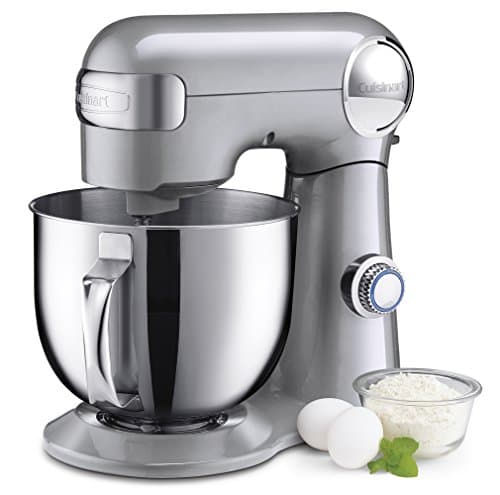 Cuisinart Precision Master SM-50 The 5.5-quart, 500-watt Precision Master gives you a bigger bowl and a stated higher wattage than a same-price KitchenAid. The trade-off is a smaller accessory ecosystem, but for straight mixing it's a lot of machine for the money. 5.5 Qt · 500W | Best big bowl for the money | 4.2★★★★★ | $229.95Amazon |
| 02 | 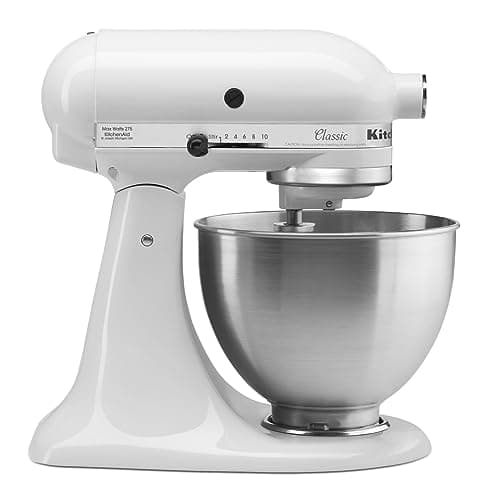 KitchenAid Classic (4.5 Qt) The 4.5-quart Classic is the cheapest way into the KitchenAid ecosystem and takes the same attachments as the Artisan. A slightly smaller bowl and fewer colors, but the same fundamentals. 4.5 Q | Best budget KitchenAid | 4.3★★★★★ | $322.99Amazon |
| 03 | 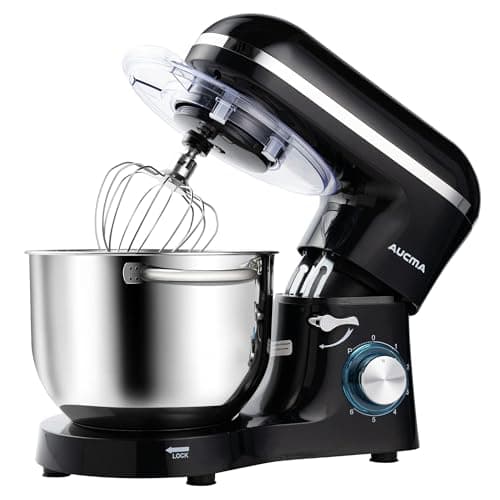 Aucma 6.5-Qt Stand Mixer The value play: a 6.5-quart stainless bowl and a stated 660-watt copper motor with 6 speeds and pulse, for less than a 4.5-quart KitchenAid Classic. You give up the brand's attachment ecosystem and resale value; you get a bigger bowl and a higher stated wattage for the money. 6.5QT · 660W | Best big bowl on a budget | 4.0★★★★★ | $129.99Amazon |
#ad · Live prices from the Amazon Product API, as of October 17, 2026. Where we have no verified live price, we show none — a gap beats a number that has rotted.
The picks, in detail
Cuisinart Precision Master SM-50
spec score /5
$319.9528% off
Price as of October 17, 2026. Prices change — Amazon's is the one that counts.
#ad · we may earn a commission from this link to Cuisinart Precision Master SM-50
The 5.5-quart, 500-watt Precision Master gives you a bigger bowl and a stated higher wattage than a same-price KitchenAid. The trade-off is a smaller accessory ecosystem, but for straight mixing it's a lot of machine for the money.
- Capacity
- 5.5 Qt
- Footprint (W×D×H)
- 11.2 × 16.5 × 15.9 in
- Power
- 500 W
- Weight
- 17 lb
- Cost per use*
- ≈3¢
- Est. per year*
- ≈$6
- Warranty
- Limited 3-Year Warranty
- Bigger 5.5-qt bowl
- 500 W stated motor
- Often cheaper than KitchenAid
- Smaller attachment ecosystem
- Less iconic resale value
- Plastic trim in places
*Cost-to-run computed from the manufacturer's stated 500W at $0.17/kWh (US average), 20-min sessions, 4×/week. Your rate and use will vary.
KitchenAid Classic (4.5 Qt)
spec score /5
$399.9919% off
Price as of October 17, 2026. Prices change — Amazon's is the one that counts.
#ad · we may earn a commission from this link to KitchenAid Classic (4.5 Qt)
The 4.5-quart Classic is the cheapest way into the KitchenAid ecosystem and takes the same attachments as the Artisan. A slightly smaller bowl and fewer colors, but the same fundamentals.
- Capacity
- 4.5 Q
- Footprint (W×D×H)
- 8.7 × 14.1 × 13.9 in
- Weight
- 24.2 lb
- Warranty
- 1 Year Limited Warranty
- Lowest-cost route to KitchenAid
- Takes the full attachment lineup
- Compact-ish 4.5-qt bowl
- Smaller bowl than the Artisan
- Fewer color options
- Same dough limits as the 5-qt
Aucma 6.5-Qt Stand Mixer
spec score /5
$169.9924% off
Price as of October 17, 2026. Prices change — Amazon's is the one that counts.
#ad · we may earn a commission from this link to Aucma 6.5-Qt Stand Mixer
The value play: a 6.5-quart stainless bowl and a stated 660-watt copper motor with 6 speeds and pulse, for less than a 4.5-quart KitchenAid Classic. You give up the brand's attachment ecosystem and resale value; you get a bigger bowl and a higher stated wattage for the money.
- Capacity
- 6.5QT
- Footprint (W×D×H)
- 9.3700787306 × 15.2362204569 × 12.3622047118 in
- Power
- 660 W
- Weight
- 11.68 lb
- Cost per use*
- ≈4¢
- Est. per year*
- ≈$8
- 6.5-qt bowl — the biggest here
- 660 W stated motor with pulse
- Whisk, dough hook and beater all dishwasher-safe
- No attachment ecosystem beyond the three included tools
- No published warranty on the listing
- Less proven long-term than the big brands
*Cost-to-run computed from the manufacturer's stated 660W at $0.17/kWh (US average), 20-min sessions, 4×/week. Your rate and use will vary.
The SM-50 is the machine we recommend most often to people who have worked out that they want a stand mixer but do not want to buy into an ecosystem. It wins more specification categories than its reputation suggests, and this review is mostly about whether those wins translate into anything you will feel.
Standard disclosure: specification and running-cost review from Cuisinart's published listing for the exact unit we link to, not a lab test. Method on how we review.
The specification
| Spec | Cuisinart SM-50 |
|---|---|
| Bowl | 5.5 qt polished stainless steel |
| Motor | 500 W (published) |
| Speeds | 12 |
| Head design | Tilt-back |
| Included | Chef's whisk, dough hook, flat paddle, splash guard with pour spout |
| Attachment outlet | Yes — one power outlet |
| Optional attachments | Pasta extruder, pasta roller/cutters, ice cream maker, meat grinder, spiralizer |
| Footprint (W × D) | 11.2 × 16.5 in |
| Height | 15.9 in |
| Weight | 17 lb |
| Warranty | Limited 3-year |
500 watts, published — and what that is worth
Cuisinart prints 500 W on the listing. KitchenAid publishes no wattage for the Artisan or Classic at all. It is tempting to read that as the Cuisinart being the more powerful machine, and it may well draw more power — but we should be careful, because stand mixers are a torque problem, not a wattage one.
What a mixer needs is to keep turning slowly against a heavy, sticky load without stalling or overheating, and that comes from gearing as much as from the motor. A lower-wattage machine with better reduction gearing can out-work a higher-wattage one. Neither brand publishes gear ratios, so nobody can settle this from spec sheets — and anyone who claims to has guessed.
What we will say: for cakes, cookies, batters, whipped cream and meringue — the overwhelming majority of home baking — both machines have far more capability than the job requires, and you will never find the ceiling on either.
The bowl is the clearest win
5.5 quartsagainst the Artisan's 5 and the Classic's 4.5. That is a genuine difference at the top of a batch — a full double batch of cookie dough, a large brioche — though for weeknight baking the extra half-quart is headroom rather than capability.
Where a bigger bowl matters more than people expect is dough. Dough needs roughly three times its own volume in bowl space to be thrown, caught and folded properly rather than just contained; a bowl more than about a third full binds instead of kneading. So bowl volume, not motor power, is often what constrains you first on bread.
Twelve speeds and the low end
Twelve against ten is not a meaningful advantage in itself — nobody uses twelve distinct speeds. Where the extra increments help is at the bottom, giving finer control when folding delicate things or starting a flour-heavy mix without dusting the kitchen.
The splash guard with a pour spout is included, which is worth noting because it is genuinely useful and frequently an upsell elsewhere.
Three years is the strongest argument
A limited 3-year warranty, against 1 year on both KitchenAid tilt-heads. On a machine you intend to work hard, that is a meaningful signal about expected life, and it is the specification we would weight most heavily here.
The counter-argument for KitchenAid is a repair-and-parts culture rather than a longer warranty — decade-old machines stay in service because parts are everywhere and independent repair is routine. Both are legitimate forms of longevity; they are just different bets.
The attachment story is better than its reputation
A correction worth making, because this is widely misstated. The SM-50 does have an attachment outlet, and Cuisinart lists a pasta extruder, a pasta roller and cutters, an ice cream maker, a meat grinder and a spiralizer for it.
So this is not a choice between an ecosystem and nothing. It is a choice between a large, decades-old accessory market with a deep third-party tail and a thriving second-hand supply, versus a smaller first-party range. If you want one or two attachments, Cuisinart covers you. If you want the widest possible choice, or expect to buy used, KitchenAid is still ahead. Our full comparison is in KitchenAid vs. Cuisinart.
What comes in the box matters more than it should
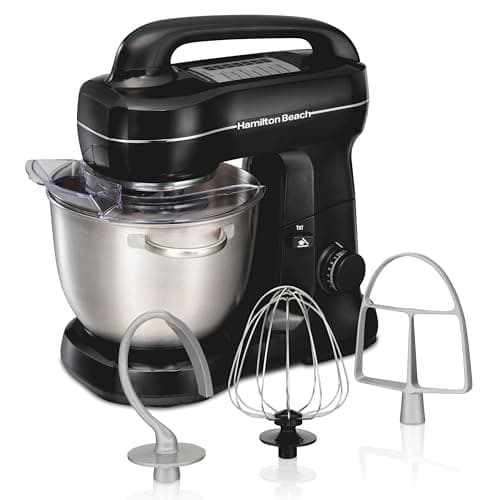
A small point that adds up. The SM-50 includes a chef's whisk, a dough hook, a flat mixing paddle and a splash guard with a pour spout.
The splash guard is the notable one, because it is frequently an accessory purchase elsewhere and it is genuinely useful — it stops flour clouding out of the bowl on the first speed and lets you add ingredients while the machine runs without stopping it. Having it included rather than upsold is a small thing that reflects the general value positioning of this machine.
The bowl is polished stainless steelrather than brushed, which is cosmetic but does show marks more readily. It has no handle, unlike the KitchenAid Artisan's 5-quart bowl — a genuine ergonomic difference when you are tipping a heavy batter out.
Footprint: the real cost
This is where the SM-50 loses, and it loses clearly. At 11.2 inches wide and 16.5 deep, it takes noticeably more counter than either KitchenAid tilt-head at 8.7 × 14.1 — about two and a half inches more in each direction. On a standard 24-inch-deep counter, 16.5 inches is a lot to give up.
It is also 15.9 inches tall with the head down, against 13.9 for the KitchenAids, and like any tilt-head it needs extra clearance above to open. Under a standard 18-inch cabinet gap you will be pulling this forward every time.
The compensation is weight: at 17 lb it is over five pounds lighter than an Artisan, which makes cupboard storage marginally more realistic — though 17 lb is still not something you will cheerfully lift daily.
The honest cons
The largest footprint here at 11.2 × 16.5 inches, and 15.9 inches tall. A smaller accessory range than KitchenAid, with a much thinner second-hand market. Little resale value— the "I can always sell it" escape hatch does not really exist outside KitchenAid. Plastic trim in places where KitchenAid uses metal. At 17 lb it can rock under a genuinely stiff dough, where a heavier machine stays planted.
And one that only shows up later: the bowl has no handle. The KitchenAid Artisan's 5-quart bowl does, and once you have tipped a full batch of stiff cookie dough out of each you will notice the difference. It is a small ergonomic point that recurs every single bake, and the polished finish also shows marks more readily than a brushed one.
What twelve speeds actually gets you
Speed counts are the easiest specification to inflate, so it is worth being precise about where the extra increments do and do not help.
They do not help at the top. Nobody needs three distinct whipping speeds, and the difference between speed 10 and speed 12 on cream is imperceptible.
They help at the bottom, and meaningfully. The gap between "too slow to combine" and "fast enough to throw flour out of the bowl" is narrow, and more increments down there means you can sit in it. That matters for folding delicate things, for starting a flour-heavy mix, and for adding liquid to a dough without splashing.
The related feature is the tilt-back head with a locking position, which is standard for the format but worth confirming — a head that does not lock open is a head that can drop while your hands are in the bowl.
Our broader view is that speed count is a weak buying signal generally. Bowl size, warranty and footprint tell you far more, which is the framework we use in best budget stand mixers.
Verdict
Buy the SM-50 if you bake cakes, cookies and the occasional loaf, want the most machine per pound spent, and value a three-year warranty over a badge. On the numbers it is the better buy and it is not especially close.
Buy a KitchenAid Artisan instead if counter space is tight, if you want the widest attachment choice, or if resale value matters to you. Buy the Aucma 6.5-quart if raw bowl size on a budget is the priority — it is in best budget stand mixers. And if you bake bread weekly, none of these tilt-heads is the right machine; read tilt-head vs. bowl-lift first.
Frequently asked questions
Is the Cuisinart SM-50 better than a KitchenAid?
On specifications, largely yes — a 5.5-quart bowl against 5 and 4.5, 12 speeds against 10, a published 500 W motor where KitchenAid publishes none, and a 3-year warranty against 1, usually for less money. KitchenAid wins on footprint, attachment choice and resale value.
Does the Cuisinart SM-50 take attachments?
Yes. It has a power outlet for optional attachments, and Cuisinart lists a pasta extruder, pasta roller and cutters, an ice cream maker, a meat grinder and a spiralizer. The range is smaller than KitchenAid's and the third-party and second-hand markets are much thinner.
How much counter space does the Cuisinart SM-50 need?
11.2 inches wide by 16.5 deep and 15.9 tall — the largest footprint of any mixer we track, and about two and a half inches bigger in each direction than a KitchenAid tilt-head. Like any tilt-head it also needs clearance above to open the head.
Is 500 watts enough for a stand mixer?
Comfortably, for normal baking. But stand mixers are a torque problem rather than a wattage one — gearing matters as much as the motor, and neither Cuisinart nor KitchenAid publishes gear ratios. For cakes, cookies and whipped cream you will never find the ceiling on either machine.
Can the Cuisinart SM-50 make bread dough?
It handles occasional bread well and has the largest tilt-head bowl here at 5.5 quarts, which matters because dough needs roughly three times its own volume to be kneaded properly. For weekly bread, a bowl-lift machine is the right class of tool.
Sources
Keep reading
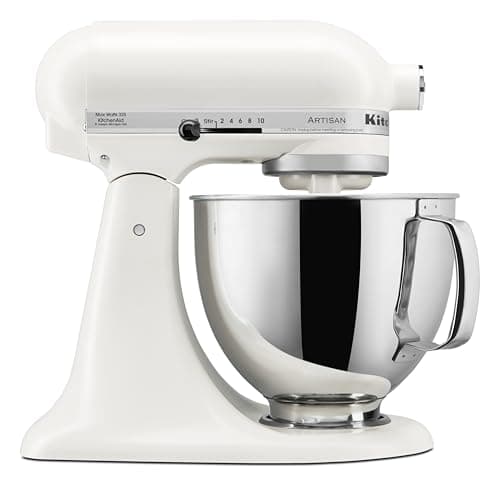
Stand Mixers
The Best Stand Mixers of 2026
KitchenAid Artisan, KitchenAid Classic and Cuisinart compared on bowl size, build and attachments.
Comparison
KitchenAid vs. Cuisinart: Which Stand Mixer Should You Buy?
KitchenAid vs Cuisinart on bowl size, wattage, warranty, attachments and resale — and who each brand is actually for.
Review
KitchenAid Artisan Review
The KitchenAid Artisan on bowl coverage, speeds, the attachment hub, weight and the one job it struggles with.
Roundup
The Best Budget Stand Mixers
Budget stand mixers ranked on bowl size, stated wattage, weight and warranty — plus what you actually give up.
https://wattandwhisk.com/stand-mixers/cuisinart-sm50-review