KitchenAid vs. Cuisinart: Which Stand Mixer Should You Buy?
One sells an ecosystem and a resale value; the other sells a bigger bowl, more stated watts and a longer warranty for less money. Here is how to tell which you need.
Disclosure:Watt & Whisk is reader-supported. When you buy through links on this page we may earn an Amazon Associates commission, at no extra cost to you. Prices are pulled live from Amazon and shown with the date checked. How this works.
Buy KitchenAid if you want the attachment ecosystem, an all-metal machine that holds its resale value, and the widest choice of colors — the Artisan at 5 quarts or the cheaper Classic at 4.5. Buy Cuisinart — the Precision Master SM-50— if you want the most machine for the money: a bigger 5.5-quart bowl, a stated 500-watt motor, 12 speeds and a 3-year limited warranty against KitchenAid's 1. The deciding question is whether you will ever buy an attachment.
The short answer
Quick picks
| # | Product | Best for | Score | Price |
|---|---|---|---|---|
| 01 | 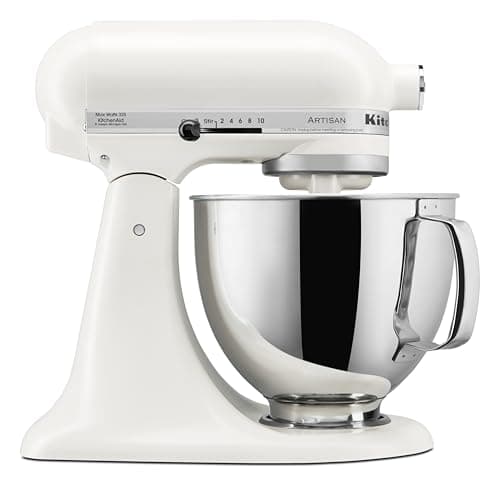 KitchenAid Artisan (5 Qt) The 5-quart tilt-head Artisan is the default for a reason: a metal body, a big color range, and the whole KitchenAid attachment ecosystem. It handles most home baking short of daily heavy bread. 5 Quart | Best overall stand mixer | 4.6★★★★★ | $489.00Amazon |
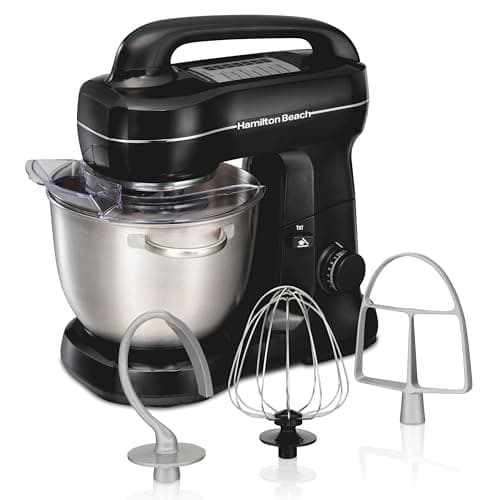
| 02 | 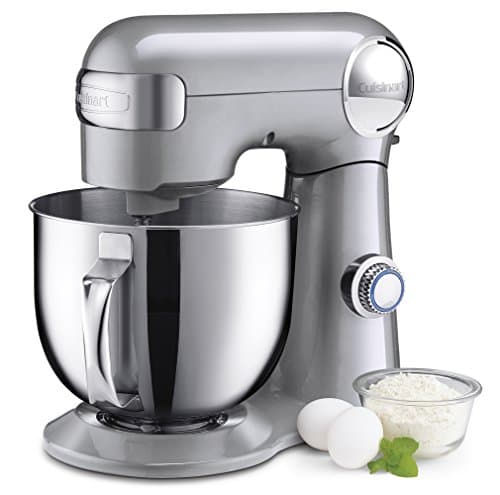 Cuisinart Precision Master SM-50 The 5.5-quart, 500-watt Precision Master gives you a bigger bowl and a stated higher wattage than a same-price KitchenAid. The trade-off is a smaller accessory ecosystem, but for straight mixing it's a lot of machine for the money. 5.5 Qt · 500W | Best big bowl for the money | 4.2★★★★★ | $229.95Amazon |
| 03 | 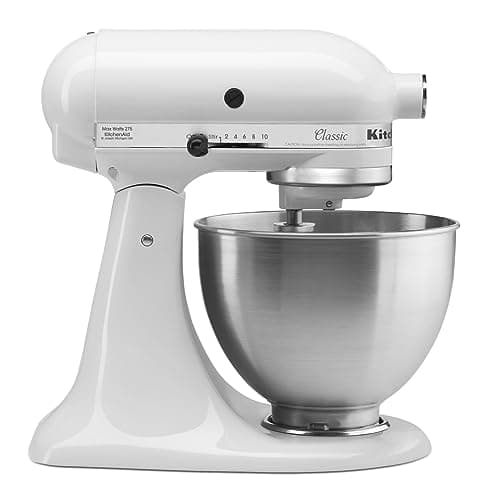 KitchenAid Classic (4.5 Qt) The 4.5-quart Classic is the cheapest way into the KitchenAid ecosystem and takes the same attachments as the Artisan. A slightly smaller bowl and fewer colors, but the same fundamentals. 4.5 Q | Best budget KitchenAid | 4.3★★★★★ | $322.99Amazon |
| 04 | 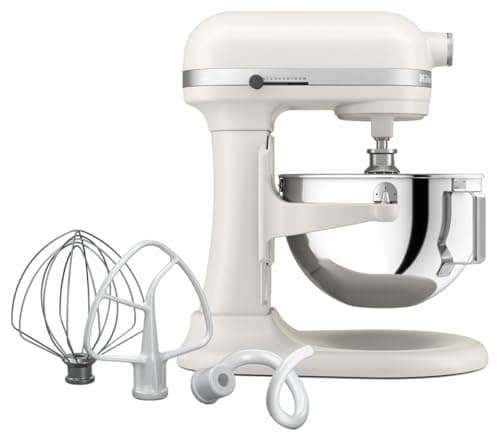 KitchenAid 5.5-Qt Bowl-Lift KSM55 This is the answer to the one thing the tilt-head Artisan genuinely struggles with. KitchenAid rates the bowl-lift KSM55 at twice the power in the bowl of a KSM150 tilt-head and lists it as kneading over 7 lb of bread dough, with a 3-point locking bowl that doesn't walk when the hook loads up. 5.5 Q | Best for bread dough | 4.6★★★★★ | Check price → |
#ad · Live prices from the Amazon Product API, as of October 17, 2026. Where we have no verified live price, we show none — a gap beats a number that has rotted.
The picks, in detail
KitchenAid Artisan (5 Qt)
spec score /5
Price as of October 17, 2026. Prices change — Amazon's is the one that counts.
#ad · we may earn a commission from this link to KitchenAid Artisan (5 Qt)
The 5-quart tilt-head Artisan is the default for a reason: a metal body, a big color range, and the whole KitchenAid attachment ecosystem. It handles most home baking short of daily heavy bread.
- Capacity
- 5 Quart
- Footprint (W×D×H)
- 8.7 × 14.1 × 13.9 in
- Weight
- 22.8 lb
- Warranty
- 1 Year Limited Warranty
- Huge attachment ecosystem (grinder, pasta, more)
- All-metal build; holds resale value
- 5-qt bowl suits most baking
- Struggles with repeated stiff bread dough
- Premium price
- Heavy to lift on and off the counter
Cuisinart Precision Master SM-50
spec score /5
$319.9528% off
Price as of October 17, 2026. Prices change — Amazon's is the one that counts.
#ad · we may earn a commission from this link to Cuisinart Precision Master SM-50
The 5.5-quart, 500-watt Precision Master gives you a bigger bowl and a stated higher wattage than a same-price KitchenAid. The trade-off is a smaller accessory ecosystem, but for straight mixing it's a lot of machine for the money.
- Capacity
- 5.5 Qt
- Footprint (W×D×H)
- 11.2 × 16.5 × 15.9 in
- Power
- 500 W
- Weight
- 17 lb
- Cost per use*
- ≈3¢
- Est. per year*
- ≈$6
- Warranty
- Limited 3-Year Warranty
- Bigger 5.5-qt bowl
- 500 W stated motor
- Often cheaper than KitchenAid
- Smaller attachment ecosystem
- Less iconic resale value
- Plastic trim in places
*Cost-to-run computed from the manufacturer's stated 500W at $0.17/kWh (US average), 20-min sessions, 4×/week. Your rate and use will vary.
KitchenAid Classic (4.5 Qt)
spec score /5
$399.9919% off
Price as of October 17, 2026. Prices change — Amazon's is the one that counts.
#ad · we may earn a commission from this link to KitchenAid Classic (4.5 Qt)
The 4.5-quart Classic is the cheapest way into the KitchenAid ecosystem and takes the same attachments as the Artisan. A slightly smaller bowl and fewer colors, but the same fundamentals.
- Capacity
- 4.5 Q
- Footprint (W×D×H)
- 8.7 × 14.1 × 13.9 in
- Weight
- 24.2 lb
- Warranty
- 1 Year Limited Warranty
- Lowest-cost route to KitchenAid
- Takes the full attachment lineup
- Compact-ish 4.5-qt bowl
- Smaller bowl than the Artisan
- Fewer color options
- Same dough limits as the 5-qt
KitchenAid 5.5-Qt Bowl-Lift KSM55
spec score /5
No buyable offer at the last price check (October 17, 2026). We show nothing rather than a stale number.
#ad · we may earn a commission from this link to KitchenAid 5.5-Qt Bowl-Lift KSM55
This is the answer to the one thing the tilt-head Artisan genuinely struggles with. KitchenAid rates the bowl-lift KSM55 at twice the power in the bowl of a KSM150 tilt-head and lists it as kneading over 7 lb of bread dough, with a 3-point locking bowl that doesn't walk when the hook loads up.
- Capacity
- 5.5 Q
- Footprint (W×D×H)
- 11.31 × 14.63 × 16.5 in
- Warranty
- 1 Year Replacement Plan - Stand Mixer - $19.95
- Listed at 2× the in-bowl power of a KSM150 tilt-head
- Rated to knead over 7 lb of bread dough
- 3-point locking bowl stays put under a heavy hook
- The priciest mixer we list
- 16.5 in tall with the bowl raised — check your cabinets
- Bowl-lift is slower to load than a tilt-head
This comparison is usually settled on vibes — KitchenAid is the one on the cooking shows, Cuisinart is the sensible alternative — and that does both brands a disservice. On paper the Cuisinart wins several categories outright, and on ownership the KitchenAid wins one category so decisively that it often settles the whole thing. Which one applies to you depends on a question most buying guides never ask.
Every figure below comes from each machine's current manufacturer listing. We have not run these side by side in a test kitchen and we are not going to imply we have — our method is documented on how we review.
At a glance
Blank cells are specs the maker does not publish on the listing. We do not fill those in with estimates.
| Spec | KitchenAid Artisan | KitchenAid Classic | Cuisinart SM-50 |
|---|---|---|---|
| Bowl capacity | 5 qt | 4.5 qt | 5.5 qt |
| Head design | Tilt-head | Tilt-head | Tilt-head |
| Stated wattage | — | — | 500 W |
| Speeds | 10 | 10 | 12 |
| Footprint (W × D) | 8.7 × 14.1 in | 8.7 × 14.1 in | 11.2 × 16.5 in |
| Height | 13.9 in | 13.9 in | 15.9 in |
| Weight | 22.8 lb | 24.2 lb | 17 lb |
| Warranty (as listed) | 1-year limited | 1-year limited | 3-year limited |
| Attachment hub | Yes — full ecosystem | Yes — full ecosystem | Limited |
The wattage argument, and why it is smaller than it looks
Cuisinart publishes 500 watts on the SM-50. KitchenAid does not publish a wattage on the Artisan or Classic listings at all. It is tempting to read that as Cuisinart being the more powerful machine, and in a straight electrical sense it may well be — but stand mixers are a torque problem, not a wattage problem.
What a mixer needs is the ability to keep turning slowly against a heavy, sticky load without stalling or overheating. That comes from gearing as much as from the motor, which is why a lower-wattage mixer with better reduction gearing can out-work a higher-wattage one on bread dough while drawing less power. Neither brand publishes gear ratios, so nobody can settle this from spec sheets, and anyone claiming to has guessed.
The honest summary: for cakes, cookies, batters, whipped cream and meringue — which is the overwhelming majority of home baking — both machines have far more capability than the job needs, and you will never find the ceiling. Where both brands' tilt-head models struggle is repeated stiff bread dough, and that is a design-class problem rather than a brand problem. We cover it in best stand mixers for bread.
Bowl size and footprint
Cuisinart wins on paper: 5.5 quarts against the Artisan's 5 and the Classic's 4.5. That is a real difference at the top end of a batch — a full double batch of cookie dough, or a big brioche — though for most weeknight baking the extra half-quart is headroom rather than capability.
The footprint tells the opposite story, and it is the one people forget to check. The Cuisinart is 11.2 inches wide by 16.5 deep; both KitchenAids are 8.7 by 14.1. That is a meaningfully smaller patch of counter — about two and a half inches narrower and two and a half shallower — which matters a lot if the mixer lives out permanently. Height goes the other way in practice: the KitchenAids are 13.9 inches, the Cuisinart 15.9, and both clear a standard 18-inch cabinet with the head down but neither does with the head tilted up. Plan to pull it forward to load it.
Weight is the third variable and it cuts against KitchenAid: 22.8 lb for the Artisan and 24.2 for the Classic, versus 17 for the Cuisinart. If your mixer has to live in a cupboard and come out for use, seven pounds is the difference between an appliance you use and an appliance you resent. If it lives on the counter, ignore this entirely — the weight is why KitchenAids do not walk across the worktop under load.
The attachment hub — the argument that usually decides it
This is the real reason KitchenAid dominates. The power hub on the front of every KitchenAid takes the same attachments across the whole range and has done for decades: a meat grinder, a pasta roller and cutters, a spiralizer, a vegetable sheet cutter, a grain mill, an ice cream bowl, a food processor attachment. KitchenAid lists over ten of them, sold separately, and the third-party market is larger still.
Cuisinart's ecosystem is real but much thinner. The SM-50 does have a power outlet for optional attachments, and Cuisinart lists a pasta extruder, pasta roller and cutters, an ice cream maker, a meat grinder and a spiralizer for it — so this is not a choice between an ecosystem and nothing. It is a choice between a large, decades-old accessory market with a deep third-party tail, and a much smaller first-party range. If you have ever thought "I might make my own pasta," both brands can do it; KitchenAid simply gives you more ways to, and far more places to buy them second-hand.
So the question to ask yourself is simply: will you ever buy an attachment? If the honest answer is no, you are paying a premium for an ecosystem you will not use, and the Cuisinart is the better-value machine. If the answer is maybe, KitchenAid is buying you an option.
Warranty and what happens after
Cuisinart lists a 3-year limited warranty on the SM-50. Both KitchenAids list 1 year. On paper that is a clear Cuisinart win, and we are not going to argue it away.
What KitchenAid has instead is a repair and parts culture. These machines are all-metal, the parts are widely available, and independent repair for a worn gear or a failed speed control is routine and well documented. The practical evidence is the second-hand market: a decade-old KitchenAid still sells for a substantial fraction of new, which is not true of most kitchen appliances and is not really true of the Cuisinart. That resale value is a genuine part of the ownership cost, and it is the thing spec sheets never capture.
Where each brand actually wins
Cuisinart wins on price, bowl size, published wattage, speed count, warranty length, and weight. That is six categories, and if you are buying a mixer to make cakes and cookies and nothing else, that is a straightforwardly better purchase.
KitchenAid wins on footprint, attachment ecosystem, parts availability, color range, and resale value. It also wins on something harder to quantify: the machine feels like it was designed to be repaired rather than replaced, and for a lot of people that alone justifies the premium.
Living with each one
A few things that only show up after purchase, and that neither spec sheet tells you.
Tilt-head clearance. Both brands here are tilt-heads, which means the stated height is the height with the head down. To load the bowl you tilt the head back, and that needs several more inches of vertical space. If the mixer lives under a cabinet, you will be pulling it forward every time you use it — which is fine, but it is worth knowing before you assign it a permanent spot.
Color is not a trivial difference.KitchenAid's much wider color range sounds like a vanity feature and is actually the main reason these machines live on counters rather than in cupboards. An appliance you are happy to look at gets used; one you hide gets forgotten. Cuisinart's range is narrower but its machines are, if anything, less visually assertive — a reasonable choice if you would rather the mixer did not announce itself.
Bowl availability. Spare and second bowls for KitchenAid are abundant and cheap, including from third parties, and a second bowl is genuinely useful when a recipe needs whipped whites and creamed butter in the same session. Cuisinart bowls are available but the aftermarket is much thinner. This is a small point that becomes a real one if you bake seriously.
If you land on KitchenAid, which one?
The Classic and the Artisan are mechanically very similar. You are choosing between a 4.5-quart and a 5-quart bowl, a narrower and a wider color range, and a price gap. Both take the identical attachment lineup, both share the same 8.7 × 14.1-inch footprint, and both have the same limits on stiff dough. If the extra half-quart and the color matter to you, buy the Artisan; if they do not, the Classic is the same capability for less. We break the whole range down in KitchenAid models compared.
The exception is bread. If you knead stiff dough weekly, neither tilt-head is the right machine and you want the bowl-lift KSM55, which KitchenAid rates at twice the in-bowl power of a KSM150 tilt-head and lists as kneading over 7 lb of bread dough.
The verdict
If you bake cakes, cookies and the occasional loaf, and you are confident you will never buy an attachment, the Cuisinart Precision Master SM-50 is the better buy and it is not especially close on the numbers. If you want the machine to still be worth something in ten years, want the option of pasta or a grinder, or simply want the smaller footprint, buy the KitchenAid — Classic if you are price-sensitive, Artisan if you want the 5-quart bowl and the colors.
Not sure a stand mixer earns its counter space at all? Start with are stand mixers worth it, or see the full field on our best stand mixers page. On a tight budget, best budget stand mixers covers what you can get for meaningfully less than either of these.
One footnote for first-time buyers, because this pairing is where most of them start: the Cuisinart publishes a limited three-year warranty and 500 watts against KitchenAid's one year and no published wattage, and it is 7 lb lighter. Whether that should decide a first mixer is the whole of best stand mixers for beginners.
One more line in the ledger, and it goes Cuisinart's way on paper and KitchenAid's way in practice: Cuisinart publishes a limited 3-year warranty against KitchenAid's 1 year, but KitchenAid's sacrificial worm gear and stocked parts supply mean an overload event costs a few dollars rather than the machine. Both halves of that argument, with the full published terms, are in how long do stand mixers last.
Frequently asked questions
Is Cuisinart as good as KitchenAid for a stand mixer?
On specifications, the Cuisinart Precision Master SM-50 beats both tilt-head KitchenAids on bowl size (5.5 vs 5 and 4.5 quarts), speeds (12 vs 10), published wattage (500 W vs unpublished) and warranty (3 years vs 1). KitchenAid wins on footprint, the attachment ecosystem, parts availability and resale value.
Why does KitchenAid not publish a wattage?
KitchenAid does not list wattage on the Artisan or Classic listings. Stand mixers are a torque problem rather than a wattage one — gearing matters as much as the motor — so a lower-wattage mixer with better reduction gearing can out-work a higher-wattage one. Neither brand publishes gear ratios.
Which stand mixer has a smaller footprint?
KitchenAid. Both the Artisan and the Classic measure 8.7 inches wide by 14.1 deep, against 11.2 by 16.5 for the Cuisinart SM-50. The Cuisinart is lighter though — 17 lb versus 22.8 and 24.2 lb — which matters if the mixer lives in a cupboard.
Do KitchenAid attachments fit Cuisinart mixers?
No. KitchenAid's power hub is a proprietary fitting, and its attachment range — pasta rollers, meat grinders, spiralizers, grain mills and more — only fits KitchenAid mixers. Cuisinart's accessory range is much thinner, so if attachments matter, that decides the purchase.
Which stand mixer is better for bread dough?
Neither of these tilt-head machines is ideal for repeated stiff dough. If you knead bread weekly, the bowl-lift KitchenAid KSM55 is the right class of machine — KitchenAid rates it at twice the in-bowl power of a KSM150 tilt-head and lists it as kneading over 7 lb of dough.
Do KitchenAid mixers hold their value?
Better than most kitchen appliances. They are all-metal, parts are widely available and independent repair is routine, so decade-old machines still sell for a substantial fraction of new. That resale value is a real part of ownership cost and is the strongest argument for the premium.
Sources
Keep reading
Stand Mixers
The Best Stand Mixers of 2026
KitchenAid Artisan, KitchenAid Classic and Cuisinart compared on bowl size, build and attachments.
Comparison
KitchenAid Models Compared: Classic vs. Artisan vs. Bowl-Lift
Classic vs Artisan vs bowl-lift KSM55 — what actually changes between KitchenAid's models, and which one you need.
Roundup
The Best Stand Mixers for Bread Dough
Four mixers ranked for bread: bowl-lift rigidity, stated dough capacity and what kneading does to a machine built for cake.
Roundup
The Best Budget Stand Mixers
Budget stand mixers ranked on bowl size, stated wattage, weight and warranty — plus what you actually give up.
Review
KitchenAid Artisan Review
The KitchenAid Artisan on bowl coverage, speeds, the attachment hub, weight and the one job it struggles with.
Review
Cuisinart Precision Master SM-50 Review
The Cuisinart SM-50 on bowl size, 500 W motor, 12 speeds, 3-year warranty and the footprint it costs you.
Roundup
The Best Stand Mixers for Beginners
Ranked on the two specs that decide whether a first mixer gets used — published weight and slow-speed control — not on quart ratings.
https://wattandwhisk.com/stand-mixers/kitchenaid-vs-cuisinart