The Best Stand Mixers for Beginners
A first stand mixer fails for one of two reasons: it is too heavy to get out, or its lowest speed throws flour across the kitchen. Those are the specs we rank on.
Disclosure:Watt & Whisk is reader-supported. When you buy through links on this page we may earn an Amazon Associates commission, at no extra cost to you. Prices are pulled live from Amazon and shown with the date checked. How this works.
For a first stand mixer, buy the Hamilton Beach 4 Qt: at 8 lb it is a third the weight of a KitchenAid, it has a built-in handle, and it publishes a slow first speed designed for exactly the moment a beginner makes a mess. If you want a machine you will not outgrow, the Cuisinart SM-50 is the best value here — 5.5 quarts, a published 500-watt motor, 12 speeds and a limited three-year warranty, triple the cover KitchenAid gives you for more money. The KitchenAid Classic is the right buy only if the attachment ecosystem is the reason you are shopping, and you should know it weighs 24.2 lb. The Aucma is the biggest bowl for the least money, with the catch that it publishes no warranty term at all. Prices below are pulled live from Amazon.
The short answer
Quick picks
| # | Product | Best for | Score | Price |
|---|---|---|---|---|
| 01 | 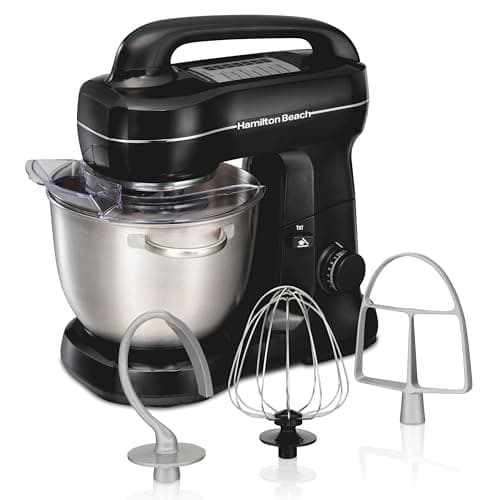 Hamilton Beach 4-Qt Stand Mixer A 300-watt, 7-speed planetary mixer with a 4-quart stainless bowl, dough hook, whisk, flat beater and splash guard included — for a fraction of a KitchenAid. At 8 lb with a molded carry handle it's also the only mixer here you can genuinely lift into a cupboard one-handed. 4 Quart · 300W | Best budget stand mixer | 4.0★★★★★ | $151.95Amazon |
| 02 | 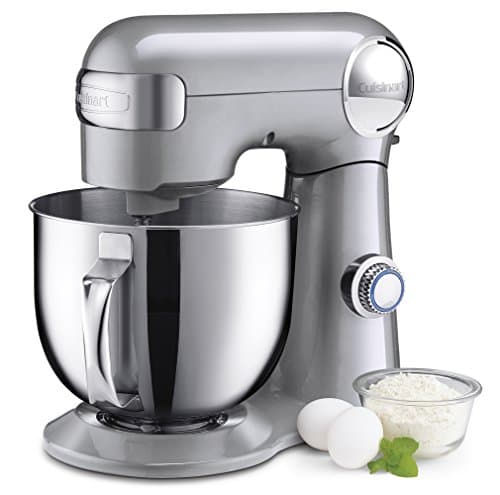 Cuisinart Precision Master SM-50 The 5.5-quart, 500-watt Precision Master gives you a bigger bowl and a stated higher wattage than a same-price KitchenAid. The trade-off is a smaller accessory ecosystem, but for straight mixing it's a lot of machine for the money. 5.5 Qt · 500W | Best big bowl for the money | 4.2★★★★★ | $219.99Amazon |
| 03 | 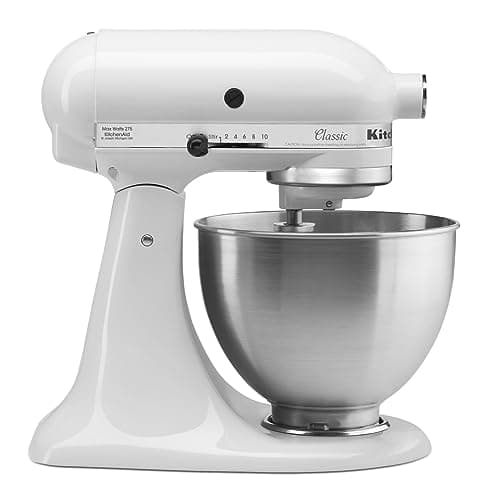 KitchenAid Classic (4.5 Qt) The 4.5-quart Classic is the cheapest way into the KitchenAid ecosystem and takes the same attachments as the Artisan. A slightly smaller bowl and fewer colors, but the same fundamentals. 4.5 Q | Best budget KitchenAid | 4.3★★★★★ | $299.99Amazon |
| 04 | 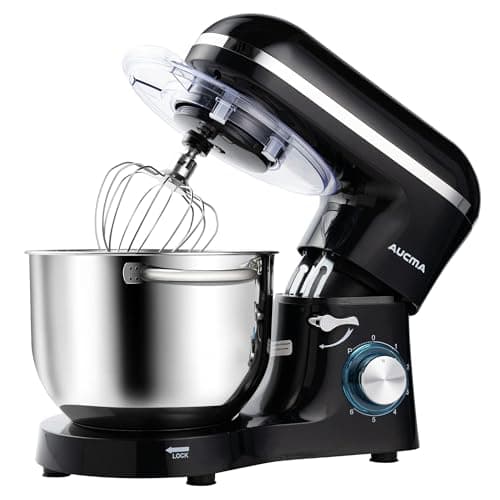 Aucma 6.5-Qt Stand Mixer The value play: a 6.5-quart stainless bowl and a stated 660-watt copper motor with 6 speeds and pulse, for less than a 4.5-quart KitchenAid Classic. You give up the brand's attachment ecosystem and resale value; you get a bigger bowl and a higher stated wattage for the money. 6.5QT · 660W | Best big bowl on a budget | 4.0★★★★★ | $129.19Amazon |
| 05 | 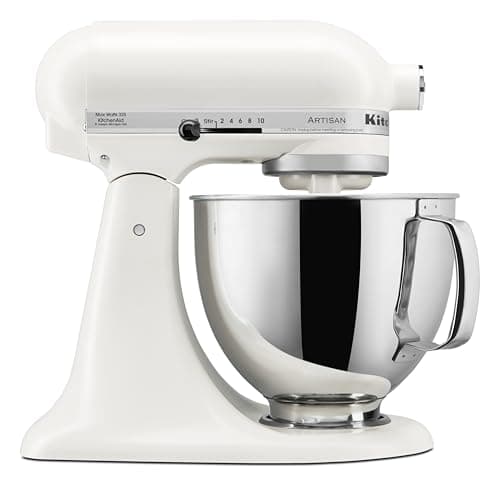 KitchenAid Artisan (5 Qt) The 5-quart tilt-head Artisan is the default for a reason: a metal body, a big color range, and the whole KitchenAid attachment ecosystem. It handles most home baking short of daily heavy bread. 5 Quart | Best overall stand mixer | 4.6★★★★★ | $359.99Amazon |
#ad · Live prices from the Amazon Product API, as of October 6, 2026. Where we have no verified live price, we show none — a gap beats a number that has rotted.
The picks, in detail
Hamilton Beach 4-Qt Stand Mixer
spec score /5
Price as of October 6, 2026. Prices change — Amazon's is the one that counts.
#ad · we may earn a commission from this link to Hamilton Beach 4-Qt Stand Mixer
A 300-watt, 7-speed planetary mixer with a 4-quart stainless bowl, dough hook, whisk, flat beater and splash guard included — for a fraction of a KitchenAid. At 8 lb with a molded carry handle it's also the only mixer here you can genuinely lift into a cupboard one-handed.
- Capacity
- 4 Quart
- Footprint (W×D×H)
- 10.9 × 14.5 × 14.4 in
- Power
- 300 W
- Weight
- 8 lb
- Cost per use*
- ≈2¢
- Est. per year*
- ≈$4
- Warranty
- One(1) Year Warranty
- All four attachments and a splash guard in the box
- 8 lb with a carry handle — actually storable
- Slow first speed keeps flour in the bowl
- 300 W is a cake-and-cookie motor, not a bread motor
- 4-qt bowl limits batch size
- No third-party attachment ecosystem
*Cost-to-run computed from the manufacturer's stated 300W at $0.17/kWh (US average), 20-min sessions, 4×/week. Your rate and use will vary.
Cuisinart Precision Master SM-50
spec score /5
$319.9531% off
Price as of October 6, 2026. Prices change — Amazon's is the one that counts.
#ad · we may earn a commission from this link to Cuisinart Precision Master SM-50
The 5.5-quart, 500-watt Precision Master gives you a bigger bowl and a stated higher wattage than a same-price KitchenAid. The trade-off is a smaller accessory ecosystem, but for straight mixing it's a lot of machine for the money.
- Capacity
- 5.5 Qt
- Footprint (W×D×H)
- 11.2 × 16.5 × 15.9 in
- Power
- 500 W
- Weight
- 17 lb
- Cost per use*
- ≈3¢
- Est. per year*
- ≈$6
- Warranty
- Limited 3-Year Warranty
- Bigger 5.5-qt bowl
- 500 W stated motor
- Often cheaper than KitchenAid
- Smaller attachment ecosystem
- Less iconic resale value
- Plastic trim in places
*Cost-to-run computed from the manufacturer's stated 500W at $0.17/kWh (US average), 20-min sessions, 4×/week. Your rate and use will vary.
KitchenAid Classic (4.5 Qt)
spec score /5
$399.9925% off
Price as of October 6, 2026. Prices change — Amazon's is the one that counts.
#ad · we may earn a commission from this link to KitchenAid Classic (4.5 Qt)
The 4.5-quart Classic is the cheapest way into the KitchenAid ecosystem and takes the same attachments as the Artisan. A slightly smaller bowl and fewer colors, but the same fundamentals.
- Capacity
- 4.5 Q
- Footprint (W×D×H)
- 8.7 × 14.1 × 13.9 in
- Weight
- 24.2 lb
- Warranty
- 1 Year Limited Warranty
- Lowest-cost route to KitchenAid
- Takes the full attachment lineup
- Compact-ish 4.5-qt bowl
- Smaller bowl than the Artisan
- Fewer color options
- Same dough limits as the 5-qt
Aucma 6.5-Qt Stand Mixer
spec score /5
$169.9924% off
Price as of October 6, 2026. Prices change — Amazon's is the one that counts.
#ad · we may earn a commission from this link to Aucma 6.5-Qt Stand Mixer
The value play: a 6.5-quart stainless bowl and a stated 660-watt copper motor with 6 speeds and pulse, for less than a 4.5-quart KitchenAid Classic. You give up the brand's attachment ecosystem and resale value; you get a bigger bowl and a higher stated wattage for the money.
- Capacity
- 6.5QT
- Footprint (W×D×H)
- 9.3700787306 × 15.2362204569 × 12.3622047118 in
- Power
- 660 W
- Weight
- 11.68 lb
- Cost per use*
- ≈4¢
- Est. per year*
- ≈$8
- 6.5-qt bowl — the biggest here
- 660 W stated motor with pulse
- Whisk, dough hook and beater all dishwasher-safe
- No attachment ecosystem beyond the three included tools
- No published warranty on the listing
- Less proven long-term than the big brands
*Cost-to-run computed from the manufacturer's stated 660W at $0.17/kWh (US average), 20-min sessions, 4×/week. Your rate and use will vary.
KitchenAid Artisan (5 Qt)
spec score /5
$499.9928% off
Price as of October 6, 2026. Prices change — Amazon's is the one that counts.
#ad · we may earn a commission from this link to KitchenAid Artisan (5 Qt)
The 5-quart tilt-head Artisan is the default for a reason: a metal body, a big color range, and the whole KitchenAid attachment ecosystem. It handles most home baking short of daily heavy bread.
- Capacity
- 5 Quart
- Footprint (W×D×H)
- 8.7 × 14.1 × 13.9 in
- Weight
- 22.8 lb
- Warranty
- 1 Year Limited Warranty
- Huge attachment ecosystem (grinder, pasta, more)
- All-metal build; holds resale value
- 5-qt bowl suits most baking
- Struggles with repeated stiff bread dough
- Premium price
- Heavy to lift on and off the counter
What actually makes a mixer beginner-friendly
Almost every guide to a first stand mixer ranks on capacity and brand, and both are close to irrelevant to whether a beginner ends up using the thing. We have looked at what goes wrong, and it is reliably one of four things.
- Weight, because you are the one lifting it. A stand mixer either lives on the counter forever or lives in a cupboard. If it lives in a cupboard, its weight decides how often it comes out — and a beginner has not yet built the habit that makes the effort feel worth it. The published weights across this page run from 8 lb to 24.2 lb, a threefold spread, and nobody ranks on it.
- The lowest speed, not the highest. The classic first-mixer disaster is adding flour and having it thrown across the kitchen. What prevents that is a genuinely slow first speed, plus a splash guard. Top speed matters for whipping cream and almost nothing else.
- What is in the box. A beginner should not have to work out which attachments they need. A flat beater, a dough hook, a whisk and a splash guard cover everything a new baker will do for a year.
- The warranty, as a proxy for risk. Nobody publishes a lifespan for these machines, so the warranty term is the only durability figure on the table — and on this page it runs from no published term at all to a limited three years, in an order that has almost nothing to do with price.
Capacity barely makes the list. Every machine here holds at least 4 quarts, which is two loaves or several dozen cookies — more than a beginner will use in one go. The sizing argument, if you want it, is what size stand mixer do I need.
One spec you cannot rank on: wattage
You will see wattage used as the headline number in this category, and across these five machines it is not a comparable figure. KitchenAid publishes no wattage at all — not on the Classic, not on the Artisan, not on any mixer we track. Cuisinart publishes 500 W on the SM-50. Hamilton Beach publishes 300 W. Aucma publishes 660 W and describes a pure copper motor.
So the highest wattage on this page belongs to the cheapest machine and the two machines most people consider the category benchmark publish nothing. That is not a scandal — a planetary mixer's useful output depends on gearing and torque at low speed, not on input watts — but it does mean a watt-for-watt ranking would be nonsense. We rank on what is comparable and we say where the figures stop.
The same trap runs through the blender aisle, if you want to see it play out on a different category: Ninja vs. NutriBullet shows why the higher wattage belongs to the machine doing the easier job once you read watts per ounce of contents rather than watts alone.
The weight ladder, lightest first
Published figures, straight from each maker's listing:
- Hamilton Beach 4 Qt — 8 lb, 10.9 × 14.5 in, 14.4 in tall. Has a built-in top handle.
- Aucma 6.5 QT — 11.68 lb, 9.37 × 15.24 in, 12.36 in tall.
- Cuisinart SM-50 — 17 lb, 11.2 × 16.5 in, 15.9 in tall.
- KitchenAid Artisan — 22.8 lb, 8.7 × 14.1 in, 13.9 in tall.
- KitchenAid Classic — 24.2 lb, 8.7 × 14.1 in, 13.9 in tall.
The Classic is the heaviest machine on this page and also the one most often recommended to beginners, which is the single biggest mismatch in this category. Twenty-four pounds is a two-handed lift at an awkward angle out of a low cupboard. If you have permanent counter space, that is irrelevant and you should ignore this entire section. If you do not, it is the most important number here.
Note the footprints run the other way: both KitchenAids are the narrowest machines on the page at 8.7 inches. They are dense rather than large. For a genuinely tight kitchen, best stand mixers for small kitchens ranks the same field on footprint instead.
The picks
Hamilton Beach 4 Qt — the best first mixer
A 4-quart stainless steel bowl with handles, 300 published watts, 7 speeds with planetary mixing action, and a splash guard, dough hook, whisk and flat beater in the box — all dishwasher safe, bowl included. 8 lb with a built-in top handle, 10.9 × 14.5 in and 14.4 in tall. One-year warranty.
It is our pick because it gets the two beginner specs right and nothing else is close on the first one. Hamilton Beach publishes a slow first speed explicitly described as good for kneading bread, and there is a speed guide printed on top of the machine so you do not have to guess. At 8 lb it is the only mixer here a beginner will cheerfully lift out of a cupboard twice a week.
Cons, honestly: 300 watts is the lowest figure on this page, and while watts are not the whole story they are not nothing either — this is the machine most likely to struggle with a stiff, low-hydration dough. Four quarts is the smallest bowl here. The attachment ecosystem is essentially what comes in the box; there is no pasta roller or grinder to grow into. And the one-year warranty is the category floor.
Cuisinart SM-50 — the one you will not outgrow
5.5 quarts, a published 500-wattmotor, 12 speeds, die-cast metal construction, a polished stainless bowl, a tilt-back head, and a power outlet on the machine for optional attachments. The box includes a chef's whisk, dough hook, flat paddle and a splash guard with a pour spout. Limited three-year warranty, and Cuisinart states the product is BPA free. 11.2 × 16.5 in, 15.9 in tall, 17 lb.
This is the value pick and the one we would choose for anyone who thinks they might get serious. Three years of cover is triple what either KitchenAid publishes, on a machine that costs less than both — the warranty ladder in this category runs in the opposite direction to the price ladder, exactly as we found with hand mixers and vacuum sealers. Twelve speeds also means more low-end resolution than the 7 on the Hamilton Beach or the 10 on the KitchenAids.
Cons, honestly:at 17 lb it is twice the Hamilton Beach, so the out-of-the-cupboard problem is real. It is the tallest machine on the page at 15.9 inches, which matters under a wall cabinet. Cuisinart's optional attachment range is real but far smaller than KitchenAid's, and the attachments are not cross-compatible between brands. Our longer look is the Cuisinart SM-50 review.
KitchenAid Classic — buy it for the ecosystem, not the mixer
A 4.5-quart stainless bowl KitchenAid states will mix 8 dozen cookies in a batch, 10 speeds, 59 touchpoints around the bowl, tilt-head design, and metal construction. Box includes the bowl, a coated flat beater, a coated dough hook and a 6-wire whip. One-year limited warranty. 8.7 × 14.1 in, 13.9 in tall, 24.2 lb.
The honest case for it is not that it mixes better than a Cuisinart — it is the power hub. KitchenAid's attachment fitting has been consistent for decades, so a pasta roller, a meat grinder, an ice cream bowl or a spiralizer bought years from now will still fit. If the plan is for the mixer to become the center of your kitchen, that ecosystem is worth paying for and no other brand has it at this scale. The range is in stand mixer attachments guide.
Cons, honestly:it is the heaviest machine here by a wide margin and needs a permanent home. It carries a one-year warranty on the highest price on this page bar the Artisan. KitchenAid publishes no wattage. And the bowl is smaller than the Cuisinart's at 4.5 quarts versus 5.5. Detail in the KitchenAid Classic review, and the head-to-head is KitchenAid vs. Cuisinart.
Aucma 6.5 QT — the most bowl for the money
A 6.5-quart stainless bowl with handles — the largest here — a published 660-watt motor that Aucma describes as pure copper, 6 speeds plus pulse, tilt-head design, ABS housing, and a whisk, dough hook and beater in the box, all dishwasher safe, with a splash guard that has an access hatch. 9.37 × 15.24 in, 12.36 in tall, 11.68 lb.
On paper it is remarkable value: the biggest bowl and the highest published wattage at the lowest price, in the second-lightest body on the page. If budget is the hard constraint and you want a big bowl, this is the machine that gives you one.
Cons, honestly, and one is significant: Aucma publishes no warranty term at all on this listing — not one year, not ninety days, nothing. On a motorized appliance that is the con that matters, and it is why this is our fourth pick rather than our second despite the specs. Six speeds is the coarsest control here, which works against the slow-speed criterion. The housing is ABS plastic where the Cuisinart is die-cast metal. And there is no attachment ecosystem.
KitchenAid Artisan — only if the Classic has already convinced you
A 5-quart stainless bowl with a handle, which KitchenAid states mixes 9 dozen cookies in a batch, 10 speeds, 59 touchpoints, tilt-head, and a pouring shield included that the Classic does not get. 8.7 × 14.1 in, 13.9 in tall, 22.8 lb — slightly lighter than the Classic. One-year limited warranty.
It is the most expensive machine on this page, and the gap to the Classic buys you half a quart, a bowl handle, the pouring shield and the color range. For a beginner that is a weak case, which is why it is last here rather than first. It is a lovely machine and it is not a sensible first purchase unless you already know you will use it.
Cons, honestly: the price, the 22.8 lb weight, and a one-year warranty on the dearest thing on the page. No wattage published. More in the KitchenAid Artisan review and KitchenAid models compared.
What a first mixer costs to run
Almost nothing, and it is worth saying so because wattage anxiety sends people to the wrong machine. On the published figures, the 660 W Aucma run for a 10-minute creaming job uses about 0.11 kWh — roughly 2 cents at the US average residential electricity price. The 300 W Hamilton Beach over the same ten minutes is under a cent. KitchenAid publishes no wattage, so we compute nothing for the Classic or the Artisan.
In other words, running cost is a non-differentiator in this category and should carry no weight in the decision. The cross-category figures are in what countertop appliances cost to run.
What we left off, and why
- The KitchenAid 5.5-Qt bowl-lift. A bowl-lift is a different machine for a different user: you raise the bowl to the beater rather than tilting the head back, which is better for heavy dough and worse for adding ingredients mid-mix. It is the wrong starting point. The distinction is the whole of tilt-head vs. bowl-lift.
- Hand mixers. For a lot of beginners this is genuinely the right answer, and pretending otherwise would be dishonest. A hand mixer creams butter, whips cream and makes cake batter for a fraction of the price and lives in a drawer. If you are not making bread, go read hand mixer vs. stand mixer before you spend anything.
- Anything under about $130. Below the Aucma, the machines we looked at either publish no model number in the title — so the exact machine cannot be pinned — or publish neither a wattage nor a warranty. We will not feature a machine we cannot identify.
Which one to buy
Buy the Hamilton Beach if this is your first mixer, it will live in a cupboard, and you want the machine most likely to actually get used — 8 lb, a handle, a published slow first speed and everything you need in the box. Buy the Cuisinart SM-50 if you want one purchase that lasts: a bigger bowl, 500 published watts, 12 speeds and three times the warranty for less than a KitchenAid. Buy the KitchenAid Classic if the attachment ecosystem is the point and you have permanent counter space for 24.2 lb. Buy the Aucma only if budget is hard and you accept there is no published warranty.
Not sure the category is right for you at all? Are stand mixers worth it is the honest read, and how to use a stand mixer is the page to read on day one — it covers the slow-speed habit this whole page is built around.
Frequently asked questions
What is the best stand mixer for a beginner?
The Hamilton Beach 4 Qt, for most people. At 8 lb with a built-in handle it is the only machine here a beginner will reliably lift out of a cupboard, it publishes a slow first speed that stops flour leaving the bowl, and the flat beater, dough hook, whisk and splash guard are all in the box. If you want something you will not outgrow, the Cuisinart SM-50 is the better buy.
Should a beginner buy a KitchenAid?
Only if the attachment ecosystem is the reason. The KitchenAid power hub fitting has been consistent for decades, so accessories bought years later still fit — that is a genuine long-term argument. But the Classic weighs 24.2 lb and carries a one-year warranty, against 17 lb and a limited three years on the cheaper Cuisinart SM-50. Buy the KitchenAid if you have permanent counter space and plan to grow into the attachments.
How many watts does a beginner stand mixer need?
Wattage is not a usable ranking spec here, because KitchenAid publishes no wattage on any of its mixers. Of the machines that do publish one, the figures run 300 W (Hamilton Beach), 500 W (Cuisinart SM-50) and 660 W (Aucma) — so the highest number belongs to the cheapest machine. A planetary mixer's useful output comes from gearing and low-speed torque, not input watts.
What size stand mixer should a beginner get?
Anything from 4 quarts up, which is every machine on this page. Four quarts is already two loaves or several dozen cookies — more than a new baker will do in one go. Capacity is the spec that gets over-weighted in this category; weight and slow-speed control matter far more for whether the machine gets used.
Is a hand mixer enough to start with?
Often, yes. A hand mixer creams butter, whips cream and makes cake batter perfectly well, costs a fraction of a stand mixer and lives in a drawer rather than on a counter. The honest dividing line is bread: if you are kneading dough regularly, a stand mixer earns its place; if you are not, start with a hand mixer.
Which beginner stand mixer has the best warranty?
The Cuisinart SM-50, at a limited three years — triple what either KitchenAid publishes. Hamilton Beach publishes one year, both KitchenAids publish one year limited, and the Aucma publishes no warranty term at all, which is the main reason it is not ranked higher despite having the biggest bowl and the highest published wattage.
How much does a stand mixer cost to run?
Pennies. The 660 W Aucma run for a ten-minute creaming job uses about 0.11 kWh, roughly 2 cents at the US average residential rate; the 300 W Hamilton Beach is under a cent for the same job. Running cost is a non-differentiator in this category and should not influence the decision.
Sources
Keep reading
Stand Mixers
The Best Stand Mixers of 2026
KitchenAid Artisan, KitchenAid Classic and Cuisinart compared on bowl size, build and attachments.
Comparison
Hand Mixer vs. Stand Mixer
Job by job: where a hand mixer is genuinely the right buy, and the three tasks that need a stand mixer.
Roundup
The Best Budget Stand Mixers
Budget stand mixers ranked on bowl size, stated wattage, weight and warranty — plus what you actually give up.
Comparison
KitchenAid vs. Cuisinart: Which Stand Mixer Should You Buy?
KitchenAid vs Cuisinart on bowl size, wattage, warranty, attachments and resale — and who each brand is actually for.
Guide
How to Use a Stand Mixer
Flat beater, dough hook or whisk; what each speed is really for; and the order of operations that stops split batters.
Guide
What Size Stand Mixer Do I Need?
4 to 6.5 quarts mapped to real batch sizes, why bread is limited by torque not volume, and the footprint each costs.
https://wattandwhisk.com/stand-mixers/best-stand-mixers-for-beginners