How to Use a Stand Mixer
Three attachments, one dial, and a running order. Almost every mixer problem comes from getting one of those three wrong.
Disclosure:Watt & Whisk is reader-supported. When you buy through links on this page we may earn an Amazon Associates commission, at no extra cost to you. Prices are pulled live from Amazon and shown with the date checked. How this works.
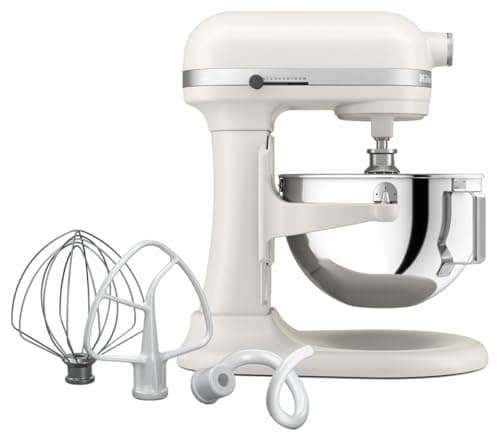
A stand mixer is three tools in one body. The flat beater is the default — creaming butter and sugar, cake batter, cookie dough, mashed potato. The dough hook is only for yeast dough. The whisk is only for things that must hold air: cream, egg whites, meringue. Start every mix on the lowest speed so dry ingredients do not fly, climb only once the mixture is wet, and never run a dough hook above the low-to-medium range. Get those three right and the rest is recipes.
The short answer
Quick picks
| # | Product | Best for | Score | Price |
|---|---|---|---|---|
| 01 | 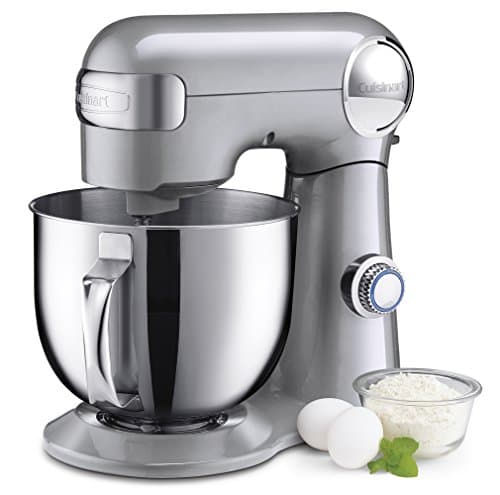 Cuisinart Precision Master SM-50 The 5.5-quart, 500-watt Precision Master gives you a bigger bowl and a stated higher wattage than a same-price KitchenAid. The trade-off is a smaller accessory ecosystem, but for straight mixing it's a lot of machine for the money. 5.5 Qt · 500W | Best big bowl for the money | 4.2★★★★★ | $229.95Amazon |
| 02 | 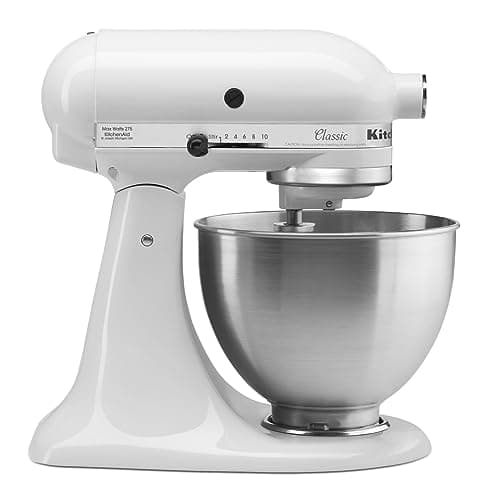 KitchenAid Classic (4.5 Qt) The 4.5-quart Classic is the cheapest way into the KitchenAid ecosystem and takes the same attachments as the Artisan. A slightly smaller bowl and fewer colors, but the same fundamentals. 4.5 Q | Best budget KitchenAid | 4.3★★★★★ | $399.00Amazon |
| 03 | 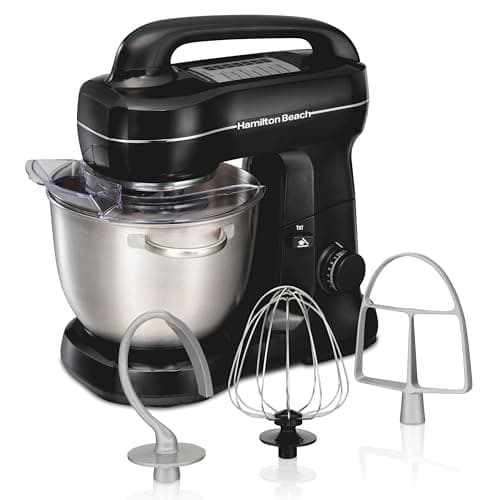 Hamilton Beach 4-Qt Stand Mixer A 300-watt, 7-speed planetary mixer with a 4-quart stainless bowl, dough hook, whisk, flat beater and splash guard included — for a fraction of a KitchenAid. At 8 lb with a molded carry handle it's also the only mixer here you can genuinely lift into a cupboard one-handed. 4 Quart · 300W | Best budget stand mixer | 4.0★★★★★ | $151.95Amazon |
#ad · Live prices from the Amazon Product API, as of Sep 17, 2026. Where we have no verified live price, we show none — a gap beats a number that has rotted.
The picks, in detail
Cuisinart Precision Master SM-50
spec score /5
$319.9528% off
Price as of Sep 17, 2026. Prices change — Amazon's is the one that counts.
#ad · we may earn a commission from this link to Cuisinart Precision Master SM-50
The 5.5-quart, 500-watt Precision Master gives you a bigger bowl and a stated higher wattage than a same-price KitchenAid. The trade-off is a smaller accessory ecosystem, but for straight mixing it's a lot of machine for the money.
- Capacity
- 5.5 Qt
- Footprint (W×D×H)
- 11.2 × 16.5 × 15.9 in
- Power
- 500 W
- Weight
- 17 lb
- Cost per use*
- ≈3¢
- Est. per year*
- ≈$6
- Warranty
- Limited 3-Year Warranty
- Bigger 5.5-qt bowl
- 500 W stated motor
- Often cheaper than KitchenAid
- Smaller attachment ecosystem
- Less iconic resale value
- Plastic trim in places
*Cost-to-run computed from the manufacturer's stated 500W at $0.17/kWh (US average), 20-min sessions, 4×/week. Your rate and use will vary.
KitchenAid Classic (4.5 Qt)
spec score /5
Price as of Sep 17, 2026. Prices change — Amazon's is the one that counts.
#ad · we may earn a commission from this link to KitchenAid Classic (4.5 Qt)
The 4.5-quart Classic is the cheapest way into the KitchenAid ecosystem and takes the same attachments as the Artisan. A slightly smaller bowl and fewer colors, but the same fundamentals.
- Capacity
- 4.5 Q
- Footprint (W×D×H)
- 8.7 × 14.1 × 13.9 in
- Weight
- 24.2 lb
- Warranty
- 1 Year Limited Warranty
- Lowest-cost route to KitchenAid
- Takes the full attachment lineup
- Compact-ish 4.5-qt bowl
- Smaller bowl than the Artisan
- Fewer color options
- Same dough limits as the 5-qt
Hamilton Beach 4-Qt Stand Mixer
spec score /5
Price as of Sep 17, 2026. Prices change — Amazon's is the one that counts.
#ad · we may earn a commission from this link to Hamilton Beach 4-Qt Stand Mixer
A 300-watt, 7-speed planetary mixer with a 4-quart stainless bowl, dough hook, whisk, flat beater and splash guard included — for a fraction of a KitchenAid. At 8 lb with a molded carry handle it's also the only mixer here you can genuinely lift into a cupboard one-handed.
- Capacity
- 4 Quart
- Footprint (W×D×H)
- 10.9 × 14.5 × 14.4 in
- Power
- 300 W
- Weight
- 8 lb
- Cost per use*
- ≈2¢
- Est. per year*
- ≈$4
- Warranty
- One(1) Year Warranty
- All four attachments and a splash guard in the box
- 8 lb with a carry handle — actually storable
- Slow first speed keeps flour in the bowl
- 300 W is a cake-and-cookie motor, not a bread motor
- 4-qt bowl limits batch size
- No third-party attachment ecosystem
*Cost-to-run computed from the manufacturer's stated 300W at $0.17/kWh (US average), 20-min sessions, 4×/week. Your rate and use will vary.
The three attachments and what each is actually for
The flat beater — your default
If a recipe does not tell you otherwise, this is the one. It is a paddle shaped to scrape through a thick mixture without trapping it, and it handles the great majority of what a mixer does: creaming butter and sugar, cake batter, cookie dough, frosting, mashed potatoes, meatloaf mix, and shredding cooked chicken. Every machine we track ships one — Cuisinart calls it a flat mixing paddle, KitchenAid a coated flat beater.
The dough hook — yeast dough only
The hook is a spiral that drags dough around the bowl to stretch and fold it. Use it for bread, pizza, rolls and enriched doughs, and for nothing else. It is the wrong tool for batters and cookie dough, where it simply drags a lump around without mixing anything.
The whisk — only when air is the point
The wire whip — KitchenAid ships a 6-wire whip, Cuisinart a chef's whisk — exists to fold air into a thin liquid. Cream, egg whites, meringue, whole-egg sponge batters. Putting a whisk into a stiff mixture bends the wires and will eventually wreck it, so if the mixture is thick enough to hold a spoon upright, it is a flat-beater job.
The dial, decoded
Speed counts vary — Cuisinart SM-50 has 12, the KitchenAid Classic and Artisan 10, the KitchenAid bowl-lift 11, the Hamilton Beach 63391 has 7 and the Aucma 6 plus pulse — but the map is the same on all of them, because it is dictated by the physics rather than the brand.
- Lowest setting — stirring and combining. Anything dry goes in here. This is the setting that stops a cloud of flour leaving the bowl, and it is where every mix should start. Hamilton Beach calls this out specifically on the 63391 as a slow first speed and prints a mixing guide on the top of the machine.
- Low to medium-low — kneading. Dough hook territory and nothing above it. Running a stiff dough fast does not knead it faster; it loads the motor, heats the dough and makes the machine walk.
- Medium — creaming and general beating. Butter and sugar, batters, frosting. This is where the flat beater spends most of its life.
- Medium-high to high — whipping only.KitchenAid publishes the top of the useful range plainly for the Classic and Artisan: ten speeds "from mixing ingredients together on the stir speed, to whipping cream at speed 8". Note that the maker's own example of a high-speed job stops at 8 out of 10.
One genuinely useful refinement exists on the KitchenAid bowl-lift: a dedicated half speed designed for folding, for adding delicate things like blueberries or whipped whites into a batter without overbeating. That is a better argument for the machine than any of the headline speed counts.
What to look for if you are still choosing a machine
Reading the sections above, three specifications do real work and the rest are noise:
- How slow the lowest speed is. More useful than how fast the top speed is. A first speed you can genuinely start dry ingredients on prevents most beginner mess.
- What comes in the box. All four machines here include a flat beater, dough hook and whisk, so you are not buying attachments to get started. The Cuisinart SM-50 and Hamilton Beach add a splash guard, which matters more than it sounds.
- Weight, against where it will live. KitchenAid Classic 24.2 lb, Cuisinart SM-50 17 lb, Aucma 11.68 lb, Hamilton Beach 8 lb with a carry handle. Heavy is good while mixing and bad everywhere else.
On published specs the picks above split cleanly. The Cuisinart SM-50 is 5.5 quarts, a published 500 W, 12 speeds, die-cast metal and a limited 3-year warranty — the longest cover of any mixer we track. The KitchenAid Classic is 4.5 quarts, all-metal, 10 speeds, rated at 8 dozen cookies a batch, 1-year limited warranty, and the cheapest door into the attachment hub. The Hamilton Beach 63391 is 4 quarts, 300 W, 7 speeds and 8 lb — the one that can live in a cupboard. KitchenAid publishes no wattage on any of its mixers, so no watt-for-watt comparison with the other two is possible and we do not attempt one.
The running order that prevents most problems
- Bring butter and eggs to room temperature.Cold butter will not cream and cold eggs split a creamed mixture. This is the single most common cause of a "curdled" cake batter.
- Cream the fat and sugar first, on medium, for five to eight minutes. It should go visibly paler and increase in volume. This is not a stirring step — it is the step that puts air into the cake.
- Add eggs one at a time, on low. Let each one disappear before the next.
- Add dry ingredients on the lowest speed, in two or three additions. Stop the moment the flour disappears. Overmixing after the flour goes in develops gluten and toughens the crumb.
- Scrape the bowl at least twice. Planetary action covers the bowl extremely well — KitchenAid publishes 59 touchpoints — but nothing reaches the very bottom center under the beater.
Five mistakes worth avoiding
- Overfilling the bowl. Rated capacity is total volume, not working volume. Batters climb, doughs expand. Treat roughly two-thirds as the practical limit.
- Walking away from a whisk. Cream goes from soft peaks to butter faster than you expect, and the mixer will not stop for you.
- Kneading at speed. The hook belongs at the bottom of the dial. Speed is what makes a mixer travel across a counter under stiff dough.
- Changing attachments with the machine plugged in and the head unlocked. Both tilt-head and bowl-lift designs lock for a reason — a head that drops mid-change is heavy.
- Putting the whole machine in water. Bowls and attachments on our picks are dishwasher safe; the head and body are wipe-clean only.
The jobs people do not realize it does
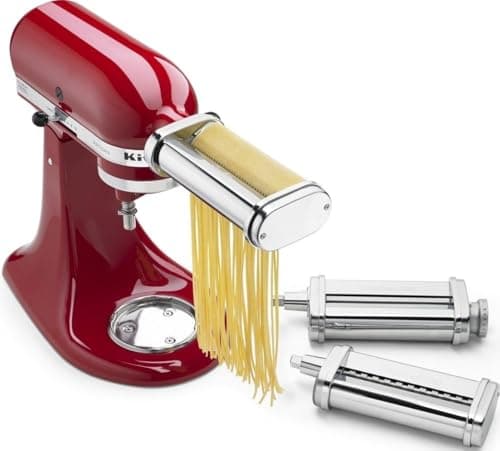
Shredding cooked chicken with the flat beater on low takes about twenty seconds and is the trick most new owners are delighted by. A mixer also mashes potatoes, mixes meatballs and meatloaf without warming the mixture with your hands, and whips the base for ice cream. Both KitchenAid and Cuisinart also sell attachments off the front power hub — pasta rollers, grinders, ice-cream bowls — which turn the motor into a small appliance platform; the ones worth having are covered in our stand mixer attachments guide, and the wider list is in what you can make with a stand mixer.
If you are still weighing whether the machine earns its counter space at all, the honest case both ways is in are stand mixers worth it, and the format comparison is hand mixer vs. stand mixer.
Frequently asked questions
Which stand mixer attachment do I use for cookies?
The flat beater. The dough hook is for yeast dough only and will just drag a lump of cookie dough around the bowl without mixing it properly.
What speed should I knead dough at?
Low to medium-low, and never higher. Running stiff dough fast does not knead it faster — it loads the motor, warms the dough and makes the machine walk across the counter.
Why is my cake batter curdled?
Almost always cold ingredients. Butter that is too cold will not cream, and cold eggs added to a creamed mixture split it. Bring both to room temperature and add eggs one at a time on low.
How full can I fill a stand mixer bowl?
Treat about two-thirds of the rated capacity as the working limit. The rated figure is total bowl volume, and batters climb while doughs expand.
Can you shred chicken in a stand mixer?
Yes, and it is the trick most new owners like best. Put warm cooked chicken in the bowl with the flat beater and run it on low for about twenty seconds.
Is a stand mixer dishwasher safe?
The bowl and attachments on the machines we track are dishwasher safe. The mixer body and head are wipe-clean only and should never go near water.
Sources
Keep reading
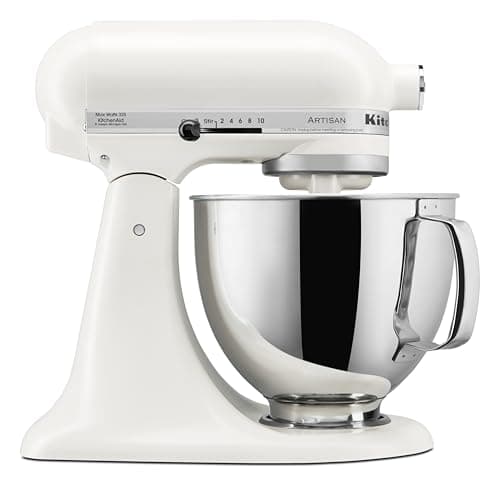
Stand Mixers
The Best Stand Mixers of 2026
KitchenAid Artisan, KitchenAid Classic and Cuisinart compared on bowl size, build and attachments.
Guide
Stand Mixer Attachments: Which Are Actually Worth It?
Which stand mixer attachments are worth buying, in what order, plus the compatibility traps to check first.
Guide
What Can You Make With a Stand Mixer?
Every job the beater, whisk and dough hook actually own — and what the attachment hub adds beyond baking.
Comparison
Hand Mixer vs. Stand Mixer
Job by job: where a hand mixer is genuinely the right buy, and the three tasks that need a stand mixer.
Comparison
Tilt-Head vs. Bowl-Lift: Which Stand Mixer Design?
Tilt-head vs bowl-lift on rigidity, dough capacity, loading, height and cost — and which design your baking needs.
Roundup
The Best Budget Stand Mixers
Budget stand mixers ranked on bowl size, stated wattage, weight and warranty — plus what you actually give up.
https://wattandwhisk.com/stand-mixers/how-to-use-a-stand-mixer