What Can You Make With a Stand Mixer?
Three attachments come in the box and each one owns a different set of jobs. Here is the full map, plus what the hub adds.
Disclosure:Watt & Whisk is reader-supported. When you buy through links on this page we may earn an Amazon Associates commission, at no extra cost to you. Prices are pulled live from Amazon and shown with the date checked. How this works.
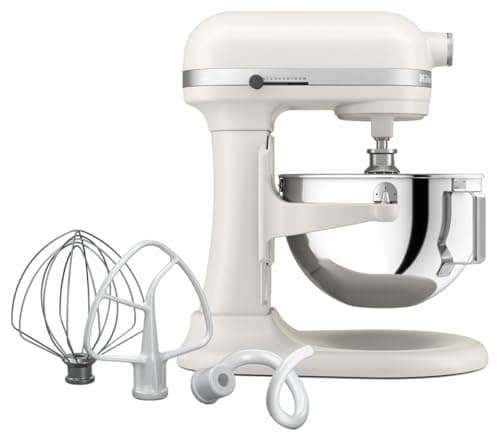
The three attachments in the box cover most of it: the flat beater creams butter and sugar, mixes cookie dough, mashes potatoes and shreds cooked chicken; the wire whip makes meringue, whipped cream and buttercream; the dough hook kneads bread, pizza and enriched doughs. Beyond that, the power hub on the front turns it into a pasta roller, meat grinder, ice cream maker, spiralizer or vegetable sheet cutter — which is where a mixer stops being a baking tool and becomes a general-purpose machine.
The short answer
Quick picks
| # | Product | Best for | Score | Price |
|---|---|---|---|---|
| 01 | 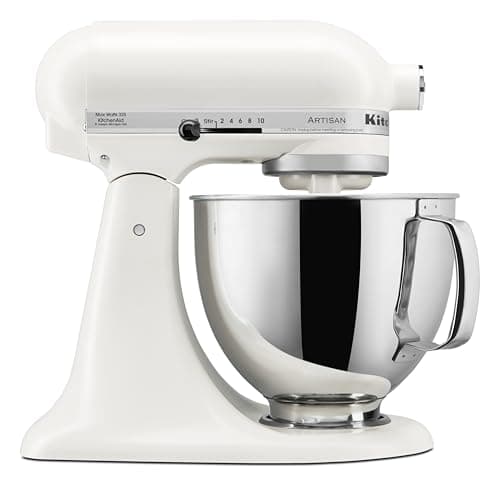 KitchenAid Artisan (5 Qt) The 5-quart tilt-head Artisan is the default for a reason: a metal body, a big color range, and the whole KitchenAid attachment ecosystem. It handles most home baking short of daily heavy bread. 5 Quart | Best overall stand mixer | 4.6★★★★★ | $489.00Amazon |
| 02 | 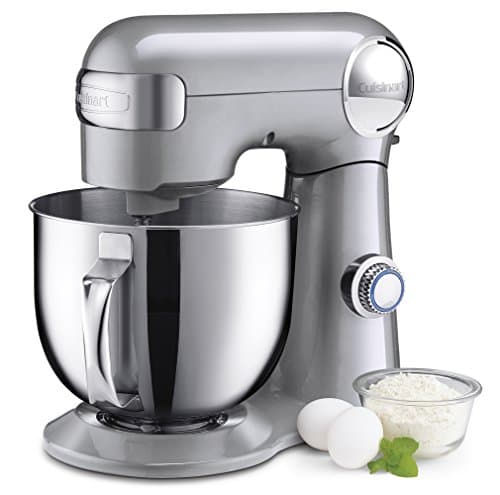 Cuisinart Precision Master SM-50 The 5.5-quart, 500-watt Precision Master gives you a bigger bowl and a stated higher wattage than a same-price KitchenAid. The trade-off is a smaller accessory ecosystem, but for straight mixing it's a lot of machine for the money. 5.5 Qt · 500W | Best big bowl for the money | 4.2★★★★★ | $229.95Amazon |
#ad · Live prices from the Amazon Product API, as of October 16, 2026. Where we have no verified live price, we show none — a gap beats a number that has rotted.
The picks, in detail
KitchenAid Artisan (5 Qt)
spec score /5
Price as of October 16, 2026. Prices change — Amazon's is the one that counts.
#ad · we may earn a commission from this link to KitchenAid Artisan (5 Qt)
The 5-quart tilt-head Artisan is the default for a reason: a metal body, a big color range, and the whole KitchenAid attachment ecosystem. It handles most home baking short of daily heavy bread.
- Capacity
- 5 Quart
- Footprint (W×D×H)
- 8.7 × 14.1 × 13.9 in
- Weight
- 22.8 lb
- Warranty
- 1 Year Limited Warranty
- Huge attachment ecosystem (grinder, pasta, more)
- All-metal build; holds resale value
- 5-qt bowl suits most baking
- Struggles with repeated stiff bread dough
- Premium price
- Heavy to lift on and off the counter
Cuisinart Precision Master SM-50
spec score /5
$319.9528% off
Price as of October 16, 2026. Prices change — Amazon's is the one that counts.
#ad · we may earn a commission from this link to Cuisinart Precision Master SM-50
The 5.5-quart, 500-watt Precision Master gives you a bigger bowl and a stated higher wattage than a same-price KitchenAid. The trade-off is a smaller accessory ecosystem, but for straight mixing it's a lot of machine for the money.
- Capacity
- 5.5 Qt
- Footprint (W×D×H)
- 11.2 × 16.5 × 15.9 in
- Power
- 500 W
- Weight
- 17 lb
- Cost per use*
- ≈3¢
- Est. per year*
- ≈$6
- Warranty
- Limited 3-Year Warranty
- Bigger 5.5-qt bowl
- 500 W stated motor
- Often cheaper than KitchenAid
- Smaller attachment ecosystem
- Less iconic resale value
- Plastic trim in places
*Cost-to-run computed from the manufacturer's stated 500W at $0.17/kWh (US average), 20-min sessions, 4×/week. Your rate and use will vary.
Most people buy a stand mixer for cake and then use it for cake. That is a lot of counter space and a lot of money for one job, and it is the main reason mixers end up as decorative objects. The machine is far more capable than its reputation, but only if you know which attachment owns which task — so this is a map rather than a recipe list.
Every job below is done by one of the three attachments that ship with essentially every mixer, or by something that clips into the power hub on the front.
The flat beater — the one you will use most
The paddle is the default attachment and it handles anything with body that does not need air whipped into it or gluten developed.
- Creaming butter and sugar. The foundation of most cakes and cookies, and genuinely tedious by hand.
- Cookie dough. KitchenAid rates the 4.5-quart Classic at 8 dozen cookies in a single batch using the flat beater, the 5-quart Artisan at 9 dozen, and the 5.5-quart bowl-lift at 11 dozen.
- Cake and brownie batter. Standard work.
- Mashed potatoes. KitchenAid rates the 5.5-quart bowl-lift at 6 lb of potatoes. Use a low speed — overworking potatoes turns them gluey.
- Shredding cooked chicken or pork. The trick nobody tells you. Put warm cooked meat in the bowl, run the beater on low, and it pulls apart in about twenty seconds.
- Meatballs, meatloaf and sausage mixes. Even distribution without warming the fat with your hands.
The wire whip — anything that needs air
The balloon whisk exists to beat air into things, and it is the attachment that makes the strongest case for owning a mixer at all, because these jobs are genuinely hard by hand.
- Whipped cream. KitchenAid specifies speed 8 for this on its 10-speed models.
- Meringue and pavlova. Egg whites need sustained high-speed beating for several minutes. This is the classic hands-free case.
- Swiss and Italian buttercream. Long beating while the mixture cools — close to impossible by hand, trivial with a mixer.
- Angel food and chiffon cakes. Entirely dependent on properly whipped whites.
- Mousse, marshmallow, nougat. All the same principle.
One genuine refinement here: KitchenAid's 5.5-quart bowl-lift adds an 11-speed range with a dedicated ½ speed for folding delicate ingredients like blueberries or whipped egg whites into a batter without knocking the air back out. That is a real feature rather than a spec-sheet number.
The dough hook — bread and enriched doughs
Kneading develops gluten, and it is ten minutes of sustained physical work that a machine does better than you do.
- Bread dough. KitchenAid rates the 5.5-quart bowl-lift at over 7 lb of bread dough per batch.
- Pizza dough. The most common weeknight use.
- Enriched doughs — brioche, challah, cinnamon rolls. These are the ones that genuinely need a machine, because the butter content makes them too sticky to knead comfortably by hand.
- Bagels and pretzels. Very stiff, low-hydration doughs that punish hand kneading — and that also punish an underpowered mixer.
This is the one job where machine choice genuinely matters. Heavy dough is what kills mixers, and a tilt-head design has less leverage over a stiff dough than a bowl-lift does — KitchenAid claims twice the power in the bowl for its bowl-lift versus the tilt-head KSM150. If bread is your main use, read tilt-head vs bowl-lift and best stand mixers for bread before buying.
The power hub — where it stops being a baking tool
The hub on the front of the mixer takes a drive from the same motor, and this is the part that changes the value calculation. KitchenAid lists over ten attachments; Cuisinart's SM-50 has a power outlet for its own range. Between them:
- Pasta roller and cutters. Fresh sheet pasta, fettuccine, spaghetti. The most-bought attachment and the one that most changes what you cook.
- Meat grinder. Grind your own burgers and sausage — you control the cut and the fat ratio.
- Ice cream maker. KitchenAid's is a 2-quart freeze bowl.
- Spiralizer and vegetable sheet cutter. Veggie noodles, ribbons.
- Food grinder and slicer/shredder. Overlaps a food processor, though a real processor does it faster.
Attachments are sold separately and they are not cheap, so treat the hub as an option rather than an included feature. Our stand mixer attachments guide works through which are worth buying and which sit in a drawer.
What a stand mixer does not do
Worth stating clearly, because this is where mis-purchases happen. A stand mixer does not chop, slice, shred raw vegetables, or purée — those are food processor and blender jobs, and the slicer attachments are a compromise rather than a replacement. It does not make smoothies. And it is poor at very small quantities: one egg white or a half-cup of cream sits below the whisk in a 5-quart bowl and never gets caught properly. For small jobs a hand mixer genuinely wins. See blender vs food processor for where those lines fall.
Which mixer for which jobs
If your list is mostly cakes, cookies and whipped things, a tilt-head is the right shape and the KitchenAid Artisan is the default — 5 quarts, 10 speeds, 59 touchpoints around the bowl, and the largest attachment ecosystem of anything here. Its 8.7-inch width is also the narrowest full-size mixer we track, which matters more than people expect.
If your list includes regular bread, or you want the widest capability for the money, the Cuisinart SM-50 gives you a 5.5-quart bowl, a 500-watt motor, 12 speeds, die-cast metal construction, a power outlet for attachments, and a 3-year warrantyagainst KitchenAid's one. That warranty gap is the single most under-discussed fact in this category — full comparison in KitchenAid vs Cuisinart.
Of everything above, cookies are the job most people buy a stand mixer for and the one with the most useful published number attached: KitchenAid rates the Classic at 8 dozen per batch, the Artisan at 9 and the 5.5-quart bowl-lift at 11, all on the flat beater at 28 grams of dough each. Nobody else publishes a comparable figure. The ranking on that basis is best stand mixers for cookies.
Frequently asked questions
What can you make with a stand mixer besides cake?
Bread and pizza dough, enriched doughs like brioche, meringue and buttercream, whipped cream, mashed potatoes, meatballs, and shredded chicken. With hub attachments it also makes fresh pasta, ground meat for burgers and sausage, ice cream, and spiralized vegetables.
Which stand mixer attachment do I use for what?
Flat beater for anything with body that does not need air or gluten — creaming, cookie dough, mashed potatoes, shredding cooked meat. Wire whip for anything needing air — meringue, whipped cream, buttercream. Dough hook for kneading bread, pizza and enriched doughs.
Can a stand mixer shred chicken?
Yes, and it is the trick most owners do not know. Put warm cooked chicken or pork in the bowl with the flat beater and run it on low — it pulls apart in about twenty seconds, far faster and neater than two forks.
How much cookie dough can a stand mixer handle?
KitchenAid rates its 4.5-quart Classic at 8 dozen cookies in a single batch using the flat beater, the 5-quart Artisan at 9 dozen, and the 5.5-quart bowl-lift at 11 dozen. The bowl-lift is also rated for over 7 lb of bread dough.
Are stand mixer attachments worth buying?
The pasta roller and the meat grinder genuinely change what you cook and are the two most-used. The slicer and shredder attachments overlap a food processor and are slower at it. Attachments are sold separately and are not cheap, so treat the hub as an option rather than an included feature.
Can a stand mixer replace a food processor?
No. A mixer does not chop, slice, shred raw vegetables or purée — the slicer attachments are a compromise rather than a replacement. It is also poor at very small quantities, because a half-cup of cream sits below the whisk in a 5-quart bowl.
Sources
Keep reading
Stand Mixers
The Best Stand Mixers of 2026
KitchenAid Artisan, KitchenAid Classic and Cuisinart compared on bowl size, build and attachments.
Guide
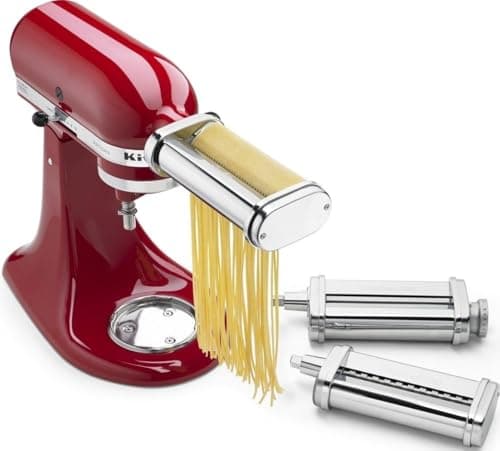
Stand Mixer Attachments: Which Are Actually Worth It?
Which stand mixer attachments are worth buying, in what order, plus the compatibility traps to check first.
Guide
Are Stand Mixers Worth It?
What a stand mixer genuinely does better than a hand mixer, what it doesn't, and the four questions that settle it.
Roundup
The Best Stand Mixers for Bread Dough
Four mixers ranked for bread: bowl-lift rigidity, stated dough capacity and what kneading does to a machine built for cake.
Comparison
Tilt-Head vs. Bowl-Lift: Which Stand Mixer Design?
Tilt-head vs bowl-lift on rigidity, dough capacity, loading, height and cost — and which design your baking needs.
Comparison
KitchenAid vs. Cuisinart: Which Stand Mixer Should You Buy?
KitchenAid vs Cuisinart on bowl size, wattage, warranty, attachments and resale — and who each brand is actually for.
https://wattandwhisk.com/stand-mixers/what-can-you-make-with-a-stand-mixer