The Best Stand Mixers for Bread Dough
Kneading is the one job that separates stand mixers. Here is what actually survives a weekly loaf — and what quietly wears out doing it.
Disclosure:Watt & Whisk is reader-supported. When you buy through links on this page we may earn an Amazon Associates commission, at no extra cost to you. Prices are pulled live from Amazon and shown with the date checked. How this works.
For regular bread the bowl-lift KitchenAid KSM55 is the machine to buy: KitchenAid rates it at twice the in-bowl power of a KSM150 tilt-head and lists it as kneading over 7 lb of dough, with a 3-point locking bowl that does not flex under a loaded hook. On a budget the Aucma 6.5-quart gives you the biggest bowl here and a stated 660 watts for a fraction of the price. The Cuisinart SM-50 is the best tilt-head compromise, and the KitchenAid Artisan handles occasional loaves but is not a weekly bread machine.
The short answer
Quick picks
| # | Product | Best for | Score | Price |
|---|---|---|---|---|
| 01 | 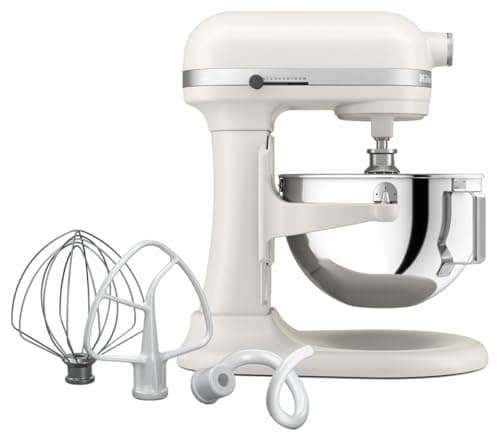 KitchenAid 5.5-Qt Bowl-Lift KSM55 This is the answer to the one thing the tilt-head Artisan genuinely struggles with. KitchenAid rates the bowl-lift KSM55 at twice the power in the bowl of a KSM150 tilt-head and lists it as kneading over 7 lb of bread dough, with a 3-point locking bowl that doesn't walk when the hook loads up. 5.5 Q | Best for bread dough | 4.6★★★★★ | Check price → |
| 02 | 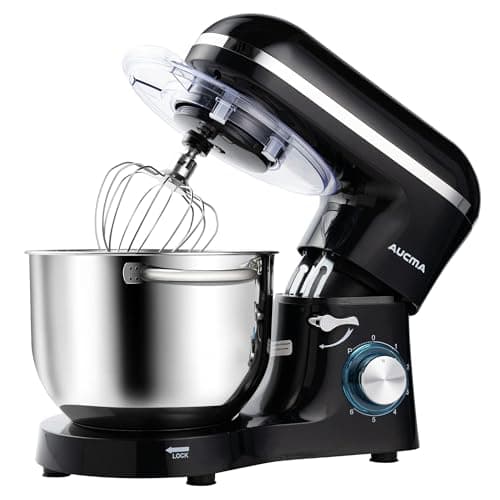 Aucma 6.5-Qt Stand Mixer The value play: a 6.5-quart stainless bowl and a stated 660-watt copper motor with 6 speeds and pulse, for less than a 4.5-quart KitchenAid Classic. You give up the brand's attachment ecosystem and resale value; you get a bigger bowl and a higher stated wattage for the money. 6.5QT · 660W | Best big bowl on a budget | 4.0★★★★★ | $129.99Amazon |
| 03 | 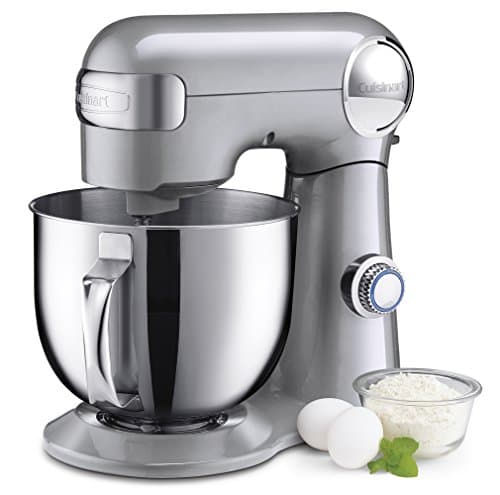 Cuisinart Precision Master SM-50 The 5.5-quart, 500-watt Precision Master gives you a bigger bowl and a stated higher wattage than a same-price KitchenAid. The trade-off is a smaller accessory ecosystem, but for straight mixing it's a lot of machine for the money. 5.5 Qt · 500W | Best big bowl for the money | 4.2★★★★★ | $229.95Amazon |
| 04 | 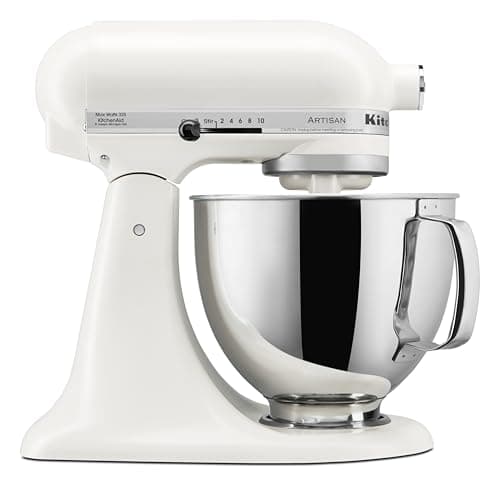 KitchenAid Artisan (5 Qt) The 5-quart tilt-head Artisan is the default for a reason: a metal body, a big color range, and the whole KitchenAid attachment ecosystem. It handles most home baking short of daily heavy bread. 5 Quart | Best overall stand mixer | 4.6★★★★★ | $489.00Amazon |
#ad · Live prices from the Amazon Product API, as of October 17, 2026. Where we have no verified live price, we show none — a gap beats a number that has rotted.
The picks, in detail
KitchenAid 5.5-Qt Bowl-Lift KSM55
spec score /5
No buyable offer at the last price check (October 17, 2026). We show nothing rather than a stale number.
#ad · we may earn a commission from this link to KitchenAid 5.5-Qt Bowl-Lift KSM55
This is the answer to the one thing the tilt-head Artisan genuinely struggles with. KitchenAid rates the bowl-lift KSM55 at twice the power in the bowl of a KSM150 tilt-head and lists it as kneading over 7 lb of bread dough, with a 3-point locking bowl that doesn't walk when the hook loads up.
- Capacity
- 5.5 Q
- Footprint (W×D×H)
- 11.31 × 14.63 × 16.5 in
- Warranty
- 1 Year Replacement Plan - Stand Mixer - $19.95
- Listed at 2× the in-bowl power of a KSM150 tilt-head
- Rated to knead over 7 lb of bread dough
- 3-point locking bowl stays put under a heavy hook
- The priciest mixer we list
- 16.5 in tall with the bowl raised — check your cabinets
- Bowl-lift is slower to load than a tilt-head
Aucma 6.5-Qt Stand Mixer
spec score /5
$169.9924% off
Price as of October 17, 2026. Prices change — Amazon's is the one that counts.
#ad · we may earn a commission from this link to Aucma 6.5-Qt Stand Mixer
The value play: a 6.5-quart stainless bowl and a stated 660-watt copper motor with 6 speeds and pulse, for less than a 4.5-quart KitchenAid Classic. You give up the brand's attachment ecosystem and resale value; you get a bigger bowl and a higher stated wattage for the money.
- Capacity
- 6.5QT
- Footprint (W×D×H)
- 9.3700787306 × 15.2362204569 × 12.3622047118 in
- Power
- 660 W
- Weight
- 11.68 lb
- Cost per use*
- ≈4¢
- Est. per year*
- ≈$8
- 6.5-qt bowl — the biggest here
- 660 W stated motor with pulse
- Whisk, dough hook and beater all dishwasher-safe
- No attachment ecosystem beyond the three included tools
- No published warranty on the listing
- Less proven long-term than the big brands
*Cost-to-run computed from the manufacturer's stated 660W at $0.17/kWh (US average), 20-min sessions, 4×/week. Your rate and use will vary.
Cuisinart Precision Master SM-50
spec score /5
$319.9528% off
Price as of October 17, 2026. Prices change — Amazon's is the one that counts.
#ad · we may earn a commission from this link to Cuisinart Precision Master SM-50
The 5.5-quart, 500-watt Precision Master gives you a bigger bowl and a stated higher wattage than a same-price KitchenAid. The trade-off is a smaller accessory ecosystem, but for straight mixing it's a lot of machine for the money.
- Capacity
- 5.5 Qt
- Footprint (W×D×H)
- 11.2 × 16.5 × 15.9 in
- Power
- 500 W
- Weight
- 17 lb
- Cost per use*
- ≈3¢
- Est. per year*
- ≈$6
- Warranty
- Limited 3-Year Warranty
- Bigger 5.5-qt bowl
- 500 W stated motor
- Often cheaper than KitchenAid
- Smaller attachment ecosystem
- Less iconic resale value
- Plastic trim in places
*Cost-to-run computed from the manufacturer's stated 500W at $0.17/kWh (US average), 20-min sessions, 4×/week. Your rate and use will vary.
KitchenAid Artisan (5 Qt)
spec score /5
Price as of October 17, 2026. Prices change — Amazon's is the one that counts.
#ad · we may earn a commission from this link to KitchenAid Artisan (5 Qt)
The 5-quart tilt-head Artisan is the default for a reason: a metal body, a big color range, and the whole KitchenAid attachment ecosystem. It handles most home baking short of daily heavy bread.
- Capacity
- 5 Quart
- Footprint (W×D×H)
- 8.7 × 14.1 × 13.9 in
- Weight
- 22.8 lb
- Warranty
- 1 Year Limited Warranty
- Huge attachment ecosystem (grinder, pasta, more)
- All-metal build; holds resale value
- 5-qt bowl suits most baking
- Struggles with repeated stiff bread dough
- Premium price
- Heavy to lift on and off the counter
Every stand mixer will make bread once. The interesting question is which ones will still be making it in five years, because kneading is the only job in home baking that puts a mixer under sustained mechanical stress rather than a brief one. Whipping cream is a sprint. Kneading a stiff dough for ten minutes is a load test.
This guide is built around that distinction. All figures come from each machine's current manufacturer listing — see how we review for what our scores mean and, more importantly, what they do not.
What kneading actually does to a mixer
Three things, and understanding them tells you what to look for.
It applies continuous torque at low speed. Manufacturers tell you to knead at speed 2 — a slow, heavy grind rather than a fast spin. Electric motors are least efficient at low speed under high load, and the excess becomes heat. A mixer that runs warm after ten minutes of kneading is behaving normally; one that runs hot is being asked for more than it has.
It applies that torque off-center.A dough hook does not sweep evenly — it catches the mass, drags it up the bowl wall, and drops it. That produces a rhythmic side load that tries to twist the whole machine. This is why mixers "walk" across a counter during kneading, and why weight and bowl mounting matter more than they do for any other job.
It runs long. A cake batter is two or three minutes. A brioche or bagel dough can be twelve. Duty cycle, not peak capability, is what wears mixers out on bread.
What to look for
- Bowl mounting. A bowl-lift with a locking cradle transmits the load into the frame. A tilt-head slot-in bowl lets the head flex fractionally on the hinge, and that flex is what you feel as rocking.
- Stated dough capacity. The most useful spec on any mixer listing, and the one most brands decline to publish. When a maker does state it, believe it.
- Bowl volume versus dough volume. Dough needs headroom to be thrown around. A 4.5-quart bowl handling a large loaf is full before it is heavy.
- Weight. Counter-intuitively, heavier is better here — mass is what stops the machine walking.
The picks
KitchenAid bowl-lift KSM55 — the right tool
This is the machine the category is built around and the only one here whose listing makes a specific dough claim: over 7 lb of bread dough, alongside 11 dozen cookies and 6 lb of mashed potato. It also states 2× the power in the bowl versus a KSM150 tilt-head — KitchenAid's own comparison, not ours — and uses a 3-point locking bowl specifically for stability under load.
The 5.5-quart bowl gives real headroom for a double batch, and the 11 speeds include a ½ speed for folding delicate things in afterwards. It shares the full KitchenAid attachment hub, so a grain mill or pasta roller is an accessory rather than another appliance.
The cons are straightforward and worth stating. It is the most expensive machine on this page by a wide margin. At 16.5 inches tall with the bowl raised it comes close to a standard 18-inch cabinet gap — measure first. A bowl-lift is genuinely slower to load and scrape than a tilt-head, and you will notice that every single time you use it for something that is not bread. And the listing carries a 1-year replacement plan rather than a long warranty.
Aucma 6.5-quart — the budget bread option
The value case is strong and worth taking seriously rather than dismissing. A 6.5-quart stainless bowl — the biggest here, a full quart more than the KitchenAid bowl-lift — with a stated 660-watt copper motor, six speeds plus pulse, and dishwasher-safe whisk, dough hook and beater in the box, for less than a 4.5-quart KitchenAid Classic.
At 11.68 lb it is also less than half the weight of a KitchenAid, and that is the honest catch: mass is what keeps a mixer planted during kneading, and a lighter tilt-head machine is more likely to travel across the counter under a heavy hook. Watch it rather than leaving the room. The other cons are a thin accessory range beyond the three included tools, no published warranty on the listing, and less long-term track record than the established brands. If your bread is a weekend hobby rather than a habit, the bowl size for the money is hard to argue with.
Cuisinart Precision Master SM-50 — best tilt-head for dough
If you want a tilt-head for the convenience but bake bread more than occasionally, this is the sensible pick. It has the largest tilt-head bowl here at 5.5 quarts, a published 500-watt motor where KitchenAid publishes nothing, 12 speeds for finer low-end control, and a 3-year limited warranty — three times what the KitchenAid tilt-heads carry, which is a meaningful signal on a machine you intend to work hard.
The trade-offs: at 17 lb it is the lightest of the established-brand options and can rock under a stiff dough, the 11.2 × 16.5-inch footprint is the largest here, and the accessory ecosystem is thin. It is a compromise machine — but it is the best-judged compromise on this page, and we compare it against KitchenAid in detail in KitchenAid vs. Cuisinart.
KitchenAid Artisan — fine for occasional loaves
Included because it is the mixer most people already own or are about to buy, and the honest advice is: it will make bread, just not endlessly. The 5-quart bowl handles a standard loaf, the all-metal build is solid, and the attachment hub is the full ecosystem. What it does not have is a published dough rating, a locking bowl, or the rigidity of a bowl-lift — and KitchenAid's own 2× claim for the KSM55 is an implicit admission of where the tilt-head sits.
If you bake bread once a month, buy this and enjoy it. If you bake weekly, buy the bowl-lift instead and you will not be replacing a mixer in three years. The full range breakdown is in KitchenAid models compared.
Dough hooks are not all the same shape
A detail that changes results and almost never gets mentioned. There are two common hook geometries and they knead differently.
The C-hook— a simple curved hook, which is what ships with most tilt-head mixers — drags the dough around the bowl and folds it against the wall. It works, and on a stiff dough it tends to let the mass ride up and spin with the hook rather than being worked, which is the "the dough is just going round with it" problem people describe.
The spiral hook — a corkscrew shape, more common on bowl-lift machines and on dedicated bread mixers — pushes the dough down and outward as it turns, so the mass stays low in the bowl and gets stretched rather than carried. For bread it is the better geometry, and it is part of why bowl-lift machines feel more capable on dough than their motor specs alone would suggest.
If your machine came with a C-hook and dough climbs it, two fixes help before you buy anything: start with a slightly wetter dough, and stop the machine once or twice to pull the mass back down. If you knead often, a spiral hook that fits your model is one of the few genuinely worthwhile mixer accessories.
Sizing the bowl to the loaf
Bowl capacity in quarts does not map intuitively onto loaves, so here is the practical relationship. Dough needs roughly three times its own volume in bowl space to be worked properly — it has to be thrown, caught and folded, not just contained. A bowl filled more than about a third with dough will bind rather than knead.
That is why the KitchenAid bowl-lift's 5.5 quarts translates to a stated capacity of over 7 lb of dough while a 4.5-quart tilt-head does not publish a figure at all, and it is why the Aucma's 6.5-quart bowl is a genuine advantage for large batches even though it is a cheaper machine. If you routinely make two loaves at once, bowl volume constrains you before motor power does.
Technique that saves your mixer
Three habits, all free, all recommended by the manufacturers themselves. Knead at speed 2, not higher — going faster does not knead better and it multiplies the heat. Rest the machine if it feels hot: split a twelve-minute knead into two six-minute sessions with a five-minute autolyse in between, which is better for the dough anyway. And do not exceed the stated flour capacity; if a maker publishes a dough limit, that is a mechanical limit, not a suggestion.
A fourth, less obvious one: high-hydration doughs are far kinder to a mixer than stiff ones. A wet ciabatta dough flows and shears; a stiff bagel dough grabs and fights. If you are working near your machine's limit, adding water is the cheapest upgrade available.
Warning signs your mixer is struggling
Four things to watch for, because catching them early is the difference between adjusting your technique and replacing a machine.
A burning or hot-electrical smell. Stop immediately and let it cool completely. This is the motor overheating, and continuing is how a repairable machine becomes a dead one. Reduce the batch, raise the hydration, or split the knead.
The motor bogging audibly at speed 2. A mixer kneading properly has a steady rhythm as the hook catches and releases. A drop in pitch that does not recover means the load is beyond it.
Dough climbing the hook. Usually a dough that is too stiff or a bowl too full rather than a machine fault, but it means the dough is riding rather than being worked — so you are running the motor without kneading anything.
Walking across the counter.Some movement under a heavy hook is normal. Traveling far enough that you have to catch it means the load, the dough stiffness or the machine's mass is wrong for the job — and a mixer that falls off a counter is a finished mixer.
When a mixer is not the answer
Two honest alternatives. A food processorwith a dough blade brings dough together in about a minute — Ninja rates the BN601's dough program for exactly this — but it mixes rather than kneads, developing gluten by shear rather than by stretch. It is excellent for pizza and pastry, poor for an open-crumb sourdough. Our blender vs. food processor guide covers where that line sits.
And your hands, genuinely. No-knead and stretch-and-fold methods produce excellent bread with no machine at all, and if you bake one loaf a week they are a legitimate reason not to spend anything. Buy a mixer for volume, for stiff doughs, or because you also want the cakes, cookies and attachments — not because bread requires one.
Why wetter dough is easier on every machine here
The cheapest upgrade available to anyone reading this is water, and it is worth understanding rather than just accepting.
Hydration is the weight of water as a percentage of the weight of flour. A standard sandwich loaf sits around 60 to 65%; a ciabatta or a rustic sourdough can run 75 to 80%. A stiff, low-hydration dough resists the hook — it grabs, binds and transmits the whole load into the machine's frame. A wetter dough flows and shears, so the hook works through it rather than fighting it.
The practical consequence is that a machine that struggles with a stiff bagel dough may be entirely comfortable with a much larger quantity of a wetter one. If you are near the limit of what your mixer can do, raising hydration by five percentage points does more than any accessory, and it usually improves the bread as well. Bagels and pretzels are the honest exception — they are supposed to be stiff, and if you make them regularly you need the bowl-lift class of machine rather than a technique adjustment.
The verdict
Weekly bread, any dough: KitchenAid bowl-lift KSM55. Big batches on a budget, watched rather than left alone: Aucma 6.5-quart. Tilt-head convenience with dough capability: Cuisinart SM-50. Occasional loaves alongside everything else: KitchenAid Artisan. If cost is the binding constraint, our budget stand mixer guide covers what the cheaper end can and cannot do.
One alternative route deserves a mention here, because it is faster than every machine on this page: a food processor with a dough blade kneads pizza and basic bread dough in 45 to 90 seconds rather than ten minutes. It is not a substitute for enriched or long-fermented doughs, and stand mixer vs. food processor explains exactly where the two part company.
Bread and cookies pull in opposite directions, which is why this page and its sibling disagree. Bread rewards a bowl-lift, a locking bowl and raw torque; cookie dough rewards low-speed resolution and a flat beater, and for once there is a published spec aimed straight at it — KitchenAid rates its mixers in dozens of cookies. The reordering on that basis is best stand mixers for cookies.
Frequently asked questions
What is the best stand mixer for bread dough?
The bowl-lift KitchenAid KSM55. Its listing states twice the in-bowl power of a KSM150 tilt-head and a capacity of over 7 lb of bread dough, and its 3-point locking bowl does not flex under a loaded hook — which is what separates a bread machine from a cake machine.
Can a tilt-head stand mixer handle bread dough?
For occasional loaves, yes. For weekly bread, it is working outside its comfort zone: the head flexes slightly on the hinge under a loaded dough hook, the machine rocks, and sustained low-speed kneading generates heat in a motor optimized for creaming.
What speed should you knead bread dough on a stand mixer?
Speed 2. Going faster does not knead better and multiplies the heat in the motor. If the machine feels hot, split a long knead into two shorter sessions with a rest in between — which is better for the dough anyway.
Why does my stand mixer move across the counter when kneading?
Because a dough hook loads the machine off-center — it catches the mass, drags it up the bowl wall and drops it, producing a rhythmic side load. Weight is what resists this, which is why heavier mixers walk less. A bowl-lift's locking cradle transmits the load into the frame instead.
Do I need a stand mixer to make bread?
No. No-knead and stretch-and-fold methods produce excellent bread with no machine at all. Buy a mixer for volume, for stiff doughs that are genuinely hard work by hand, or because you also want cakes, cookies and the attachment ecosystem.
How much dough can a stand mixer handle?
Only when the maker publishes a figure can you know. KitchenAid states over 7 lb of bread dough for the bowl-lift KSM55; neither KitchenAid tilt-head listing publishes a dough capacity at all. Treat a published limit as a mechanical limit rather than a suggestion.
Sources
Keep reading
Stand Mixers
The Best Stand Mixers of 2026
KitchenAid Artisan, KitchenAid Classic and Cuisinart compared on bowl size, build and attachments.
Comparison
KitchenAid Models Compared: Classic vs. Artisan vs. Bowl-Lift
Classic vs Artisan vs bowl-lift KSM55 — what actually changes between KitchenAid's models, and which one you need.
Roundup
The Best Budget Stand Mixers
Budget stand mixers ranked on bowl size, stated wattage, weight and warranty — plus what you actually give up.
Comparison
KitchenAid vs. Cuisinart: Which Stand Mixer Should You Buy?
KitchenAid vs Cuisinart on bowl size, wattage, warranty, attachments and resale — and who each brand is actually for.
Comparison
Tilt-Head vs. Bowl-Lift: Which Stand Mixer Design?
Tilt-head vs bowl-lift on rigidity, dough capacity, loading, height and cost — and which design your baking needs.
https://wattandwhisk.com/stand-mixers/best-stand-mixers-for-bread