KitchenAid Models Compared: Classic vs. Artisan vs. Bowl-Lift
Three machines, one attachment hub, and a genuine capability step between the tilt-heads and the bowl-lift that the price tags don't advertise.
Disclosure:Watt & Whisk is reader-supported. When you buy through links on this page we may earn an Amazon Associates commission, at no extra cost to you. Prices are pulled live from Amazon and shown with the date checked. How this works.
The Classic (4.5 qt) and Artisan (5 qt) are mechanically the same tilt-head machine — you are buying half a quart, a wider color range and a price difference, and they take identical attachments. The bowl-lift KSM55 (5.5 qt) is the one that is genuinely different: KitchenAid rates it at twice the in-bowl power of a KSM150 tilt-head and lists it as kneading over 7 lb of bread dough. If you bake bread, that is the model. If you bake cakes and cookies, it is not worth the money.
The short answer
Quick picks
| # | Product | Best for | Score | Price |
|---|---|---|---|---|
| 01 | 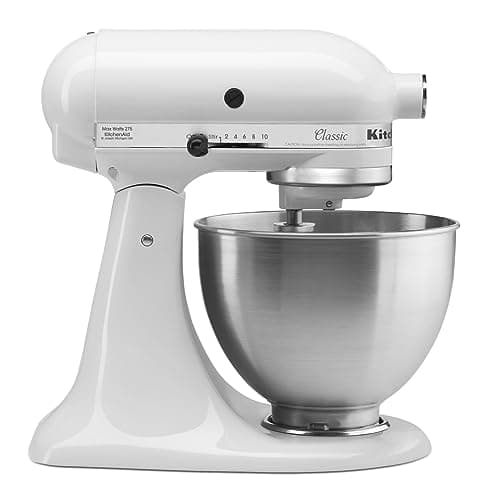 KitchenAid Classic (4.5 Qt) The 4.5-quart Classic is the cheapest way into the KitchenAid ecosystem and takes the same attachments as the Artisan. A slightly smaller bowl and fewer colors, but the same fundamentals. 4.5 Q | Best budget KitchenAid | 4.3★★★★★ | $322.99Amazon |
| 02 | 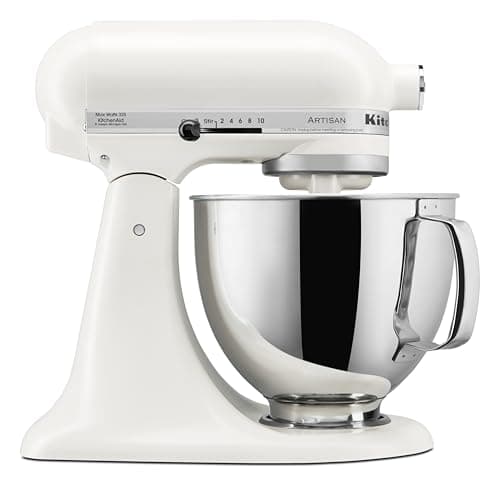 KitchenAid Artisan (5 Qt) The 5-quart tilt-head Artisan is the default for a reason: a metal body, a big color range, and the whole KitchenAid attachment ecosystem. It handles most home baking short of daily heavy bread. 5 Quart | Best overall stand mixer | 4.6★★★★★ | $489.00Amazon |
| 03 | 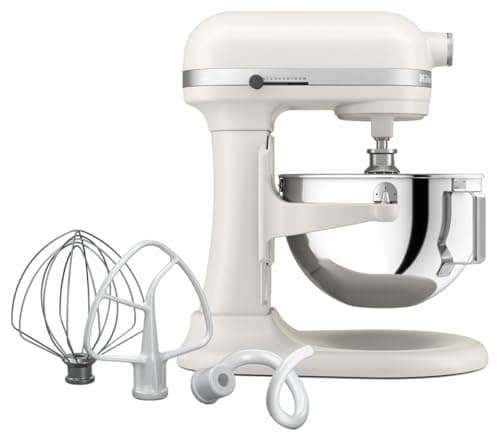 KitchenAid 5.5-Qt Bowl-Lift KSM55 This is the answer to the one thing the tilt-head Artisan genuinely struggles with. KitchenAid rates the bowl-lift KSM55 at twice the power in the bowl of a KSM150 tilt-head and lists it as kneading over 7 lb of bread dough, with a 3-point locking bowl that doesn't walk when the hook loads up. 5.5 Q | Best for bread dough | 4.6★★★★★ | Check price → |
#ad · Live prices from the Amazon Product API, as of October 17, 2026. Where we have no verified live price, we show none — a gap beats a number that has rotted.
The picks, in detail
KitchenAid Classic (4.5 Qt)
spec score /5
$399.9919% off
Price as of October 17, 2026. Prices change — Amazon's is the one that counts.
#ad · we may earn a commission from this link to KitchenAid Classic (4.5 Qt)
The 4.5-quart Classic is the cheapest way into the KitchenAid ecosystem and takes the same attachments as the Artisan. A slightly smaller bowl and fewer colors, but the same fundamentals.
- Capacity
- 4.5 Q
- Footprint (W×D×H)
- 8.7 × 14.1 × 13.9 in
- Weight
- 24.2 lb
- Warranty
- 1 Year Limited Warranty
- Lowest-cost route to KitchenAid
- Takes the full attachment lineup
- Compact-ish 4.5-qt bowl
- Smaller bowl than the Artisan
- Fewer color options
- Same dough limits as the 5-qt
KitchenAid Artisan (5 Qt)
spec score /5
Price as of October 17, 2026. Prices change — Amazon's is the one that counts.
#ad · we may earn a commission from this link to KitchenAid Artisan (5 Qt)
The 5-quart tilt-head Artisan is the default for a reason: a metal body, a big color range, and the whole KitchenAid attachment ecosystem. It handles most home baking short of daily heavy bread.
- Capacity
- 5 Quart
- Footprint (W×D×H)
- 8.7 × 14.1 × 13.9 in
- Weight
- 22.8 lb
- Warranty
- 1 Year Limited Warranty
- Huge attachment ecosystem (grinder, pasta, more)
- All-metal build; holds resale value
- 5-qt bowl suits most baking
- Struggles with repeated stiff bread dough
- Premium price
- Heavy to lift on and off the counter
KitchenAid 5.5-Qt Bowl-Lift KSM55
spec score /5
No buyable offer at the last price check (October 17, 2026). We show nothing rather than a stale number.
#ad · we may earn a commission from this link to KitchenAid 5.5-Qt Bowl-Lift KSM55
This is the answer to the one thing the tilt-head Artisan genuinely struggles with. KitchenAid rates the bowl-lift KSM55 at twice the power in the bowl of a KSM150 tilt-head and lists it as kneading over 7 lb of bread dough, with a 3-point locking bowl that doesn't walk when the hook loads up.
- Capacity
- 5.5 Q
- Footprint (W×D×H)
- 11.31 × 14.63 × 16.5 in
- Warranty
- 1 Year Replacement Plan - Stand Mixer - $19.95
- Listed at 2× the in-bowl power of a KSM150 tilt-head
- Rated to knead over 7 lb of bread dough
- 3-point locking bowl stays put under a heavy hook
- The priciest mixer we list
- 16.5 in tall with the bowl raised — check your cabinets
- Bowl-lift is slower to load than a tilt-head
KitchenAid's line-up is confusing on purpose — the model codes are opaque, the color options multiply the SKUs, and the marketing implies a smooth ladder of quality from cheap to expensive. It is not a ladder. There is one real step in it, and knowing where that step sits saves you either a lot of money or a lot of frustration.
All figures below are from each model's current listing. Our method is on how we review — this is a specification comparison, not a hands-on bake-off, and we say so plainly.
The three models side by side
| Spec | Classic (K45SS) | Artisan (KSM150) | Bowl-lift (KSM55) |
|---|---|---|---|
| Bowl capacity | 4.5 qt | 5 qt | 5.5 qt |
| Head design | Tilt-head | Tilt-head | Bowl-lift |
| Speeds | 10 | 10 | 11 (incl. ½ speed) |
| Stated dough capacity | — | — | Over 7 lb bread dough |
| Footprint (W × D) | 8.7 × 14.1 in | 8.7 × 14.1 in | 11.31 × 14.63 in |
| Height | 13.9 in | 13.9 in | 16.5 in |
| Weight | 24.2 lb | 22.8 lb | — |
| Bowl attachment | Slot-in | Slot-in | 3-point locking |
| Warranty (as listed) | 1-year limited | 1-year limited | 1-year replacement plan |
| Attachment hub | Yes | Yes | Yes |
Tilt-head vs. bowl-lift: the only real difference
A tilt-head mixer hinges backwards so you can lift the head away and get at the bowl. It is quicker to load, easier to scrape, and lower — 13.9 inches, which clears any cabinet with the head down. The bowl slots into a plate and twists to lock.
A bowl-lift keeps the head fixed and raises the bowl to the beater on a lever, with the bowl held in a three-point locking cradle. It is slower to load and taller — 16.5 inches — but the fixed head and locked bowl mean the whole assembly does not flex when the dough hook loads up. That rigidity is the point.
KitchenAid quantifies the consequence on the KSM55 listing: 2× the power in the bowl compared to a KSM150 tilt-head, and a stated capacity of over 7 lb of bread dough, 11 dozen cookies in a batch, or 6 lb of mashed potato. Neither tilt-head listing publishes a dough figure at all, which is itself informative.
This is the step in the range. Everything else — bowl size, colors, price — is a preference. Tilt-head versus bowl-lift is a capability difference, and it is the only question in this comparison with a wrong answer.
Classic vs. Artisan: half a quart and a color chart
These two are the same machine in the ways that matter. Identical 8.7 × 14.1-inch footprint, identical 13.9-inch height, same 10 speeds, same tilt-head design, same attachment hub, same 1-year limited warranty. The differences are a 4.5-quart bowl against a 5-quart one, a much narrower color range on the Classic, and the price.
Half a quart sounds trivial and mostly is — it is roughly one extra dozen cookies per batch. Where it shows up is at the bottom of the bowl rather than the top: a smaller bowl with the same beater geometry copes slightly less well with very small quantities, like whipping a single egg white or creaming a quarter-cup of butter. Both machines have the same complaint there; the Classic just has it marginally more.
Oddly, the Classic is listed as the heavier of the two at 24.2 lb against the Artisan's 22.8. Neither is a machine you want to lift daily. If you plan to store it in a cupboard rather than leave it out, that is worth knowing before you buy — and it is a strong argument for the much lighter alternatives in our budget stand mixer guide.
What all three struggle with
Both tilt-heads share a well-known limit: repeated stiff, low-hydration bread dough. The head flexes very slightly under a loaded hook, the machine rocks on the counter, and sustained kneading generates heat in a motor that was optimized for creaming rather than grinding. It will make a loaf. It does not enjoy making a loaf every week for five years.
The bowl-lift addresses exactly this, which is why it exists. If bread is an occasional weekend thing, a tilt-head is fine and you should not spend the extra. If bread is a routine, buy the bowl-lift and stop reading — we go deeper in best stand mixers for bread.
What the model codes actually mean
KitchenAid's naming is the main reason this range confuses people, so here is the decode. The letters are the series and the digits are the capacity or generation; the trailing letters are the color, and they are why the same machine appears under a dozen different codes.
- K45SS — the Classic. K for the original tilt-head line, 45 for 4.5 quarts, SS for the stainless bowl. Trailing letters like WH are the color.
- KSM150 — the Artisan. KSM is KitchenAid Stand Mixer; the 150 series is the 5-quart tilt-head. The Artisan is the KSM150 whatever the color suffix says.
- KSM55 — the 5.5-quart bowl-lift. Same KSM prefix, different series number, and the one whose listing carries the 2× in-bowl power claim and the 7 lb dough rating.
The practical takeaway: ignore the trailing letters entirely. If two listings show the same series number, they are the same machine in different colors, and the price gap between them is a color premium rather than a capability one. That is the single most useful thing to know when comparing listings, because the range looks far more complicated than it is.
The other consequence is that a color going out of fashion is a buying opportunity — the discontinued shade of a current-series machine is mechanically identical to the fashionable one and frequently much cheaper.
Attachments: identical across all three
This is the good news and the main reason to buy into the brand at all. The power hub is the same fitting on every model here, so a pasta roller, meat grinder, spiralizer, grain mill or ice cream bowl bought today fits whichever machine you own and whichever you replace it with in fifteen years. KitchenAid lists over ten attachments, sold separately, and the third-party market is larger.
Practically, this means you should not choose a model based on attachments — they all take them. Choose on bowl design and capacity, and buy attachments later if you actually want them. Most people never do, which is worth being honest with yourself about before paying the ecosystem premium; the alternative view is in KitchenAid vs. Cuisinart.
The one underrated feature
The KSM55 listing calls out a ½ speed designed for folding — gently adding delicate ingredients like blueberries or whipped egg whites into a batter without overbeating them. Anyone who has watched a mixer on its lowest setting demolish a folded mousse will recognize the problem. It is a small thing that only appears on the bowl-lift, and it is genuinely useful.
What does not change across the range
Almost as useful as knowing what differs is knowing what does not, because it stops you paying for things you already have.
The beater set. All three ship with a flat beater, a dough hook and a wire whip. There is no model here where you have to buy the basics separately.
The build. These are all-metal machines across the range — the Classic is not a plastic version of the Artisan. That is why even the entry model holds resale value and why independent repair is routine.
The speed behavior.Ten or eleven speeds sounds like a difference and is not much of one; the useful settings for almost every recipe are the lowest (combining), somewhere in the middle (creaming) and near the top (whipping). The bowl-lift's extra ½ speed for folding is the only genuinely distinct addition.
The maintenance. All of them need the same occasional attention: check the beater-to-bowl clearance if the paddle starts leaving a film at the bottom, and keep the attachment hub clean. Neither is model-specific.
Who should buy which
Buy the Classic if you want into the KitchenAid ecosystem for the least money and 4.5 quarts covers your baking. Buy the Artisan if you want the 5-quart bowl or a specific color, and accept you are paying for both. Buy the bowl-lift KSM55 if you knead bread regularly, batch-bake, or want the folding speed and the rigidity — and check your cabinet clearance first, because 16.5 inches with the bowl raised is close to the standard 18-inch gap.
If none of these is quite right, our best stand mixers guide covers the whole category, and what each appliance brand is good at puts KitchenAid in context against the rest of your kitchen.
Notice what is absent from all three spec sheets above: a wattage figure. KitchenAid publishes none on any stand mixer, and its single power claim — the bowl-lift's "2x the power in the bowl" — is footnoted as peak horsepower measured in the bowl, above speed 2, against the KSM150. What that means, and what the rest of the category publishes, is in how many watts a stand mixer needs.
Frequently asked questions
What is the difference between a KitchenAid Classic and Artisan?
Very little mechanically. Both are tilt-head mixers with an identical 8.7 × 14.1-inch footprint, 13.9-inch height, 10 speeds and the same attachment hub. The Artisan has a 5-quart bowl and a much wider color range; the Classic has 4.5 quarts and fewer colors for less money.
Is a bowl-lift KitchenAid better than a tilt-head?
For dough, yes. KitchenAid rates the bowl-lift KSM55 at twice the in-bowl power of a KSM150 tilt-head and lists it as kneading over 7 lb of bread dough, with a 3-point locking bowl that does not flex under a loaded hook. For cakes and cookies, a tilt-head is easier to load and cheaper.
Which KitchenAid is best for bread?
The bowl-lift KSM55. Tilt-head models flex slightly under a loaded dough hook and generate heat in a motor optimized for creaming, so they cope with occasional loaves but not weekly bread. The bowl-lift's fixed head and locking bowl are designed for exactly that load.
Do all KitchenAid mixers take the same attachments?
Yes. The power hub is the same fitting across the Classic, Artisan and bowl-lift models, so pasta rollers, meat grinders, spiralizers and grain mills fit any of them — and will fit whatever KitchenAid you replace it with. KitchenAid lists over ten attachments, sold separately.
How tall is a KitchenAid stand mixer?
The Classic and Artisan are both 13.9 inches tall, which clears a standard 18-inch cabinet gap with the head down. The bowl-lift KSM55 is 16.5 inches, so measure before you buy if it will live under a cabinet — and remember tilt-heads need clearance to tilt back.
Sources
Keep reading
Stand Mixers
The Best Stand Mixers of 2026
KitchenAid Artisan, KitchenAid Classic and Cuisinart compared on bowl size, build and attachments.
Comparison
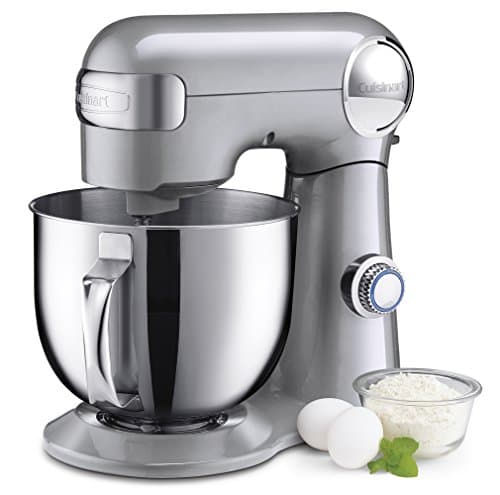
KitchenAid vs. Cuisinart: Which Stand Mixer Should You Buy?
KitchenAid vs Cuisinart on bowl size, wattage, warranty, attachments and resale — and who each brand is actually for.
Roundup
The Best Stand Mixers for Bread Dough
Four mixers ranked for bread: bowl-lift rigidity, stated dough capacity and what kneading does to a machine built for cake.
Guide
Are Stand Mixers Worth It?
What a stand mixer genuinely does better than a hand mixer, what it doesn't, and the four questions that settle it.
Review
KitchenAid Artisan Review
The KitchenAid Artisan on bowl coverage, speeds, the attachment hub, weight and the one job it struggles with.
Comparison
Tilt-Head vs. Bowl-Lift: Which Stand Mixer Design?
Tilt-head vs bowl-lift on rigidity, dough capacity, loading, height and cost — and which design your baking needs.
https://wattandwhisk.com/stand-mixers/kitchenaid-models-compared