How Many Watts Does a Stand Mixer Need?
The brand that owns this category refuses to publish a wattage figure at all — which is the most useful fact on the page.
Disclosure:Watt & Whisk is reader-supported. When you buy through links on this page we may earn an Amazon Associates commission, at no extra cost to you. Prices are pulled live from Amazon and shown with the date checked. How this works.
Between 300 and 660 watts covers every home stand mixer worth buying, and the number is close to useless for choosing between them. The proof is sitting in the table below: KitchenAid publishes no wattage at all on the Artisan, the Classic or the 5.5-quart bowl-lift, and KitchenAid is the brand people buy and keep for twenty years. Meanwhile the highest published figure here — 660 W on the Aucma — belongs to the cheapest machine. If you want a published figure and a long warranty, the Cuisinart SM-50 states 500 W with a limited 3-year warranty. If you want the machine that will outlive the decision, buy the KitchenAid Artisan and accept that the box will not tell you its wattage.
The short answer
Quick picks
| # | Product | Best for | Score | Price |
|---|---|---|---|---|
| 01 | 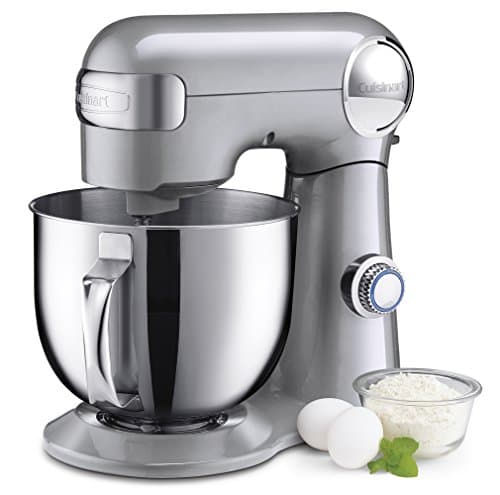 Cuisinart Precision Master SM-50 The 5.5-quart, 500-watt Precision Master gives you a bigger bowl and a stated higher wattage than a same-price KitchenAid. The trade-off is a smaller accessory ecosystem, but for straight mixing it's a lot of machine for the money. 5.5 Qt · 500W | Best big bowl for the money | 4.2★★★★★ | $229.95Amazon |
| 02 | 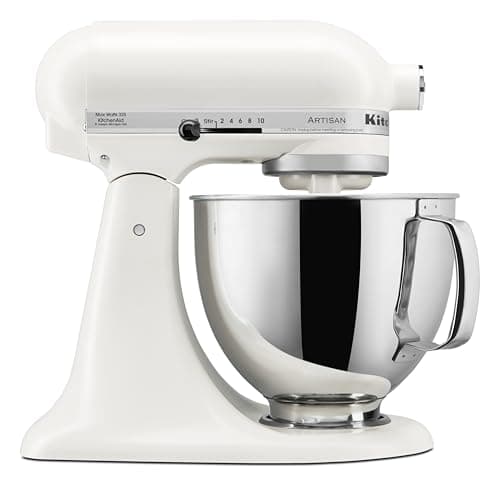 KitchenAid Artisan (5 Qt) The 5-quart tilt-head Artisan is the default for a reason: a metal body, a big color range, and the whole KitchenAid attachment ecosystem. It handles most home baking short of daily heavy bread. 5 Quart | Best overall stand mixer | 4.6★★★★★ | $489.00Amazon |
| 03 | 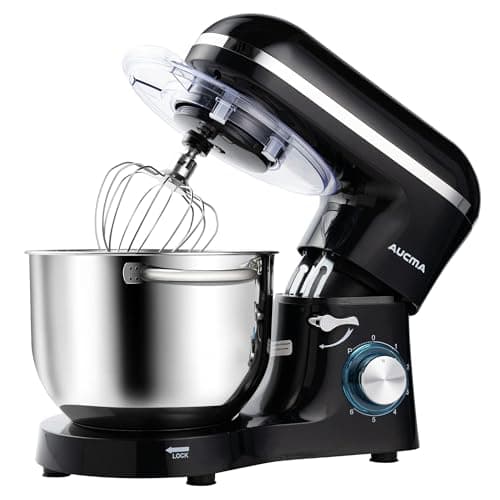 Aucma 6.5-Qt Stand Mixer The value play: a 6.5-quart stainless bowl and a stated 660-watt copper motor with 6 speeds and pulse, for less than a 4.5-quart KitchenAid Classic. You give up the brand's attachment ecosystem and resale value; you get a bigger bowl and a higher stated wattage for the money. 6.5QT · 660W | Best big bowl on a budget | 4.0★★★★★ | $129.99Amazon |
| 04 | 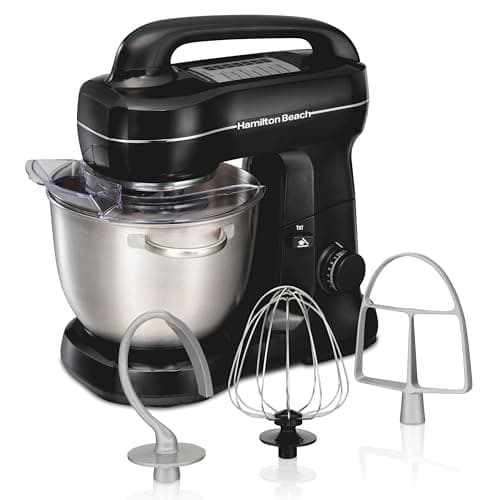 Hamilton Beach 4-Qt Stand Mixer A 300-watt, 7-speed planetary mixer with a 4-quart stainless bowl, dough hook, whisk, flat beater and splash guard included — for a fraction of a KitchenAid. At 8 lb with a molded carry handle it's also the only mixer here you can genuinely lift into a cupboard one-handed. 4 Quart · 300W | Best budget stand mixer | 4.0★★★★★ | $139.99Amazon |
#ad · Live prices from the Amazon Product API, as of October 16, 2026. Where we have no verified live price, we show none — a gap beats a number that has rotted.
Side by side
What each maker publishes about power
Read the second row first. The most expensive machine on this page publishes no wattage, the cheapest publishes the highest figure, and the ordering of those two facts is the whole argument of this page.
| Model | Key specs | Motor claim, as published | Best for | Price |
|---|---|---|---|---|
| Cuisinart Precision Master SM-50SM-50BC | 5.5 Qt500 W11.2 × 16.5 × 15.9 in3-yr warranty | 500 W, published as a motor rating, with die-cast metal construction and 12 speeds. The best-documented machine here: a real figure plus the longest warranty on the page. | Published watts and a 3-year warranty | $229.95Check Price |
| KitchenAid Artisan (5 Qt)KSM150PSPL | 5 Quart8.7 × 14.1 × 13.9 in1-yr warranty | No wattage published, anywhere. KitchenAid publishes capacity in work instead: 9 dozen cookies at 28 g of dough each, and 59 touchpoints around the bowl. | The spec that matters is not watts | $489.00Check Price |
| Aucma 6.5-Qt Stand MixerSM-1518N | 6.5 QT660 W9.3700787306 × 15.2362204569 × 12.3622047118 in | 660 W, the highest figure on this page, described as a pure copper motor in an ABS housing. Also the only mixer here publishing a noise figure: 76 dB or less. | Most watts, least money | $129.99Check Price |
| Hamilton Beach 4-Qt Stand Mixer63391 | 4 Quart300 W10.9 × 14.5 × 14.4 in | 300 W, the lowest figure here, with planetary mixing action and 7 speeds. Hamilton Beach's own pitch is that the mixing action matches higher-priced brands — which is the honest argument. | Proof that low watts can be enough | $139.99Check Price |
#ad · we may earn a commission · Specs read from each manufacturer's Amazon listing; prices pulled live from the Amazon Product API, as of October 16, 2026. Where a maker publishes no figure (wattage, warranty term) we leave the cell empty rather than estimate one.
The picks, in detail
Cuisinart Precision Master SM-50
spec score /5
$319.9528% off
Price as of October 16, 2026. Prices change — Amazon's is the one that counts.
#ad · we may earn a commission from this link to Cuisinart Precision Master SM-50
The 5.5-quart, 500-watt Precision Master gives you a bigger bowl and a stated higher wattage than a same-price KitchenAid. The trade-off is a smaller accessory ecosystem, but for straight mixing it's a lot of machine for the money.
- Capacity
- 5.5 Qt
- Footprint (W×D×H)
- 11.2 × 16.5 × 15.9 in
- Power
- 500 W
- Weight
- 17 lb
- Cost per use*
- ≈3¢
- Est. per year*
- ≈$6
- Warranty
- Limited 3-Year Warranty
- Bigger 5.5-qt bowl
- 500 W stated motor
- Often cheaper than KitchenAid
- Smaller attachment ecosystem
- Less iconic resale value
- Plastic trim in places
*Cost-to-run computed from the manufacturer's stated 500W at $0.17/kWh (US average), 20-min sessions, 4×/week. Your rate and use will vary.
KitchenAid Artisan (5 Qt)
spec score /5
Price as of October 16, 2026. Prices change — Amazon's is the one that counts.
#ad · we may earn a commission from this link to KitchenAid Artisan (5 Qt)
The 5-quart tilt-head Artisan is the default for a reason: a metal body, a big color range, and the whole KitchenAid attachment ecosystem. It handles most home baking short of daily heavy bread.
- Capacity
- 5 Quart
- Footprint (W×D×H)
- 8.7 × 14.1 × 13.9 in
- Weight
- 22.8 lb
- Warranty
- 1 Year Limited Warranty
- Huge attachment ecosystem (grinder, pasta, more)
- All-metal build; holds resale value
- 5-qt bowl suits most baking
- Struggles with repeated stiff bread dough
- Premium price
- Heavy to lift on and off the counter
Aucma 6.5-Qt Stand Mixer
spec score /5
$169.9924% off
Price as of October 16, 2026. Prices change — Amazon's is the one that counts.
#ad · we may earn a commission from this link to Aucma 6.5-Qt Stand Mixer
The value play: a 6.5-quart stainless bowl and a stated 660-watt copper motor with 6 speeds and pulse, for less than a 4.5-quart KitchenAid Classic. You give up the brand's attachment ecosystem and resale value; you get a bigger bowl and a higher stated wattage for the money.
- Capacity
- 6.5QT
- Footprint (W×D×H)
- 9.3700787306 × 15.2362204569 × 12.3622047118 in
- Power
- 660 W
- Weight
- 11.68 lb
- Cost per use*
- ≈4¢
- Est. per year*
- ≈$8
- 6.5-qt bowl — the biggest here
- 660 W stated motor with pulse
- Whisk, dough hook and beater all dishwasher-safe
- No attachment ecosystem beyond the three included tools
- No published warranty on the listing
- Less proven long-term than the big brands
*Cost-to-run computed from the manufacturer's stated 660W at $0.17/kWh (US average), 20-min sessions, 4×/week. Your rate and use will vary.
Hamilton Beach 4-Qt Stand Mixer
spec score /5
Price as of October 16, 2026. Prices change — Amazon's is the one that counts.
#ad · we may earn a commission from this link to Hamilton Beach 4-Qt Stand Mixer
A 300-watt, 7-speed planetary mixer with a 4-quart stainless bowl, dough hook, whisk, flat beater and splash guard included — for a fraction of a KitchenAid. At 8 lb with a molded carry handle it's also the only mixer here you can genuinely lift into a cupboard one-handed.
- Capacity
- 4 Quart
- Footprint (W×D×H)
- 10.9 × 14.5 × 14.4 in
- Power
- 300 W
- Weight
- 8 lb
- Cost per use*
- ≈2¢
- Est. per year*
- ≈$4
- Warranty
- One(1) Year Warranty
- All four attachments and a splash guard in the box
- 8 lb with a carry handle — actually storable
- Slow first speed keeps flour in the bowl
- 300 W is a cake-and-cookie motor, not a bread motor
- 4-qt bowl limits batch size
- No third-party attachment ecosystem
*Cost-to-run computed from the manufacturer's stated 300W at $0.17/kWh (US average), 20-min sessions, 4×/week. Your rate and use will vary.
What a wattage figure actually measures
Watts measure electricity going in. What you care about when you are kneading bread dough is torque coming out — the twisting force at the beater. Between those two things sits a gearbox, and the gearbox is where most of the decision lives.
A gear reduction trades speed for force. A modest motor spinning fast, geared down aggressively, delivers more usable torque at the beater than a bigger motor geared poorly. This is not a theoretical point: it is why a 300-watt mixer can knead dough that stalls a 600-watt one, and why the wattage column is the wrong column.
No maker in this category publishes a gear ratio. Not one. So the figure that would let you convert watts into kneading ability is simply not available, which is why we treat wattage as a rough category marker — is this a real mixer or a toy? — rather than a ranking tool. We make the same argument about blenders, for a slightly different reason, in how many watts you need in a blender.
The most informative fact: KitchenAid publishes nothing
We read every spec on this site off the manufacturer's own listing. Across the three KitchenAid stand mixers we track — the 4.5-quart Classic K45SS, the 5-quart Artisan KSM150PS and the 5.5-quart bowl-lift KSM55SX — there is no wattage figure anywhere. Nor on the KHM512 hand mixer. This is not an oversight on one listing; it is a brand-wide decision by the market leader.
What KitchenAid publishes instead is capacity in work done, and it is far more useful because the unit is defined:
- Classic, 4.5 qt: up to 8 dozen cookies in a single batch, using the flat beater, at 28 g of dough each.
- Artisan, 5 qt: up to 9 dozen cookies, same method, same 28 g.
- Bowl-lift, 5.5 qt: up to 11 dozen cookies, plus "knead over 7 lbs of bread" and "mash 6 lbs of potatoes".
That is a comparable ladder with a stated test condition, which is more than any wattage figure in this category offers. KitchenAid also makes exactly one relative power claim, and it is worth quoting precisely: the bowl-lift has "2x the power in the bowl than tilt-head", footnoted as "compared to KSM150 when measuring peak HP in the bowl; above speed 2". Note the three qualifiers in that footnote — peak, in the bowl, above speed 2. It is a measured claim about torque at the beater rather than electricity at the plug, which is the right thing to measure and still not a number you can compare across brands. The three models are set against each other in KitchenAid models compared.
What the published figures do tell you
Wattage is not useless. It is a coarse band marker, and the three machines here that publish one land in a sensible order.
- Under 250 W: hand mixer territory. Cuisinart publishes 220 W on both its hand mixers and Hamilton Beach 300 W on its own. These are fine machines for creaming butter and whipping cream and will not knead bread dough. If that is your actual need, read hand mixer vs stand mixer and best hand mixers instead — it is a cheaper answer to a different question.
- 300 W in a stand mixer: genuinely enough for most baking. Hamilton Beach's 4-quart 63391 publishes 300 W with planetary mixing action and 7 speeds, and its pitch is explicitly that the mixing action matches higher-priced brands. That is the honest claim: the mechanism is the same, and the mechanism matters more than the motor. At 8 lb it is also the only stand mixer here you can lift into a cupboard one-handed.
- 500 W: the comfortable middle. Cuisinart's 5.5-quart SM-50 publishes 500 W with die-cast metal construction, 12 speeds and a limited 3-year warranty — three times KitchenAid's one-year term. For stiff bread dough three or four times a month, this is the band to be in.
- 660 W: a number, not a ranking. Aucma's 6.5-quart SM-1518N publishes the highest figure on the page and costs the least, which should tell you how much the market values the figure. It describes a pure copper motor in an ABS housing — plastic, where the Cuisinart is die-cast and the KitchenAid is metal — with 6 speeds plus pulse and the biggest bowl here. It is also the only mixer in our catalog publishing a noise figure: 76 dB or less. Aucma publishes no warranty term we can read.
The four specs to shop on instead
- Bowl capacity, against what you actually bake. 4 to 4.5 quarts handles a standard loaf and a single batch of cookies. 5 to 5.5 quarts handles a double batch. 6.5 quarts is for people who bake for other people. Sized properly in what size stand mixer do I need.
- Planetary action, not just a spinning beater. Planetary means the beater rotates on its own axis while travelling around the bowl, which is how you get complete coverage without scraping. Every machine on this page has it, including the 300 W one, and it is published on all of them.
- Build material and weight. A mixer stays still by being heavy. The KitchenAid Artisan weighs 22.8 lb and the Classic 24.2 lb in metal; the Cuisinart 17 lb in die-cast; the Aucma 11.68 lb in ABS; the Hamilton Beach 8 lb. On stiff dough a light mixer walks across the counter no matter what the motor says.
- Warranty term. Cuisinart publishes 3 years, KitchenAid 1 year, Hamilton Beach 1 year, Aucma nothing we can read. Note that KitchenAid's short term coexists with the best longevity reputation in the category, which is a useful reminder that a warranty is a commercial decision rather than an engineering disclosure. We go through what actually fails, and when, in how long do stand mixers last.
What about the 1,000-watt mixers?
You will see them, usually from brands with no track record, and the figure should raise an eyebrow rather than interest. There is no 1,000-watt machine in our catalog, so we have no listing to read and we will not characterise one we have not sourced. What we can say is general and sound: a higher input-power figure with no published gear ratio, no published dough capacity, no stated warranty term and a plastic housing is a marketing number. The machines that have dominated this category for forty years do not print one at all.
The same logic applies to peak-versus-continuous wording, which is the trap in the adjacent categories. Ninja publishes 1,000 peak watts for its food processor — a momentary figure, not a rating you can set against a continuous one. If a stand-mixer listing says peak, the comparable number is smaller than the one printed.
The short version
Stop shopping on watts. Pick the bowl size for what you bake, then pick on build weight and warranty, then check that the machine has planetary action — which at this point they all do. If you want a published power figure and the longest warranty, the Cuisinart SM-50 at 500 W is the most completely documented mixer here. If you want the one that will still be on the counter in fifteen years, buy the KitchenAid Artisan, which publishes nine dozen cookies and no watts at all. If the budget is the constraint, the Hamilton Beach at 300 W will do more baking than most people ever ask of it, and the Aucma gets you the biggest bowl and the biggest number for the least money — just know which of those two you are buying.
Frequently asked questions
How many watts does a stand mixer need?
Anything from 300 to 660 watts covers every home machine worth buying, and the figure is a poor way to choose between them. Hamilton Beach's 300-watt 4-quart mixer handles most home baking; Cuisinart's 500-watt SM-50 is the comfortable middle for regular bread dough. KitchenAid, the category leader, publishes no wattage at all.
Why does KitchenAid not publish wattage?
It publishes capacity in work instead, which is more useful because the unit is defined: 8 dozen cookies for the 4.5-quart Classic, 9 dozen for the 5-quart Artisan, 11 dozen plus over 7 lb of bread dough for the 5.5-quart bowl-lift, all at 28 g of dough each. Its one power claim is about peak horsepower measured in the bowl, not electricity at the plug.
Is 300 watts enough for a stand mixer?
For most home baking, yes. Hamilton Beach's 300-watt 63391 has full planetary mixing action and 7 speeds, and the maker's own pitch is that the mixing action matches higher-priced brands. Where 300 watts and 8 lb of mixer struggle is stiff bread dough, where the machine can move on the counter.
Does more wattage mean a mixer kneads better?
Not reliably. Watts measure electricity in; kneading needs torque out, and a gearbox converts between the two. A modest motor geared down hard beats a bigger motor geared poorly. No maker in this category publishes a gear ratio, so the conversion is not available to you.
Are 1,000-watt stand mixers better?
Treat the figure with suspicion rather than interest. A high input-power number alongside no published dough capacity, no gear ratio, no stated warranty and a plastic housing is a marketing number. The brands that have dominated this category for decades publish no wattage at all.
What is planetary mixing action?
The beater spins on its own axis while also travelling around the bowl, so it covers the whole bowl without you stopping to scrape. It is the mechanism that separates a stand mixer from a hand mixer clamped to a stand, and it is published on every machine on this page, including the 300-watt one.
Which stand mixer specs should I compare instead of watts?
Bowl capacity against what you actually bake, whether the action is planetary, build material and weight — 22.8 lb of metal on the KitchenAid Artisan versus 8 lb on the Hamilton Beach — and the published warranty term, which runs from one year on KitchenAid and Hamilton Beach to three on Cuisinart.
Keep reading
Stand Mixers
The Best Stand Mixers of 2026
KitchenAid Artisan, KitchenAid Classic and Cuisinart compared on bowl size, build and attachments.
Guide
What Size Stand Mixer Do I Need?
4 to 6.5 quarts mapped to real batch sizes, why bread is limited by torque not volume, and the footprint each costs.
Comparison
KitchenAid Models Compared: Classic vs. Artisan vs. Bowl-Lift
Classic vs Artisan vs bowl-lift KSM55 — what actually changes between KitchenAid's models, and which one you need.
Comparison
KitchenAid vs. Cuisinart: Which Stand Mixer Should You Buy?
KitchenAid vs Cuisinart on bowl size, wattage, warranty, attachments and resale — and who each brand is actually for.
Roundup
The Best Budget Stand Mixers
Budget stand mixers ranked on bowl size, stated wattage, weight and warranty — plus what you actually give up.
Guide
How Long Do Stand Mixers Last?
Published warranty terms for every stand mixer we track, the sacrificial gear that ends most of them, and why that gear is good news.
Comparison
Hand Mixer vs. Stand Mixer
Job by job: where a hand mixer is genuinely the right buy, and the three tasks that need a stand mixer.
https://wattandwhisk.com/stand-mixers/how-many-watts-does-a-stand-mixer-need