How Long Do Stand Mixers Last?
The machine with the reputation for lasting forever publishes the shortest warranty in our catalog. Here is what each maker actually commits to, and which part gives out first.
Disclosure:Watt & Whisk is reader-supported. When you buy through links on this page we may earn an Amazon Associates commission, at no extra cost to you. Prices are pulled live from Amazon and shown with the date checked. How this works.
No manufacturer publishes a lifespan for a stand mixer, so the only honest number to shop on is the warranty — and the result is the opposite of the reputation. The longest published term in our catalog belongs to the Cuisinart Precision Master SM-50 at a limited 3 years. Both KitchenAids — the Classic and the Artisan, the machines everyone expects to outlive them — publish 1 year limited. Hamilton Beach publishes 1 year, and Aucma publishes no term at all. On the KitchenAid 5.5-quart bowl-lift, the listing's warranty field shows a paid replacement plan rather than a manufacturer term. The reason KitchenAids survive anyway is mechanical rather than contractual: the part that gives out is a deliberately sacrificial nylon worm gear buried in the head, it costs a few dollars, and replacing it is the single most common stand-mixer repair there is. Prices below are pulled live from Amazon.
The short answer
Quick picks
| # | Product | Best for | Score | Price |
|---|---|---|---|---|
| 01 | 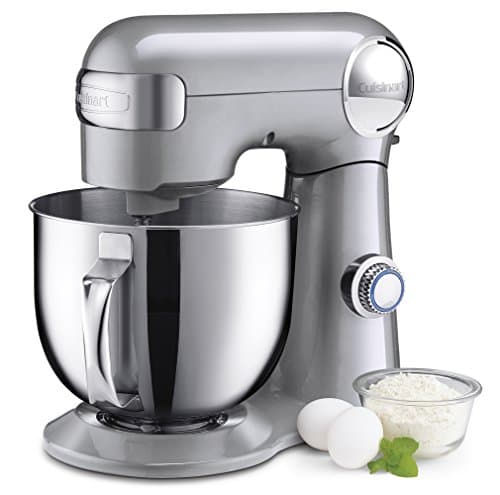 Cuisinart Precision Master SM-50 The 5.5-quart, 500-watt Precision Master gives you a bigger bowl and a stated higher wattage than a same-price KitchenAid. The trade-off is a smaller accessory ecosystem, but for straight mixing it's a lot of machine for the money. 5.5 Qt · 500W | Best big bowl for the money | 4.2★★★★★ | $219.99Amazon |
| 02 | 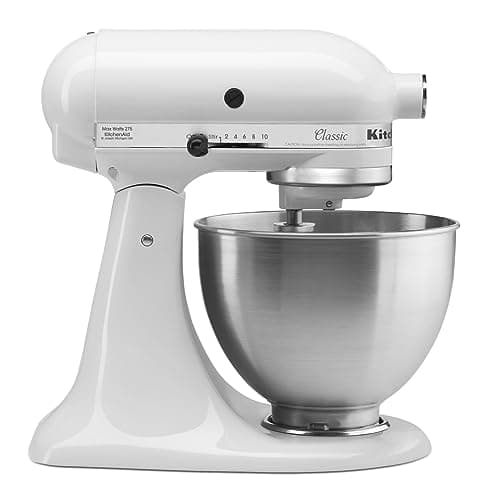 KitchenAid Classic (4.5 Qt) The 4.5-quart Classic is the cheapest way into the KitchenAid ecosystem and takes the same attachments as the Artisan. A slightly smaller bowl and fewer colors, but the same fundamentals. 4.5 Q | Best budget KitchenAid | 4.3★★★★★ | $299.99Amazon |
| 03 | 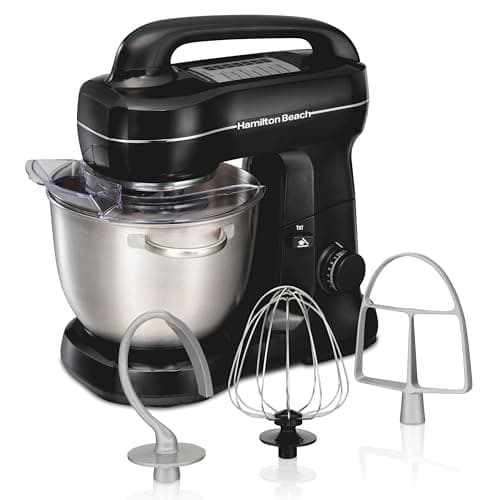 Hamilton Beach 4-Qt Stand Mixer A 300-watt, 7-speed planetary mixer with a 4-quart stainless bowl, dough hook, whisk, flat beater and splash guard included — for a fraction of a KitchenAid. At 8 lb with a molded carry handle it's also the only mixer here you can genuinely lift into a cupboard one-handed. 4 Quart · 300W | Best budget stand mixer | 4.0★★★★★ | $151.95Amazon |
#ad · Live prices from the Amazon Product API, as of October 10, 2026. Where we have no verified live price, we show none — a gap beats a number that has rotted.
The picks, in detail
Cuisinart Precision Master SM-50
spec score /5
$319.9531% off
Price as of October 10, 2026. Prices change — Amazon's is the one that counts.
#ad · we may earn a commission from this link to Cuisinart Precision Master SM-50
The 5.5-quart, 500-watt Precision Master gives you a bigger bowl and a stated higher wattage than a same-price KitchenAid. The trade-off is a smaller accessory ecosystem, but for straight mixing it's a lot of machine for the money.
- Capacity
- 5.5 Qt
- Footprint (W×D×H)
- 11.2 × 16.5 × 15.9 in
- Power
- 500 W
- Weight
- 17 lb
- Cost per use*
- ≈3¢
- Est. per year*
- ≈$6
- Warranty
- Limited 3-Year Warranty
- Bigger 5.5-qt bowl
- 500 W stated motor
- Often cheaper than KitchenAid
- Smaller attachment ecosystem
- Less iconic resale value
- Plastic trim in places
*Cost-to-run computed from the manufacturer's stated 500W at $0.17/kWh (US average), 20-min sessions, 4×/week. Your rate and use will vary.
KitchenAid Classic (4.5 Qt)
spec score /5
$399.9925% off
Price as of October 10, 2026. Prices change — Amazon's is the one that counts.
#ad · we may earn a commission from this link to KitchenAid Classic (4.5 Qt)
The 4.5-quart Classic is the cheapest way into the KitchenAid ecosystem and takes the same attachments as the Artisan. A slightly smaller bowl and fewer colors, but the same fundamentals.
- Capacity
- 4.5 Q
- Footprint (W×D×H)
- 8.7 × 14.1 × 13.9 in
- Weight
- 24.2 lb
- Warranty
- 1 Year Limited Warranty
- Lowest-cost route to KitchenAid
- Takes the full attachment lineup
- Compact-ish 4.5-qt bowl
- Smaller bowl than the Artisan
- Fewer color options
- Same dough limits as the 5-qt
Hamilton Beach 4-Qt Stand Mixer
spec score /5
Price as of October 10, 2026. Prices change — Amazon's is the one that counts.
#ad · we may earn a commission from this link to Hamilton Beach 4-Qt Stand Mixer
A 300-watt, 7-speed planetary mixer with a 4-quart stainless bowl, dough hook, whisk, flat beater and splash guard included — for a fraction of a KitchenAid. At 8 lb with a molded carry handle it's also the only mixer here you can genuinely lift into a cupboard one-handed.
- Capacity
- 4 Quart
- Footprint (W×D×H)
- 10.9 × 14.5 × 14.4 in
- Power
- 300 W
- Weight
- 8 lb
- Cost per use*
- ≈2¢
- Est. per year*
- ≈$4
- Warranty
- One(1) Year Warranty
- All four attachments and a splash guard in the box
- 8 lb with a carry handle — actually storable
- Slow first speed keeps flour in the bowl
- 300 W is a cake-and-cookie motor, not a bread motor
- 4-qt bowl limits batch size
- No third-party attachment ecosystem
*Cost-to-run computed from the manufacturer's stated 300W at $0.17/kWh (US average), 20-min sessions, 4×/week. Your rate and use will vary.
Why there is no lifespan figure
Ask how long a stand mixer lasts and you will be told twenty years, or that your grandmother's is still going. The second part is often true and the first part is not a number anybody publishes. No manufacturer states a service life for a stand mixer, and nobody is running accelerated-life testing on them and publishing results, so we are not going to print a range.
What makers do publish is a warranty term, and it is a genuinely useful proxy because it is a financial commitment rather than a marketing claim. A company offering three years has priced in honouring it. What makes stand mixers unusual is that the warranty and the real-world reputation point in opposite directions — so this page covers both, separately.
Published warranty terms, longest first
Every figure below is read from the machine's own Amazon listing. Where a maker publishes no term, the row says so rather than guessing.
- Cuisinart Precision Master SM-50 — limited 3 years. The longest published term on any stand mixer we track, on a machine that is not the most expensive one here.
- KitchenAid Artisan (5 qt) — 1 year limited.
- KitchenAid Classic (4.5 qt) — 1 year limited.
- Hamilton Beach 4-Qt — 1 year.
- KitchenAid 5.5-Qt Bowl-Lift KSM55— the listing's warranty field shows a one-year replacement plan offered at a price rather than a manufacturer term. We report that as what it is: a paid add-on, not cover included with the machine.
- Aucma 6.5-Qt — no warranty term published anywhere on the listing. It is the biggest bowl and the highest published wattage in our catalog at the lowest price, and this is the reason it does not rank higher on any of our mixer pages.
For context, the hand mixers in the same hub publish longer cover than the stand mixers do: the Cuisinart HM-90S and HM-50both state limited 3-year terms. So within one brand's own range, the hand mixers carry three times the written commitment of either KitchenAid stand mixer at a fraction of the outlay. The hand-mixer field is in best hand mixers.
This inversion is now the fifth category we have found it in — air fryers, blenders, hand mixers, food processors and vacuum sealers all show it — so it is a property of this market rather than a quirk of one brand. The head-to-head on everything else is KitchenAid vs. Cuisinart.
The part that actually fails, and why it is good news
A stand mixer's planetary head contains a gear train that converts a fast motor into slow, high-torque rotation. In that train sits a worm gear made of nylon or a similar polymer rather than metal, and that is not a cost saving — it is a fuse.
When the mixer is overloaded, something has to give. A metal gear train would transfer that load straight into the motor or crack the die-cast housing, both of which are terminal. A polymer worm gear strips its teeth instead. The machine makes a grinding noise, the beater stops turning, and the motor is fine. That part is a few dollars, it is widely stocked, and replacing it is the most common stand-mixer repair in existence — a well-documented job with hand tools and a tub of food-grade grease.
In rough order of how often things end a stand mixer:
- The worm gear. Stripped by overload — too much dough, dough too stiff, or a long run at a speed that was too high. Replaceable.
- The gearbox grease. Factory grease in a planetary head separates over many years; the oil migrates and can weep out past the planet ring, sometimes into the bowl. The fix is to clean the old grease out and repack it, which is the same job as the gear replacement and usually done at the same time.
- The speed control board or governor. Symptoms are a mixer that runs only at full speed, surges, or will not start. A replaceable board on most machines.
- The beaters, not the mixer. Coated flat beaters and dough hooks chip, and a chipped coating is a reason to replace a beater — bare aluminium and stainless beaters are sold separately. This is a consumable, not a failure.
- The bowl-lift mechanism or tilt-head pin. Develops play, so the beater starts knocking the bowl. Adjustable on most bowl-lift machines.
- The motor. Genuinely last, and normally only after repeated overheating.
The practical consequence: a stand mixer that has stopped working is usually a repair, not a purchase — and that, far more than any warranty, is why these machines have the reputation they do. Price the worm gear for your model before you price a new mixer.
What actually extends the life
- Respect the dough ceiling. Overload is what strips the gear, and bread dough is the load that does it. KitchenAid publishes a figure for the bowl-lift KSM55 — over 7 pounds of bread dough — and nothing comparable for the tilt-heads. If you knead regularly, buy for that: best stand mixers for bread.
- Knead at low speed only.Dough at speed 4 is how a gear train gets destroyed. Every maker specifies a low speed for dough, and the printed guide on the Hamilton Beach's body exists because people ignore it.
- Let it rest on long jobs. If the head is hot to the touch, stop. Heat is what thins the gearbox grease and what eventually kills motors.
- Do not run it dry or empty at speed. There is nothing to absorb the load and the beater knocks the bowl.
- Keep the bowl and head interface clean. Dried dough in the attachment hub makes beaters sit proud, which means they knock, which loads the pin. The routine is in how to use a stand mixer.
- Use the right attachment. A wire whip in stiff cookie dough bends, and a dough hook in a thin batter does nothing. The attachment-by-job list is in the stand mixer attachments guide, and the cookie-specific version is best stand mixers for cookies.
If longevity is what you are buying
Three machines, three different arguments:
- Cuisinart Precision Master SM-50 — the longest published cover here at a limited 3 years, with die-cast metal construction, a 5.5-quart stainless bowl, 500 published watts and 12 speeds. If you want the longest written commitment rather than the strongest reputation, this is it. Our SM-50 review has the detail.
- KitchenAid Classic — one year on paper, and the best-supported repair ecosystem in the category: worm gears, grease, beaters, bowls and boards are all stocked, and the sacrificial-gear design means the expensive parts are the ones that survive. 24.2 pounds of metal, 10 speeds, 4.5-quart stainless bowl. Our Classic review covers it, and the range is in KitchenAid models compared.
- Hamilton Beach 4-Qt— one year, 300 watts, 7 speeds and 8 pounds. The honest case for it is not longevity; it is that at a third of the Classic's weight it actually gets used, and a machine in a cupboard lasts forever without ever being worth anything. It leads best budget stand mixers.
If you are weighing whether to buy one at all, are stand mixers worth it is the honest read, and hand mixer vs. stand mixeris the cheaper answer for a lot of people. The same question in the site's other categories is how long do air fryers last, how long do blenders last and how long do food processors last — all three find the same inverted ladder.
Frequently asked questions
How long should a stand mixer last?
No manufacturer publishes a lifespan, so we will not invent a range. What they publish is a warranty, and across the stand mixers we track that runs from no term at all to three years — Cuisinart's Precision Master SM-50 at a limited 3 years, both KitchenAids and the Hamilton Beach at 1 year, and Aucma publishing nothing. The machines outlast those terms by a wide margin because the part that fails is a cheap, replaceable gear.
What breaks first on a stand mixer?
The worm gear in the planetary head. It is made of nylon rather than metal on purpose — it is a mechanical fuse that strips its teeth under overload instead of letting the motor burn out or the housing crack. The symptom is a grinding noise with a beater that will not turn. The part costs a few dollars and replacing it is the most common stand-mixer repair there is.
Which stand mixer has the longest warranty?
The Cuisinart Precision Master SM-50, at a limited 3 years — the longest published term on any stand mixer we track. Both KitchenAid tilt-heads publish 1 year limited, Hamilton Beach publishes 1 year, and Aucma publishes no term at all. On KitchenAid's 5.5-quart bowl-lift, the listing shows a paid one-year replacement plan rather than included cover.
Is it worth repairing a stand mixer?
Usually, yes, and more so than in any other category we cover. The common failures are a stripped worm gear, separated gearbox grease, a speed control board and a worn tilt-head pin — all replaceable, and the gear is the cheapest of them. A dead motor is the one case where replacing the machine is normally right, and it is the rarest.
Why do KitchenAid mixers last so long if the warranty is only a year?
Because the design puts the sacrifice in the cheapest component. The nylon worm gear strips before the motor or the die-cast housing takes the load, so overload events cost a few dollars instead of the machine. That, plus a parts supply that stocks gears, grease, boards, bowls and beaters, is the reputation — it is a repairability story rather than a warranty story.
Can you re-grease a stand mixer yourself?
Yes, and it is the standard companion job to a worm gear replacement. Factory grease in a planetary head separates over many years and the oil can weep past the planet ring, sometimes into the bowl. The fix is to open the head, clean out the old grease and repack it with food-grade grease.
What ruins a stand mixer fastest?
Kneading stiff dough at a high speed. Every maker specifies a low speed for dough, and ignoring that is what strips the worm gear. Running the machine until the head is hot is second, because heat thins the gearbox grease and is what eventually kills motors.
Keep reading
Stand Mixers
The Best Stand Mixers of 2026
KitchenAid Artisan, KitchenAid Classic and Cuisinart compared on bowl size, build and attachments.
Guide
Are Stand Mixers Worth It?
What a stand mixer genuinely does better than a hand mixer, what it doesn't, and the four questions that settle it.
Roundup
Best Stand Mixers for Cookies
Ranked on the published cookie-dozen rating, the flat beater in the box and low-speed creaming control — not on price or bowl size.
Comparison
KitchenAid vs. Cuisinart: Which Stand Mixer Should You Buy?
KitchenAid vs Cuisinart on bowl size, wattage, warranty, attachments and resale — and who each brand is actually for.
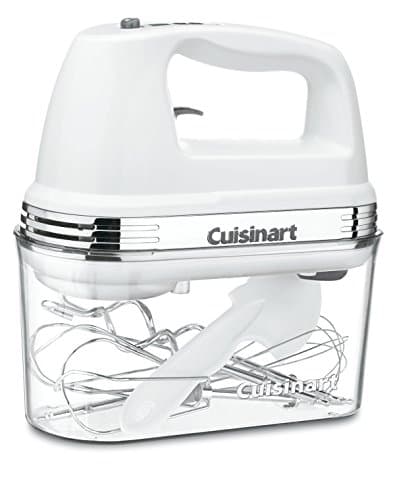
Roundup
The Best Hand Mixers of 2026
Five hand mixers compared on weight, beater design, how slow the slowest speed really is, and what is actually in the box.
Guide
How to Use a Stand Mixer
Flat beater, dough hook or whisk; what each speed is really for; and the order of operations that stops split batters.
https://wattandwhisk.com/stand-mixers/how-long-do-stand-mixers-last