The Best Budget Stand Mixers
What a stand mixer costs has almost nothing to do with what it whips. Here is where the cheap machines are genuinely fine — and where they are not.
Disclosure:Watt & Whisk is reader-supported. When you buy through links on this page we may earn an Amazon Associates commission, at no extra cost to you. Prices are pulled live from Amazon and shown with the date checked. How this works.
The Hamilton Beach 4-quart is the best genuinely cheap stand mixer: 300 watts, 7 speeds, planetary mixing, and a dough hook, whisk, flat beater and splash guard all in the box — at 8 lb with a carry handle, it is also the only one here you can store easily. The Aucma 6.5-quart gives you the biggest bowl and a stated 660 watts for a little more. Above them, the Cuisinart SM-50 and KitchenAid Classic are the step up worth making if you bake often.
The short answer
Quick picks
| # | Product | Best for | Score | Price |
|---|---|---|---|---|
| 01 | 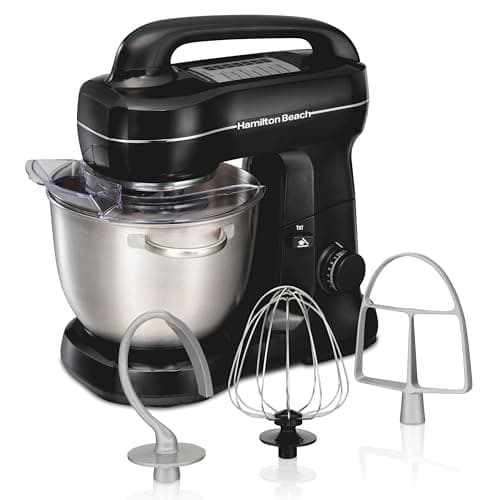 Hamilton Beach 4-Qt Stand Mixer A 300-watt, 7-speed planetary mixer with a 4-quart stainless bowl, dough hook, whisk, flat beater and splash guard included — for a fraction of a KitchenAid. At 8 lb with a molded carry handle it's also the only mixer here you can genuinely lift into a cupboard one-handed. 4 Quart · 300W | Best budget stand mixer | 4.0★★★★★ | $139.99Amazon |
| 02 | 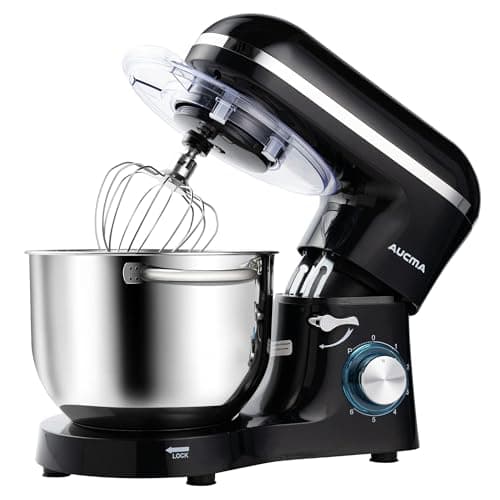 Aucma 6.5-Qt Stand Mixer The value play: a 6.5-quart stainless bowl and a stated 660-watt copper motor with 6 speeds and pulse, for less than a 4.5-quart KitchenAid Classic. You give up the brand's attachment ecosystem and resale value; you get a bigger bowl and a higher stated wattage for the money. 6.5QT · 660W | Best big bowl on a budget | 4.0★★★★★ | $129.99Amazon |
| 03 | 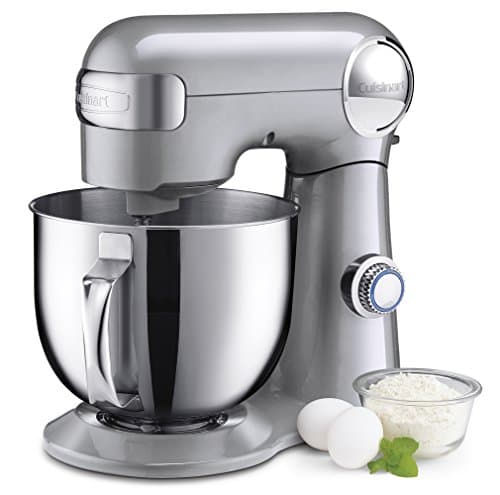 Cuisinart Precision Master SM-50 The 5.5-quart, 500-watt Precision Master gives you a bigger bowl and a stated higher wattage than a same-price KitchenAid. The trade-off is a smaller accessory ecosystem, but for straight mixing it's a lot of machine for the money. 5.5 Qt · 500W | Best big bowl for the money | 4.2★★★★★ | $229.95Amazon |
| 04 | 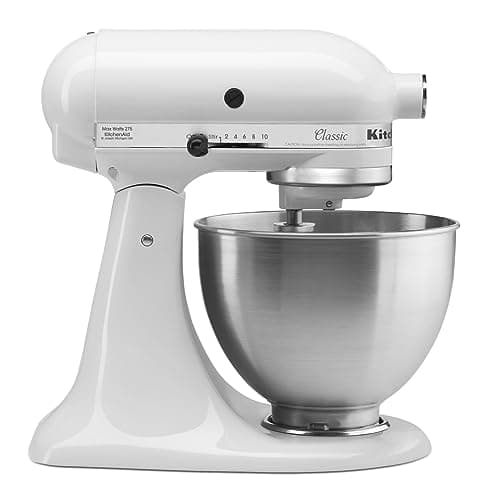 KitchenAid Classic (4.5 Qt) The 4.5-quart Classic is the cheapest way into the KitchenAid ecosystem and takes the same attachments as the Artisan. A slightly smaller bowl and fewer colors, but the same fundamentals. 4.5 Q | Best budget KitchenAid | 4.3★★★★★ | $322.99Amazon |
#ad · Live prices from the Amazon Product API, as of October 17, 2026. Where we have no verified live price, we show none — a gap beats a number that has rotted.
The picks, in detail
Hamilton Beach 4-Qt Stand Mixer
spec score /5
Price as of October 17, 2026. Prices change — Amazon's is the one that counts.
#ad · we may earn a commission from this link to Hamilton Beach 4-Qt Stand Mixer
A 300-watt, 7-speed planetary mixer with a 4-quart stainless bowl, dough hook, whisk, flat beater and splash guard included — for a fraction of a KitchenAid. At 8 lb with a molded carry handle it's also the only mixer here you can genuinely lift into a cupboard one-handed.
- Capacity
- 4 Quart
- Footprint (W×D×H)
- 10.9 × 14.5 × 14.4 in
- Power
- 300 W
- Weight
- 8 lb
- Cost per use*
- ≈2¢
- Est. per year*
- ≈$4
- Warranty
- One(1) Year Warranty
- All four attachments and a splash guard in the box
- 8 lb with a carry handle — actually storable
- Slow first speed keeps flour in the bowl
- 300 W is a cake-and-cookie motor, not a bread motor
- 4-qt bowl limits batch size
- No third-party attachment ecosystem
*Cost-to-run computed from the manufacturer's stated 300W at $0.17/kWh (US average), 20-min sessions, 4×/week. Your rate and use will vary.
Aucma 6.5-Qt Stand Mixer
spec score /5
$169.9924% off
Price as of October 17, 2026. Prices change — Amazon's is the one that counts.
#ad · we may earn a commission from this link to Aucma 6.5-Qt Stand Mixer
The value play: a 6.5-quart stainless bowl and a stated 660-watt copper motor with 6 speeds and pulse, for less than a 4.5-quart KitchenAid Classic. You give up the brand's attachment ecosystem and resale value; you get a bigger bowl and a higher stated wattage for the money.
- Capacity
- 6.5QT
- Footprint (W×D×H)
- 9.3700787306 × 15.2362204569 × 12.3622047118 in
- Power
- 660 W
- Weight
- 11.68 lb
- Cost per use*
- ≈4¢
- Est. per year*
- ≈$8
- 6.5-qt bowl — the biggest here
- 660 W stated motor with pulse
- Whisk, dough hook and beater all dishwasher-safe
- No attachment ecosystem beyond the three included tools
- No published warranty on the listing
- Less proven long-term than the big brands
*Cost-to-run computed from the manufacturer's stated 660W at $0.17/kWh (US average), 20-min sessions, 4×/week. Your rate and use will vary.
Cuisinart Precision Master SM-50
spec score /5
$319.9528% off
Price as of October 17, 2026. Prices change — Amazon's is the one that counts.
#ad · we may earn a commission from this link to Cuisinart Precision Master SM-50
The 5.5-quart, 500-watt Precision Master gives you a bigger bowl and a stated higher wattage than a same-price KitchenAid. The trade-off is a smaller accessory ecosystem, but for straight mixing it's a lot of machine for the money.
- Capacity
- 5.5 Qt
- Footprint (W×D×H)
- 11.2 × 16.5 × 15.9 in
- Power
- 500 W
- Weight
- 17 lb
- Cost per use*
- ≈3¢
- Est. per year*
- ≈$6
- Warranty
- Limited 3-Year Warranty
- Bigger 5.5-qt bowl
- 500 W stated motor
- Often cheaper than KitchenAid
- Smaller attachment ecosystem
- Less iconic resale value
- Plastic trim in places
*Cost-to-run computed from the manufacturer's stated 500W at $0.17/kWh (US average), 20-min sessions, 4×/week. Your rate and use will vary.
KitchenAid Classic (4.5 Qt)
spec score /5
$399.9919% off
Price as of October 17, 2026. Prices change — Amazon's is the one that counts.
#ad · we may earn a commission from this link to KitchenAid Classic (4.5 Qt)
The 4.5-quart Classic is the cheapest way into the KitchenAid ecosystem and takes the same attachments as the Artisan. A slightly smaller bowl and fewer colors, but the same fundamentals.
- Capacity
- 4.5 Q
- Footprint (W×D×H)
- 8.7 × 14.1 × 13.9 in
- Weight
- 24.2 lb
- Warranty
- 1 Year Limited Warranty
- Lowest-cost route to KitchenAid
- Takes the full attachment lineup
- Compact-ish 4.5-qt bowl
- Smaller bowl than the Artisan
- Fewer color options
- Same dough limits as the 5-qt
A stand mixer is one of the few appliances where the budget end is genuinely competent, because the core job — turning a beater slowly through a bowl on a planetary path — is well-understood engineering that stopped being hard decades ago. What money buys is durability under load, an attachment ecosystem and resale value. For a lot of households none of those three matters.
So this guide is honest about both directions: where the cheap machines are fine, and the specific circumstances where spending more is not snobbery. All specs come from each machine's current listing; our method is on how we review.
What you give up below KitchenAid money
- Sustained dough capability. Budget motors handle batters, creaming and whipping without complaint. Stiff bread dough, repeatedly, is where they age fast.
- The attachment ecosystem. No budget mixer has a hub that takes pasta rollers, grinders or spiralizers. You get the three tools in the box, permanently.
- Mass. Cheap mixers are light, and light mixers walk across the counter under a loaded dough hook. This is the most noticeable day-to-day difference.
- Resale value. A decade-old KitchenAid is worth real money. A decade-old budget mixer is worth nothing, which quietly changes the true cost of ownership.
What you emphatically do not give up is the ability to make excellent cakes, cookies, meringue, whipped cream, frosting and pastry. That is worth saying, because a lot of buying advice implies the cheap machines cannot bake.
The picks
Hamilton Beach 4-quart — best cheap mixer
This is the one we would put in most first kitchens. A 300-watt motor driving 7 speeds with proper planetary action — the beater rotates on its own axis while orbiting the bowl, which is what gives complete coverage without scraping — and a 4-quart stainless bowl. The box includes the dough hook, whisk, flat beater and a splash guard, so there is nothing else to buy.
Two details raise it above the generic cheap mixer. It weighs 8 lb and has a molded carry handle on the head, which makes it the only mixer in this entire guide you can genuinely lift into a cupboard one-handed — and a mixer you can store is a mixer you will actually own rather than resent. And it has a slow first speed, which is the difference between combining flour and redecorating your kitchen with it.
The cons, plainly: 300 watts is a cake-and-cookie motor and will labor on stiff bread dough, the 4-quart bowl caps batch size, there is no attachment ecosystem at all, and the warranty is one year. For someone baking a few times a month, none of that will ever come up.
Aucma 6.5-quart — most bowl for the money
If capacity is what you want, this is the outlier: a 6.5-quart stainless bowl — larger than every KitchenAid tilt-head and larger than the bowl-lift KSM55 — with a stated 660-watt copper motor, six speeds plus pulse, and a tilt-head that opens for loading. The whisk, dough hook and beater are all dishwasher-safe.
On paper that is more bowl and more stated wattage than a KitchenAid Classic for less money, and for large-batch baking it genuinely delivers. The honest catch is weight: at 11.68 lb it is light for the size, and mass is what keeps a mixer planted when a dough hook starts throwing a stiff load around. Watch it during kneading rather than leaving the room. There is also no published warranty on the listing and no accessory range beyond the three included tools. If bread is your main use, read best stand mixers for bread before you decide.
Cuisinart Precision Master SM-50 — the sensible step up
Not a budget mixer, but the first machine above the budget tier that justifies the jump, and worth including because the gap is smaller than people assume. You get a 5.5-quart bowl, a published 500-watt motor, 12 speeds for genuinely fine low-end control, and — the real argument — a 3-year limited warranty, three times what a KitchenAid tilt-head carries.
At 17 lb it has enough mass to stay put in normal use, and the build quality step over the sub-$150 machines is obvious in the hand. Cons: the largest footprint here at 11.2 × 16.5 inches, a thin accessory ecosystem, and plastic trim in places where KitchenAid uses metal. Our full head-to-head is in KitchenAid vs. Cuisinart.
KitchenAid Classic — the cheapest way into the ecosystem
Included for one specific reason: it is the least expensive machine that takes the full KitchenAid attachment hub. Same 4.5-quart tilt-head design that has been in production for decades, all-metal body, 10 speeds, an 8.7 × 14.1-inch footprint that is the smallest here, and the parts and repair culture that makes these last.
It is a lot more money than the Hamilton Beach for a bowl only half a quart larger, and the 1-year limited warranty is shorter than the Cuisinart's. At 24.2 lb it is also the heaviest machine on this page — excellent for stability, miserable for cupboard storage. Buy it if you want the option of a pasta roller or a grinder one day, or if resale value matters to you; the alternatives are better value if neither does. The whole range is broken down in KitchenAid models compared.
What to buy at each budget
Prices shift, so treat these as tiers rather than figures — but the shape of the market is stable and knowing it stops you overpaying for a marginal step.
The genuinely cheap tier. A 4-quart, 300-watt planetary machine with all the attachments in the box, like the Hamilton Beach. This tier does cakes, cookies, frosting, meringue and whipped cream without complaint, weighs little enough to store, and is the correct purchase for most people buying their first mixer. Do not go below it — the machines under this tier are hand mixers bolted to stands, without planetary action.
The big-bowl budget tier. A 6-to-6.5-quart machine with a stated 600-plus watts from a challenger brand, like the Aucma. You are buying capacity and stated power rather than build quality or ecosystem. Worth it specifically if you double batches; not worth it if you do not, because a bigger bowl handles small quantities less well.
The step-up tier. A 5-to-5.5-quart machine from an established brand with a real warranty — the Cuisinart SM-50 with its 3 years, or the KitchenAid Classic with the attachment hub. This is where build quality becomes obvious in the hand, and it is the right tier if you bake weekly.
There is no meaningful gap between those last two tiers in what the machine can do for cakes and cookies. The gap is in how long it lasts and what you can bolt onto it.
The accessories worth buying, and the ones that are not
Worth it: a second bowl. Any recipe needing whipped whites and creamed butter separately means washing and drying the bowl mid-recipe, and a wet bowl will not whip whites. A spare bowl removes the single most annoying constraint of owning one mixer, and for KitchenAid the third-party market makes it cheap.
Worth it: a flex-edge beater. A flat beater with a silicone edge that scrapes the bowl wall as it turns, which removes most of the stopping-and-scraping from creaming and cake batter. Available for all the established-brand machines here.
Usually not worth it: the pouring shield. Most machines here include a splash guard already, and the aftermarket ones are awkward to fit and washed reluctantly.
Not worth it yet: the specialist attachments. Pasta rollers, grinders and spiralizers are excellent and almost nobody uses them in year one. Buy the mixer, bake with it for six months, and buy the attachment when you find yourself actually wanting it — the hub is not going anywhere, and this is the whole practical value of the KitchenAid ecosystem.
One spec worth checking on any cheap mixer
Planetary mixing action. It means the beater spins on its own axis while simultaneously orbiting the bowl, so it sweeps the entire bowl rather than cutting one circular track and leaving unmixed material at the sides. Every machine on this page has it, including the cheapest, but at the very bottom of the market there are hand-mixer-on-a- stand designs that do not, and they are a false economy — you will spend the session scraping with a spatula.
The second thing to check is whether the bowl is stainless steel and whether the attachments are dishwasher-safe. Both are standard on everything here; neither is guaranteed at the very bottom.
Red flags on a cheap stand mixer listing
The bottom of this market contains some genuinely poor machines alongside the good ones, and the listings look similar. Five things to check.
- No mention of planetary action. If a listing describes beaters that spin but not a head that orbits the bowl, it is a hand mixer on a stand and you will spend the session scraping.
- A wattage figure with no bowl size. Wattage on its own is meaningless here; a big number under a 3-quart bowl is not a bread machine.
- A plastic bowl. Every machine worth buying at this price has a stainless bowl. Plastic scratches, retains grease and will not chill for whipping cream.
- No dough hook in the box. Some very cheap machines ship with beaters only, which tells you what the manufacturer expects it to survive.
- No stated warranty term.A year is the honest baseline. A listing that declines to state one at all is telling you something, and it is the reason we flag the Aucma's missing warranty despite otherwise liking the machine.
When spending more is genuinely worth it
Three cases. Weekly bread — budget motors and light frames are not built for repeated stiff-dough kneading, and this is the one job where the price difference buys real capability. You will use attachments — if pasta, grinding or spiralizing appeals, only KitchenAid makes that a $90 accessory instead of a new appliance. Volume — if you bake most days, a machine designed to be repaired rather than replaced is cheaper across a decade.
If none of those describes you, a budget mixer is not a compromise, it is just the correct purchase. And if you are not yet sure a stand mixer earns its counter space at all, read are stand mixers worth it before spending anything — a hand mixer plus a food processor covers more ground than people expect.
The route that beats every machine here on value
Worth naming even though it is not a product we can link you to: a used established-brand mixer. Because these are all-metal machines with widely available parts and a repair culture around them, a well-kept older KitchenAid or Cuisinart is mechanically the same as a new one and frequently costs less than a new budget machine — while keeping the attachment hub and the resale value that budget machines never have.
Four things to check if you go that way. Play in the head — rock it gently; a little movement is normal, a lot means worn hinge pins. The speed control — it should move smoothly through the range rather than jumping or cutting out. The beaters — all three should be present, and a missing dough hook is more expensive to replace than you would think. And grease at the head — a little weeping is a known and repairable KitchenAid quirk, but heavy leakage means a service is due.
The verdict
Hamilton Beach 4-quart if you want the cheapest machine we would actually stand behind, and the only one here you can lift into a cupboard. Aucma 6.5-quart if bowl size is what you are short of. Cuisinart SM-50 if you can stretch to the tier where the warranty triples. KitchenAid Classic if the attachment hub and resale value are worth the premium to you.
Worth checking before you spend anything at all: for a lot of households the honest answer at this end of the market is that a hand mixer already covers the job. Hand mixer vs. stand mixer sets out which three tasks genuinely need the bigger machine, and which ones do not — and if the answer is that a handheld covers you, best hand mixers ranks that field on published weight, beater design and how slow the slowest speed really is. The cheapest machine there costs less than half of anything on this page.
Shopping on budget and on being new to this are not the same filter. Best stand mixers for beginners takes the same machines and reorders them on weight and slow-speed control, which is why the lightest mixer here rather than the cheapest comes out on top — and it flags the one budget machine that publishes no warranty term at all.
One number on this page is easy to over-read. The Aucma publishes 660 W, the highest figure of any mixer we track, and it is also the cheapest machine here — which should tell you how much the market values that figure. Watts measure electricity in, not torque out, and no maker publishes a gear ratio. The argument in full: how many watts a stand mixer needs.
Frequently asked questions
What is the best budget stand mixer?
The Hamilton Beach 4-quart. It has a 300-watt motor, 7 speeds, genuine planetary mixing action and includes the dough hook, whisk, flat beater and splash guard. At 8 lb with a carry handle it is also the only mixer here you can easily lift into a cupboard.
Are cheap stand mixers any good?
For cakes, cookies, meringue, whipped cream, frosting and pastry — yes, genuinely. The core job is well-understood engineering. Where budget machines age fast is repeated stiff bread dough, and where they never compete is the attachment ecosystem and resale value.
What is planetary mixing action and does it matter?
It means the beater spins on its own axis while orbiting the bowl, sweeping the whole bowl instead of cutting one circular track. It matters a lot — without it you spend the session scraping with a spatula. Every mixer in this guide has it, but the very cheapest machines on the market do not.
Is a KitchenAid worth the extra money over a budget mixer?
Only in three cases: you bake bread weekly, you will actually use attachments like a pasta roller or meat grinder, or you bake most days and want a machine designed to be repaired rather than replaced. Otherwise you are paying for an ecosystem and a resale value you will not use.
How big a bowl do I need on a stand mixer?
Four to 4.5 quarts covers standard home baking — a single batch of cookies, a two-layer cake, a loaf. Go to 5.5 or 6.5 quarts if you double batches routinely or make large doughs, since dough needs headroom to be thrown around rather than just fitting.
Sources
Keep reading
Stand Mixers
The Best Stand Mixers of 2026
KitchenAid Artisan, KitchenAid Classic and Cuisinart compared on bowl size, build and attachments.
Guide
Are Stand Mixers Worth It?
What a stand mixer genuinely does better than a hand mixer, what it doesn't, and the four questions that settle it.
Roundup
The Best Stand Mixers for Bread Dough
Four mixers ranked for bread: bowl-lift rigidity, stated dough capacity and what kneading does to a machine built for cake.
Comparison
KitchenAid vs. Cuisinart: Which Stand Mixer Should You Buy?
KitchenAid vs Cuisinart on bowl size, wattage, warranty, attachments and resale — and who each brand is actually for.
Review
Cuisinart Precision Master SM-50 Review
The Cuisinart SM-50 on bowl size, 500 W motor, 12 speeds, 3-year warranty and the footprint it costs you.
Guide
Stand Mixer Attachments: Which Are Actually Worth It?
Which stand mixer attachments are worth buying, in what order, plus the compatibility traps to check first.
Roundup
The Best Stand Mixers for Beginners
Ranked on the two specs that decide whether a first mixer gets used — published weight and slow-speed control — not on quart ratings.
https://wattandwhisk.com/stand-mixers/best-budget-stand-mixers