KitchenAid Classic K45SS Review
The cheapest way into a KitchenAid. The bowl is half a quart smaller than the Artisan's — and it weighs more. Here is whether that matters.
Disclosure:Watt & Whisk is reader-supported. When you buy through links on this page we may earn an Amazon Associates commission, at no extra cost to you. Prices are pulled live from Amazon and shown with the date checked. How this works.
The KitchenAid Classic K45SS is the entry point to the range and it is more machine than its position suggests: the same durable metal construction, 10 speeds, 59 touchpoints around the bowl, the same tilt-head design and the same 8.7-inch footprint as the Artisan — with a 4.5-quart bowl rated at 8 dozen cookiesinstead of the Artisan's 5 quarts and 9 dozen. The oddity is that it is heavier at 24.2 lb, and it ships without a bowl handle.
The short answer
Quick picks
| # | Product | Best for | Score | Price |
|---|---|---|---|---|
| 01 | 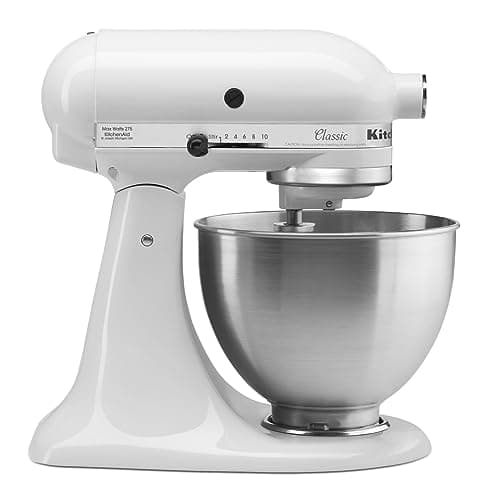 KitchenAid Classic (4.5 Qt) The 4.5-quart Classic is the cheapest way into the KitchenAid ecosystem and takes the same attachments as the Artisan. A slightly smaller bowl and fewer colors, but the same fundamentals. 4.5 Q | Best budget KitchenAid | 4.3★★★★★ | $322.99Amazon |
| 02 | 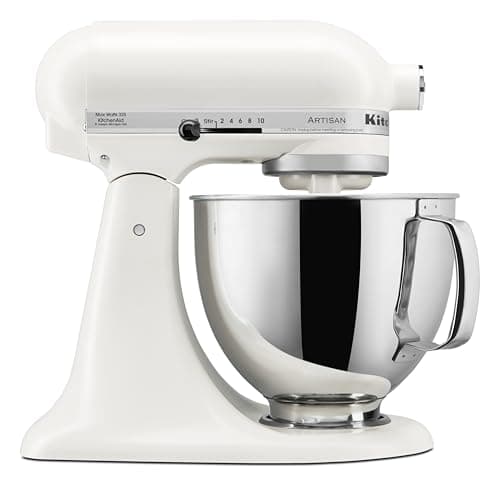 KitchenAid Artisan (5 Qt) The 5-quart tilt-head Artisan is the default for a reason: a metal body, a big color range, and the whole KitchenAid attachment ecosystem. It handles most home baking short of daily heavy bread. 5 Quart | Best overall stand mixer | 4.6★★★★★ | $489.00Amazon |
| 03 | 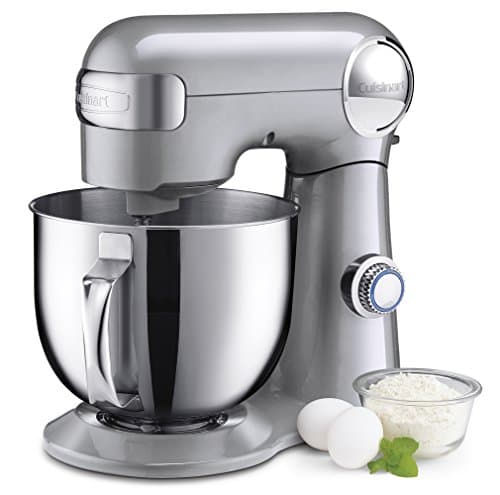 Cuisinart Precision Master SM-50 The 5.5-quart, 500-watt Precision Master gives you a bigger bowl and a stated higher wattage than a same-price KitchenAid. The trade-off is a smaller accessory ecosystem, but for straight mixing it's a lot of machine for the money. 5.5 Qt · 500W | Best big bowl for the money | 4.2★★★★★ | $229.95Amazon |
#ad · Live prices from the Amazon Product API, as of October 17, 2026. Where we have no verified live price, we show none — a gap beats a number that has rotted.
The picks, in detail
KitchenAid Classic (4.5 Qt)
spec score /5
$399.9919% off
Price as of October 17, 2026. Prices change — Amazon's is the one that counts.
#ad · we may earn a commission from this link to KitchenAid Classic (4.5 Qt)
The 4.5-quart Classic is the cheapest way into the KitchenAid ecosystem and takes the same attachments as the Artisan. A slightly smaller bowl and fewer colors, but the same fundamentals.
- Capacity
- 4.5 Q
- Footprint (W×D×H)
- 8.7 × 14.1 × 13.9 in
- Weight
- 24.2 lb
- Warranty
- 1 Year Limited Warranty
- Lowest-cost route to KitchenAid
- Takes the full attachment lineup
- Compact-ish 4.5-qt bowl
- Smaller bowl than the Artisan
- Fewer color options
- Same dough limits as the 5-qt
KitchenAid Artisan (5 Qt)
spec score /5
Price as of October 17, 2026. Prices change — Amazon's is the one that counts.
#ad · we may earn a commission from this link to KitchenAid Artisan (5 Qt)
The 5-quart tilt-head Artisan is the default for a reason: a metal body, a big color range, and the whole KitchenAid attachment ecosystem. It handles most home baking short of daily heavy bread.
- Capacity
- 5 Quart
- Footprint (W×D×H)
- 8.7 × 14.1 × 13.9 in
- Weight
- 22.8 lb
- Warranty
- 1 Year Limited Warranty
- Huge attachment ecosystem (grinder, pasta, more)
- All-metal build; holds resale value
- 5-qt bowl suits most baking
- Struggles with repeated stiff bread dough
- Premium price
- Heavy to lift on and off the counter
Cuisinart Precision Master SM-50
spec score /5
$319.9528% off
Price as of October 17, 2026. Prices change — Amazon's is the one that counts.
#ad · we may earn a commission from this link to Cuisinart Precision Master SM-50
The 5.5-quart, 500-watt Precision Master gives you a bigger bowl and a stated higher wattage than a same-price KitchenAid. The trade-off is a smaller accessory ecosystem, but for straight mixing it's a lot of machine for the money.
- Capacity
- 5.5 Qt
- Footprint (W×D×H)
- 11.2 × 16.5 × 15.9 in
- Power
- 500 W
- Weight
- 17 lb
- Cost per use*
- ≈3¢
- Est. per year*
- ≈$6
- Warranty
- Limited 3-Year Warranty
- Bigger 5.5-qt bowl
- 500 W stated motor
- Often cheaper than KitchenAid
- Smaller attachment ecosystem
- Less iconic resale value
- Plastic trim in places
*Cost-to-run computed from the manufacturer's stated 500W at $0.17/kWh (US average), 20-min sessions, 4×/week. Your rate and use will vary.
The Classic occupies an unusual place: it is the cheapest KitchenAid stand mixer, and the differences between it and the far more popular Artisan are smaller than the price gap makes them look. This is a specification-and-running-cost review — we have not lab-tested it, and our method is on how we review.
The specifications
- Bowl: 4.5-quart stainless steel, dishwasher safe. Rated at 8 dozen cookies per batch using the flat beater.
- Speeds: 10, from stir up to whipping cream at speed 8.
- Design: tilt-head, lockable in place while mixing.
- Construction: metal, with 59 touchpoints around the bowl.
- Footprint: 8.7 × 14.1 × 13.9 in, 24.2 lb.
- Attachments: 10+ hub attachments available, sold separately.
- Warranty: 1 year limited.
Classic vs Artisan: the honest difference
These two machines share more than they differ. Identical 8.7 × 14.1 × 13.9-inch footprint. Same tilt-head mechanism. Same 10 speeds. Same 59 touchpoints. Same one-year warranty. Same attachment hub.
What actually differs:
- Bowl capacity: 4.5 qt versus 5 qt. In batch terms that is 8 dozen cookies versus 9 — about an 11% difference.
- Bowl handle:the Artisan's 5-quart bowl has one; the Classic's does not. Carrying a full stainless bowl of dough without a handle is genuinely more awkward than it sounds.
- Included accessories: the Artisan (KSM150PS) ships with a coated flat beater, coated dough hook, 6-wire whip and a pouring shield. The Classic ships without the shield.
- Weight: the Classic is heavier at 24.2 lb versus 22.8.
- Colors:the Artisan's range is vastly larger. Not a performance point, but it is a real part of why people buy the Artisan.
Our KitchenAid models compared guide runs the whole range including the bowl-lift models.
Does half a quart matter?
For most home baking, no. Eight dozen cookies in a single batch is more than almost anyone makes at once, and 4.5 quarts handles a standard cake, a batch of cookies, or bread for a household comfortably.
Where it shows up is at the edges. Doubling a bread recipe, making a large batch of buttercream for a layer cake, or mixing a big brioche is where 4.5 quarts starts to feel tight — and the tilt-head design compounds it, because a tilt-head has less leverage over a stiff, heavy dough than a bowl-lift does. KitchenAid claims its bowl-lift delivers twice the power in the bowl compared with the tilt-head KSM150. If bread is a regular part of your baking, neither the Classic nor the Artisan is really the right machine — best stand mixers for bread covers that properly.
The build is the reason to buy it
What you are actually paying for with any KitchenAid is the metal construction and the planetary mixing geometry. KitchenAid specifies 59 touchpoints around the bowl — the number of positions the beater passes as it orbits — which is the metric that decides whether you have to stop and scrape. The Classic gets the same figure as the Artisan and the same all-metal build.
The ten speeds are properly spread rather than nominal: stir at the bottom for combining without a flour cloud, speed 8 specified for whipping cream. This is the range of control that separates a stand mixer from a hand mixer, and the Classic does not have it cut down.
The warranty is the weak spot
One year.That is KitchenAid's term across the tilt-head range, and it is the number that should give a value-focused buyer pause — because the direct competitor undercuts it badly.
The Cuisinart SM-50 gives you a 5.5-quart bowl, a published 500-watt motor, 12 speeds, die-cast metal construction, a power outlet for attachments, and a limited 3-year warranty. On paper that is a bigger bowl, more speeds, a published wattage KitchenAid does not provide, and triple the cover. It also weighs 17 lb against 24.2. What KitchenAid has that Cuisinart does not is the attachment ecosystem, parts availability, resale value, and the narrower 8.7-inch footprint — the full argument is in KitchenAid vs Cuisinart.
24.2 lb, and what that means day to day
The Classic is the heaviest mixer we track. That mass is functional — it is what stops the machine walking across the counter under a stiff dough — but it has a practical consequence: this is not an appliance you lift in and out of a cupboard.
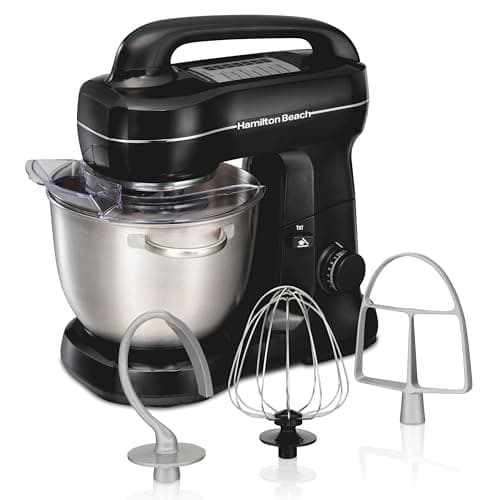
Budget for it living on the counter permanently, in an 8.7 × 14.1-inch space, with clearance above 13.9 inches so the head can tilt back. If that is not available, look at the 11.68-lb Aucma or the 8-lb Hamilton Beach in our small-kitchen mixer guide instead — a mixer that gets stored is a mixer that stops being used.
Who should buy it — and who shouldn't
Buy it if you want a KitchenAid for the build quality, the attachment hub and the parts availability, you bake normal home quantities, and you would rather put the saving toward a pasta roller or grinder than toward half a quart of bowl. On that reasoning it is the smart buy in the range.
Don't buy itif you bake bread regularly — get a bowl-lift. Don't buy it if the extra bowl handle and pouring shield matter to you, because the Artisan is not much more. And don't buy it purely on value, because the Cuisinart SM-50 gives you a bigger bowl and three years of warranty for less — you are paying KitchenAid for the ecosystem, and that is a legitimate thing to pay for, but it should be a choice rather than an accident.
Frequently asked questions
Is the KitchenAid Classic worth it?
Yes, if you want a KitchenAid for the build and the attachment hub and you bake normal home quantities. It shares the metal construction, 10 speeds, 59 touchpoints, tilt-head design and 8.7-inch footprint with the Artisan — the difference is half a quart of bowl.
What is the difference between the KitchenAid Classic and Artisan?
The Classic has a 4.5-quart bowl rated at 8 dozen cookies; the Artisan has 5 quarts rated at 9 dozen, plus a bowl handle and an included pouring shield. Footprint, speeds, touchpoints, warranty and mechanism are identical. Oddly the Classic is heavier at 24.2 lb versus 22.8.
Is a 4.5-quart bowl big enough?
For most home baking, comfortably — KitchenAid rates it at 8 dozen cookies in a single batch. It gets tight when doubling a bread recipe or making buttercream for a layer cake, and a tilt-head has less leverage over heavy dough than a bowl-lift.
How heavy is the KitchenAid Classic?
24.2 lb, the heaviest mixer we track. The mass is functional — it stops the machine moving under stiff dough — but it means this is a permanent counter resident rather than something you store in a cupboard between uses.
What warranty does the KitchenAid Classic have?
One year limited, which is KitchenAid's term across the tilt-head range. It is the machine's weakest number: the Cuisinart SM-50 offers a limited 3-year warranty along with a larger 5.5-quart bowl, 12 speeds and a published 500-watt motor.
Can the KitchenAid Classic knead bread dough?
It can, with the included dough hook, but it is not the ideal machine for it. KitchenAid claims its bowl-lift models deliver twice the power in the bowl compared with the tilt-head KSM150, and stiff dough is what strains a tilt-head hinge.
Sources
Keep reading
Stand Mixers
The Best Stand Mixers of 2026
KitchenAid Artisan, KitchenAid Classic and Cuisinart compared on bowl size, build and attachments.
Comparison
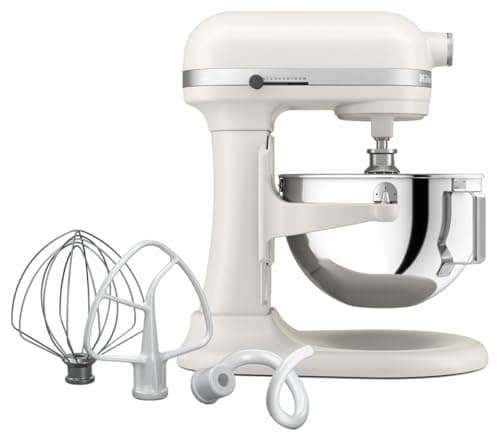
KitchenAid Models Compared: Classic vs. Artisan vs. Bowl-Lift
Classic vs Artisan vs bowl-lift KSM55 — what actually changes between KitchenAid's models, and which one you need.
Review
KitchenAid Artisan Review
The KitchenAid Artisan on bowl coverage, speeds, the attachment hub, weight and the one job it struggles with.
Comparison
KitchenAid vs. Cuisinart: Which Stand Mixer Should You Buy?
KitchenAid vs Cuisinart on bowl size, wattage, warranty, attachments and resale — and who each brand is actually for.
Guide
What Size Stand Mixer Do I Need?
4 to 6.5 quarts mapped to real batch sizes, why bread is limited by torque not volume, and the footprint each costs.
Roundup
The Best Budget Stand Mixers
Budget stand mixers ranked on bowl size, stated wattage, weight and warranty — plus what you actually give up.
https://wattandwhisk.com/stand-mixers/kitchenaid-classic-review