What Size Stand Mixer Do I Need?
Bowl quarts are easy to compare and only half the story — for heavy dough, motor and mechanism matter more than capacity.
Disclosure:Watt & Whisk is reader-supported. When you buy through links on this page we may earn an Amazon Associates commission, at no extra cost to you. Prices are pulled live from Amazon and shown with the date checked. How this works.
4.5–5 quarts suits most households: KitchenAid rates its 4.5-qt Classic at 8 dozen cookies and the 5-qt Artisan at 9 dozen per batch. Go to 5.5–6.5 quarts if you bake bread regularly or double recipes — the 5.5-qt bowl-lift is rated for 11 dozen cookies, over 7 lb of bread dough and 6 lb of potatoes. But for heavy dough the limiting factor is usually the motor and the mechanism, not the bowl: a big bowl on a weak mixer just means it labors with more in it.
The short answer
Quick picks
| # | Product | Best for | Score | Price |
|---|---|---|---|---|
| 01 | 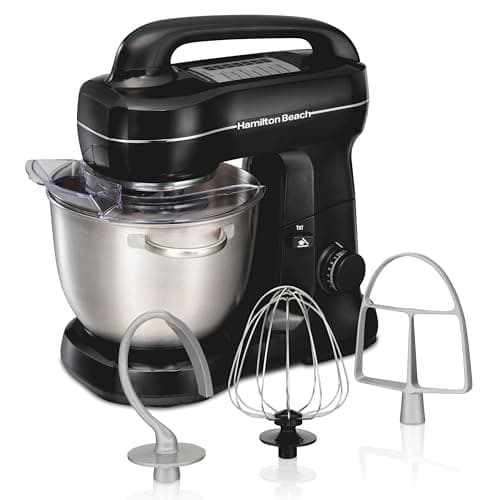 Hamilton Beach 4-Qt Stand Mixer A 300-watt, 7-speed planetary mixer with a 4-quart stainless bowl, dough hook, whisk, flat beater and splash guard included — for a fraction of a KitchenAid. At 8 lb with a molded carry handle it's also the only mixer here you can genuinely lift into a cupboard one-handed. 4 Quart · 300W | Best budget stand mixer | 4.0★★★★★ | $139.99Amazon |
| 02 | 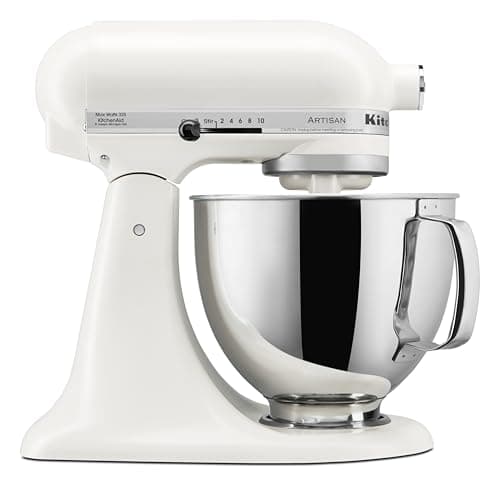 KitchenAid Artisan (5 Qt) The 5-quart tilt-head Artisan is the default for a reason: a metal body, a big color range, and the whole KitchenAid attachment ecosystem. It handles most home baking short of daily heavy bread. 5 Quart | Best overall stand mixer | 4.6★★★★★ | $489.00Amazon |
| 03 | 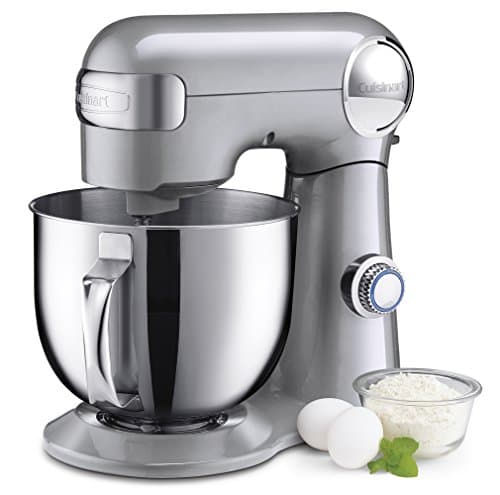 Cuisinart Precision Master SM-50 The 5.5-quart, 500-watt Precision Master gives you a bigger bowl and a stated higher wattage than a same-price KitchenAid. The trade-off is a smaller accessory ecosystem, but for straight mixing it's a lot of machine for the money. 5.5 Qt · 500W | Best big bowl for the money | 4.2★★★★★ | $229.95Amazon |
| 04 | 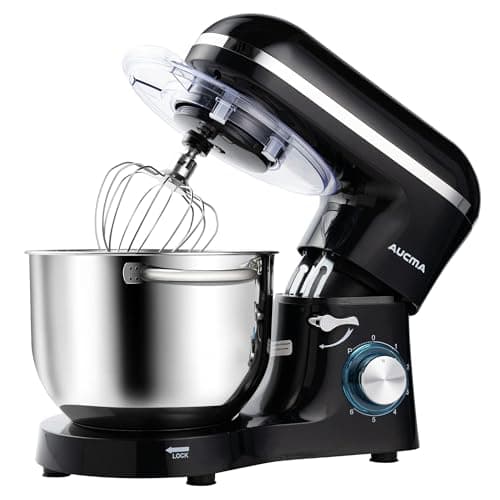 Aucma 6.5-Qt Stand Mixer The value play: a 6.5-quart stainless bowl and a stated 660-watt copper motor with 6 speeds and pulse, for less than a 4.5-quart KitchenAid Classic. You give up the brand's attachment ecosystem and resale value; you get a bigger bowl and a higher stated wattage for the money. 6.5QT · 660W | Best big bowl on a budget | 4.0★★★★★ | $129.99Amazon |
#ad · Live prices from the Amazon Product API, as of October 17, 2026. Where we have no verified live price, we show none — a gap beats a number that has rotted.
The picks, in detail
Hamilton Beach 4-Qt Stand Mixer
spec score /5
Price as of October 17, 2026. Prices change — Amazon's is the one that counts.
#ad · we may earn a commission from this link to Hamilton Beach 4-Qt Stand Mixer
A 300-watt, 7-speed planetary mixer with a 4-quart stainless bowl, dough hook, whisk, flat beater and splash guard included — for a fraction of a KitchenAid. At 8 lb with a molded carry handle it's also the only mixer here you can genuinely lift into a cupboard one-handed.
- Capacity
- 4 Quart
- Footprint (W×D×H)
- 10.9 × 14.5 × 14.4 in
- Power
- 300 W
- Weight
- 8 lb
- Cost per use*
- ≈2¢
- Est. per year*
- ≈$4
- Warranty
- One(1) Year Warranty
- All four attachments and a splash guard in the box
- 8 lb with a carry handle — actually storable
- Slow first speed keeps flour in the bowl
- 300 W is a cake-and-cookie motor, not a bread motor
- 4-qt bowl limits batch size
- No third-party attachment ecosystem
*Cost-to-run computed from the manufacturer's stated 300W at $0.17/kWh (US average), 20-min sessions, 4×/week. Your rate and use will vary.
KitchenAid Artisan (5 Qt)
spec score /5
Price as of October 17, 2026. Prices change — Amazon's is the one that counts.
#ad · we may earn a commission from this link to KitchenAid Artisan (5 Qt)
The 5-quart tilt-head Artisan is the default for a reason: a metal body, a big color range, and the whole KitchenAid attachment ecosystem. It handles most home baking short of daily heavy bread.
- Capacity
- 5 Quart
- Footprint (W×D×H)
- 8.7 × 14.1 × 13.9 in
- Weight
- 22.8 lb
- Warranty
- 1 Year Limited Warranty
- Huge attachment ecosystem (grinder, pasta, more)
- All-metal build; holds resale value
- 5-qt bowl suits most baking
- Struggles with repeated stiff bread dough
- Premium price
- Heavy to lift on and off the counter
Cuisinart Precision Master SM-50
spec score /5
$319.9528% off
Price as of October 17, 2026. Prices change — Amazon's is the one that counts.
#ad · we may earn a commission from this link to Cuisinart Precision Master SM-50
The 5.5-quart, 500-watt Precision Master gives you a bigger bowl and a stated higher wattage than a same-price KitchenAid. The trade-off is a smaller accessory ecosystem, but for straight mixing it's a lot of machine for the money.
- Capacity
- 5.5 Qt
- Footprint (W×D×H)
- 11.2 × 16.5 × 15.9 in
- Power
- 500 W
- Weight
- 17 lb
- Cost per use*
- ≈3¢
- Est. per year*
- ≈$6
- Warranty
- Limited 3-Year Warranty
- Bigger 5.5-qt bowl
- 500 W stated motor
- Often cheaper than KitchenAid
- Smaller attachment ecosystem
- Less iconic resale value
- Plastic trim in places
*Cost-to-run computed from the manufacturer's stated 500W at $0.17/kWh (US average), 20-min sessions, 4×/week. Your rate and use will vary.
Aucma 6.5-Qt Stand Mixer
spec score /5
$169.9924% off
Price as of October 17, 2026. Prices change — Amazon's is the one that counts.
#ad · we may earn a commission from this link to Aucma 6.5-Qt Stand Mixer
The value play: a 6.5-quart stainless bowl and a stated 660-watt copper motor with 6 speeds and pulse, for less than a 4.5-quart KitchenAid Classic. You give up the brand's attachment ecosystem and resale value; you get a bigger bowl and a higher stated wattage for the money.
- Capacity
- 6.5QT
- Footprint (W×D×H)
- 9.3700787306 × 15.2362204569 × 12.3622047118 in
- Power
- 660 W
- Weight
- 11.68 lb
- Cost per use*
- ≈4¢
- Est. per year*
- ≈$8
- 6.5-qt bowl — the biggest here
- 660 W stated motor with pulse
- Whisk, dough hook and beater all dishwasher-safe
- No attachment ecosystem beyond the three included tools
- No published warranty on the listing
- Less proven long-term than the big brands
*Cost-to-run computed from the manufacturer's stated 660W at $0.17/kWh (US average), 20-min sessions, 4×/week. Your rate and use will vary.
Bowl capacity is the number every stand mixer is sold on because it is the easiest thing to compare. It is a genuinely useful figure for baking volume, and a genuinely misleading one for bread — which is where most sizing regret comes from. This guide covers both.
The size ladder, with real ratings
These are manufacturer batch ratings rather than our estimates, which makes them unusually comparable:
- 4 quarts — Hamilton Beach 63391. A 300-watt motor, 7 speeds with a slow first speed, planetary mixing action and a stainless bowl. Fine for a household that bakes occasionally.
- 4.5 quarts — KitchenAid Classic K45SS. Rated at 8 dozen cookies per batch, 10 speeds, 59 touchpoints around the bowl.
- 5 quarts — KitchenAid Artisan KSM150PS. Rated at 9 dozen cookies, 10 speeds, bowl with a handle. The default recommendation for most people.
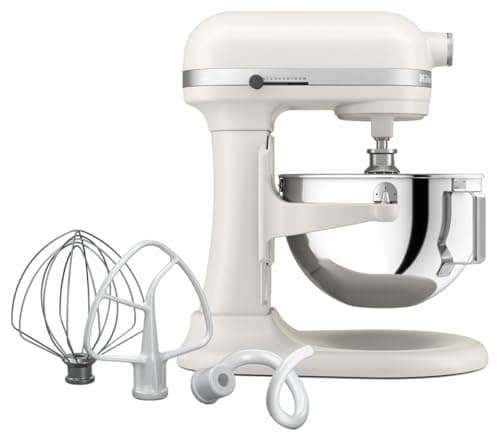
- 5.5 quarts— Cuisinart SM-50 (500 W, 12 speeds, die-cast metal) and KitchenAid's bowl-lift KSM55SXXX, rated at 11 dozen cookies, over 7 lb of bread dough and 6 lb of potatoes, with 11 speeds including a ½ speed for folding.
- 6.5 quarts — Aucma SM-1518N. A 660-watt copper motor, 6 speeds with pulse, and the largest bowl we track.
Why the bowl is not the limit for bread
Here is the thing sizing guides skip. Cookie dough and cake batter are limited by volume — you can only fit so much in the bowl. Bread dough is limited by torque and mechanism — how hard the machine can push against a stiff mass without straining or walking across the counter.
KitchenAid is explicit about this: it claims its bowl-lift design delivers twice the power in the bowl as its tilt-head models, measured against the KSM150, and pairs it with a 3-point locking bowl for stability. That is not a capacity claim, it is a leverage claim — the bowl is clamped at three points instead of a head hinging above it, so the machine can work a stiff dough without flexing.
The practical consequence: a 6.5-quart bowl on a mixer without the torque to use it is worse than a 5-quart bowl on one that has it. If bread is your main job, read tilt-head vs bowl-lift before you shop on quarts at all, and check best stand mixers for bread.
The problem with buying too big
Oversizing has a real cost that undersizing does not, and it is the opposite of what people expect: a big bowl handles small quantities badly.
A wire whip in a 6.5-quart bowl cannot catch one egg white or a half-cup of cream — the liquid sits below the sweep of the whisk and never gets aerated. Beating two eggs in a large bowl is genuinely worse than doing it in a small one. If most of what you make is modest quantities, a 4.5 or 5-quart bowl will serve you better than a 6.5.
The other cost is weight and footprint, covered below.
The footprint each size costs
Real measured dimensions from the machines we track. The surprise is that capacity and size are only loosely related:
- Hamilton Beach 4 qt — 10.9 × 14.5 × 14.4 in, 8 lb
- KitchenAid Classic 4.5 qt — 8.7 × 14.1 × 13.9 in, 24.2 lb
- KitchenAid Artisan 5 qt — 8.7 × 14.1 × 13.9 in, 22.8 lb
- Cuisinart SM-50 5.5 qt — 11.2 × 16.5 × 15.9 in, 17 lb
- KitchenAid bowl-lift 5.5 qt — 11.31 × 14.63 × 16.5 in
- Aucma 6.5 qt — 9.37 × 15.24 × 12.36 in, 11.68 lb
Two things worth noticing. The KitchenAid tilt-heads are the narrowest at 8.7 inches despite being mid-capacity — useful in a tight kitchen, and the reason they show up in our small-kitchen mixer guide. And they are by far the heaviest, at 22.8–24.2 lb against 8 lb for the Hamilton Beach and 11.68 for the Aucma.
That weight is deliberate — mass is what stops a mixer walking across the counter under a stiff dough — but it has a consequence people underestimate. A 24-lb mixer does not get put away. It lives on the counter permanently, or it never gets used. Hamilton Beach's built-in carry handle is a direct response to this problem.
Check the height, not just the width
A tilt-head mixer needs clearance above its stated height to tip the head back, and a bowl-lift needs room to raise the bowl. Standing heights run 12.36 inches (Aucma) to 16.5 (KitchenAid bowl-lift), and a standard counter-to-cabinet gap is about 18 inches — so the taller machines cannot open under a cabinet at all. If the mixer will live under upper cabinets, measure the gap and add a few inches of working room.
The recommendation
Most households: 5 quarts. The KitchenAid Artisan at 9 dozen cookies a batch covers everything a home baker normally does, in the narrowest full-size body available, with the biggest attachment ecosystem behind it.
Regular bread baking: 5.5 quarts and a bowl-lift, or the Cuisinart SM-50 if you want a 500-watt motor, 12 speeds and a 3-year warrantyinstead of KitchenAid's one.
Occasional baking, or a tight budget: 4 quarts is genuinely enough, and the Hamilton Beach at 8 lb with a carry handle is the one that will actually get taken out of the cupboard.
For the models compared head to head, see KitchenAid models compared and best budget stand mixers.
A note on the spec people reach for after capacity. Wattage is a poor way to choose between these machines, and the clearest evidence is that KitchenAid publishes none at all — not on the Classic, the Artisan or the bowl-lift. It publishes dozens of cookies instead, at a stated 28 g of dough each. Why that is the more useful figure is in how many watts a stand mixer needs.
Frequently asked questions
What size stand mixer do I need for bread?
5.5 quarts is the sensible size, but capacity is not the real constraint — torque and mechanism are. KitchenAid rates its 5.5-quart bowl-lift at over 7 lb of bread dough and claims twice the power in the bowl versus its tilt-head models, with a 3-point locking bowl for stability.
Is a 5-quart stand mixer big enough?
For most households, yes. KitchenAid rates the 5-quart Artisan at 9 dozen cookies in a single batch, which covers normal home baking comfortably. Step up only if you regularly double recipes or bake bread.
Can a stand mixer bowl be too big?
Yes, and this surprises people. A wire whip in a 6.5-quart bowl cannot catch one egg white or a half-cup of cream — the liquid sits below the sweep of the whisk. If you mostly make modest quantities, a 4.5 or 5-quart bowl performs better.
How much does a stand mixer weigh?
From 8 lb for the Hamilton Beach 4-quart to 24.2 lb for the KitchenAid Classic. The weight is deliberate — mass stops a mixer walking across the counter under stiff dough — but a 24-lb machine lives on the counter permanently rather than in a cupboard.
Will a stand mixer fit under my cabinets?
Check the height plus working room. Standing heights run from 12.36 inches to 16.5, and a standard counter-to-cabinet gap is about 18 — but a tilt-head needs clearance above its stated height to tip back, and a bowl-lift needs room to raise the bowl.
Does a bigger motor matter more than a bigger bowl?
For bread, yes. Cookie dough and batter are limited by volume; stiff dough is limited by how hard the machine can push without straining. A 6.5-quart bowl on an underpowered mixer is worse than a 5-quart bowl on one with the torque to use it.
Sources
Keep reading
Stand Mixers
The Best Stand Mixers of 2026
KitchenAid Artisan, KitchenAid Classic and Cuisinart compared on bowl size, build and attachments.
Comparison
Tilt-Head vs. Bowl-Lift: Which Stand Mixer Design?
Tilt-head vs bowl-lift on rigidity, dough capacity, loading, height and cost — and which design your baking needs.
Roundup
The Best Stand Mixers for Bread Dough
Four mixers ranked for bread: bowl-lift rigidity, stated dough capacity and what kneading does to a machine built for cake.
Comparison
KitchenAid Models Compared: Classic vs. Artisan vs. Bowl-Lift
Classic vs Artisan vs bowl-lift KSM55 — what actually changes between KitchenAid's models, and which one you need.
Roundup
The Best Stand Mixers for Small Kitchens
Stand mixers ranked on real width, height and weight — the specs that matter when counter space is the constraint.
Comparison
KitchenAid vs. Cuisinart: Which Stand Mixer Should You Buy?
KitchenAid vs Cuisinart on bowl size, wattage, warranty, attachments and resale — and who each brand is actually for.
https://wattandwhisk.com/stand-mixers/what-size-stand-mixer-do-i-need