Tilt-Head vs. Bowl-Lift: Which Stand Mixer Design?
The only structural decision in buying a stand mixer, and the one that actually has a wrong answer for some people.
Disclosure:Watt & Whisk is reader-supported. When you buy through links on this page we may earn an Amazon Associates commission, at no extra cost to you. Prices are pulled live from Amazon and shown with the date checked. How this works.
Tilt-head mixers hinge back for easy loading, sit lower (about 13.9 in), cost less and suit cakes, cookies and occasional bread — which is most baking. Bowl-lift mixers raise the bowl on a lever into a fixed head with a 3-point locking cradle, so nothing flexes under a loaded dough hook: KitchenAid rates its bowl-lift KSM55 at twice the in-bowl power of a tilt-head KSM150 and over 7 lb of bread dough. Bake bread weekly, buy bowl-lift. Otherwise, tilt-head.
The short answer
Quick picks
| # | Product | Best for | Score | Price |
|---|---|---|---|---|
| 01 | 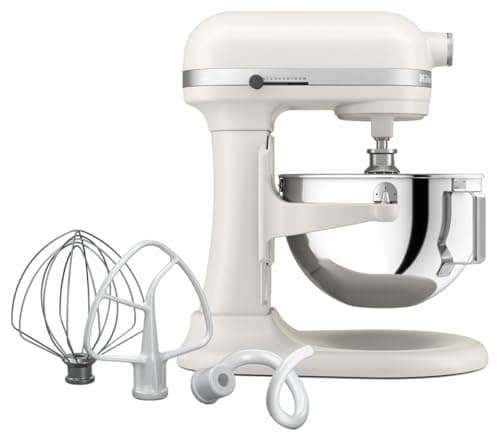 KitchenAid 5.5-Qt Bowl-Lift KSM55 This is the answer to the one thing the tilt-head Artisan genuinely struggles with. KitchenAid rates the bowl-lift KSM55 at twice the power in the bowl of a KSM150 tilt-head and lists it as kneading over 7 lb of bread dough, with a 3-point locking bowl that doesn't walk when the hook loads up. 5.5 Q | Best for bread dough | 4.6★★★★★ | Check price → |
| 02 | 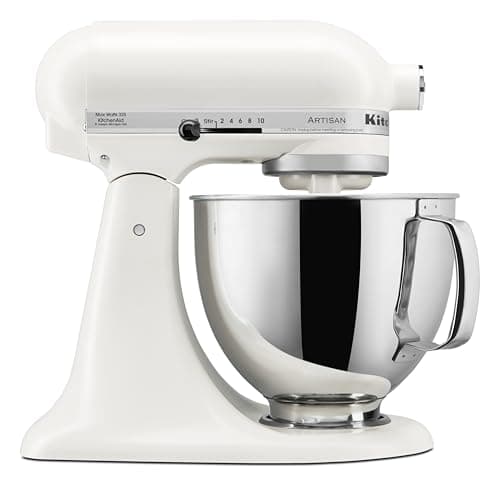 KitchenAid Artisan (5 Qt) The 5-quart tilt-head Artisan is the default for a reason: a metal body, a big color range, and the whole KitchenAid attachment ecosystem. It handles most home baking short of daily heavy bread. 5 Quart | Best overall stand mixer | 4.6★★★★★ | $489.00Amazon |
| 03 | 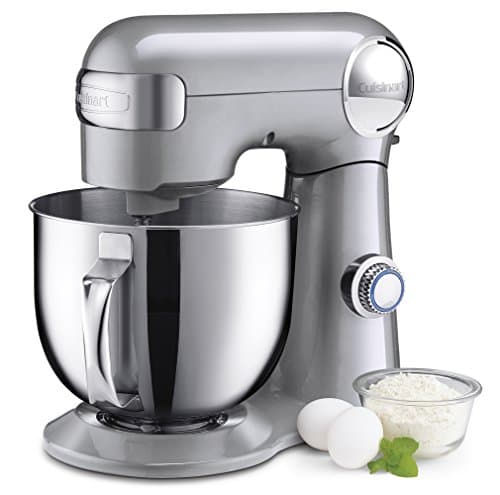 Cuisinart Precision Master SM-50 The 5.5-quart, 500-watt Precision Master gives you a bigger bowl and a stated higher wattage than a same-price KitchenAid. The trade-off is a smaller accessory ecosystem, but for straight mixing it's a lot of machine for the money. 5.5 Qt · 500W | Best big bowl for the money | 4.2★★★★★ | $229.95Amazon |
| 04 | 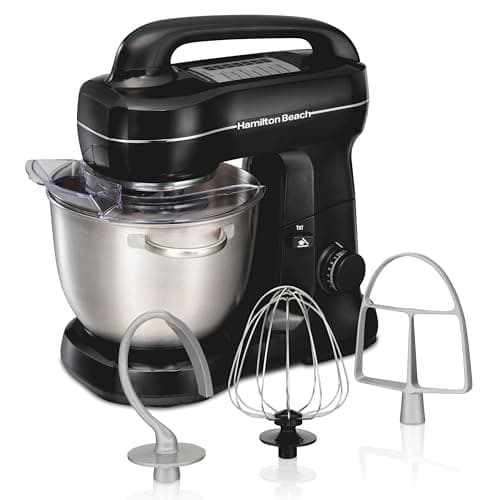 Hamilton Beach 4-Qt Stand Mixer A 300-watt, 7-speed planetary mixer with a 4-quart stainless bowl, dough hook, whisk, flat beater and splash guard included — for a fraction of a KitchenAid. At 8 lb with a molded carry handle it's also the only mixer here you can genuinely lift into a cupboard one-handed. 4 Quart · 300W | Best budget stand mixer | 4.0★★★★★ | $139.99Amazon |
#ad · Live prices from the Amazon Product API, as of October 17, 2026. Where we have no verified live price, we show none — a gap beats a number that has rotted.
The picks, in detail
KitchenAid 5.5-Qt Bowl-Lift KSM55
spec score /5
No buyable offer at the last price check (October 17, 2026). We show nothing rather than a stale number.
#ad · we may earn a commission from this link to KitchenAid 5.5-Qt Bowl-Lift KSM55
This is the answer to the one thing the tilt-head Artisan genuinely struggles with. KitchenAid rates the bowl-lift KSM55 at twice the power in the bowl of a KSM150 tilt-head and lists it as kneading over 7 lb of bread dough, with a 3-point locking bowl that doesn't walk when the hook loads up.
- Capacity
- 5.5 Q
- Footprint (W×D×H)
- 11.31 × 14.63 × 16.5 in
- Warranty
- 1 Year Replacement Plan - Stand Mixer - $19.95
- Listed at 2× the in-bowl power of a KSM150 tilt-head
- Rated to knead over 7 lb of bread dough
- 3-point locking bowl stays put under a heavy hook
- The priciest mixer we list
- 16.5 in tall with the bowl raised — check your cabinets
- Bowl-lift is slower to load than a tilt-head
KitchenAid Artisan (5 Qt)
spec score /5
Price as of October 17, 2026. Prices change — Amazon's is the one that counts.
#ad · we may earn a commission from this link to KitchenAid Artisan (5 Qt)
The 5-quart tilt-head Artisan is the default for a reason: a metal body, a big color range, and the whole KitchenAid attachment ecosystem. It handles most home baking short of daily heavy bread.
- Capacity
- 5 Quart
- Footprint (W×D×H)
- 8.7 × 14.1 × 13.9 in
- Weight
- 22.8 lb
- Warranty
- 1 Year Limited Warranty
- Huge attachment ecosystem (grinder, pasta, more)
- All-metal build; holds resale value
- 5-qt bowl suits most baking
- Struggles with repeated stiff bread dough
- Premium price
- Heavy to lift on and off the counter
Cuisinart Precision Master SM-50
spec score /5
$319.9528% off
Price as of October 17, 2026. Prices change — Amazon's is the one that counts.
#ad · we may earn a commission from this link to Cuisinart Precision Master SM-50
The 5.5-quart, 500-watt Precision Master gives you a bigger bowl and a stated higher wattage than a same-price KitchenAid. The trade-off is a smaller accessory ecosystem, but for straight mixing it's a lot of machine for the money.
- Capacity
- 5.5 Qt
- Footprint (W×D×H)
- 11.2 × 16.5 × 15.9 in
- Power
- 500 W
- Weight
- 17 lb
- Cost per use*
- ≈3¢
- Est. per year*
- ≈$6
- Warranty
- Limited 3-Year Warranty
- Bigger 5.5-qt bowl
- 500 W stated motor
- Often cheaper than KitchenAid
- Smaller attachment ecosystem
- Less iconic resale value
- Plastic trim in places
*Cost-to-run computed from the manufacturer's stated 500W at $0.17/kWh (US average), 20-min sessions, 4×/week. Your rate and use will vary.
Hamilton Beach 4-Qt Stand Mixer
spec score /5
Price as of October 17, 2026. Prices change — Amazon's is the one that counts.
#ad · we may earn a commission from this link to Hamilton Beach 4-Qt Stand Mixer
A 300-watt, 7-speed planetary mixer with a 4-quart stainless bowl, dough hook, whisk, flat beater and splash guard included — for a fraction of a KitchenAid. At 8 lb with a molded carry handle it's also the only mixer here you can genuinely lift into a cupboard one-handed.
- Capacity
- 4 Quart
- Footprint (W×D×H)
- 10.9 × 14.5 × 14.4 in
- Power
- 300 W
- Weight
- 8 lb
- Cost per use*
- ≈2¢
- Est. per year*
- ≈$4
- Warranty
- One(1) Year Warranty
- All four attachments and a splash guard in the box
- 8 lb with a carry handle — actually storable
- Slow first speed keeps flour in the bowl
- 300 W is a cake-and-cookie motor, not a bread motor
- 4-qt bowl limits batch size
- No third-party attachment ecosystem
*Cost-to-run computed from the manufacturer's stated 300W at $0.17/kWh (US average), 20-min sessions, 4×/week. Your rate and use will vary.
Almost every stand mixer decision — brand, bowl size, color, price — is a preference. This one is not. Tilt-head versus bowl-lift is a genuine structural difference with a genuine capability consequence, and it is the only question in the category where a substantial number of people buy the wrong thing and find out two years later.
All figures come from the current manufacturer listings for the machines we link to. This is a specification comparison, not a bake-off — see how we review.
The mechanical difference
A tilt-head mixer has a head that hinges backwards. The bowl slots into a plate at the base and twists to lock. To load it, you tilt the head up and away, which gives you unobstructed access to the whole bowl.
A bowl-liftmixer has a fixed head that never moves. The bowl sits in a cradle on two arms, and a lever raises the whole bowl up to meet the beater. On KitchenAid's bowl-lift machines that cradle is a 3-point locking design, so the bowl is held rigidly from three points rather than resting on a plate.
Everything else follows from that. A hinge, however well made, has a small amount of play. A fixed head does not. Under light loads the difference is invisible; under a dough hook dragging a stiff mass around a bowl, it is the whole story.
At a glance
| Factor | Tilt-head | Bowl-lift |
|---|---|---|
| Loading | Easy — head swings away | Slower — lower bowl, load, raise |
| Scraping mid-recipe | Easy | Awkward |
| Rigidity under dough | Some flex at the hinge | Fixed head, locked bowl |
| Stated dough capacity | Usually unpublished | KSM55: over 7 lb |
| Height | 13.9 in (KitchenAid) | 16.5 in (KSM55) |
| Clearance needed | Extra above, to tilt back | Extra above, to raise bowl |
| Typical bowl | 4.5–5.5 qt | 5.5 qt and up |
| Price | Lower | Higher |
What KitchenAid's own numbers say
The most useful evidence here comes from the manufacturer rather than from us. The bowl-lift KSM55 listing claims 2× the power in the bowl compared with a KSM150 tilt-head, and states capacities of over 7 lb of bread dough, 11 dozen cookies in a batch, or 6 lb of mashed potato.
The tilt-head Artisan listing publishes no dough figure at all. It states 9 dozen cookies. That absence is informative — when a manufacturer is willing to print a dough capacity, believe it; when they decline to, that is a choice.
So the honest summary is that KitchenAid itself positions the bowl-lift as roughly double the machine where dough is concerned, and we have no reason to argue with them.
Why kneading is the load that matters
Worth understanding, because it explains why a machine that whips cream beautifully can still be the wrong tool.
Kneading applies continuous torque at low speed — manufacturers specify speed 2 — and electric motors are least efficient at low speed under high load, with the excess becoming heat. It applies that torque off-center, because a dough hook catches the mass, drags it up the bowl wall and drops it, producing a rhythmic side load that tries to twist the whole machine. And it runs long: a cake batter is three minutes, a brioche can be twelve.
Heat, twist and duration together are what age a mixer. A bowl-lift resists the twist by being rigid, and its bigger bowl gives the dough room to be thrown rather than bound — dough needs roughly three times its own volume to knead properly. We go deeper in best stand mixers for bread.
Where tilt-head genuinely wins
This is not a walkover, and for most buyers the tilt-head is the correct choice.
Loading and scraping. You will scrape a bowl mid-recipe far more often than you will knead bread. A head that swings away gives unobstructed access; a raised bowl under a fixed head does not. Over a year of baking this is the difference you actually feel.
Height. KitchenAid tilt-heads are 13.9 inches with the head down; the bowl-lift KSM55 is 16.5 inches. Against a standard 18-inch counter-to-cabinet gap, the bowl-lift is genuinely tight — and you need clearance to raise the bowl on top of that.
Price. Tilt-heads are consistently cheaper, and for cakes, cookies, frosting, meringue and whipped cream they are not compromised in the slightest.
Small quantities. Neither design is brilliant with a single egg white, but a smaller tilt-head bowl gets closer than a large bowl-lift one.
Where bowl-lift genuinely wins
Any dough, repeatedly. The core case, and the reason the design exists.
Large batches. Bigger bowls with the rigidity to drive them.
Stability. A locked bowl in a rigid frame does not walk across the counter under a heavy hook — the complaint people most often have about lighter tilt-head machines.
The folding speed. A small one, but the KSM55 listing calls out a ½ speed designed for folding delicate ingredients like blueberries or whipped egg whites into a batter without overbeating. Anyone who has watched a mixer on its lowest setting demolish a folded mousse will recognize the problem.
Living with each, day to day
Beyond the dough question, three practical differences show up every time you bake.
Adding ingredients mid-mix. On a tilt-head you drop things into an open bowl from above. On a bowl-lift the fixed head sits over the bowl, so you are working around it — most bowl-lifts have a gap at the front, and a pouring shield helps considerably. Recipes that stream in oil, syrup or butter over several minutes are noticeably easier on a tilt-head.
Getting the bowl off. A tilt-head bowl twists out of a plate; a bowl-lift bowl lowers on the lever and unclips from the cradle. Neither is difficult, but the bowl-lift is a two-step operation you repeat every time.
Cleaning around the machine. A fixed head means a fixed shadow on your counter that is awkward to wipe under. A tilt-head lifts out of the way.
None of these is decisive. They are the reason we say most people should buy a tilt-head unless dough specifically pushes them the other way — the convenience is felt constantly, the rigidity only when kneading.
Two things that are not differences
Worth clearing up, because both come up constantly and neither should influence a purchase.
"Bowl-lift mixers are more powerful."Not inherently. The KSM55's 2× claim is specifically about power delivered in the bowl — a function of the rigid frame and locked bowl transmitting load into the machine rather than into flex, as much as of the motor itself. A bowl-lift with a weak motor would still be a weak mixer. Design and motor both matter, and the claim is about the combination.
"Bowl-lift means bigger." Only loosely. Bowl-lift machines tend to start at 5.5 quarts and go up, but the Cuisinart SM-50 is a tilt-head with a 5.5-quart bowl — the same capacity as the bowl-lift KSM55. Capacity and head design are separate specifications and you should check them separately rather than assuming one implies the other.
The genuinely reliable rule is narrower than either myth: bowl-lift machines resist flex under a dough hook, and tilt-heads are easier to load. Everything else varies by model.
Which should you buy?
Answer one question honestly: how often will you knead stiff dough?
Never, or a few times a year — buy a tilt-head, and spend the saving on a bigger bowl or a second one. The KitchenAid Artisan or the Cuisinart SM-50 are the two we would shortlist, and the much lighter Hamilton Beach is the budget answer if the mixer needs to live in a cupboard.
Monthly — a tilt-head is still fine. Use speed 2, raise your hydration a little, and split long kneads into two sessions with a rest.
Weekly, or you make bagels and pretzels — buy the bowl-lift and stop reading. Stiff, low-hydration doughs are exactly the load tilt-heads are worst at, and no technique adjustment substitutes for a rigid frame.
One caveat worth repeating: the bowl-lift is 16.5 inches tall. Measure your counter-to-cabinet gap before committing, because the right machine that does not fit is the wrong machine. The full range breakdown is in KitchenAid models compared, and if you are still not sure a stand mixer earns its space at all, are stand mixers worth it is the honest version of that question.
Whichever body style you land on, the operating technique is the same on both, and it is where most first-time owners go wrong — the beater choice, the speed map and the order ingredients go in. How to use a stand mixer walks through all three.
Frequently asked questions
What is the difference between a tilt-head and bowl-lift stand mixer?
A tilt-head hinges backwards so you can swing the head away to load the bowl. A bowl-lift has a fixed head and raises the bowl to the beater on a lever, held in a locking cradle. The fixed head does not flex under a loaded dough hook, which is why bowl-lifts handle bread better.
Is a bowl-lift mixer better than a tilt-head?
Only for dough and large batches. KitchenAid rates its bowl-lift KSM55 at twice the in-bowl power of a KSM150 tilt-head and over 7 lb of bread dough. For cakes, cookies and whipped cream a tilt-head is easier to load, sits lower and costs less.
Do I need a bowl-lift mixer for bread?
If you bake bread weekly, or make stiff low-hydration doughs like bagels and pretzels, yes. For a loaf a month a tilt-head is fine — knead at speed 2, raise the hydration slightly, and split long kneads into two sessions with a rest in between.
Are bowl-lift mixers taller than tilt-head mixers?
Yes. KitchenAid tilt-heads are 13.9 inches with the head down; the bowl-lift KSM55 is 16.5 inches. Against a standard 18-inch counter-to-cabinet gap that is tight, and you need clearance above to raise the bowl on top of that.
Why does my tilt-head mixer rock when kneading?
Because a dough hook loads the machine off-center — it catches the mass, drags it up the bowl wall and drops it, producing a rhythmic side load. A hinge has a small amount of play that a fixed bowl-lift head does not, and lighter machines have less mass to resist it.
Sources
Keep reading
Stand Mixers
The Best Stand Mixers of 2026
KitchenAid Artisan, KitchenAid Classic and Cuisinart compared on bowl size, build and attachments.
Roundup
The Best Stand Mixers for Bread Dough
Four mixers ranked for bread: bowl-lift rigidity, stated dough capacity and what kneading does to a machine built for cake.
Comparison
KitchenAid Models Compared: Classic vs. Artisan vs. Bowl-Lift
Classic vs Artisan vs bowl-lift KSM55 — what actually changes between KitchenAid's models, and which one you need.
Review
KitchenAid Artisan Review
The KitchenAid Artisan on bowl coverage, speeds, the attachment hub, weight and the one job it struggles with.
https://wattandwhisk.com/stand-mixers/tilt-head-vs-bowl-lift