KitchenAid Artisan Review
The default stand mixer for a reason, and a machine whose real product is the hub on the front and the resale value, not the motor.
Disclosure:Watt & Whisk is reader-supported. When you buy through links on this page we may earn an Amazon Associates commission, at no extra cost to you. Prices are pulled live from Amazon and shown with the date checked. How this works.
The KitchenAid Artisan (KSM150) is the stand mixer most people should buy and the one most people do: a 5-quart stainless bowl rated for 9 dozen cookies a batch, 10 speeds, an all-metal body, and 59 touchpoints around the bowl for thorough mixing. What you are really buying is the attachment hub and the resale value. Its one genuine weakness is repeated stiff bread dough, and at 22.8 lb it lives on your counter permanently.
The short answer
Quick picks
| # | Product | Best for | Score | Price |
|---|---|---|---|---|
| 01 | 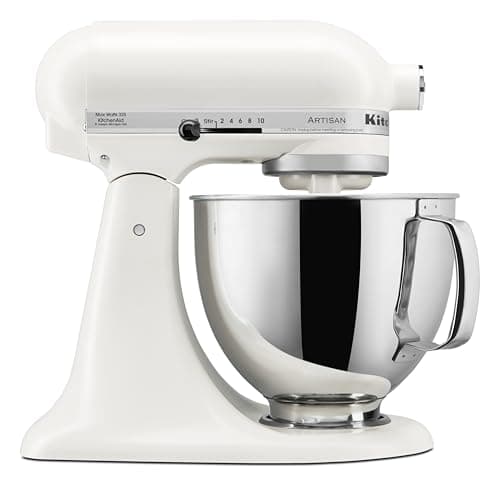 KitchenAid Artisan (5 Qt) The 5-quart tilt-head Artisan is the default for a reason: a metal body, a big color range, and the whole KitchenAid attachment ecosystem. It handles most home baking short of daily heavy bread. 5 Quart | Best overall stand mixer | 4.6★★★★★ | $489.00Amazon |
| 02 | 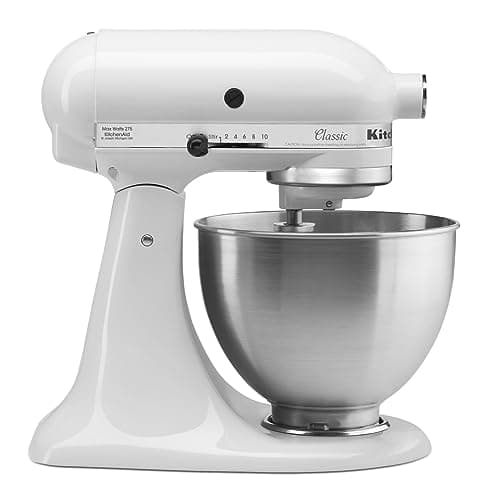 KitchenAid Classic (4.5 Qt) The 4.5-quart Classic is the cheapest way into the KitchenAid ecosystem and takes the same attachments as the Artisan. A slightly smaller bowl and fewer colors, but the same fundamentals. 4.5 Q | Best budget KitchenAid | 4.3★★★★★ | $322.99Amazon |
| 03 | 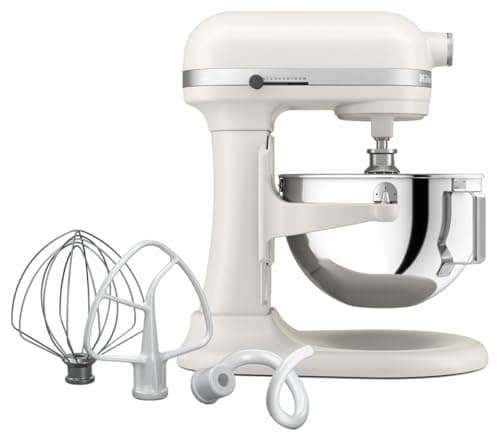 KitchenAid 5.5-Qt Bowl-Lift KSM55 This is the answer to the one thing the tilt-head Artisan genuinely struggles with. KitchenAid rates the bowl-lift KSM55 at twice the power in the bowl of a KSM150 tilt-head and lists it as kneading over 7 lb of bread dough, with a 3-point locking bowl that doesn't walk when the hook loads up. 5.5 Q | Best for bread dough | 4.6★★★★★ | Check price → |
#ad · Live prices from the Amazon Product API, as of October 16, 2026. Where we have no verified live price, we show none — a gap beats a number that has rotted.
The picks, in detail
KitchenAid Artisan (5 Qt)
spec score /5
Price as of October 16, 2026. Prices change — Amazon's is the one that counts.
#ad · we may earn a commission from this link to KitchenAid Artisan (5 Qt)
The 5-quart tilt-head Artisan is the default for a reason: a metal body, a big color range, and the whole KitchenAid attachment ecosystem. It handles most home baking short of daily heavy bread.
- Capacity
- 5 Quart
- Footprint (W×D×H)
- 8.7 × 14.1 × 13.9 in
- Weight
- 22.8 lb
- Warranty
- 1 Year Limited Warranty
- Huge attachment ecosystem (grinder, pasta, more)
- All-metal build; holds resale value
- 5-qt bowl suits most baking
- Struggles with repeated stiff bread dough
- Premium price
- Heavy to lift on and off the counter
KitchenAid Classic (4.5 Qt)
spec score /5
$399.9919% off
Price as of October 16, 2026. Prices change — Amazon's is the one that counts.
#ad · we may earn a commission from this link to KitchenAid Classic (4.5 Qt)
The 4.5-quart Classic is the cheapest way into the KitchenAid ecosystem and takes the same attachments as the Artisan. A slightly smaller bowl and fewer colors, but the same fundamentals.
- Capacity
- 4.5 Q
- Footprint (W×D×H)
- 8.7 × 14.1 × 13.9 in
- Weight
- 24.2 lb
- Warranty
- 1 Year Limited Warranty
- Lowest-cost route to KitchenAid
- Takes the full attachment lineup
- Compact-ish 4.5-qt bowl
- Smaller bowl than the Artisan
- Fewer color options
- Same dough limits as the 5-qt
KitchenAid 5.5-Qt Bowl-Lift KSM55
spec score /5
No buyable offer at the last price check (October 16, 2026). We show nothing rather than a stale number.
#ad · we may earn a commission from this link to KitchenAid 5.5-Qt Bowl-Lift KSM55
This is the answer to the one thing the tilt-head Artisan genuinely struggles with. KitchenAid rates the bowl-lift KSM55 at twice the power in the bowl of a KSM150 tilt-head and lists it as kneading over 7 lb of bread dough, with a 3-point locking bowl that doesn't walk when the hook loads up.
- Capacity
- 5.5 Q
- Footprint (W×D×H)
- 11.31 × 14.63 × 16.5 in
- Warranty
- 1 Year Replacement Plan - Stand Mixer - $19.95
- Listed at 2× the in-bowl power of a KSM150 tilt-head
- Rated to knead over 7 lb of bread dough
- 3-point locking bowl stays put under a heavy hook
- The priciest mixer we list
- 16.5 in tall with the bowl raised — check your cabinets
- Bowl-lift is slower to load than a tilt-head
It is difficult to review the Artisan neutrally, because it is less a product than a default. It appears on wedding registries, in cooking shows and on countertops in a dozen colors, and that ubiquity is itself part of what you are buying. So this review tries to separate what the machine actually does from what the badge does.
Standard disclosure: a specification review from KitchenAid's published listing for the exact unit we link to, not a lab test. Method on how we review. Note also that KitchenAid suppresses the price on this listing, so we show a live check-price link rather than a number — that is a manufacturer pricing policy, not a stale page.
The specification
| Spec | KitchenAid Artisan KSM150 |
|---|---|
| Bowl | 5 qt stainless steel, with handle |
| Stated batch | 9 dozen cookies in a single batch |
| Head design | Tilt-head, locking |
| Speeds | 10 |
| Bowl coverage | 59 touchpoints |
| Included | Coated flat beater, coated dough hook, 6-wire whip |
| Construction | All-metal |
| Footprint (W × D) | 8.7 × 14.1 in |
| Height | 13.9 in (head down) |
| Weight | 22.8 lb |
| Warranty | 1-year limited |
The 59 touchpoints figure, explained
KitchenAid quotes 59 touchpoints around the bowl, and it is one of the few marketing numbers in this category that describes something real. It refers to how many points the beater passes close to the bowl wall as it follows its planetary path — spinning on its own axis while orbiting the bowl.
What that buys you is less scraping. A mixer with poor bowl coverage leaves unmixed butter and flour at the sides and bottom, so you stop, scrape with a spatula, and restart — three or four times per recipe. Good coverage largely removes that. It is not a glamorous feature and it is the one you notice most in daily use.
Worth knowing: if your Artisan starts leaving a film of unmixed batter at the very bottom of the bowl, that is usually beater-to-bowl clearance drifting out of adjustment rather than a fault. It is a screw adjustment described in the manual, and it is a five-minute fix.
Ten speeds and what they are for
Ten sounds like more than you need and broadly is — most baking uses three. Speed 1 (stir) combines dry ingredients without redecorating the kitchen. Speed 4 is the creaming speed for butter and sugar. Speed 8 is where KitchenAid puts whipping cream.
The important one is the bottom. A mixer that starts too fast throws flour out of the bowl, which is the single most common complaint about cheap mixers, and a genuinely slow first speed is a real quality marker. The Artisan has one.
The hub is the actual product
This is the honest core of the review. The Artisan's motor is good but not remarkable, and its bowl is a sensible size. What makes it worth the premium is the power hubon the front, which has taken the same attachments across KitchenAid's range for decades.
The genuine ones are excellent: the KSMPRA pasta roller set takes dough through 8 thickness settings and cuts spaghetti and fettuccine; the KSMMGA metal food grinder comes with three plates and two sausage tubes; the KSMICM ice cream maker churns 2 quarts in under 30 minutes. Beyond those there is a spiralizer, a grain mill, a vegetable sheet cutter and a large third-party market. We cover the whole range in the attachments guide.
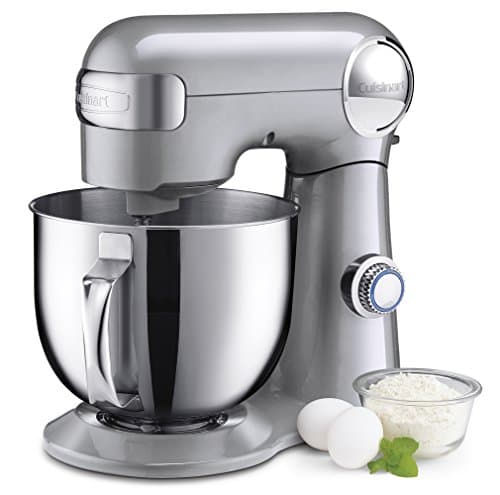
Be honest with yourself about this, though: most owners never buy one. If you are confident you never will, you are paying an ecosystem premium for an option you will not exercise, and the Cuisinart SM-50 gives you a bigger bowl, a published wattage and a longer warranty for less. That comparison is in KitchenAid vs. Cuisinart.
The dough limit is real
Every honest Artisan review has to say this. Tilt-head mixers cope with occasional bread and struggle with routine bread, and the reason is structural rather than motoric: the head hinges, so under a loaded dough hook there is a small amount of flex, the machine rocks, and sustained low-speed kneading generates heat in a motor optimized for creaming.
KitchenAid effectively concedes this in its own marketing. The bowl-lift KSM55 listing claims twice the in-bowl power of a KSM150 and a rated capacity of over 7 lb of bread dough. The Artisan listing publishes no dough figure at all, which is itself informative.
Practically: a loaf a month is fine. A loaf a week for five years is asking for a repair. If bread is the point, buy the bowl-lift — see best stand mixers for bread.
22.8 lb is a feature and a problem
The all-metal construction is why these last, why they are repairable, and why they hold value. It is also why the machine weighs 22.8 lb, which has a practical consequence people underestimate: this mixer lives on your counter permanently, or it does not get used.
Lifting 22.8 lb out of a low cupboard before baking is enough friction to stop most people baking. So the real question when buying is not "can I afford it" but "do I have a permanent 8.7 × 14.1-inch patch of counter for it". If you do not, the 8 lb Hamilton Beach with a carry handle is a genuinely different proposition, covered in best budget stand mixers.
On height: 13.9 inches with the head down clears any cabinet, but you need several more inches of clearance to tilt the head back for loading. Plan to pull it forward.
The three beaters, and when to use which
The Artisan ships with a coated flat beater, a coated dough hook and a 6-wire whip. People routinely use the wrong one, so briefly:
The flat beater is the default for almost everything — creaming butter and sugar, cake batter, cookie dough, mashed potato, anything where you want mixing without aeration. If you are unsure, this is the answer.
The 6-wire whip is for incorporating air: egg whites, cream, meringue, mousse. The wire count matters here — more wires cut the mixture more times per rotation, so a 6-wire whip aerates faster than the 3- or 4-wire whisks on cheaper machines. Never use it on anything stiff; it will bend.
The dough hook is for bread and pizza only. It is the tool that puts the machine under the load discussed above, and it is worth knowing it is a C-hookon this model rather than a spiral. A C-hook drags dough around the bowl and folds it against the wall; on a stiff dough the mass tends to ride up and spin with the hook rather than being worked, which is the "it's just going round" complaint. A slightly wetter dough fixes it, and a spiral hook fixes it better.
Resale value is part of the price
Rarely discussed and genuinely relevant. Because these are all-metal, widely repairable and have decades of parts availability, a well-kept Artisan holds a substantial fraction of its value for years. Two consequences: the true cost of trying one is the purchase price minus what you could recover, which is a much smaller number than the sticker; and buying a well-kept used one is a sensible route in, since it is mechanically identical to new.
The honest cons
Struggles with repeated stiff bread dough — the one real capability gap. 22.8 lb, so cupboard storage is not realistic. 1-year limited warranty, where Cuisinart offers three. The 5-quart bowl copes less well with very small quantities— a single egg white or a quarter-cup of butter sits below the beater's reach. You pay for the ecosystem whether you use it or not. KitchenAid suppresses the listed price, so comparison shopping takes an extra click.
Verdict
Buy the Artisan if you bake regularly, have permanent counter space, and want either the attachment option or a machine that will still be worth something in ten years. It is the default for good reasons and we would not talk anyone out of it.
Buy the Classic if you want the same machine and hub with a 4.5-quart bowl for less — the differences are half a quart and a color chart, laid out in KitchenAid models compared. Buy the bowl-lift KSM55 if you bake bread weekly. And buy the Cuisinart SM-50 if you want more bowl, more speeds and a longer warranty and will genuinely never buy an attachment.
Frequently asked questions
Is the KitchenAid Artisan worth the money?
If you bake regularly and have permanent counter space, yes — but understand what you are paying for. The motor is good rather than remarkable; the premium buys the attachment hub, the all-metal repairability and a resale value most kitchen appliances do not have.
Can a KitchenAid Artisan handle bread dough?
Occasional loaves, yes. Weekly bread, not comfortably. The tilt-head hinge flexes slightly under a loaded dough hook and sustained kneading heats a motor optimized for creaming. KitchenAid's own bowl-lift KSM55 listing claims twice the in-bowl power and over 7 lb of dough capacity.
How heavy is a KitchenAid Artisan?
22.8 lb. That weight is why it does not walk across the counter under load, and also why it realistically lives on your counter permanently — lifting it out of a cupboard before baking is enough friction to stop most people baking.
What are 59 touchpoints on a KitchenAid?
It describes how many points the beater passes close to the bowl wall as it follows its planetary path. Good bowl coverage means far less stopping to scrape with a spatula, which is the thing you notice most in daily use.
Why is there no price shown for the KitchenAid Artisan?
KitchenAid suppresses the listed price on this product, which is a manufacturer pricing policy rather than a stale page on our end. We show a live check-price link instead of displaying a number we cannot verify.
KitchenAid Artisan or Classic — which should I buy?
They are mechanically the same tilt-head machine with an identical footprint, height, speed count and attachment hub. The Artisan has a 5-quart bowl and a much wider color range; the Classic has 4.5 quarts and fewer colors for less money.
Sources
Keep reading
Stand Mixers
The Best Stand Mixers of 2026
KitchenAid Artisan, KitchenAid Classic and Cuisinart compared on bowl size, build and attachments.
Comparison
KitchenAid Models Compared: Classic vs. Artisan vs. Bowl-Lift
Classic vs Artisan vs bowl-lift KSM55 — what actually changes between KitchenAid's models, and which one you need.
Guide
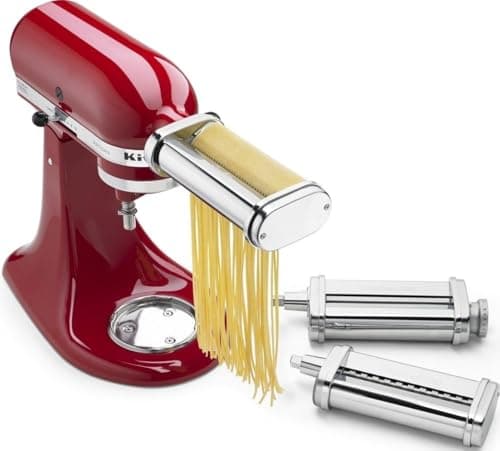
Stand Mixer Attachments: Which Are Actually Worth It?
Which stand mixer attachments are worth buying, in what order, plus the compatibility traps to check first.
Comparison
KitchenAid vs. Cuisinart: Which Stand Mixer Should You Buy?
KitchenAid vs Cuisinart on bowl size, wattage, warranty, attachments and resale — and who each brand is actually for.
https://wattandwhisk.com/stand-mixers/kitchenaid-artisan-review