The Best Ceramic Air Fryers of 2026
Ranked on what the manufacturer actually publishes about the coating, because "ceramic" and "PFAS-free" are two different claims and plenty of listings make neither.
Disclosure:Watt & Whisk is reader-supported. When you buy through links on this page we may earn an Amazon Associates commission, at no extra cost to you. Prices are pulled live from Amazon and shown with the date checked. How this works.
The best ceramic air fryer is the Cosori TurboBlaze, and it is the right buy for most kitchens — one to three people who want the strongest published coating claim at a sane price. Cosori lists a PFAS-free ceramic coating on both the basket and the crisper tray as a specification, in a 6-quart square basket with a 2-year warranty. Cooking for four or more? The Cosori TWINFRY carries that same stated PFAS-free ceramic onto a 9-quart divided basket. Shopping on price, the Ninja AF101 is the cheapest machine here with a genuine ceramic-coated basket — though Ninja publishes no PFAS-free claim for it, so we do not either. Every pick is compared on published specs below, with live Amazon prices.
The short answer
Quick picks
| # | Product | Best for | Score | Price |
|---|---|---|---|---|
| 01 | 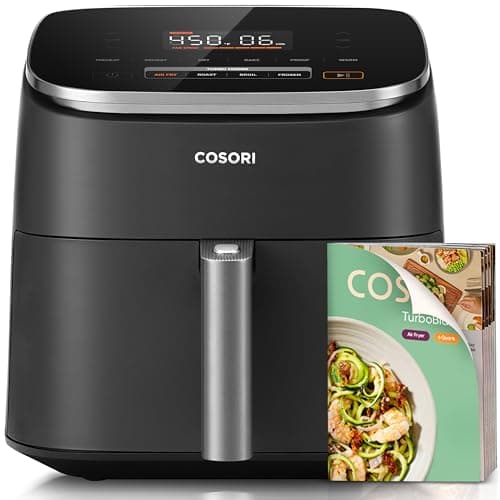 Cosori TurboBlaze Cosori's TurboBlaze pairs a 6-quart square basket with a genuinely PFAS-free ceramic coating and a faster 3,600-rpm fan. It's the pick if you want a modern, roomier air fryer without stepping up to a dual-basket footprint — and the coating claim is on the spec sheet, not marketing. 6QT | Best for most kitchens | 4.5★★★★★ | $99.99Amazon |
| 02 | 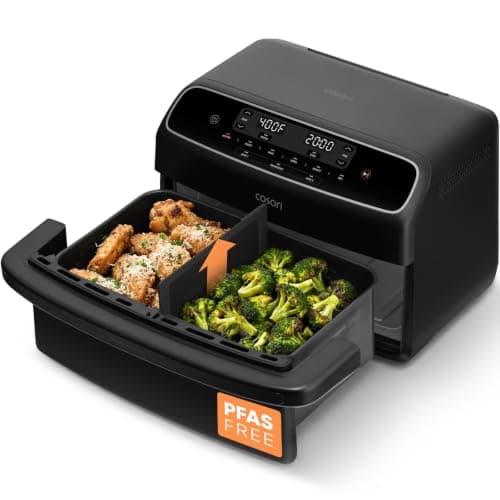 Cosori TWINFRY (9 Qt) The TWINFRY is the first machine we track that puts a stated PFAS-free ceramic coating on a family-sized dual basket. A removable divider turns two 4.5-quart zones into one 9-quart basket, so it cooks a main and a side together or a whole chicken on its own — with a 2-year warranty behind it. 9 QT | Best ceramic for a family | 4.3★★★★★ | $159.99Amazon |
| 03 | 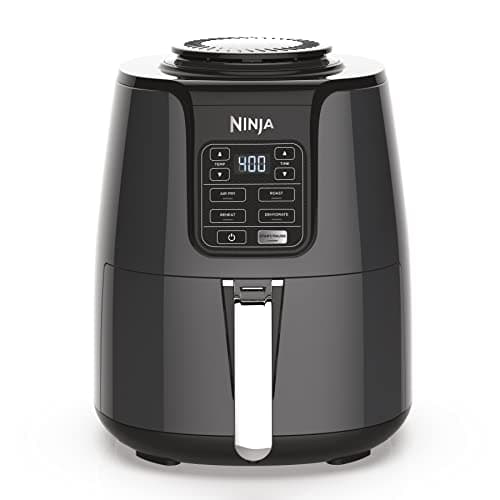 Ninja AF101 The 4-quart Ninja AF101 is the one we point most people to: a genuinely simple dial-and-button air fryer with a ceramic-coated basket, a 105–400°F range, and a footprint that fits a normal counter. It has been the reliable default since 2018 for good reason. 4 QT · 1550W | Best overall on value | 4.6★★★★★ | $104.99Amazon |
| 04 | 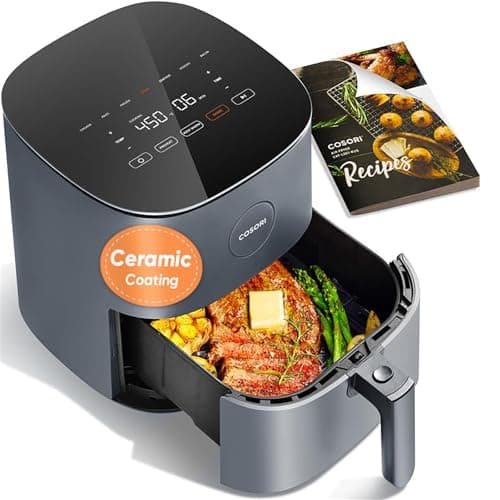 Cosori Pro LE The 5-quart Pro LE is the friendliest first air fryer here: seven clearly labeled presets, a ceramic nonstick basket, and 450°F top heat in a body that doesn't hog the counter. If dials intimidate you, this removes the guesswork. 5 QT | Best presets for beginners | 4.4★★★★★ | $89.95Amazon |
| 05 | 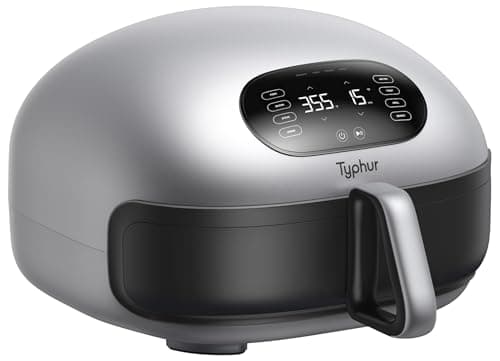 Typhur Dome 2 The Typhur Dome 2 is the splurge: a very large, wide, single-layer basket built for cooking a lot of food in one pass, with a premium finish. It's a lot of counter, but for entertaining it's a genuinely different tool. Large | Best premium large basket | 4.0★★★★★ | $339.99Amazon |
#ad · Live prices from the Amazon Product API, as of October 17, 2026. Where we have no verified live price, we show none — a gap beats a number that has rotted.
Side by side
Compare the picks on specs
Capacity, footprint, wattage and warranty are read off each manufacturer's Amazon listing. The coating column is the one that decides this page: it quotes what each maker publishes, and says plainly where a maker stops short of a PFAS-free claim.
| Model | Key specs | Cooking surface, as published | Best for | Price |
|---|---|---|---|---|
| Cosori TurboBlazeCAF-DC601-KUS | 6 QT11.8 × 14.4 × 11.9 in2-yr warranty | Ceramic coating on the basket AND the crisper tray, published by Cosori as PFAS-free. The most complete claim here — it covers the perforated plate food rests on. | Most kitchens: the strongest claim at a sane price | $99.99Check Price |
| Cosori TWINFRY (9 Qt)CAF-TF901-KUS | 9 QT11.1 × 19 × 11.9 in2-yr warranty | Ceramic coating on the basket and crisper plate, published by Cosori as PFAS-free. Removable divider: two 4.5 qt zones or one 9 qt basket. | Stated PFAS-free ceramic scaled to a family | $159.99Check Price |
| Ninja AF101 | 4 QT1550 W12.25 × 15.1 × 15.25 in1-yr warranty | Aluminum basket and crisper plate with a nonstick ceramic coating, stated by Ninja. No PFAS-free claim published — ceramic is the whole claim. | The cheapest genuine ceramic basket | $104.99Check Price |
| Cosori Pro LECAF-L501-KUS | 5 QT10.8 × 14.4 × 12 in2-yr warranty | “Premium ceramic coating” on the nonstick basket and crisper tray. Cosori states ceramic here but, unlike the TurboBlaze, attaches no PFAS-free claim. | Presets over settings, in the narrowest body | $89.95Check Price |
| Typhur Dome 2AF03 | 5.6 QT (flat)15.6 × 19.7 × 10.3 in1-yr warranty | Ceramic-coated basket, published by Typhur as PFAS-free, nonstick and dishwasher-safe. Wide and flat: a stated 2.36 in interior height without the grill plate. | The most single-layer ceramic area, at a price | $339.99Check Price |
#ad · we may earn a commission · Specs read from each manufacturer's Amazon listing; prices pulled live from the Amazon Product API, as of October 17, 2026. Where a maker publishes no figure (wattage, warranty term) we leave the cell empty rather than estimate one.
The picks, in detail
Cosori TurboBlaze
spec score /5
$119.9917% off
Price as of October 17, 2026. Prices change — Amazon's is the one that counts.
#ad · we may earn a commission from this link to Cosori TurboBlaze
Cosori's TurboBlaze pairs a 6-quart square basket with a genuinely PFAS-free ceramic coating and a faster 3,600-rpm fan. It's the pick if you want a modern, roomier air fryer without stepping up to a dual-basket footprint — and the coating claim is on the spec sheet, not marketing.
- Capacity
- 6QT
- Footprint (W×D×H)
- 11.8 × 14.4 × 11.9 in
- Weight
- 13.2 lb
- Warranty
- 2 Year Manufacturer
- PFAS-free ceramic basket (per spec sheet)
- 6-qt square basket fits more than round baskets
- Quieter, faster fan; 2-year warranty
- Pricier than a basic basket fryer
- Taller than a compact model
- Digital panel is a small learning curve
Cosori TWINFRY (9 Qt)
spec score /5
$179.9911% off
Price as of October 17, 2026. Prices change — Amazon's is the one that counts.
#ad · we may earn a commission from this link to Cosori TWINFRY (9 Qt)
The TWINFRY is the first machine we track that puts a stated PFAS-free ceramic coating on a family-sized dual basket. A removable divider turns two 4.5-quart zones into one 9-quart basket, so it cooks a main and a side together or a whole chicken on its own — with a 2-year warranty behind it.
- Capacity
- 9 QT
- Footprint (W×D×H)
- 11.1 × 19 × 11.9 in
- Weight
- 17.2 lb
- Warranty
- 2 Years
- PFAS-free ceramic on the basket and the crisper plate
- Removable divider: two 4.5-qt zones or one 9-qt basket
- Sync and Match finish two foods together; 2-year warranty
- 19 inches along its longest edge — a real run of counter
- 17.2 lb, so it stays out rather than living in a cupboard
- Released July 2026, so there is no long-term durability record yet
Ninja AF101
spec score /5
$119.9913% off
Price as of October 17, 2026. Prices change — Amazon's is the one that counts.
#ad · we may earn a commission from this link to Ninja AF101
The 4-quart Ninja AF101 is the one we point most people to: a genuinely simple dial-and-button air fryer with a ceramic-coated basket, a 105–400°F range, and a footprint that fits a normal counter. It has been the reliable default since 2018 for good reason.
- Capacity
- 4 QT
- Footprint (W×D×H)
- 12.25 × 15.1 × 15.25 in
- Power
- 1550 W
- Weight
- 10.58 lb
- Cost per use*
- ≈9¢
- Est. per year*
- ≈$18
- Warranty
- 1 Year Manufacturers
- Ceramic-coated aluminum basket — no PTFE nonstick
- Dead-simple controls; nothing to learn
- Small enough for a normal counter (12 × 15 in)
- 4 qt is tight for a family of 4+
- No preset buttons or window
- Dial isn't the most precise
*Cost-to-run computed from the manufacturer's stated 1550W at $0.17/kWh (US average), 20-min sessions, 4×/week. Your rate and use will vary.
Cosori Pro LE
spec score /5
$99.9910% off
Price as of October 17, 2026. Prices change — Amazon's is the one that counts.
#ad · we may earn a commission from this link to Cosori Pro LE
The 5-quart Pro LE is the friendliest first air fryer here: seven clearly labeled presets, a ceramic nonstick basket, and 450°F top heat in a body that doesn't hog the counter. If dials intimidate you, this removes the guesswork.
- Capacity
- 5 QT
- Footprint (W×D×H)
- 10.8 × 14.4 × 12 in
- Weight
- 10 lb
- Warranty
- 2 year manufacturer
- 7 one-touch presets take the guesswork out
- Ceramic coating, dishwasher-safe basket
- Compact 10.8-in-wide body
- 5 qt still tight for big families
- App is optional and skippable
- No cook window
Typhur Dome 2
spec score /5
$390.0013% off
Price as of October 17, 2026. Prices change — Amazon's is the one that counts.
#ad · we may earn a commission from this link to Typhur Dome 2
The Typhur Dome 2 is the splurge: a very large, wide, single-layer basket built for cooking a lot of food in one pass, with a premium finish. It's a lot of counter, but for entertaining it's a genuinely different tool.
- Capacity
- Large
- Footprint (W×D×H)
- 15.6 × 19.7 × 10.3 in
- Weight
- 20.5 lb
- Warranty
- This appliance carries a limited one-year warranty against defects from the date of purchase.
- Huge single-layer cooking area
- Premium build and finish
- Cooks a full tray in one go
- Expensive
- Wide 19.7-in footprint
- Overkill for everyday single meals
"Ceramic" has become the word air-fryer listings reach for when they want to say "not Teflon" without saying anything testable. Some of them mean it — the coating type is written into the specification alongside the capacity and the warranty. Others use it as a color word for a pale basket. This page separates the two, and ranks only the machines where the maker puts the claim in writing.
What "ceramic" actually means on a basket
A ceramic air-fryer basket is not solid ceramic. It is an aluminum basket sprayed with a silica-based sol-gel coating — a liquid that cures into a hard, glassy inorganic layer — instead of the fluoropolymer film used in conventional nonstick. Both give you food release. They are built from completely different chemistry, and that is the whole reason anyone shops for one over the other.
The practical differences follow from that. A silica layer is hard and handles heat well, but it is thin and rigid, so it is more vulnerable to a knock or a scrape than a slightly more forgiving fluoropolymer film. It also tends to lose its release performance gradually as the surface collects polymerized oil, rather than failing visibly the way a peeling nonstick basket does. Neither of those is a reason to avoid ceramic — but they change how you should treat it, which we come back to further down.
Three claims that get mixed up constantly
Almost every argument about air-fryer coatings comes from treating these as one thing. They are three, and a machine can make any combination of them:
- "Ceramic coating." A statement about what the coating is made of. The Ninja AF101, both Cosori models here and the Typhur Dome 2 all state it.
- "PFAS-free." A statement about what the coating is not made of. It is the stronger claim, and fewer listings make it. Cosori publishes it for the TurboBlaze and the TWINFRY; Typhur publishes it for the Dome 2.
- "PFAS-free" without "ceramic."This exists too, and it surprises people. Ninja lists the DualZone XL DZ401's cooking surface as 100% PFAS-free without calling it ceramic — so a machine can clear the chemistry bar you actually care about while sitting outside this page entirely. If PFAS is your real question rather than ceramic specifically, start with the best non-toxic air fryers.
We only rank a machine here if the ceramic claim appears in the manufacturer's own published specification. Where a maker stops short of a PFAS-free claim, we say so on that pick rather than quietly rounding it up.
How we ranked them
Four things, in this order. What the coating claim actually says — ceramic alone, or ceramic plus PFAS-free, and whether it covers the crisper plate as well as the basket, because the plate is the part your food actually rests on. Warranty, because a coating is the first thing to age and two years of cover is worth real money against the category-standard one. Usable capacity and footprint from the published dimensions. And the coating's working conditions — a square basket you can reach into with a silicone spatula is easier to keep intact than a deep round one.
We have not lab-tested coating durability, and nobody publishes a controlled figure for how many cycles a ceramic basket survives, so we do not invent one. Our full method is on how we review.
Where each pick earns its place
Cosori TurboBlaze — the best ceramic for most kitchens
The TurboBlaze leads because its coating claim is the most complete one at a sane price. Cosori states a PFAS-free, nonstick ceramic coating on the basket and the crisper tray — the tray matters, because that is the perforated plate food sits on and the part a cheaper machine leaves out of the claim. Around it you get a 6-quart square basket, a 3,600-rpm fan with five speeds, a 90–450°F range that is the widest we track, and a stated under-53 dB at full fan. The body measures 11.8 by 14.4 by 11.9 inches and weighs 13.2 lb, and Cosori backs it with a two-year warranty against the one year most rivals give you.
The honest cons: it costs more than a basic basket fryer, its 14.4-inch depth is real counter you have to give up, and the digital panel takes a session or two to stop poking at. Six quarts is also genuinely tight for more than three people. We go through it properly in the Cosori TurboBlaze review.
Cosori TWINFRY — ceramic that finally scales to a family
Until recently, wanting a stated PFAS-free ceramic coating meant accepting a single basket of six quarts or less. The TWINFRY (model CAF-TF901-KUS, released July 2026) is the first machine we track that puts that same claim — PFAS-free ceramic on the basket and the crisper plate — on a family-sized dual-zone machine. A removable divider is the good idea: leave it in for two independent 4.5-quart zones, take it out for one 9-quart basket that Cosori says fits a whole chicken. Sync and Match do what those functions do on every dual-basket fryer — finish two different foods together, or mirror one setting across both. It carries the same two-year warranty as the TurboBlaze and runs six functions: air fry, roast, bake, broil, reheat and dry.
The cons come with the format. It measures 19 inches along its longest edge, so it wants a real run of counter, and at 17.2 lb it is a machine that lives out rather than in a cupboard. It also launched in July 2026, which means there is no long-term record of how that coating holds up — something we can only tell you honestly rather than reassure you about. And Cosori publishes no wattage figure for it, so we cannot compute its running cost the way we can for the Ninja. If a divided basket is the part you care about most, compare it against the field in best dual-basket air fryers.
Ninja AF101 — the cheapest genuine ceramic basket
The AF101 is on this page for one reason: Ninja's own listing describes the basket and crisper plate as aluminum with a nonstick ceramic coating, which is unusual at this price and is a large part of why we keep recommending it. You get 4 quarts rated for 2 lb of fries, a 1,550-wattelement, a 105–400°F range, and dial-and-button controls with nothing to learn.
Be clear about what Ninja does notsay, though: there is no published PFAS-free claim for the AF101, so we do not repeat one. It is a ceramic coating, stated as such, and that is the whole claim. The other cons are the familiar ones — 4 quarts is tight for a family, the 400°F ceiling is 50 degrees below the Cosoris, there is no window or preset, and the warranty is the category-standard one year. It is also the tallest thing here at 15.25 inches. Full detail in the Ninja AF101 review.
Cosori Pro LE — the easiest ceramic to live with
The 5-quart Pro LE is the friendliest machine on this page and the narrowest full-size one at 10.8 inches wide (10.8 by 14.4 by 12 in, 10 lb). Cosori lists a premium ceramic coating on the nonstick basket and crisper tray, seven presets with preheat and keep-warm, 450°F top heat, and the same two-year warranty as the TurboBlaze. For a first air fryer where you would rather press one labeled button than think about temperature, it is the obvious choice.
One distinction matters enough to put it fourth rather than second: unlike the TurboBlaze and the TWINFRY, Cosori's Pro LE listing does not carry an explicit PFAS-free claim — it states ceramic, and stops there. If the PFAS wording is what you are shopping for, pay the difference for the TurboBlaze. Otherwise the cons are ordinary: 5 quarts is a two-to-three-person basket, the app is an extra you can ignore, and there is no cook window.
Typhur Dome 2 — the most ceramic surface area, at a price
If your problem with air fryers is that nothing fits in a single layer, the Dome 2 is the answer and it is not close. Typhur specifies a PFAS-free, nonstick, dishwasher-safe ceramic-coated basket, and builds it wide and shallow: a 5.6-quart flat capacity with a stated interior height of 2.36 inches without the grill plate, sized to take a 12-inch pizzaor, per Typhur, 32 wings in 14 minutes. It runs 15 functions with dual top-and-bottom heating, a self-cleaning cycle for the top cavity, and a stated 51 dB. Typhur's listing also cites recommendations from America's Test Kitchen and Consumer Reports.
The cons are steep and worth taking seriously. It is by far the most expensive machine here, it occupies 15.6 by 19.7 inches of counter — nearly two feet in one dimension — and it weighs 20.5 lb. It also drops back to a one-year limited warranty, which is a genuine mark against a premium machine whose selling point is a coating. Several features route through a phone app, which is an extra dependency in a kitchen. Buy it for the flat cooking area; do not buy it for the badge.
Ceramic vs. PTFE: the trade nobody puts on the box
Here is the part the marketing skips. Conventional PTFE nonstick is notknown to be dangerous at air-frying temperatures — these machines top out around 400 to 450°F, and the concerns people cite relate to manufacturing chemistry and to overheating a coating far beyond normal cooking. We go through the evidence properly in are air fryers toxic? Buying ceramic is a reasonable preference. It is not a rescue from a hazard.
What you are really trading is failure mode. A fluoropolymer basket usually keeps releasing food well for years and then visibly deteriorates. A ceramic basket rarely peels, but its release performance tends to fade quietly as a thin film of polymerized oil bakes onto that hard silica surface — and because nothing looks obviously wrong, most people blame the machine rather than the layer of varnish they have built up. That is a maintenance problem, not a defect, which makes it the one thing on this page you can genuinely control.
Four habits that decide how long a ceramic basket lasts
These are our recommendations rather than a manufacturer's instruction, but they follow directly from how a silica coating fails:
- Wash it after the batch, not after dinner. Oil that cools and sets on a ceramic surface is much harder to lift than oil wiped off while the basket is still warm, and every round that stays on becomes part of the surface.
- Skip aerosol cooking sprays. The propellants and lecithin in spray cans leave a residue that bakes into a brown film almost no ceramic coating shrugs off. Brush oil onto the food instead of spraying the basket.
- Silicone or wood, never metal. Ceramic is hard but thin and rigid, so the point of a metal tong concentrates enough force to chip it — and a chip is where degradation starts.
- Hand wash even when it says dishwasher-safe. Every basket here is listed as dishwasher-safe and that is true. Repeated hot cycles with alkaline detergent are still the harshest thing a coating meets in its life, and two minutes at the sink is cheaper than a replacement basket.
If food is sticking on a basket you have owned a while, that is usually residue rather than wear — the deep-clean routine in how to clean an air fryer recovers more baskets than people expect.
When to skip ceramic entirely
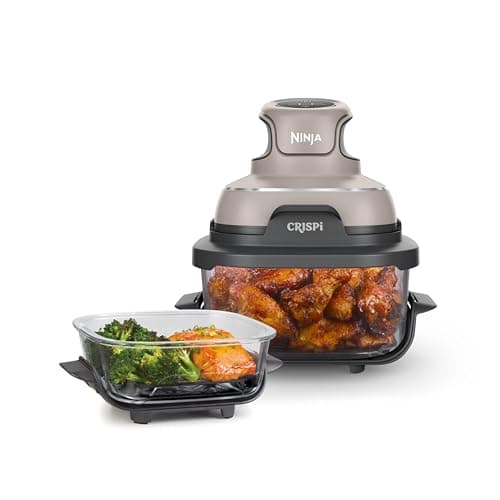
Ceramic is still a coating. If what actually bothers you is the existence of a surface layer that can eventually wear, the only way to remove that question is to stop using one: the Ninja Crispi cooks in borosilicate glass containers Ninja lists as free of PFAS, PTFE and nonstick chemical coatings. It is a pod-and-container system rather than a basket machine, so it trades convenience and practical capacity to get there, and we lay that trade out in best glass air fryers.
What these cost to run
A coating has no effect on the electricity bill, and air fryers are cheap to run regardless. The catch when comparing them is that only the Ninja AF101 publishes a wattage figure among the picks here — 1,550 watts — so it is the only one we can compute honestly. A 20-minute batch at 1,550 watts uses about 0.52 kWh, roughly 9 cents at the 17-cents-per-kWh US residential average. Expect the others to land in the same neighborhood; we will not print a number for a machine whose maker does not state one. The full arithmetic is in what an air fryer costs to run.
The verdict
Buy the Cosori TurboBlaze. It is the only machine here that pairs a published PFAS-free ceramic claim covering both the basket and the crisper tray with a two-year warranty and a footprint a normal kitchen can absorb. If you are cooking for four or more, the Cosori TWINFRY carries the same claim onto a 9-quart divided basket — accept the 19-inch edge and the fact that it is too new to have a durability record. Shopping on price, the Ninja AF101 is a genuine ceramic basket for the least money, with no PFAS wording attached. Want presets over paperwork? The Cosori Pro LE. And if single-layer cooking area is the whole point, the Typhur Dome 2 — on the understanding that you are paying premium money for a one-year warranty. Everything else we track is ranked in the main air fryer guide.
If you have not settled on a ceramic coating yet, glass vs. ceramic air fryersis the format-level decision this page sits inside: what each of the three cooking surfaces actually is, and why "stainless steel air fryer" usually describes the body. And if a ceramic basket has already started to lift, what to do when an air fryer coating comes off covers the five causes and whether the basket is replaceable.
The premium end of this list now has its own page. Our Typhur Dome 2 review goes through the published PFAS-free ceramic claim, the 5.6-quart flat basket and the self-cleaning top cavity in full — and is honest about the 2.36-inch interior height and the fact that the much cheaper Cosori TurboBlaze carries the same coating claim with twice the warranty.
Worth knowing which part a ceramic claim actually covers. Cosori states PFAS-free ceramic on the basket and the crisper tray of the TWINFRY, and the crisper plate is the surface food physically rests on — a claim that covers only the basket is a smaller claim than it looks. That machine is also the only convertible dual-basket we track, and we go through what it publishes and what it leaves out in our Cosori TWINFRY review.
A footnote that matters if your kitchen is open-plan: two of the ceramic machines on this page are also the only air fryers in the category that publish a noise figure — Typhur states 51 dB for the Dome 2 and Cosori states under 53 dB for the TurboBlaze even at full fan. Nobody else publishes one at all. We rank on that evidence in the quietest air fryers.
Frequently asked questions
What is the best ceramic air fryer?
The Cosori TurboBlaze. Its coating claim goes furthest — Cosori lists a PFAS-free ceramic coating on both the 6-quart basket and the crisper tray — and it is backed by a two-year warranty where most rivals give one. For a family, the 9-quart Cosori TWINFRY carries the same claim on a divided basket.
Is a ceramic air fryer actually safer than a nonstick one?
Not in the way most people assume. PTFE nonstick is generally regarded as safe at the 400-450F temperatures air fryers reach, and the real PFAS concerns are environmental and manufacturing-related. Choosing ceramic is a reasonable preference about chemistry, not a rescue from a hazard.
Does 'ceramic' mean the same thing as 'PFAS-free'?
No, and that is the most common mistake in this category. Ceramic describes what the coating is made of; PFAS-free describes what it is not made of. Cosori publishes both for the TurboBlaze and the TWINFRY, and Typhur for the Dome 2, but plenty of ceramic listings — including Ninja's AF101 and Cosori's own Pro LE — state only the first.
How long does a ceramic air fryer basket last?
Nobody publishes a controlled figure, so we will not invent one. What is predictable is the failure mode: ceramic rarely peels but gradually loses release performance as polymerized oil bakes onto the surface. Washing it warm after each batch and avoiding aerosol sprays does more for its lifespan than anything you can buy.
Can you use metal utensils in a ceramic air fryer basket?
Better not to. A ceramic layer is hard but thin and rigid, so the point of a metal tong concentrates enough force to chip it, and a chip is where degradation begins. Silicone or wood costs nothing and removes the risk entirely.
Is ceramic or glass better for avoiding coatings?
Glass, if that is your actual requirement — borosilicate glass has no surface layer at all, so there is nothing to wear, scratch or flake. The Ninja Crispi is the one mainstream machine that does it. Ceramic is the practical compromise: a normal basket you already know how to use, with silica on it instead of fluoropolymer.
Which ceramic air fryer has the longest warranty?
Cosori, across its range: the TurboBlaze, the TWINFRY and the Pro LE all list two years. Ninja lists one year on the AF101 and Typhur lists a limited one year on the Dome 2 — which is a genuine mark against the most expensive machine here, given that a coating is the first thing to age.
What size ceramic air fryer should I buy?
Match the published capacity to the number you cook for, remembering air frying wants a single layer. The Ninja AF101 is 4 quarts and rated for 2 lb of fries, the Cosori Pro LE is 5, the TurboBlaze is 6 in a square basket, and the TWINFRY is 9 with a removable divider that splits it into two 4.5-quart zones. The Typhur Dome 2 is the odd one: 5.6 quarts spread wide and flat rather than deep, sized for a 12-inch pizza.
Can you put a ceramic air fryer basket in the dishwasher?
Every basket on this page is listed as dishwasher-safe, and that is accurate. We still suggest hand washing: repeated hot cycles with alkaline detergent are the harshest thing a coating meets in its life, and two minutes at the sink costs less than a replacement basket.
Sources
Keep reading
Review
Typhur Dome 2 Review
The Typhur Dome 2 on its published figures: flat 5.6-qt basket, 2.36-in interior height, 51 dB, self-cleaning cavity, and who should skip it.
Comparison
Glass vs. Ceramic Air Fryers
Glass, ceramic coating and stainless steel compared on what the makers actually publish about the cooking surface.
Guide
Air Fryer Coating Coming Off: What To Do
What the FDA publishes about ingesting nonstick flakes, the five things that destroy a basket coating, and when to replace basket vs. machine.
Air Fryers
The Best Air Fryers of 2026
Our ranked air-fryer picks, compared on capacity, footprint, materials and running cost — with live Amazon prices.
Roundup
The Best Non-Toxic Air Fryers of 2026
Glass and PFAS-free ceramic air fryers, ranked — with an honest take on coatings.
Roundup
The Best Glass Air Fryers of 2026
The one true borosilicate-glass air fryer, what it trades away, and the PFAS-free ceramic alternatives worth cross-shopping.
Guide
Are Air Fryers Toxic? The Honest, Sourced Answer
PTFE, PFOA, PFAS and acrylamide explained plainly — plus how ceramic and glass baskets avoid coatings.
Review
Cosori TurboBlaze Review
The Cosori TurboBlaze on materials, fan speed, temperature range and footprint — and the two reasons to buy something else.
Roundup
The Best Dual-Basket Air Fryers
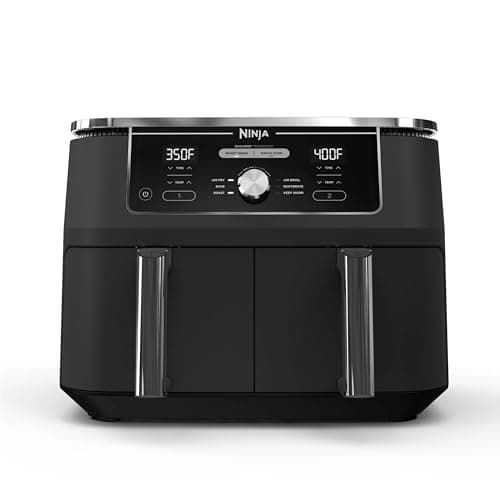
Four double-drawer air fryers ranked on per-basket capacity, footprint and sync cooking — and when one basket is smarter.
Review
Cosori TWINFRY Review
The 9-quart Cosori TWINFRY on its published figures: a removable divider, a PFAS-free ceramic basket, a 2-year warranty, and no wattage anywhere.
https://wattandwhisk.com/air-fryers/best-ceramic-air-fryers