Sous Vide vs. Instant Pot
A circulator moves the water. A multicooker heats the bottom of a still pot. That one difference decides almost everything else.
Disclosure:Watt & Whisk is reader-supported. When you buy through links on this page we may earn an Amazon Associates commission, at no extra cost to you. Prices are pulled live from Amazon and shown with the date checked. How this works.
An immersion circulator pumps water past a heater and a probe, so every part of the bath sits at the same temperature and stays there for hours. An Instant Pot heats the base of a still inner pot, so the water stratifies and the sensor reads the vessel rather than the water around your food. Check the function list on the exact model before you assume it can do this at all — neither Instant Pot we track lists a sous vide program. If precision is the point, buy a circulator: the Anova Precision Cooker 3.0 at 1,100 W, or the Inkbird ISV-100W, which publishes a ±0.1°C accuracy figure. Prices below are pulled live from Amazon.
The short answer
Quick picks
| # | Product | Best for | Score | Price |
|---|---|---|---|---|
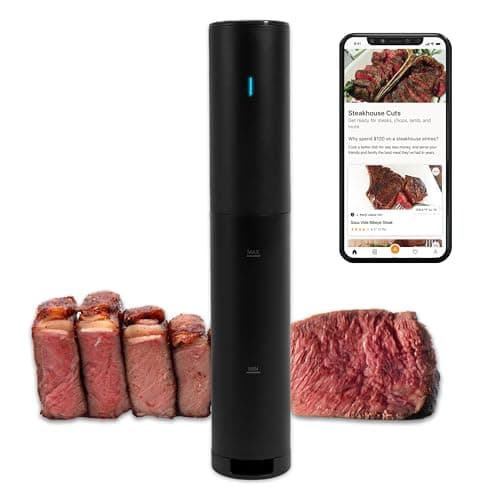
| 01 | 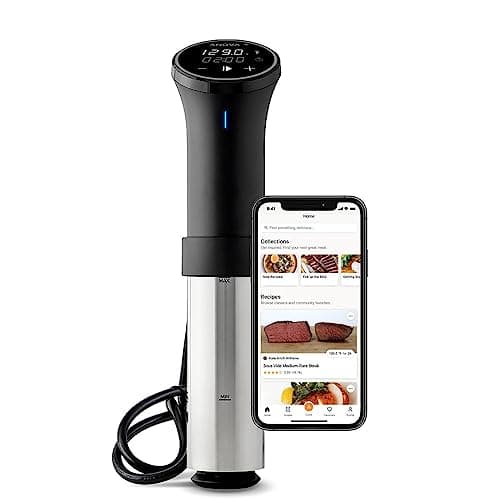 Anova Precision Cooker Anova's Precision Cooker is the category default: a 1,100-watt immersion circulator with a clip, a clear display, and a mature app. It clamps to any pot and holds temperature tightly, which is the entire job. 1100 watts · 1100W | Best overall sous vide | 4.4★★★★★ | $169.00Amazon |
| 02 | 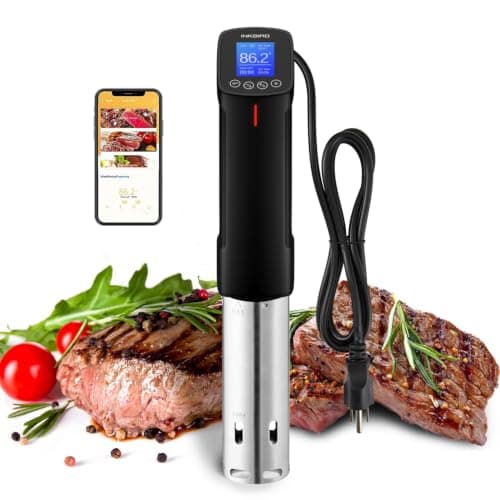 Inkbird ISV-100W The Inkbird undercuts the name brands while still giving you Wi-Fi and tight temperature control in a slim wand. It's the low-risk way to find out whether sous vide earns a place in your kitchen. 1 WIFI Sous Vide Machine · 100W | Best budget sous vide | 4.0★★★★★ | $95.99Amazon |
| 03 | 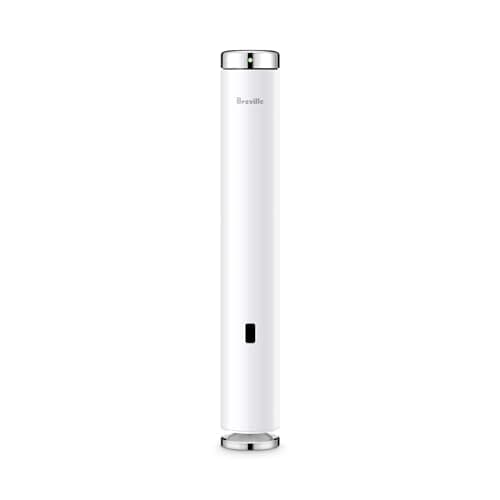 Breville Joule Turbo The Joule Turbo is the app-first circulator: at 1.65 inches across and 2.09 lb it's the smallest wand here, and its Turbo mode runs a cloud-computed variable-temperature curve that Breville states reaches precise results in half the time. You pick doneness by picture, not by number. Small | Best app experience | 4.4★★★★★ | $234.95Amazon |
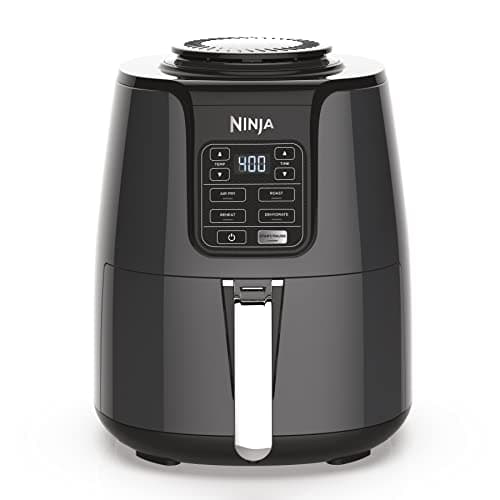
| 04 | 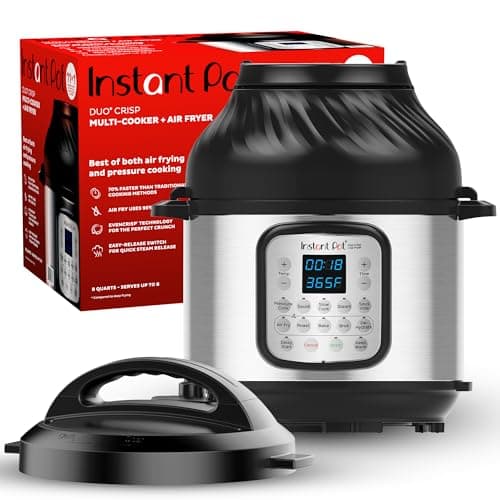 Instant Pot Duo Crisp (8 Qt, 11-in-1) The genuine both-in-one: a 1,500-watt 8-quart cooker that ships with two separate lids — a pressure lid and an air-fry lid — so one appliance covers sealed steam and dry crisping. Instant states an air-fry range of 70 to 450 degrees F. You pay for it in size, weight, and a second lid you have to put somewhere. 8 Quart · 1500W | Best if you only have room for one machine | 4.1★★★★★ | $189.99Amazon |
#ad · Live prices from the Amazon Product API, as of Sep 17, 2026. Where we have no verified live price, we show none — a gap beats a number that has rotted.
The picks, in detail
Anova Precision Cooker
spec score /5
$229.0026% off
Price as of Sep 17, 2026. Prices change — Amazon's is the one that counts.
#ad · we may earn a commission from this link to Anova Precision Cooker
Anova's Precision Cooker is the category default: a 1,100-watt immersion circulator with a clip, a clear display, and a mature app. It clamps to any pot and holds temperature tightly, which is the entire job.
- Capacity
- 1100 watts
- Footprint (W×D×H)
- 3.07 × 12.79 × 5.51 in
- Power
- 1100 W
- Weight
- 1.92 lb
- Cost per use*
- ≈6¢
- Est. per year*
- ≈$13
- Warranty
- 2 year manufacturer
- Holds temperature precisely
- 1,100 W heats water quickly
- Mature, reliable app
- Needs a container and a bag/clip
- App-dependent for some features
- Not silent
*Cost-to-run computed from the manufacturer's stated 1100W at $0.17/kWh (US average), 20-min sessions, 4×/week. Your rate and use will vary.
Inkbird ISV-100W
spec score /5
Price as of Sep 17, 2026. Prices change — Amazon's is the one that counts.
#ad · we may earn a commission from this link to Inkbird ISV-100W
The Inkbird undercuts the name brands while still giving you Wi-Fi and tight temperature control in a slim wand. It's the low-risk way to find out whether sous vide earns a place in your kitchen.
- Capacity
- 1 WIFI Sous Vide Machine
- Footprint (W×D×H)
- 2.362204722 × 2.362204722 × 16.141732267 in
- Power
- 100 W
- Cost per use*
- ≈1¢
- Est. per year*
- ≈$1
- Warranty
- 365
- Much cheaper than premium wands
- Wi-Fi with a usable app
- Slim, easy to store
- Slower to heat large pots
- Less polished app
- Shorter brand track record
*Cost-to-run computed from the manufacturer's stated 100W at $0.17/kWh (US average), 20-min sessions, 4×/week. Your rate and use will vary.
Breville Joule Turbo
spec score /5
$249.956% off
Price as of Sep 17, 2026. Prices change — Amazon's is the one that counts.
#ad · we may earn a commission from this link to Breville Joule Turbo
The Joule Turbo is the app-first circulator: at 1.65 inches across and 2.09 lb it's the smallest wand here, and its Turbo mode runs a cloud-computed variable-temperature curve that Breville states reaches precise results in half the time. You pick doneness by picture, not by number.
- Capacity
- Small
- Footprint (W×D×H)
- 1.65 × 1.65 × 11.97 in
- Weight
- 2.09 lb
- Warranty
- 1 year limited product warranty
- Turbo mode cuts cook time roughly in half (per Breville)
- Smallest wand here — 1.65 in across, fits a drawer
- Visual Doneness and Prime Time make timing forgiving
- Leans hard on the app — no full standalone control
- 1-year limited warranty vs Anova's 2
- Premium price for a circulator
Instant Pot Duo Crisp (8 Qt, 11-in-1)
spec score /5
$219.9914% off
Price as of Sep 17, 2026. Prices change — Amazon's is the one that counts.
#ad · we may earn a commission from this link to Instant Pot Duo Crisp (8 Qt, 11-in-1)
The genuine both-in-one: a 1,500-watt 8-quart cooker that ships with two separate lids — a pressure lid and an air-fry lid — so one appliance covers sealed steam and dry crisping. Instant states an air-fry range of 70 to 450 degrees F. You pay for it in size, weight, and a second lid you have to put somewhere.
- Capacity
- 8 Quart
- Footprint (W×D×H)
- 13.58 × 14.76 × 15.28 in
- Power
- 1500 W
- Weight
- 22.18 lb
- Cost per use*
- ≈9¢
- Est. per year*
- ≈$18
- Warranty
- Warranty
- Pressure cooking and air frying in one 8-qt pot
- Stainless tri-ply inner pot rated stovetop- and oven-safe
- Air-fry range stated as 70-450 degrees F
- Ships with the basket, trays, racks and both lids
- 22.18 lb and 15.28 in tall — the biggest machine on this page
- Two lids, and the air-fry lid has nowhere to live between uses
- The listing states a warranty exists but names no term
- Sits in the same price bracket as buying a good air fryer and a good pressure cooker separately
*Cost-to-run computed from the manufacturer's stated 1500W at $0.17/kWh (US average), 20-min sessions, 4×/week. Your rate and use will vary.
Read the function list, not the brand
"Instant Pot" is a brand with a wide range, not a single machine, and sous vide is not a standard function across it. Of the two Instant Pots in our catalog, the Duo 6 Qt publishes seven functions — pressure cook, slow cook, sauté, steam, rice, yogurt and keep warm — and the Duo Crisp 8 Qt publishes eleven — air fry, roast, bake, dehydrate, pressure cook, slow cook, sauté, steam, sterilize, warm and rice. Neither list includes sous vide. Instant sells models that do list it; we do not track one, so we will not name a model we have not verified. The practical advice is simple: read the printed function list on the exact model number you are buying rather than assuming the brand covers it.
The rest of this page is about the more interesting question — what a multicooker with a sous vide program can and cannot match, and whether you should buy one instead of a circulator at all.
Circulation is the whole argument
Sous vide is not "cooking at a low temperature". It is cooking at a known and constant temperature, which is what lets you leave a steak in the bath for an hour past its target without overcooking it. Holding that constant depends on two things: moving the water, and measuring it where the food is.
A circulator does both by design. Anova describes the Precision Cooker 3.0 as circulating water at the exact temperature required, and it clamps to the side of the pot so the heater, the impeller and the probe all sit in the same moving stream. Water that moves has no cold corners, and the probe reads what the food feels.
A multicooker heats from an element under the inner pot with the water sitting still. Heat rises, so a static bath stratifies — warmer at the bottom, cooler at the top — and a bag resting on the base is in a different environment from one floating near the surface. The sensor, meanwhile, is reading the pot, not the water column. None of that matters for pressure cooking, where you only care about reaching and holding pressure. It matters a lot when the entire premise is that 129°F and 133°F produce visibly different steaks.
What the makers actually publish about accuracy
This is where the comparison gets one-sided, and it is worth being precise about why.
- Inkbird ISV-100W publishes an accuracy figure: ±0.1°C (±0.2°F), a 77–210°F range, and a self-calibration function adjustable from −10°F to +10°F — the only machine here that lets you correct the sensor against a reference thermometer. Its listing title states 1,000 watts.
- Anova Precision Cooker 3.0 publishes 1,100 watts, Wi-Fi control, an adjustable clamp that fits nearly any pot deep enough, and a removable stainless skirt for cleaning. Two-year manufacturer warranty.
- Breville Joule Turbo publishes no wattage figure and no accuracy figure. What it publishes instead is software: a Turbo mode Breville states delivers precise results in half the time, visual doneness selection, and a Prime Time window. One-year limited warranty, and at 1.65 in across and 2.09 lb it is the smallest thing here.
- Instant Pot Duo Crisp publishes 1,500 watts and eleven functions. It publishes no temperature-accuracy figure of any kind, because nothing it is designed to do requires one.
We are not going to convert that silence into a number. The honest summary is that the machines built for this job publish accuracy specifications and the machine built for pressure does not.
Where the multicooker genuinely wins
Three real advantages, and the last one is the one that decides it for a lot of kitchens.
It is a sealed vessel. A long sous vide cook in an open pot loses water to evaporation, which is why circulator users cover the bath with a lid, foil or ping-pong balls. A multicooker has a lid on it already.
It can brown, and sous vide cannot. Nothing in a water bath below the boiling point will ever brown, so every sous vide cook ends with a sear in a hot pan or with a torch. A multicooker with a sauté function does that step in the same pot; the Duo Crisp goes further and air fries.
It does a job a circulator cannot touch. Pressure cooking is the opposite technique — fast, above boiling, for collagen-heavy cuts, beans and stock. Instant states up to 70% faster cooking, and it is worth reading the fine print on that claim, which is measured against slow cooking rather than against an oven. If a single machine has to cover both dried beans on a weeknight and a steak at the weekend, the multicooker is the more useful one to own. We cover its other half in air fryer vs. Instant Pot.
Capacity works in opposite directions
A multicooker's bath is its inner pot: 6 quarts on the Duo, 8 on the Duo Crisp, and that is the ceiling. A circulator has no vessel of its own — it clamps to whatever you have. Anova's clamp fits nearly any pot deep enough to meet its minimum water depth, which means a stockpot, a cooler or a plastic tub for a large batch. For cooking eight portions at once, the circulator is the far more flexible machine, and it is also the cheaper way to scale, because you already own the pot.
Storage runs the other way. The Joule Turbo is 1.65 × 1.65 × 11.97 in and 2.09 lb; the Anova Nano stows in a drawer. The Duo Crisp is 13.58 × 14.76 in and 15.28 in tall at 22.18 lb — a permanent counter resident. Whether that counts against it depends entirely on how many jobs it replaces.
Running cost, honestly
Published wattage tells you heat-up speed, not running cost, because a circulator draws full power only while bringing the bath up to temperature and then cycles to hold it. We do not have a published duty cycle for any of these machines, so we do not publish a cents-per-cook figure derived from one. What we can say is that the Instant Pot's 1,500 W and the Anova's 1,100 W are in the same bracket, and that the cost of a long hold is dominated by how well your pot is insulated and covered rather than by the machine. The fuller treatment is in what sous vide costs to run.
Which one to buy
Buy a circulator if the reason you want this is the result — edge-to-edge medium-rare, chicken that is safe and still juicy, eggs at a temperature you chose. The Anova Precision Cooker 3.0 is the default: the most powerful machine here, a clamp that fits your existing pots, and a two-year warranty. The Inkbird ISV-100W is the value answer and the only one that publishes both an accuracy figure and a way to calibrate the sensor — Anova vs. Inkbird puts them side by side. The Joule Turbo is for people who want the software to make the decisions; note it has no on-device display, so the phone is not optional. That trade-off is the whole of Anova vs. Joule.
Buy the Instant Pot Duo Crisp if you have room for one machine and want breadth rather than precision: pressure cooking, air frying and searing in a single body. Just buy it for what it is. Treating a multicooker as a sous vide machine is the same category error as treating a slow cooker as one — different premise, different results, laid out in sous vide vs. slow cooker.
And if you have not decided whether the technique is for you at all, is sous vide worth it is the honest case both ways, while what is sous vide covers the method from scratch.
Frequently asked questions
Can an Instant Pot do sous vide?
Some models list a sous vide program and many do not. Neither Instant Pot we track lists one — the Duo 6 Qt publishes seven functions and the Duo Crisp 8 Qt publishes eleven, and sous vide is in neither list. Check the printed function list on the exact model number before buying.
Is an Instant Pot sous vide as good as a circulator?
No, and the reason is structural. A circulator moves the water past a heater and a probe so the whole bath sits at one temperature; a multicooker heats the base of a still pot, so the water stratifies and the sensor reads the vessel rather than the water around the food.
Which sous vide machine is most accurate?
Of the machines we track, only the Inkbird ISV-100W publishes an accuracy figure: plus or minus 0.1 degrees Celsius, with a self-calibration function adjustable from minus 10 to plus 10 degrees Fahrenheit. Anova and Breville publish precision claims but no tolerance number, and Instant Pot publishes none at all.
Do I need a special container for sous vide?
No. A circulator clamps to any pot deep enough to meet its minimum water depth, so a stockpot works. For long cooks, cover the bath with a lid or foil to slow evaporation. A multicooker is limited to its own inner pot, which is 6 or 8 quarts on the models we track.
Can you sear food in a sous vide machine?
No. Nothing below the boiling point of water will brown, so every sous vide cook finishes with a sear in a hot pan or with a torch. This is one genuine advantage of a multicooker, which can sauté in the same pot it cooked in.
Is a multicooker or a circulator better value?
It depends on how many jobs you need covered. A circulator does one thing extremely well and uses pots you already own, which makes scaling up cheap. A multicooker does pressure cooking, slow cooking and, on the Duo Crisp, air frying — breadth a circulator cannot match.
Sources
Keep reading
Sous Vide
The Best Sous Vide Machines of 2026
Anova and Inkbird immersion circulators compared on wattage, precision, app and running cost.
Comparison
Sous Vide vs Slow Cooker
Where sous vide and slow cooking genuinely differ — temperature control, texture, cuts, cost and counter space.
Comparison
Anova vs Inkbird: Which Sous Vide Circulator?
Anova Precision Cooker 3.0 vs Inkbird ISV-100W on power, range, accuracy, app and warranty.
Guide
Is Sous Vide Worth It?
What sous vide genuinely transforms, what it does not, and the three types of cook who should skip it.
Comparison
Air Fryer vs. Instant Pot: Which One Do You Actually Need?
Crisping vs. pressure cooking, compared on real specs — and an honest look at the Duo Crisp combo.
Guide
Is Sous Vide Safe?
Bacteria, bags and unattended cooking: what is settled, what the FDA actually says, and what to buy if plastic is your worry.
https://wattandwhisk.com/sous-vide/sous-vide-vs-instant-pot