What Does Sous Vide Actually Cost to Run?
A 48-hour cook sounds expensive. Here is the arithmetic from published wattage — including the bound we can prove and the part we won't guess at.
Disclosure:Watt & Whisk is reader-supported. When you buy through links on this page we may earn an Amazon Associates commission, at no extra cost to you. Prices are pulled live from Amazon and shown with the date checked. How this works.
Far less than the run time suggests. An Anova Precision Cooker 3.0 is rated at 1,100 watts, but it only draws that while heating the bath — after that it cycles at a low duty to replace heat lost to the room. The worst case, if it somehow ran at full power the whole time, is about 37 cents for 2 hours, $1.50 for 8 hours and $8.98 for 48 hours at the US average of $0.17/kWh. Real consumption sits well below all three, and two habits — hot tap water and a lid — cut it further.
The short answer
Quick picks
| # | Product | Best for | Score | Price |
|---|---|---|---|---|
| 01 | 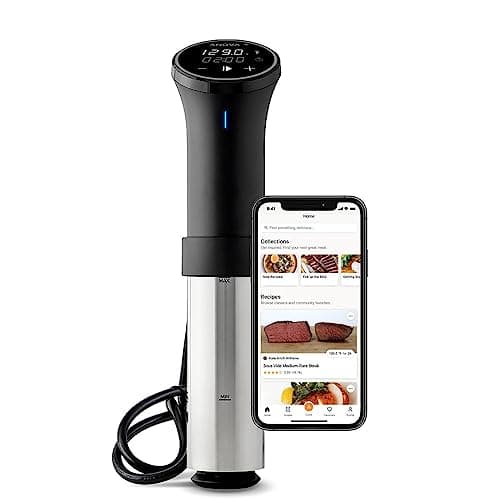 Anova Precision Cooker Anova's Precision Cooker is the category default: a 1,100-watt immersion circulator with a clip, a clear display, and a mature app. It clamps to any pot and holds temperature tightly, which is the entire job. 1100 watts · 1100W | Best overall sous vide | 4.4★★★★★ | $169.99Amazon |
| 02 | 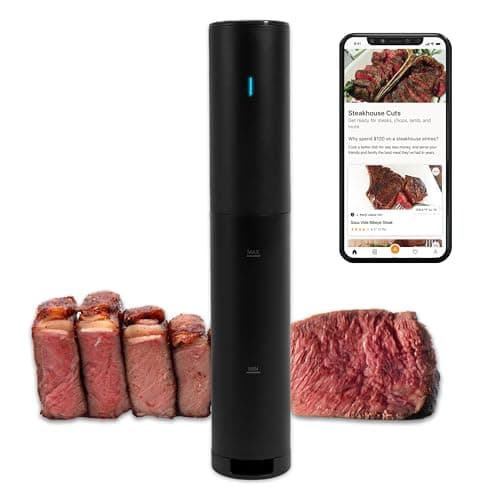 Anova Precision Cooker Mini Anova's most affordable circulator: 850 watts, 1.83 lb, Bluetooth control from the free app. It is the low-stakes way to find out whether you'll actually cook this way twice a month, and it costs less than the steak you'd ruin learning on the hob. Mini · 850W | Best cheapest way to try sous vide | 4.0★★★★★ | $26.99Amazon |
| 03 | 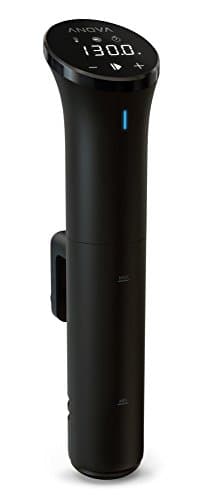 Anova Precision Cooker Nano 2.0 The Nano is the sensible middle: a 12.8-inch, 1.7 lb wand that stows in a kitchen drawer, runs from the unit itself or the free app, and carries Anova's 2-year warranty. It costs a fraction of the flagship and holds temperature just as tightly for a home-sized pot. 12.8" x 2.2" x 4.1" | Best value sous vide | 4.3★★★★★ | $71.99Amazon |
#ad · Live prices from the Amazon Product API, as of October 16, 2026. Where we have no verified live price, we show none — a gap beats a number that has rotted.
The picks, in detail
Anova Precision Cooker
spec score /5
$229.0026% off
Price as of October 16, 2026. Prices change — Amazon's is the one that counts.
#ad · we may earn a commission from this link to Anova Precision Cooker
Anova's Precision Cooker is the category default: a 1,100-watt immersion circulator with a clip, a clear display, and a mature app. It clamps to any pot and holds temperature tightly, which is the entire job.
- Capacity
- 1100 watts
- Footprint (W×D×H)
- 3.07 × 12.79 × 5.51 in
- Power
- 1100 W
- Weight
- 1.92 lb
- Cost per use*
- ≈6¢
- Est. per year*
- ≈$13
- Warranty
- 2 year manufacturer
- Holds temperature precisely
- 1,100 W heats water quickly
- Mature, reliable app
- Needs a container and a bag/clip
- App-dependent for some features
- Not silent
*Cost-to-run computed from the manufacturer's stated 1100W at $0.17/kWh (US average), 20-min sessions, 4×/week. Your rate and use will vary.
Anova Precision Cooker Mini
spec score /5
$29.007% off
Price as of October 16, 2026. Prices change — Amazon's is the one that counts.
#ad · we may earn a commission from this link to Anova Precision Cooker Mini
Anova's most affordable circulator: 850 watts, 1.83 lb, Bluetooth control from the free app. It is the low-stakes way to find out whether you'll actually cook this way twice a month, and it costs less than the steak you'd ruin learning on the hob.
- Capacity
- Mini
- Footprint (W×D×H)
- 2.2 × 4.13 × 12.2 in
- Power
- 850 W
- Weight
- 1.83 lb
- Cost per use*
- ≈5¢
- Est. per year*
- ≈$10
- Cheapest circulator we'd actually recommend
- 850 W is plenty for a stockpot
- 1.83 lb — stores anywhere
- Bluetooth only on the free app; Wi-Fi needs a subscription
- Slowest to bring a big bath up to temperature
- No published warranty on the listing
*Cost-to-run computed from the manufacturer's stated 850W at $0.17/kWh (US average), 20-min sessions, 4×/week. Your rate and use will vary.
Anova Precision Cooker Nano 2.0
spec score /5
$149.0052% off
Price as of October 16, 2026. Prices change — Amazon's is the one that counts.
#ad · we may earn a commission from this link to Anova Precision Cooker Nano 2.0
The Nano is the sensible middle: a 12.8-inch, 1.7 lb wand that stows in a kitchen drawer, runs from the unit itself or the free app, and carries Anova's 2-year warranty. It costs a fraction of the flagship and holds temperature just as tightly for a home-sized pot.
- Capacity
- 12.8" x 2.2" x 4.1"
- Footprint (W×D×H)
- 2.2 × 4.1 × 12.8 in
- Weight
- 1.7 lb
- Warranty
- 2 year warranty
- Fits in a drawer — 12.8 in, 1.7 lb
- 2-year warranty
- Full control on the unit; app is optional
- Slower than 1,100 W wands on a big pot
- Best suited to smaller containers
- Some app content sits behind a subscription
Sous vide is the one countertop technique where the running cost question is genuinely reasonable to ask. A 48-hour short rib sounds like it should cost a fortune in electricity, and almost nobody publishes the math. So here it is, with the working shown and the limits of what we can honestly claim stated up front.
How the math works
The formula is watts ÷ 1,000 × hours × your electricity rate. We use the US average residential rate of about $0.17 per kWh from the EIA — substitute your own rate if you know it, since regional rates vary by a factor of three.
The published wattages of the machines we track:
- Anova Precision Cooker 3.0 — 1,100 W
- Inkbird ISV-100W — 1,000 W(the "100" is a model number, not a wattage)
- Anova Precision Cooker Mini — 850 W
- Anova Nano 2.0 and Breville Joule Turbo — no wattage published in their listings, so we will not state one
The upper bound, which we can prove
If a 1,100-watt circulator drew its full rated power continuously for the entire cook, the cost would be:
- 2 hours (a steak) — 2.2 kWh ≈ 37 cents
- 4 hours (chicken, vegetables) — 4.4 kWh ≈ 75 cents
- 8 hours (pork shoulder) — 8.8 kWh ≈ $1.50
- 24 hours (brisket) — 26.4 kWh ≈ $4.49
- 48 hours (short rib) — 52.8 kWh ≈ $8.98
On the 850-watt Anova Mini every figure above drops by roughly 23%: about 29 cents for 2 hours and $6.94 for 48.
Why the real number is much lower
A circulator does not draw full power for the length of a cook, and the reason is straightforward physics. There are two distinct phases:
Heat-up. Raising a pot of water from tap temperature to the target takes sustained full power. This is genuinely the expensive part, and it is a fixed cost regardless of how long the cook runs.
Holding. Once at temperature, the machine is only replacing heat lost through the pot walls and the water surface. That is a small fraction of its rated output, so the heating element cycles on and off at a low duty rather than running continuously. This is why a 48-hour cook is nothing like 24 times the cost of a 2-hour one in practice.
Here is what we will not do: put a number on that duty cycle. It depends on your pot, your kitchen temperature, whether the pot is covered, and the target temperature, and none of the manufacturers publish a measured figure. We have not metered these machines ourselves. So the honest position is that the table above is a ceiling you can rely on, and the real figure is meaningfully below it — not a fabricated percentage. Our approach to this kind of claim is set out on how we review.
Two habits that actually cut the cost
Start with hot tap water. This is the single biggest lever, because it removes most of the heat-up phase — the expensive part. Your water heater has already done the work, usually more efficiently than a 1,100-watt immersion element will. It also gets you cooking sooner, which is the real reason to do it.
Cover the pot.Evaporation is the dominant heat loss from an open water bath, and it costs you twice: it takes energy with it, and on a long cook it drops the water level below the circulator's minimum line, which stops the cook. A lid with a notch for the circulator, foil, or a layer of ping-pong balls all work. On a 24 or 48-hour cook this is not optional — it is the difference between finishing and finding a machine that shut off in the night.
Two smaller ones: use the smallest pot that fits the food, since less water means less to heat and less surface to lose from; and put the pot somewhere out of a draft.
How it compares with the alternatives
The 48-hour figure looks alarming in isolation and much less so in context. Running a conventional oven for the same 48 hours would cost dramatically more — an oven element is typically 2,000–5,000 watts and it is heating a large air-filled cavity that leaks heat every time you open the door. Sous vide is heating water, which holds heat far better than air, in a closed insulated pot.
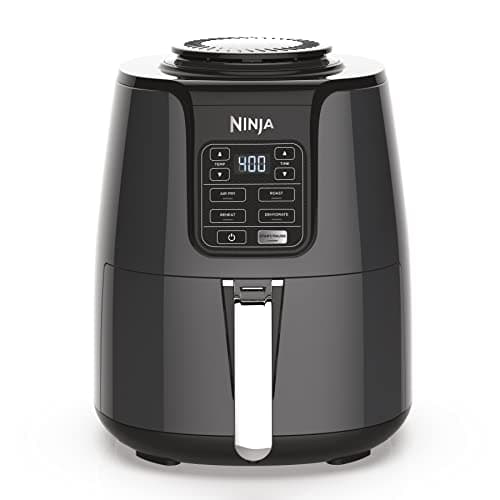
Against the appliances we cover elsewhere: an air fryer at 1,550 watts costs about 9 cents for a 20-minute batch, and a 1,000-watt blender costs about 0.4 cents for a 90-second blend. Sous vide is the most expensive countertop technique per session simply because it runs the longest — but per meal, a 37-cent steak cook is not a meaningful line on a household bill. The cross-category numbers are in what countertop appliances cost to run.
The costs that are not electricity
Electricity is the small one. The recurring cost people underestimate is bags. If you use a vacuum sealer you are buying rolls or pre-cut bags continuously, and over a year that will comfortably exceed what you spend on power. Zip-top bags with the water-displacement method cost less and work fine for most cooks — do you need a vacuum sealer? works through when the sealer is genuinely worth it.
The other one is the sear. Almost every sous vide protein needs finishing in a hot pan or with a torch, because no browning happens at sous vide temperatures. That is a few minutes of a gas or induction hob on top of every cook, plus a pan to wash.
The verdict
Running cost is not a reason to avoid sous vide. The provable ceiling for a normal weeknight cook is 37 cents, the realistic figure is lower, and the marathon 48-hour cooks that sound extravagant are a handful of dollars for a cut of meat that would otherwise be inedible. Buy the machine on capability, warranty and pot fit instead — that is what is sous vide worth it? and best budget sous vide are for.
Frequently asked questions
How much electricity does a sous vide use?
Less than the run time suggests. An 1,100-watt Anova drawing full power continuously would cost about 37 cents for a 2-hour cook at the US average of 17 cents per kWh — but it only draws full power while heating the bath, then cycles at a low duty to hold temperature, so real usage is well below that.
Is it expensive to run sous vide for 48 hours?
The provable worst case for a 1,100-watt machine is about $8.98 over 48 hours, and actual consumption is meaningfully lower because holding temperature needs a fraction of the rated power. For a cut of meat that would otherwise be tough, that is a few dollars well spent.
Does starting with hot water save electricity?
Yes, and it is the biggest single lever. Heating the bath from cold is the expensive phase; filling from the hot tap means your water heater has already done that work, usually more efficiently than a 1,100-watt immersion element.
Should I cover the pot when cooking sous vide?
Always on long cooks. Evaporation is the main heat loss from an open bath, so covering it cuts the holding power draw — and more importantly it stops the water level dropping below the circulator's minimum line, which would end the cook part way through.
Which sous vide machine uses the least power?
Of the machines with a published figure, the Anova Precision Cooker Mini at 850 watts, against 1,000 for the Inkbird ISV-100W and 1,100 for the Anova Precision Cooker 3.0. Anova's Nano and Breville's Joule Turbo do not publish wattages, so we cannot rank them.
Is sous vide cheaper than using an oven?
For long cooks, yes, and by a wide margin. An oven element is typically 2,000-5,000 watts heating a large air-filled cavity that loses heat every time the door opens. Sous vide heats water in a covered pot, and water holds heat far better than air.
Sources
Keep reading
Sous Vide
The Best Sous Vide Machines of 2026
Anova and Inkbird immersion circulators compared on wattage, precision, app and running cost.
Guide
Is Sous Vide Worth It?
What sous vide genuinely transforms, what it does not, and the three types of cook who should skip it.
Comparison
Sous Vide vs Slow Cooker
Where sous vide and slow cooking genuinely differ — temperature control, texture, cuts, cost and counter space.
Guide
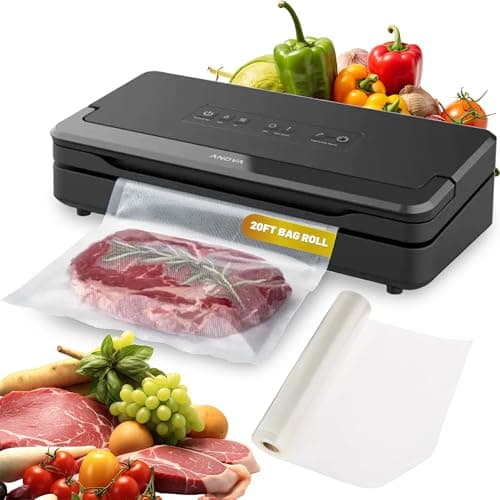
Do You Need a Vacuum Sealer for Sous Vide?
Why zip-top bags work for most sous vide, the water displacement method, and the four cases where a sealer earns its money.
Roundup
The Best Budget Sous Vide Machines
Four budget circulators ranked on power, app access, size and warranty — and the three things extra money actually buys.
Running costs
How Much Does an Air Fryer Cost to Run?
A typical air fryer costs about 9 to 10 cents of electricity per batch. Here is exactly how that is calculated.
https://wattandwhisk.com/sous-vide/sous-vide-running-costs