Are Air Fryers Worth It?
Worth it for most households, and genuinely not for some. Here is the running-cost math, the counter-space cost, and how to tell which group you're in.
Disclosure:Watt & Whisk is reader-supported. When you buy through links on this page we may earn an Amazon Associates commission, at no extra cost to you. Prices are pulled live from Amazon and shown with the date checked. How this works.
For most households, yes — an air fryer preheats in a fraction of the time of a full-size oven, costs roughly 9 cents of electricity per batch at the US average rate, and does the reheating job a microwave does badly. It is genuinely not worth it if you cook for more than four regularly on one machine, if your counter cannot spare 12 inches, if you already own a good convection toaster oven, or if what you actually want is deep-fried food, which an air fryer cannot make.
The short answer
Quick picks
| # | Product | Best for | Score | Price |
|---|---|---|---|---|
| 01 | 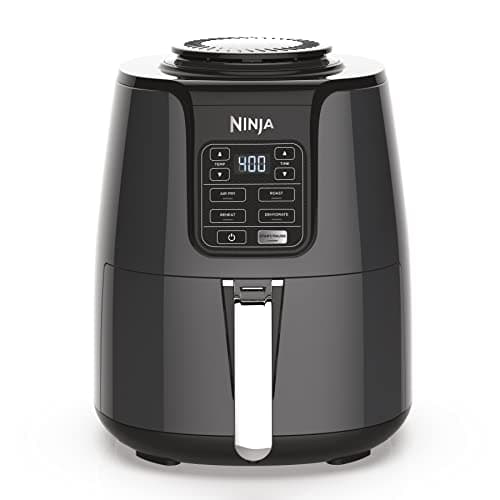 Ninja AF101 The 4-quart Ninja AF101 is the one we point most people to: a genuinely simple dial-and-button air fryer with a ceramic-coated basket, a 105–400°F range, and a footprint that fits a normal counter. It has been the reliable default since 2018 for good reason. 4 QT · 1550W | Best overall on value | 4.6★★★★★ | $104.99Amazon |
| 02 | 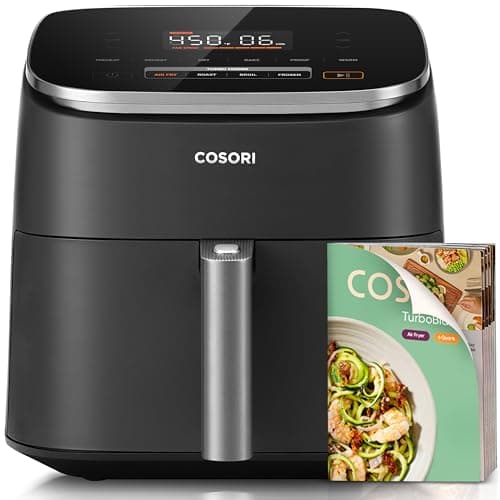 Cosori TurboBlaze Cosori's TurboBlaze pairs a 6-quart square basket with a genuinely PFAS-free ceramic coating and a faster 3,600-rpm fan. It's the pick if you want a modern, roomier air fryer without stepping up to a dual-basket footprint — and the coating claim is on the spec sheet, not marketing. 6QT | Best for most kitchens | 4.5★★★★★ | $99.99Amazon |
#ad · Live prices from the Amazon Product API, as of October 16, 2026. Where we have no verified live price, we show none — a gap beats a number that has rotted.
The picks, in detail
Ninja AF101
spec score /5
$119.9913% off
Price as of October 16, 2026. Prices change — Amazon's is the one that counts.
#ad · we may earn a commission from this link to Ninja AF101
The 4-quart Ninja AF101 is the one we point most people to: a genuinely simple dial-and-button air fryer with a ceramic-coated basket, a 105–400°F range, and a footprint that fits a normal counter. It has been the reliable default since 2018 for good reason.
- Capacity
- 4 QT
- Footprint (W×D×H)
- 12.25 × 15.1 × 15.25 in
- Power
- 1550 W
- Weight
- 10.58 lb
- Cost per use*
- ≈9¢
- Est. per year*
- ≈$18
- Warranty
- 1 Year Manufacturers
- Ceramic-coated aluminum basket — no PTFE nonstick
- Dead-simple controls; nothing to learn
- Small enough for a normal counter (12 × 15 in)
- 4 qt is tight for a family of 4+
- No preset buttons or window
- Dial isn't the most precise
*Cost-to-run computed from the manufacturer's stated 1550W at $0.17/kWh (US average), 20-min sessions, 4×/week. Your rate and use will vary.
Cosori TurboBlaze
spec score /5
$119.9917% off
Price as of October 16, 2026. Prices change — Amazon's is the one that counts.
#ad · we may earn a commission from this link to Cosori TurboBlaze
Cosori's TurboBlaze pairs a 6-quart square basket with a genuinely PFAS-free ceramic coating and a faster 3,600-rpm fan. It's the pick if you want a modern, roomier air fryer without stepping up to a dual-basket footprint — and the coating claim is on the spec sheet, not marketing.
- Capacity
- 6QT
- Footprint (W×D×H)
- 11.8 × 14.4 × 11.9 in
- Weight
- 13.2 lb
- Warranty
- 2 Year Manufacturer
- PFAS-free ceramic basket (per spec sheet)
- 6-qt square basket fits more than round baskets
- Quieter, faster fan; 2-year warranty
- Pricier than a basic basket fryer
- Taller than a compact model
- Digital panel is a small learning curve
"Worth it" is a real question and it deserves a real answer rather than a restatement of the marketing. An air fryer is a small convection oven with a fast fan. That sounds unglamorous, and it is — but it changes three specific things about weeknight cooking, and whether those three things matter to you is the whole decision.
The three things it actually changes
Preheat time. This is the underrated one. A full-size oven has a large cavity and heavy metal racks to bring up to temperature, which takes 10–15 minutes. An air fryer has a small cavity and a fast fan, and is ready in two or three. On a weeknight that is the difference between using it and ordering something.
Reheating quality. A microwave reheats by exciting water molecules, which is why leftover pizza and fries come back limp. An air fryer reheats with dry moving air, so the surface re-crisps. Most people who love their air fryer are, if they are honest, mostly using it for this.
Oil volume. You use a teaspoon or a spray instead of a quart. Ninja states up to 75% less fat than deep frying, tested against hand-cut deep-fried fries; Instant quotes 95% less oil for its EvenCrisp models. Those are manufacturer figures for a like-for-like food, not a claim that air-fried food is health food — we go through what it does and does not mean in are air fryers healthy?
The running-cost math, in full
This is the number almost nobody publishes, so here it is with the working shown. The formula is watts ÷ 1,000 × hours × your electricity rate. We use the US average residential rate of about $0.17 per kWh from the EIA.
- Ninja AF101, 1,550 W, 20-minute batch: 1.55 kW × 0.33 h = 0.52 kWh ≈ 9 cents
- Instant Vortex Plus, 1,700 W, 20-minute batch: 1.7 kW × 0.33 h = 0.57 kWh ≈ 10 cents
- Chefman TurboFry Dual, 1,500 W, 25-minute batch: 1.5 kW × 0.42 h = 0.63 kWh ≈ 11 cents
Cook five nights a week on the AF101 and you are spending about $2 a month. The comparison that matters is not against a microwave — it is against heating a full-size oven, which has far more air and metal to bring to temperature and holds it for longer. For a small portion, the air fryer wins on energy comfortably. For a full tray of roast vegetables for six, the oven is more efficient per pound of food, because you are heating one cavity instead of running four batches. The full method is on how we review, with the category numbers in what an air fryer costs to run.
The cost people forget: counter space
An air fryer is not expensive to buy or to run. It is expensive in the one resource most kitchens are actually short of. Real measured footprints from the machines we track: 8.1 inches wide for a 2-quart Dash Compact, 12.25 for a 4-quart Ninja AF101, 11.8 for a 6-quart Cosori TurboBlaze, and 15.63 for an 8-quart Ninja DZ201. Depth is the sharper problem: 14.4 inches on the Cosori models is a serious bite out of a 24-inch counter, and heights of 12–15 inches plus venting clearance can be tight under an 18-inch cabinet gap.
This is the actual reason air fryers end up in cupboards, and an air fryer in a cupboard has a value of zero. Before buying, measure the space and be honest about whether the machine will live there. Our best small air fryers guide ranks the field on measured width for exactly this reason.
Who it is genuinely worth it for
- One or two people cooking on weeknights. The preheat saving and the small batch size line up perfectly with how you actually eat. This is the strongest case.
- Anyone who eats a lot of leftovers. Re-crisping is the thing it does better than any other appliance in the kitchen.
- Small kitchens without a decent oven. Apartments, dorms, RVs. A 2-quart Dash at 8.1 inches wide and 5.8 lb is a genuinely different proposition to a full oven.
- People cutting down on frying oil. Not because air-fried food is health food, but because the same food with a teaspoon instead of a quart of oil is a real change.
Who should skip it
- You want actual deep-fried food. Wet batter does not work in hot air — it runs off before it sets. This is a physical limit, not a technique problem. See air fryer vs. deep fryer and what not to cook in an air fryer.
- You already own a good convection toaster oven. You own most of an air fryer already. The gain is a faster fan and a smaller cavity, which is a real but modest upgrade — air fryer vs. toaster oven is the honest comparison.
- You regularly cook for five or more. Single-basket machines top out around 6 quarts of single-layer space, and you will be running batches. A conventional oven does that better in one go.
- Your counter cannot spare it. Covered above, and it is the most common reason for regret.
How much to spend if the answer is yes
You do not need to spend much for the core function — every air fryer at every price is a heating element and a fan, and they all crisp food. What more money buys is materials, warranty and basket geometry. The Ninja AF101 is the value answer: 4 quarts, a ceramic-coated aluminum basket rather than a PTFE one, 105–400°F, and a reliability record going back to 2018 — a reasonable amount of appliance for very little money.
Stepping up to the Cosori TurboBlaze buys three concrete things: a 6-quart square basket with more usable single-layer area than a round one, a PFAS-free ceramic coating listed as a specification on both basket and crisper tray, and a two-year warranty in a category where one year is the norm. If you expect to use it several times a week for years, that is where the money is well spent. Full breakdown in our air fryer buying guide, and the price-led field in best air fryers under $100.
The other half of the value question is how long the machine lasts, and no maker publishes a lifespan figure. How long do air fryers last collects every warranty term we can read off a listing — from three years down to no published term at all — and explains which three components actually fail.
Frequently asked questions
Are air fryers worth buying?
For most one-to-four-person households, yes. They preheat in two or three minutes instead of ten to fifteen, cost about 9 cents of electricity a batch, and re-crisp leftovers better than any other appliance. They are not worth it if you want deep-fried food, already own a convection toaster oven, cook for five or more, or cannot spare the counter space.
Do air fryers really save money?
On electricity, modestly and only against a full-size oven. A 1,550-watt air fryer running 20 minutes costs about 9 cents at the US average of 17 cents per kWh; an oven heats far more air and metal for the same small portion. For a full tray of food for six, the oven is more efficient per pound.
Is an air fryer better than an oven?
For small portions and reheating, yes — faster preheat, less energy, better crisping. For volume, no. An oven cooks a large tray in one go where an air fryer needs several batches, and batches cost both time and electricity.
Do people actually keep using their air fryer?
The ones who had space for it do. The most common regret in this category is not capacity but footprint — a machine that does not fit the counter ends up in a cupboard and stops getting used. Measure before you buy.
How long do air fryers last?
The parts that fail are the fan bearing and the heating element. Warranty length is the most honest signal a manufacturer gives you about expected life: one year is the category norm, and Cosori's two-year cover on the TurboBlaze and Pro LE is genuinely unusual.
Is an air fryer worth it for one person?
It is arguably the strongest case for one. Small batches, fast preheat, and no reason to heat a full oven for a single portion. A 2-quart machine at 8.1 inches wide handles one person's cooking and stores in a cabinet.
Sources
Keep reading
Air Fryers
The Best Air Fryers of 2026
Our ranked air-fryer picks, compared on capacity, footprint, materials and running cost — with live Amazon prices.
Running costs
How Much Does an Air Fryer Cost to Run?
A typical air fryer costs about 9 to 10 cents of electricity per batch. Here is exactly how that is calculated.
Comparison
Air Fryer vs. Toaster Oven: Which One Fits Your Kitchen?
Basket-style crisping vs. an oven-style box that toasts and bakes — compared on shape, capacity and cost.
Comparison
Air Fryer vs. Deep Fryer: Which One Belongs on Your Counter?
Air fryer vs deep fryer on batter, oil cost, electricity, footprint, cleanup and safety — including what an air fryer genuinely cannot do.
Roundup
The Best Air Fryers Under $100 of 2026
The best-value air fryers, with an honest take on what budget models leave out.
Guide
What Size Air Fryer Do I Need?
Quarts-to-people, why square baskets beat round ones, and the real counter space each size costs you.
https://wattandwhisk.com/air-fryers/are-air-fryers-worth-it