Cosori Pro LE Review
It holds a quart more than the Ninja everyone recommends, in a body an inch and a half narrower and three inches shorter. That is the whole case — and the coating claim needs reading carefully.
Disclosure:Watt & Whisk is reader-supported. When you buy through links on this page we may earn an Amazon Associates commission, at no extra cost to you. Prices are pulled live from Amazon and shown with the date checked. How this works.
The Cosori Pro LE is the air fryer to buy if you want presets rather than dials and your counter is tight. Its 5-quart square basket holds a quart more than the Ninja AF101 most people default to, inside a body that is 10.8 inches wide and 12 inches tall — narrower and a full three inches shorter than that Ninja. You get seven one-touch presets with preheat and keep-warm, 450°F top heat, a ceramic-coated basket and crisper tray, and a 2-year warranty where most of this category gives one. The thing to read carefully before you buy: Cosori describes the Pro LE's coating as ceramic but makes no PFAS-free claim for it — only its pricier TurboBlaze carries that wording. This is a specifications-and-cost review, not a lab test. Prices below are pulled live from Amazon.
The short answer
Quick picks
| # | Product | Best for | Score | Price |
|---|---|---|---|---|
| 01 | 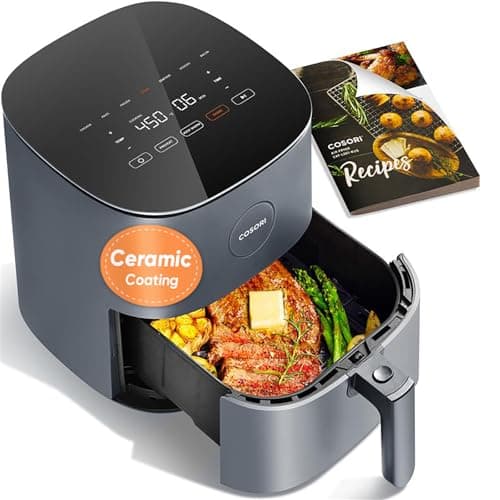 Cosori Pro LE The 5-quart Pro LE is the friendliest first air fryer here: seven clearly labeled presets, a ceramic nonstick basket, and 450°F top heat in a body that doesn't hog the counter. If dials intimidate you, this removes the guesswork. 5 QT | Best presets for beginners | 4.4★★★★★ | $89.95Amazon |
| 02 | 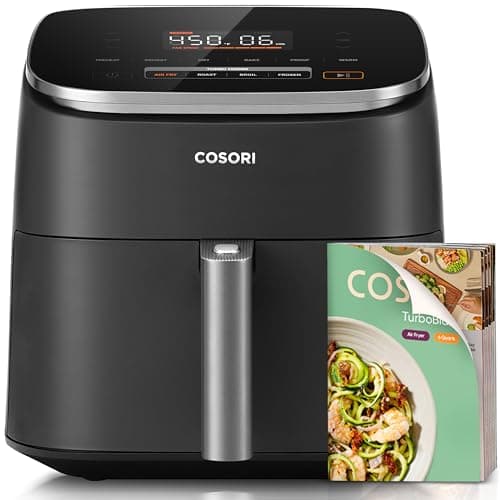 Cosori TurboBlaze Cosori's TurboBlaze pairs a 6-quart square basket with a genuinely PFAS-free ceramic coating and a faster 3,600-rpm fan. It's the pick if you want a modern, roomier air fryer without stepping up to a dual-basket footprint — and the coating claim is on the spec sheet, not marketing. 6QT | Best for most kitchens | 4.5★★★★★ | $99.99Amazon |
| 03 | 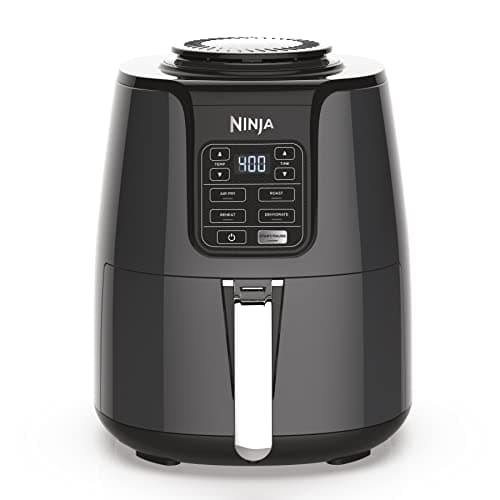 Ninja AF101 The 4-quart Ninja AF101 is the one we point most people to: a genuinely simple dial-and-button air fryer with a ceramic-coated basket, a 105–400°F range, and a footprint that fits a normal counter. It has been the reliable default since 2018 for good reason. 4 QT · 1550W | Best overall on value | 4.6★★★★★ | $104.99Amazon |
#ad · Live prices from the Amazon Product API, as of October 20, 2026. Where we have no verified live price, we show none — a gap beats a number that has rotted.
The picks, in detail
Cosori Pro LE
spec score /5
$99.9910% off
Price as of October 20, 2026. Prices change — Amazon's is the one that counts.
#ad · we may earn a commission from this link to Cosori Pro LE
The 5-quart Pro LE is the friendliest first air fryer here: seven clearly labeled presets, a ceramic nonstick basket, and 450°F top heat in a body that doesn't hog the counter. If dials intimidate you, this removes the guesswork.
- Capacity
- 5 QT
- Footprint (W×D×H)
- 10.8 × 14.4 × 12 in
- Weight
- 10 lb
- Warranty
- 2 year manufacturer
- 7 one-touch presets take the guesswork out
- Ceramic coating, dishwasher-safe basket
- Compact 10.8-in-wide body
- 5 qt still tight for big families
- App is optional and skippable
- No cook window
Cosori TurboBlaze
spec score /5
$119.9917% off
Price as of October 20, 2026. Prices change — Amazon's is the one that counts.
#ad · we may earn a commission from this link to Cosori TurboBlaze
Cosori's TurboBlaze pairs a 6-quart square basket with a genuinely PFAS-free ceramic coating and a faster 3,600-rpm fan. It's the pick if you want a modern, roomier air fryer without stepping up to a dual-basket footprint — and the coating claim is on the spec sheet, not marketing.
- Capacity
- 6QT
- Footprint (W×D×H)
- 11.8 × 14.4 × 11.9 in
- Weight
- 13.2 lb
- Warranty
- 2 Year Manufacturer
- PFAS-free ceramic basket (per spec sheet)
- 6-qt square basket fits more than round baskets
- Quieter, faster fan; 2-year warranty
- Pricier than a basic basket fryer
- Taller than a compact model
- Digital panel is a small learning curve
Ninja AF101
spec score /5
$119.9913% off
Price as of October 20, 2026. Prices change — Amazon's is the one that counts.
#ad · we may earn a commission from this link to Ninja AF101
The 4-quart Ninja AF101 is the one we point most people to: a genuinely simple dial-and-button air fryer with a ceramic-coated basket, a 105–400°F range, and a footprint that fits a normal counter. It has been the reliable default since 2018 for good reason.
- Capacity
- 4 QT
- Footprint (W×D×H)
- 12.25 × 15.1 × 15.25 in
- Power
- 1550 W
- Weight
- 10.58 lb
- Cost per use*
- ≈9¢
- Est. per year*
- ≈$18
- Warranty
- 1 Year Manufacturers
- Ceramic-coated aluminum basket — no PTFE nonstick
- Dead-simple controls; nothing to learn
- Small enough for a normal counter (12 × 15 in)
- 4 qt is tight for a family of 4+
- No preset buttons or window
- Dial isn't the most precise
*Cost-to-run computed from the manufacturer's stated 1550W at $0.17/kWh (US average), 20-min sessions, 4×/week. Your rate and use will vary.
What Cosori actually publishes
Everything here is read off the current listing for the exact model we link, the CAF-L501-KUS. We have not cooked on this machine, we do not run a lab, and we are not going to pretend otherwise — our method is on how we review.
- 5-quart square basket, which Cosori describes as holding a full meal in one batch.
- Seven preset cooking functions with preheat and keep warm.
- 450°F top-end heat. Cosori adds that a steak can be cooked in about six minutes at that temperature.
- Ceramic coating on the nonstick basket and the crisper tray, both dishwasher-safe.
- 10.8 × 14.4 × 12 inches and 10 lb.
- 2-year manufacturer warranty.
- A 30-recipe cookbook, 100+ app recipes, and a VeSync app that displays calories, protein, fat and fiber.
- A shake reminder, prominent enough that Cosori puts it in the product title.
Listed in 2021, so this is a mature product rather than a new release. That cuts both ways, and we come back to it at the end.
The actual case for it: 5 quarts in a small body
The reason this machine earns a recommendation is a footprint argument, and it is more striking than the spec sheet makes it look.
The default recommendation in this category for years has been the 4-quart Ninja AF101, which measures 12.25 inches wide, 15.1 deep and 15.25 tall. The Pro LE holds a quart more and measures 10.8 wide, 14.4 deep and 12 tall. It is 1.45 inches narrower, 0.7 inches shallower and 3.25 inches shorter — while being bigger inside.
That height difference is the one that decides purchases. A standard upper cabinet sits about 18 inches above the counter, and an air fryer vents upward, so you want real clearance rather than a flush fit. At 12 inches the Pro LE lives comfortably under a cabinet; at 15.25 the Ninja is tight in a lot of kitchens and has to be pulled forward to run.
Some of the gain is shape rather than engineering. The Pro LE's basket is square, and square baskets convert the corners into usable floor area where a round basket of the same volume wastes them. Air frying only works in a single layer, so floor area is the number that decides how much food actually cooks. If a tight counter is your binding constraint, the whole field is ranked by measured width in best small air fryers.
The coating claim, read precisely
This is where we part company with most write-ups of this machine, and it matters because a large share of air-fryer buyers are shopping on materials.
Cosori's bullet for the Pro LE reads: "Premium ceramic coating on the nonstick basket and crisper tray helps food release easily." That is a statement about what the coating is. It is not a statement about what it is free of, and the Pro LE's listing contains no PFAS-free claim anywhere.
Compare that with Cosori's own TurboBlaze, whose equivalent bullet reads "the basket and crisper tray feature a PFAS-free, nonstick ceramic coating". Same brand, same material family, materially different promise. The same split runs through the category: the TurboBlaze, the Cosori TWINFRY and the Typhur Dome 2 publish explicit PFAS-free statements; the Ninja AF101 and this Pro LE describe ceramic coatings and publish no PFAS claim at all.
We are not saying the Pro LE's coating contains PFAS. We have no evidence either way, which is exactly the point — an absent claim is an absent claim, not a negative one. If PFAS-free is a requirement rather than a preference, buy a machine that states it. The vocabulary is unpicked in what PFAS-free actually means, the machines that state it are in best ceramic air fryers, and the ones with no coating at all are in best non-toxic air fryers.
Seven presets, nine functions, one listing
The product title says 9-in-1. The feature bullet says seven preset cooking functions. Both numbers are on the same page and Cosori does not reconcile them, so treat the seven as the figure you can act on — that is the one attached to a described behavior.
What the presets are genuinely worth: they fold preheat into the program. Most air fryers leave preheating to you, and for most cooking that is fine — but for a short, high-heat cook like the six-minute steak Cosori cites, starting in a cold cavity costs you a meaningful share of the cook. Having it happen automatically is the difference between a preset that saves a decision and one that just relabels a temperature. We go through which cooks actually need it in do air fryers need preheating.
The keep-warm function is the other quietly useful one, because the failure mode of a 5-quart basket is cooking a main and a side in two rounds and having the first go cold.
The shake reminder is a mixed blessing and worth knowing about before it surprises you: it is an audible alert partway through a cook, and if a quiet kitchen matters to you, find the mute before you decide how you feel about the machine. Cosori is the only basket-fryer brand publishing any noise data at all, though not for this model — the quietest air fryers has the two machines in the category that publish a decibel figure.
What Cosori does not publish
Three gaps, stated rather than filled.
- No wattage. Cosori publishes none for the Pro LE, the TurboBlaze or the TWINFRY. That means we compute no running cost for this machine, and we will not estimate one. For comparison, the Ninja AF101 publishes 1,550 watts, which works out to roughly 9 cents for a 20-minute batch at the 17-cents-per-kWh US residential average. The full arithmetic is in what an air fryer costs to run.
- No bottom of the temperature range. Cosori publishes the 450°F top end and no minimum. The TurboBlaze publishes 90–450°F and the Ninja AF101 publishes 105–400°F. If you want to dehydrate — which needs a genuinely low setting held for hours — that missing figure is the one you need, and neither we nor the listing can give it to you.
- No noise figure for this model, and no SGS-style citation behind its oil claim. Cosori states "up to 85% less oil" for the Pro LE as a bare claim, where the TurboBlaze's 95% figure carries a stated SGS lab fat-content analysis. We pass both along as Cosori's claims rather than findings of ours, but the one with a named test behind it is the better-supported of the two.
Pro LE vs TurboBlaze
This is the comparison people actually search for, and the honest answer is that the TurboBlaze is the better machine and the Pro LE is often the better buy.
The TurboBlaze gives you a quart more (6 qt), the PFAS-free ceramic claim the Pro LE does not make, a published 90–450°F range instead of a top end only, a 3,600 rpm five-speed fan, a published under-53 dB noise ceiling, and the SGS-cited oil figure. Both carry the same 2-year warranty. It is 2023 rather than 2021, and it is Cosori's current flagship basket machine.
What the Pro LE keeps: it is a full inch narrower (10.8 against 11.8 inches), 3.2 lb lighter, and it costs meaningfully less. If the money is the constraint, or the counter is, the Pro LE is a legitimate choice rather than a compromise — you are giving up a quart, a published temperature floor and a materials claim to get a narrower, cheaper machine with the same warranty. Our full write-up of the bigger one is the Cosori TurboBlaze review.
Pro LE vs Ninja AF101
The other comparison worth making, because the AF101 is the machine most people are choosing between this and.
The Pro LE wins on capacity, size and warranty. Five quarts against four, a square basket against a round one, a smaller body in every dimension, and two years of warranty against one. It also has presets where the Ninja has a dial and four programs.
The AF101 wins on two published things. It states 1,550 watts, so you can actually compute what it costs to run, and it publishes a 105–400°F range, so you know it will dehydrate. It has also been on sale since 2018 with a reliability record to match, which is not a spec but is not nothing. Our take on it is the Ninja AF101 review, and the two are set against their peers in best air fryers under $100.
Who should buy it
Buy it if you want an air fryer you can hand to someone without explaining it, you cook for one or two people with occasional leftovers, and your counter or cabinet clearance is genuinely tight. The combination of seven presets, 5 quarts and a 12-inch-tall, 10.8-inch-wide body is not matched by anything else at this price, and the 2-year warranty is a real advantage over the Ninja. It is a strong first air fryer, which is why it appears on best air fryers for beginners.
Do not buy it if PFAS-free is a requirement — the listing makes no such claim, and the TurboBlaze does. Skip it too if you want to dehydrate, since no minimum temperature is published; if you need to know your running cost, since no wattage is; or if you are feeding four people a main and a side in one round, where 5 quarts means two rounds and the answer is a 6-quart square or a dual-basket machine — in which case start with Ninja DZ201 vs DZ401, the two that dominate that format. Those cases are covered in best air fryers for 2 people and best air fryers for a family of 4.
The verdict
A well-judged machine that has aged well: five quarts of square basket, presets that genuinely remove decisions, 450°F of top heat, dishwasher-safe ceramic-coated parts and two years of warranty, in the narrowest body of anything in its capacity class. Being a 2021 design is not the drawback it sounds like — it has been superseded within Cosori's own range rather than abandoned, which is usually what makes a good appliance affordable.
The one thing we would not let you walk past is the coating wording. If you came to air fryers because of what the basket is made of, read that section again and then buy the TurboBlaze instead. If you came because you want a straightforward 5-quart air fryer that fits under your cabinets and will not need a manual, this is the one.
Frequently asked questions
Is the Cosori Pro LE PFAS-free?
Cosori does not say. The Pro LE's listing describes a premium ceramic coating on the basket and crisper tray but makes no PFAS-free claim anywhere, where Cosori's own TurboBlaze explicitly states a PFAS-free nonstick ceramic coating. An absent claim is not a negative one, but if PFAS-free is a requirement, buy a model that states it.
How big is the Cosori Pro LE?
10.8 inches wide, 14.4 deep and 12 tall, weighing 10 lb, with a 5-quart square basket. That makes it narrower, shallower and 3.25 inches shorter than the 4-quart Ninja AF101 while holding a quart more — the 12-inch height is what lets it sit under a standard upper cabinet.
How many watts does the Cosori Pro LE use?
Cosori publishes no wattage for it, or for the TurboBlaze or TWINFRY, so we compute no running cost for this machine and do not estimate one. For scale, the Ninja AF101 publishes 1,550 watts, which is about 9 cents for a 20-minute batch at the US average electricity rate.
Cosori Pro LE or TurboBlaze?
The TurboBlaze is the better machine: 6 quarts, a PFAS-free ceramic claim, a published 90 to 450°F range, a 3,600 rpm five-speed fan and a stated under-53 dB noise ceiling. The Pro LE is a full inch narrower, 3.2 lb lighter and cheaper, with the same 2-year warranty. Pick on counter space and budget.
Does the Cosori Pro LE preheat automatically?
Yes — its seven preset cooking functions include preheat along with keep warm, so you do not have to remember it. That matters most on short, high-heat cooks like the six-minute steak Cosori cites, where starting in a cold cavity costs a real share of the cooking time.
Can the Cosori Pro LE dehydrate?
Cosori publishes the 450°F top end but no minimum temperature, and dehydrating needs a genuinely low setting held for hours. Without a published floor we cannot tell you, and we will not guess. If dehydrating matters, the TurboBlaze publishes 90°F and the Ninja AF101 publishes 105°F.
Is the Cosori Pro LE too old to buy in 2026?
No. It was listed in 2021 and has been superseded within Cosori's own range by the TurboBlaze rather than discontinued, which is usually what makes a good appliance affordable. It carries the same 2-year warranty as the current flagship.
Keep reading
Air Fryers
The Best Air Fryers of 2026
Our ranked air-fryer picks, compared on capacity, footprint, materials and running cost — with live Amazon prices.
Review
Cosori TurboBlaze Review
The Cosori TurboBlaze on materials, fan speed, temperature range and footprint — and the two reasons to buy something else.
Review
Ninja AF101 Review
The 4-quart Ninja AF101 on materials, wattage, footprint and running cost — and who should skip it.
Roundup
The Best Air Fryers for Beginners of 2026
The easiest air fryers to learn on, with presets that take out the guesswork.
Roundup
The Best Air Fryers Under $100 of 2026
The best-value air fryers, with an honest take on what budget models leave out.
Roundup
The Best Ceramic Air Fryers of 2026
The air fryers with a genuine published ceramic coating, what each maker does and does not claim, and how to make ceramic last.
Roundup
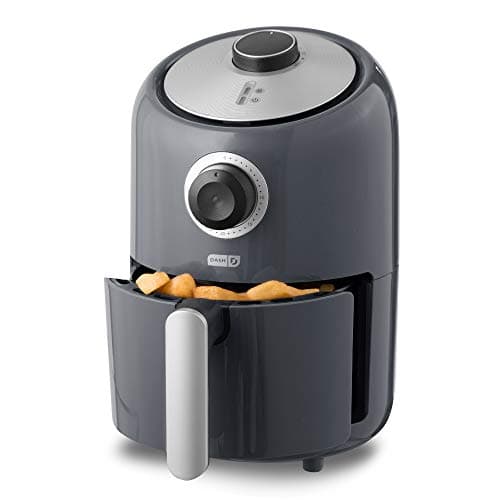
The Best Small Air Fryers of 2026
The smallest-footprint air fryers for apartments, dorms and RVs, ranked by real width.
https://wattandwhisk.com/air-fryers/cosori-pro-le-review