How to Read Air Fryer Reviews
Three different things get called an air fryer review, and only one of them involves anyone cooking. Telling them apart is most of the skill.
Disclosure:Watt & Whisk is reader-supported. When you buy through links on this page we may earn an Amazon Associates commission, at no extra cost to you. Prices are pulled live from Amazon and shown with the date checked. How this works.
Three different things get called an air fryer review. A lab test cooks standardized food and measures the result — that is the only kind that can tell you about browning evenness or whether a machine actually reaches its setpoint, and the serious ones usually sit behind a paywall. A specification comparison, which is what this site publishes, reads every figure the manufacturer puts in writing and computes what it means. A content-farm roundup does neither and is recognizable in about ten seconds. The practical skill is telling which one you are reading, and knowing which claims are measured, which are marketing, and which nobody has published at all — a longer list than you would expect. Prices below are pulled live from Amazon.
The short answer
Quick picks
| # | Product | Best for | Score | Price |
|---|---|---|---|---|
| 01 | 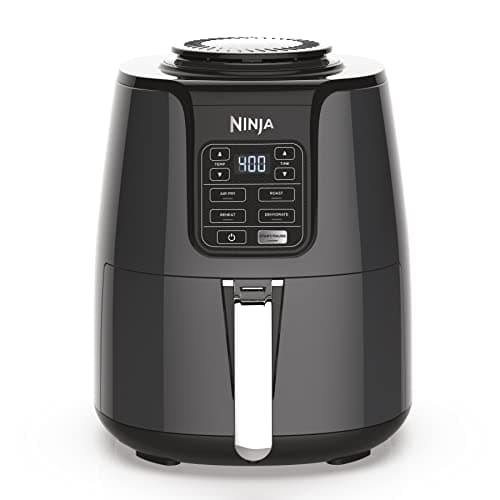 Ninja AF101 The 4-quart Ninja AF101 is the one we point most people to: a genuinely simple dial-and-button air fryer with a ceramic-coated basket, a 105–400°F range, and a footprint that fits a normal counter. It has been the reliable default since 2018 for good reason. 4 QT · 1550W | Best overall on value | 4.6★★★★★ | $119.99Amazon |
| 02 | 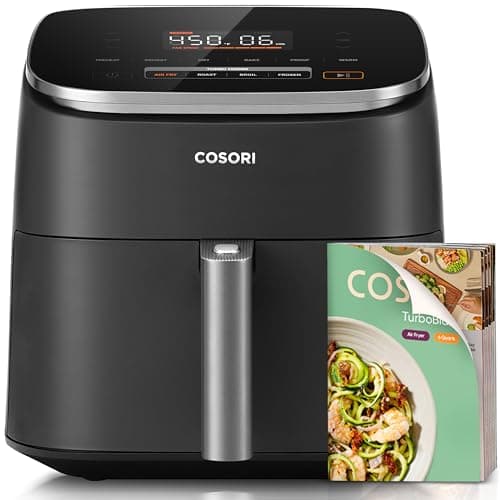 Cosori TurboBlaze Cosori's TurboBlaze pairs a 6-quart square basket with a genuinely PFAS-free ceramic coating and a faster 3,600-rpm fan. It's the pick if you want a modern, roomier air fryer without stepping up to a dual-basket footprint — and the coating claim is on the spec sheet, not marketing. 6QT | Best for most kitchens | 4.5★★★★★ | $99.99Amazon |
| 03 | 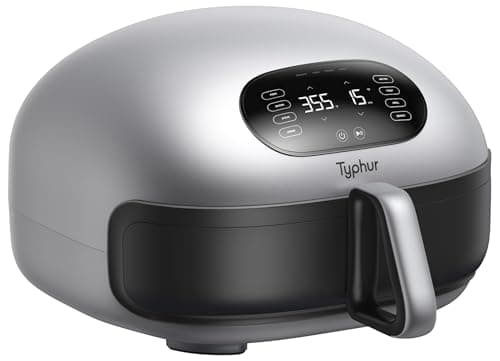 Typhur Dome 2 The Typhur Dome 2 is the splurge: a very large, wide, single-layer basket built for cooking a lot of food in one pass, with a premium finish. It's a lot of counter, but for entertaining it's a genuinely different tool. Large | Best premium large basket | 4.0★★★★★ | $339.99Amazon |
| 04 | 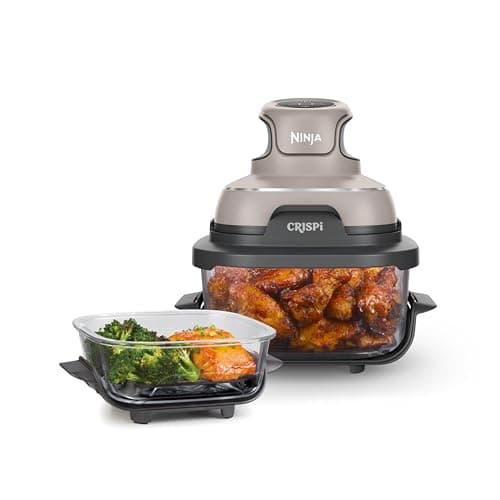 Ninja Crispi The Crispi is the cleanest materials story in air frying: you cook directly in borosilicate glass containers that Ninja lists as PFAS- and PTFE-free — no nonstick coating touching your food at all. A pod-style heater clips on top, and it stores nested. 4 QT | Best non-toxic / glass | 4.3★★★★★ | $179.99Amazon |
#ad · Live prices from the Amazon Product API, as of October 27, 2026. Where we have no verified live price, we show none — a gap beats a number that has rotted.
Side by side
How much each maker actually publishes
The same four machines a review might rank. Read this column and you can see why two of them can be fairly compared on running cost and two cannot — the evidence base is not uniform, and a review that hides that is doing you a disservice.
| Model | Key specs | Published evidence, by machine | Best for | Price |
|---|---|---|---|---|
| Ninja AF101 | 4 QT1550 W12.25 × 15.1 × 15.25 in1-yr warranty | The most completely documented machine we track: 1,550 W, a 105-400°F range, and a stated ceramic-coated aluminum basket. Enough published figures to compute a running cost AND check the dehydrate claim. | Most complete spec sheet | $119.99Check Price |
| Cosori TurboBlazeCAF-DC601-KUS | 6 QT11.8 × 14.4 × 11.9 in2-yr warranty | Publishes under 53 dB at highest fan speed, 90-450°F, a 3,600 rpm 5-speed fan, and cites an SGS lab fat analysis behind its 95%-less-oil claim. Publishes NO wattage, so no running cost is computable. | Cites its own lab source | $99.99Check Price |
| Typhur Dome 2AF03 | 15.6 × 19.7 × 10.3 in1-yr warranty | Publishes 51 dB, a 2.36-in interior height and a 5.6-qt flat capacity. Its listing also QUOTES third-party recommendations from America's Test Kitchen and Consumer Reports — a maker's claim about reviews, not a review. No wattage published. | Quotes others' verdicts | $339.99Check Price |
| Ninja CrispiFN101ST | 4 QT11.96 × 13.38 × 13.58 in1-yr warranty | Unusually explicit on materials — borosilicate glass stated free of PFAS, PTFE and nonstick coatings — and unusually silent elsewhere: no wattage, no noise figure. Documentation can be excellent in one dimension and absent in another. | Clear on materials only | $179.99Check Price |
#ad · we may earn a commission · Specs read from each manufacturer's Amazon listing; prices pulled live from the Amazon Product API, as of October 27, 2026. Where a maker publishes no figure (wattage, warranty term) we leave the cell empty rather than estimate one.
The picks, in detail
Ninja AF101
spec score /5
Price as of October 27, 2026. Prices change — Amazon's is the one that counts.
#ad · we may earn a commission from this link to Ninja AF101
The 4-quart Ninja AF101 is the one we point most people to: a genuinely simple dial-and-button air fryer with a ceramic-coated basket, a 105–400°F range, and a footprint that fits a normal counter. It has been the reliable default since 2018 for good reason.
- Capacity
- 4 QT
- Footprint (W×D×H)
- 12.25 × 15.1 × 15.25 in
- Power
- 1550 W
- Weight
- 10.58 lb
- Cost per use*
- ≈9¢
- Est. per year*
- ≈$18
- Warranty
- 1 Year Manufacturers
- Ceramic-coated aluminum basket — no PTFE nonstick
- Dead-simple controls; nothing to learn
- Small enough for a normal counter (12 × 15 in)
- 4 qt is tight for a family of 4+
- No preset buttons or window
- Dial isn't the most precise
*Cost-to-run computed from the manufacturer's stated 1550W at $0.17/kWh (US average), 20-min sessions, 4×/week. Your rate and use will vary.
Cosori TurboBlaze
spec score /5
$119.9917% off
Price as of October 27, 2026. Prices change — Amazon's is the one that counts.
#ad · we may earn a commission from this link to Cosori TurboBlaze
Cosori's TurboBlaze pairs a 6-quart square basket with a genuinely PFAS-free ceramic coating and a faster 3,600-rpm fan. It's the pick if you want a modern, roomier air fryer without stepping up to a dual-basket footprint — and the coating claim is on the spec sheet, not marketing.
- Capacity
- 6QT
- Footprint (W×D×H)
- 11.8 × 14.4 × 11.9 in
- Weight
- 13.2 lb
- Warranty
- 2 Year Manufacturer
- PFAS-free ceramic basket (per spec sheet)
- 6-qt square basket fits more than round baskets
- Quieter, faster fan; 2-year warranty
- Pricier than a basic basket fryer
- Taller than a compact model
- Digital panel is a small learning curve
Typhur Dome 2
spec score /5
$390.0013% off
Price as of October 27, 2026. Prices change — Amazon's is the one that counts.
#ad · we may earn a commission from this link to Typhur Dome 2
The Typhur Dome 2 is the splurge: a very large, wide, single-layer basket built for cooking a lot of food in one pass, with a premium finish. It's a lot of counter, but for entertaining it's a genuinely different tool.
- Capacity
- Large
- Footprint (W×D×H)
- 15.6 × 19.7 × 10.3 in
- Weight
- 20.5 lb
- Warranty
- This appliance carries a limited one-year warranty against defects from the date of purchase.
- Huge single-layer cooking area
- Premium build and finish
- Cooks a full tray in one go
- Expensive
- Wide 19.7-in footprint
- Overkill for everyday single meals
Ninja Crispi
spec score /5
Price as of October 27, 2026. Prices change — Amazon's is the one that counts.
#ad · we may earn a commission from this link to Ninja Crispi
The Crispi is the cleanest materials story in air frying: you cook directly in borosilicate glass containers that Ninja lists as PFAS- and PTFE-free — no nonstick coating touching your food at all. A pod-style heater clips on top, and it stores nested.
- Capacity
- 4 QT
- Footprint (W×D×H)
- 11.96 × 13.38 × 13.58 in
- Warranty
- 1 year limited warranty
- Cooks in PFAS/PTFE-free borosilicate glass
- Nests to store; pod is tiny
- Glass containers double as meal prep
- Newer design, shorter track record
- Glass adds weight
- Not the cheapest per quart
The three kinds of review
1. The lab test. Someone buys the machines, cooks the same food in all of them under controlled conditions, and measures what comes out. Consumer Reports, America's Test Kitchen and the larger magazine test kitchens work this way. This is the only kind of review that can answer questions a spec sheet physically cannot — does the fan brown evenly from corner to corner, does the cavity actually hold the temperature on the dial, how loud is it in a real kitchen, how much food fits before crowding ruins it.
Two honest caveats. The serious lab results are usually paywalled, which is their business model and entirely fair — we do not reproduce them here and you should be suspicious of any free page that claims to. And a lab test is a snapshot of the units tested at the time, which matters in a category where models turn over fast.
2. The specification comparison. This is what we publish. Every figure is read off the manufacturer's own current listing — capacity, wattage, temperature range, materials, footprint, warranty — and then used: running cost computed from wattage, cabinet clearance from height, batch size from basket geometry. The strength is that it is checkable; you can open the same listing and see the same numbers. The limitation is absolute and we state it on every page: we have not cooked on these machines and we do not run a lab. Our method is on how we review.
3. The content-farm roundup. No method, no measurements, no published figures — just adjectives, a ranking, and buy buttons. These are the majority of what a search returns, and they are easy to spot once you know the tells, which are below.
How to tell which one you are reading, in ten seconds
Four questions, in order of how quickly they sort the field:
- Does it say what it did? A real review states its method somewhere — we cooked X in each machine, or we compared published specifications. A page that never explains where its conclusions came from has no conclusions, only copy.
- Does it admit what it did not do? This is the sharpest single filter. Any honest spec comparison will tell you it has not lab-tested; any honest lab test will tell you how many units it bought and when. Pages that imply hands-on testing without ever quite claiming it are the ones to close.
- Are there numbers, and are they attributed? "Crisps beautifully" is not a finding. "1,550 watts, 105-400°F, ceramic-coated aluminum basket" is, and you can verify every word of it on the listing.
- Does it have gaps? Counterintuitively, a review with blanks in its table is usually more trustworthy than one where every cell is filled. In this category the manufacturers simply do not publish some figures — so a complete table means somebody estimated.
What no review can tell you, because nobody publishes it
This is the part that surprises people, and it is why the gaps test above works. Across the 20 air fryers and air fryer ovens we track:
- Wattage is frequently missing. Cosori publishes none for the TurboBlaze or the Pro LE. Typhur publishes none for the Dome 2. Ninja publishes none for the Crispi or for either DualZone model. Without it, running cost cannot be computed, and any page that gives you one for those machines has invented it. The arithmetic for the machines that do publish is in what an air fryer costs to run.
- Noise is almost never published. Exactly two machines state a decibel figure: Typhur at 51 dB and Cosori at under 53 dB at the highest fan speed. Every other "quietest air fryer" ranking you will read is ranking machines on numbers nobody measured. Ours refuses to, and says so: the quietest air fryers.
- Temperature ranges are sometimes half-published. The Ninja DZ401 states no range at all, where its 8-quart sibling publishes 105-450°F. Cosori publishes the Pro LE's 450°F top end with no minimum — so nobody can tell you whether it dehydrates properly.
- Interior dimensions are rare. Capacity is sold in quarts, but quarts include headroom you cannot use, since air frying needs a single layer. Only a few makers publish an interior height — Typhur states 2.36 inches, Breville a 16 × 13.5 × 7-inch cavity.
When a figure does not exist, the honest move is an empty cell and a sentence saying so. That is the standard we hold ourselves to, and the one to hold others to.
Reading the claims themselves
Five patterns worth recognizing, all drawn from listings we have actually read:
- Peak watts versus continuous watts. A peak figure is a momentary draw and is not comparable with a continuous rating. Ninja publishes 1,000 peak watts on its food processor where Cuisinart publishes 720 W continuous — put those in one column and the comparison is meaningless.
- "PFAS-free" is not "uncoated". A PFAS-free ceramic coating is still a coating with a finite life. And the claim is per model, not per brand: Cosori states PFAS-free on the TurboBlaze and makes no such claim on the Pro LE. Unpicked in what PFAS-free actually means.
- "Stainless steel" in a title usually describes the housing. Instant's 4-quart Vortex Plus carries it in the title and a non-stick basket in the bullets. The whole trap is laid out in best stainless steel air fryers.
- Percentage claims deserve a source. Cosori's "up to 95% less oil" cites an SGS lab fat-content analysis; its "up to 85% less oil" on the Pro LE cites nothing. Same brand, same style of claim, different evidential weight. Both are the maker's claims and we attribute rather than adopt them.
- A maker quoting a review is not a review. Typhur's listing states that the Dome 2 is recommended by America's Test Kitchen and Consumer Reports. That is a fact about what Typhur has written on its listing — it is not us verifying what those organizations concluded, and we do not present it as one. If their verdict is what you want, go to them.
If you came here looking for the Consumer Reports picks
We will not reproduce them, and no free page honestly can. Consumer Reports funds its independence by charging for its results; copying them out would be both a copyright problem and a disservice to the model that makes them trustworthy. If their rankings are what you want, subscribe — it is a reasonable amount of money for genuinely independent lab testing, and we would rather tell you that than keep you here.
What we can do is the part they do not: read every published specification across the category, compute what it means for your counter and your electricity bill, and be explicit about the gaps. The two approaches answer different questions, and using both is better than either. Where to start on ours: best air fryers under $100 for the value end, air fryer brands compared for the maker-level view, and our air fryer buying guide for choosing by spec.
The checklist
Before you trust any air fryer review, including this site's:
- Find the method statement. No method, no weight.
- Find what it admits it did not do. Silence here is the biggest red flag.
- Spot-check one number against the manufacturer's listing. If it does not match, stop reading.
- Look for blanks. In this category, a table with no gaps is a table with estimates in it.
- Check whether a cited test is the maker's or the reviewer's. "SGS analyzed" and "we measured" are very different sentences.
- Check the date against the model. This category turns over fast, and a machine one generation back is often the better buy anyway — when do air fryers go on sale explains why.
Apply that list to this page and you should find it passes: the method is spec-and-cost comparison, we have said plainly that we have not cooked on any of these machines, every figure above is on a current listing, there are gaps where makers publish nothing, and the one third-party endorsement mentioned is clearly labeled as Typhur's claim rather than our verification.
Frequently asked questions
What does Consumer Reports say is the best air fryer?
We do not reproduce Consumer Reports' rankings, and no free page honestly can — their results sit behind a paywall, which is what funds their independence. If their verdict is what you want, subscribing is the right move. What we publish instead is a specification-and-running-cost comparison built from manufacturers' own current listings.
How can you review air fryers without testing them?
We do not claim to test them, and we say so on every page. What we do is read every figure the manufacturer publishes — capacity, wattage, temperature range, materials, footprint, warranty — and then use it: running cost computed from wattage, cabinet clearance from height, batch size from basket geometry. It answers different questions from a lab test, and it is checkable against the same listing you can open.
What can a lab test tell me that a spec comparison cannot?
Whether the fan browns evenly across the basket, whether the cavity actually holds the temperature on the dial, how loud the machine is in a real kitchen, and how much food fits before crowding spoils the result. None of those appear on a spec sheet, and no amount of reading listings will produce them.
How do I spot a fake or low-effort air fryer review?
Four tells: it never states a method; it never admits what it did not do; its claims are adjectives rather than attributable numbers; and its comparison table has no blanks. That last one is counterintuitive but reliable — manufacturers in this category leave real gaps, so a table where every cell is filled contains estimates.
Why do some air fryer pages not show a running cost?
Because the maker publishes no wattage. Cosori publishes none for the TurboBlaze or Pro LE, Typhur none for the Dome 2, and Ninja none for the Crispi or either DualZone model. Without a stated wattage a running cost cannot be computed, so we leave it out rather than estimate one.
Is a manufacturer citing a lab test the same as independent testing?
No, though it is better than nothing. Cosori cites an SGS fat-content analysis behind its 95%-less-oil claim, which is a named third-party test; its 85% claim on another model cites nothing. And a maker stating that a magazine recommended its product, as Typhur's listing does, is a claim about a review rather than a review.
Which air fryer publishes the most useful specifications?
Of the machines we track, the Ninja AF101: 1,550 watts, a 105 to 400°F range and a stated ceramic-coated aluminum basket. That is enough published detail to compute a running cost and to check the dehydrate claim, which is more than most of the category offers.
Keep reading
Air Fryers
The Best Air Fryers of 2026
Our ranked air-fryer picks, compared on capacity, footprint, materials and running cost — with live Amazon prices.
Buying guide
Air Fryer Buying Guide: How to Choose
The five things worth deciding before you buy an air fryer — none of which need a lab test to judge.
Comparison
Air Fryer Brands, Compared
What Ninja, Cosori, Instant, Philips, Dash, Chefman and Typhur each actually compete on — and who should buy which.
Roundup
The Quietest Air Fryers of 2026
The only two air fryers that publish a decibel rating, what 51 dB actually sounds like, and what makes a fryer loud when no maker will tell you.
Roundup
The Best Air Fryers Under $100 of 2026
The best-value air fryers, with an honest take on what budget models leave out.
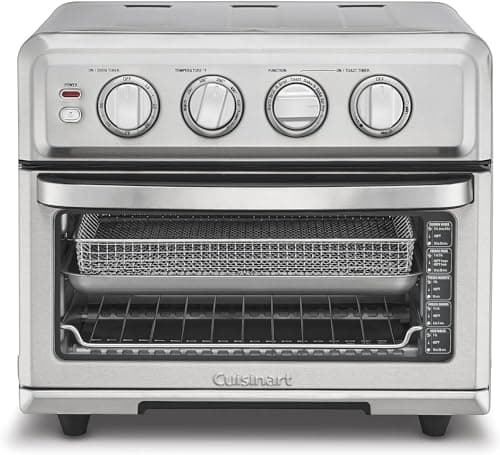
Roundup
The Best Stainless Steel Air Fryers
Why "stainless steel" on an air fryer box usually means the housing, and the four machines where food sits on steel, glass or enamel instead of a coating.
Guide
How Air Fryers Work — and What a Batch Really Costs
Convection heat, a fast fan, Maillard browning — and the real watts-to-cents cost of a batch.
https://wattandwhisk.com/air-fryers/how-to-read-air-fryer-reviews