Anova Models Compared
Three circulators from one brand — and not one of the three listings publishes a complete spec sheet, which makes the comparison stranger than it should be.
Disclosure:Watt & Whisk is reader-supported. When you buy through links on this page we may earn an Amazon Associates commission, at no extra cost to you. Prices are pulled live from Amazon and shown with the date checked. How this works.
For most home cooks, buy the Nano 2.0. It is the only one of the three whose listing publishes the specification sous vide actually exists for — ±0.1°C (±0.2°F) accuracy across 32–197°F — it carries a 2-year warranty, and it is the lightest and most drawer-friendly of the three. Step up to the Precision Cooker 3.0 if you want the adjustable clamp that fits nearly any pot, a published 1,100 watts for faster heat-up, and a stainless body with a removable skirt you can descale. Take the Mini only as the cheapest way to find out whether you like the method — and know before you buy that its free app tier is Bluetooth only, and that Anova publishes no warranty term for it. Prices below are pulled live from Amazon.
The short answer
Quick picks
| # | Product | Best for | Score | Price |
|---|---|---|---|---|
| 01 | 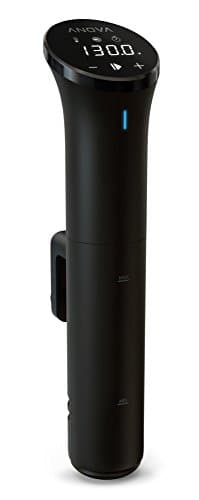 Anova Precision Cooker Nano 2.0 The Nano is the sensible middle: a 12.8-inch, 1.7 lb wand that stows in a kitchen drawer, runs from the unit itself or the free app, and carries Anova's 2-year warranty. It costs a fraction of the flagship and holds temperature just as tightly for a home-sized pot. 12.8" x 2.2" x 4.1" | Best value sous vide | 4.3★★★★★ | $89.99Amazon |
| 02 | 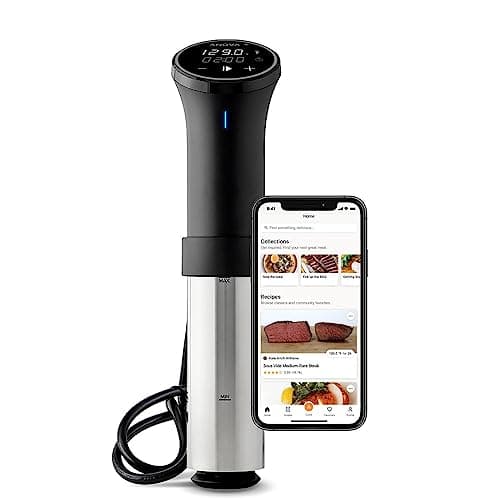 Anova Precision Cooker Anova's Precision Cooker is the category default: a 1,100-watt immersion circulator with a clip, a clear display, and a mature app. It clamps to any pot and holds temperature tightly, which is the entire job. 1100 watts · 1100W | Best overall sous vide | 4.4★★★★★ | $117.59Amazon |
| 03 | 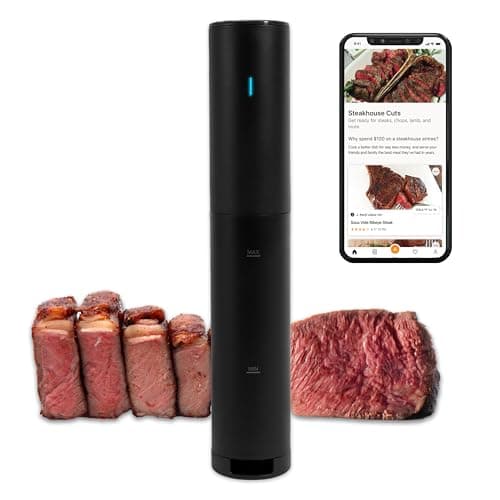 Anova Precision Cooker Mini Anova's most affordable circulator: 850 watts, 1.83 lb, Bluetooth control from the free app. It is the low-stakes way to find out whether you'll actually cook this way twice a month, and it costs less than the steak you'd ruin learning on the hob. Mini · 850W | Best cheapest way to try sous vide | 4.0★★★★★ | $25.95Amazon |
#ad · Live prices from the Amazon Product API, as of October 20, 2026. Where we have no verified live price, we show none — a gap beats a number that has rotted.
The picks, in detail
Anova Precision Cooker Nano 2.0
spec score /5
$149.0040% off
Price as of October 20, 2026. Prices change — Amazon's is the one that counts.
#ad · we may earn a commission from this link to Anova Precision Cooker Nano 2.0
The Nano is the sensible middle: a 12.8-inch, 1.7 lb wand that stows in a kitchen drawer, runs from the unit itself or the free app, and carries Anova's 2-year warranty. It costs a fraction of the flagship and holds temperature just as tightly for a home-sized pot.
- Capacity
- 12.8" x 2.2" x 4.1"
- Footprint (W×D×H)
- 2.2 × 4.1 × 12.8 in
- Weight
- 1.7 lb
- Warranty
- 2 year warranty
- Fits in a drawer — 12.8 in, 1.7 lb
- 2-year warranty
- Full control on the unit; app is optional
- Slower than 1,100 W wands on a big pot
- Best suited to smaller containers
- Some app content sits behind a subscription
Anova Precision Cooker
spec score /5
$229.0049% off
Price as of October 20, 2026. Prices change — Amazon's is the one that counts.
#ad · we may earn a commission from this link to Anova Precision Cooker
Anova's Precision Cooker is the category default: a 1,100-watt immersion circulator with a clip, a clear display, and a mature app. It clamps to any pot and holds temperature tightly, which is the entire job.
- Capacity
- 1100 watts
- Footprint (W×D×H)
- 3.07 × 12.79 × 5.51 in
- Power
- 1100 W
- Weight
- 1.92 lb
- Cost per use*
- ≈6¢
- Est. per year*
- ≈$13
- Warranty
- 2 year manufacturer
- Holds temperature precisely
- 1,100 W heats water quickly
- Mature, reliable app
- Needs a container and a bag/clip
- App-dependent for some features
- Not silent
*Cost-to-run computed from the manufacturer's stated 1100W at $0.17/kWh (US average), 20-min sessions, 4×/week. Your rate and use will vary.
Anova Precision Cooker Mini
spec score /5
$29.0011% off
Price as of October 20, 2026. Prices change — Amazon's is the one that counts.
#ad · we may earn a commission from this link to Anova Precision Cooker Mini
Anova's most affordable circulator: 850 watts, 1.83 lb, Bluetooth control from the free app. It is the low-stakes way to find out whether you'll actually cook this way twice a month, and it costs less than the steak you'd ruin learning on the hob.
- Capacity
- Mini
- Footprint (W×D×H)
- 2.2 × 4.13 × 12.2 in
- Power
- 850 W
- Weight
- 1.83 lb
- Cost per use*
- ≈5¢
- Est. per year*
- ≈$10
- Cheapest circulator we'd actually recommend
- 850 W is plenty for a stockpot
- 1.83 lb — stores anywhere
- Bluetooth only on the free app; Wi-Fi needs a subscription
- Slowest to bring a big bath up to temperature
- No published warranty on the listing
*Cost-to-run computed from the manufacturer's stated 850W at $0.17/kWh (US average), 20-min sessions, 4×/week. Your rate and use will vary.
Not one of the three publishes a complete spec sheet
This is the finding that shapes the whole page, and it is genuinely unusual for three machines sold by one brand under one product name.
The Precision Cooker 3.0 publishes its power — 1,100 watts, in the product title — and says nothing about temperature accuracy. The Nano 2.0 publishes its accuracy — ±0.1°C (±0.2°F) — and its range, 0–92°C (32–197°F), and says nothing about power. The Mini publishes power, 850 watts, and neither an accuracy figure nor a range.
So there is no single number you can line all three up on. The flagship cannot be compared with the Nano on precision, because only one of them states it; the Nano cannot be compared with either on power, because only they state it. Anyone who shows you a tidy three-column table where every cell is filled has estimated something. We leave the cells empty, which is what the rest of this page is: a map of which facts exist.
Power: 1,100 W, 850 W, and one blank
Start with what wattage does and does not buy in this category, because it is routinely oversold. A sous vide circulator spends a short burst at full power bringing a pot up to temperature, then cycles briefly to hold it there. More watts means a faster heat-up, and almost nothing else. It does not make the bath more accurate, and it does not make the food cook faster once the water is at temperature — the setpoint is the setpoint.
On that basis, 1,100 W on the Precision Cooker 3.0 against 850 W on the Mini is a difference in how long you wait before you drop the bag in, scaled by how much water you are heating. For a 6-quart pot that is a matter of minutes either way. For a large insulated container it matters more. The Nano publishes no figure at all, and we are not going to infer one from the fact that it sits between them in the range.
This is also why the running-cost arithmetic on this site uses the Precision Cooker: it is the only full-size circulator in our catalog with a published wattage to compute from. That working is in what sous vide costs to run.
Accuracy: only the Nano states it
Sous vide is a technique whose entire claim is holding one temperature exactly, so the tolerance is the most important number a circulator can publish. Exactly one Anova in our catalog does: the Nano 2.0, at ±0.1°C (±0.2°F) over a 32–197°F range.
That is not a small thing to have in writing. It is the figure that separates a water bath from an oven — no oven manufacturer publishes a thermostat tolerance at all, which is the structural argument we make in sous vide vs reverse sear. The only other machine in our catalog publishing the same tolerance is the Inkbird ISV-100W, set against Anova in Anova vs Inkbird.
To be fair to the flagship: a Precision Cooker 3.0 not publishing a tolerance is not evidence that it holds temperature worse than the Nano. It is the third generation of the machine that started this category in 2014, and nothing about the hardware suggests it is less capable. It simply means that on the one specification that defines the product, the cheaper model is the one you can hold Anova to.
The clamp is the spec nobody reads and everybody should
Here is the practical difference most buyers find out about after the box is open.
- Precision Cooker 3.0 — adjustable clamp. Anova describes it as making the cooker "an ideal fit on nearly any pot that is deep enough to meet the minimum water depth requirements". That is the broadest vessel-compatibility claim anyone in the category makes.
- Nano 2.0 — fixed clamp. Anova says it "easily attaches to any stock pot or container with a fixed clamp". A fixed clamp has one opening width. Stock pots are fine; a thick-walled plastic container or a heavily rolled rim can be outside it.
- Mini — not stated. The listing describes attaching the cooker to a water-filled pot and does not name the clamp type, so we do not characterise it.
If you already own the vessel you intend to use, measure its rim before buying a fixed-clamp cooker. If you have not bought a vessel at all, you probably do not need to — the argument for using a pot you already own, and the three checks that decide whether it works, are in do you need a sous vide container.
Build: stainless and serviceable, or plastic and light
The Precision Cooker 3.0 is stainless steel, and the detail worth paying for is the removable stainless skirt on its lower half, which Anova says detaches "as easy as a twist of the wrist" and goes in the dishwasher. That matters over years rather than weeks: mineral scale builds on the heating element in hard water, and a scaled element holds temperature less well. A skirt you can remove is a machine you can descale properly.
The Nano 2.0 is built from what Anova calls "super durable plastic". It is the lightest of the three at 1.7 lb and Anova pitches it on storage — it "stows away in any kitchen drawer next to the whisk and ladle". For a machine that otherwise lives in a cupboard between uses, that is a real argument.
Heights are near enough identical and worth knowing for pot depth: 12.79 in for the 3.0, 12.8 in for the Nano, 12.2 in for the Mini. The Mini is the shortest, which makes it the most forgiving in a shallow pan. Weights run 1.92, 1.7 and 1.83 lb respectively.
The app tier that catches Mini buyers out
All three machines are app-connected and all three can be driven from the device itself, so none of them is unusable without a phone. But the free tiers are not the same, and the difference is only visible if you read the bullets carefully.
On the Precision Cooker 3.0 and the Nano 2.0, Anova describes the free app as controlling time and temperature directly, and the 3.0 carries WiFi in its product title. On the Mini, the equivalent bullet reads "Anova App (free/bluetooth connectivity only)", with "Anova App (subscription/Wifi connectivity)" as a separate line.
In plain terms: on the Mini, the free remote control is Bluetooth, and WiFi sits behind the subscription — which Anova prices at $1.99 a month or $9.99 a year, cancellable. Bluetooth means roughly the same room. If the appeal of a connected circulator was starting a cook from the office, the Mini is not the model that does that for free. The subscription on all three models is otherwise about recipe and guide content rather than basic control.
Warranty
Two of the three publish a term and one does not. The Precision Cooker 3.0 states a 2-year manufacturer warranty and the Nano 2.0 states 2 years as well. The Mini publishes no warranty term we can read, so that cell stays empty rather than being filled with the family term.
Two years is good for this category — Breville publishes one year on the Joule Turbo, and Inkbird's term reads as 365 days. It is also the quiet argument for staying inside the Anova range if you are nervous about a circulator that sits in hot water for 24 hours at a stretch.
One thing to know: there is now a Nano 3.0
The Nano discussed on this page is the Nano 2.0, which is the version Amazon stocks and the one our price layer tracks. Anova has since shipped a Nano 3.0, sold on its own site and described there as "this latest iteration of our entry-level sous vide circulator". We do not track it yet, so there is no card for it above and no price — but you should know it exists before you buy.
What Anova publishes about the 3.0: the same 850 watts as the Mini, the same ±0.1°C (±0.2°F) accuracy the 2.0 states, a two-line touchscreen showing time and temperature together, and a 2-year warranty. The substantive change is connectivity: Anova describes having "upgraded Nano from bluetooth to dual band WiFi". That is the same gap this page flags on the Mini, closed — so if remote control from outside the room is what you want from a connected circulator, the 3.0 is the Nano that does it.
Does that make the 2.0 a bad buy? No, and the reason is the pattern we describe in when do air fryers go on sale: a machine one generation back is permanently on sale. The 2.0 is still sold, still publishes the accuracy figure that matters, and still carries two years of warranty. Buy it knowing it is the previous generation and that the discount is the point. If you want current hardware and dual-band WiFi, buy the 3.0 direct from Anova rather than expecting to find it in the comparison above.
Which one to buy
Buy the Nano 2.0 if you are buying one sous vide machine and want to stop thinking about it. It publishes the tolerance that is the entire point of the technique, carries the same 2-year warranty as the flagship, weighs the least, and fits in a drawer. The fixed clamp is its one real limitation and it only bites if your vessel has an unusual rim.
Buy the Precision Cooker 3.0 if you cook sous vide often. The adjustable clamp means you never have to think about what you are clamping to, the published 1,100 W brings a big container up faster, and the removable stainless skirt is the difference between a machine you can descale and one you cannot. It is also the model our running-cost arithmetic uses, and the one we reviewed in full — Anova Precision Cooker 3.0 review.
Buy the Mini only as a trial. It is the cheapest way into the method by a wide margin and it is a real circulator, not a toy — 850 W, the shortest body of the three, and the same technique. Just go in knowing the two gaps: Bluetooth-only on the free app tier, and no published warranty term. If it turns out you cook sous vide weekly, you will want one of the other two, and that is a fine way to find out. Cheaper routes in generally, including machines from outside Anova, are ranked in best budget sous vide machines.
Where Anova sits against the rest
This page is deliberately within one brand, because "which Anova" is a different question from "which circulator". If you have not settled on Anova at all, the two comparisons that matter are Anova vs Joule — Breville's machine is the slimmest in the water at 1.65 inches square and the most app-dependent, with Turbo and Prime Time modes Anova has no equivalent for — and Anova vs Inkbird, where the budget challenger matches the Nano's published ±0.2°F and adds a 99-hour timer and self-calibration, at the cost of being the tallest device we track.
And if you are still deciding whether the whole method earns its counter space, start with is sous vide worth it rather than a model page.
Frequently asked questions
What is the difference between the Anova Precision Cooker 3.0 and the Nano?
The 3.0 publishes 1,100 watts, an adjustable clamp that Anova says fits nearly any pot deep enough, and a removable stainless skirt for descaling. The Nano 2.0 publishes a ±0.1°C (±0.2°F) accuracy figure across 32 to 197°F, has a fixed clamp, is built from durable plastic and is the lightest at 1.7 lb. Both state a 2-year warranty.
Which Anova is most accurate?
Only the Nano 2.0 publishes an accuracy figure — ±0.1°C (±0.2°F) — so it is the only one whose precision Anova has put in writing. That is not evidence the Precision Cooker 3.0 holds temperature worse; it simply does not state a tolerance on its listing, and we do not estimate one.
Does the extra wattage on the Precision Cooker matter?
Mainly for heat-up time. A circulator runs at full power bringing the water up, then cycles briefly to hold it, so 1,100 watts against the Mini's 850 changes how long you wait before dropping the bag in. It does not make the bath more accurate or the food cook faster once the setpoint is reached.
Is the Anova Mini worth it?
As the cheapest genuine way into the method, yes — it is a real 850-watt circulator and the shortest of the three at 12.2 inches. Two caveats to know first: its free app tier is Bluetooth only, with WiFi behind Anova's subscription, and Anova publishes no warranty term for it where the other two state two years.
Will the Anova Nano fit my pot?
Usually, but check the rim. The Nano uses a fixed clamp with one opening width, which handles stock pots happily but can fail to close on a thick-walled plastic container or a heavily rolled rim. The Precision Cooker 3.0's clamp adjusts, which is the reason to pay more if you cook in varied vessels.
Do I need the Anova subscription?
Not for basic cooking on any of the three — all can be driven from the device itself, and the 3.0 and Nano control time and temperature from the free app. The subscription, priced at $1.99 a month or $9.99 a year, adds recipe and guide content. On the Mini specifically it also unlocks WiFi, since the free tier there is Bluetooth only.
Which Anova has the best warranty?
The Precision Cooker 3.0 and the Nano 2.0 tie: both publish two years. The Mini publishes no term we can read. Two years is strong for the category — Breville states one year on the Joule Turbo and Inkbird's reads as 365 days.
Is there an Anova Nano 3.0, and should I wait for it?
Yes. Anova sells a Nano 3.0 on its own site, described there as the latest iteration of its entry-level circulator. Anova publishes 850 watts, the same ±0.1°C (±0.2°F) accuracy the 2.0 states, a two-line touchscreen and a 2-year warranty, and says it upgraded the Nano from Bluetooth to dual-band WiFi. We do not track it yet, so it has no card or price on this page. The Nano 2.0 is still sold and still a sound buy — a generation back is effectively a permanent discount — but buy the 3.0 direct from Anova if you want dual-band WiFi.
Keep reading
Sous Vide
The Best Sous Vide Machines of 2026
Anova and Inkbird immersion circulators compared on wattage, precision, app and running cost.
Review
Anova Precision Cooker 3.0 Review
The Anova Precision Cooker 3.0 on power, on-unit control, the clamp, Wi-Fi and what the optional subscription covers.
Comparison
Anova vs. Joule: Which Sous Vide Circulator Should You Buy?
Anova vs Breville Joule on standalone control, size, speed, app dependence and warranty — and who each one suits.
Comparison
Anova vs Inkbird: Which Sous Vide Circulator?
Anova Precision Cooker 3.0 vs Inkbird ISV-100W on power, range, accuracy, app and warranty.
Roundup
The Best Budget Sous Vide Machines
Four budget circulators ranked on power, app access, size and warranty — and the three things extra money actually buys.
Guide
Do You Need a Special Sous Vide Container?
Why a stockpot you already own is usually the right sous vide vessel, and the clamp, height and depth specs that decide whether yours will work.
Guide
What Does Sous Vide Actually Cost to Run?
Worked electricity math for 2, 8 and 48-hour sous vide cooks, and the two habits that cut it most.
https://wattandwhisk.com/sous-vide/anova-models-compared