Sous Vide vs Reverse Sear
One of these costs nothing and gives a better crust. The other publishes a temperature tolerance no oven can match and will not overcook while you answer the door.
Disclosure:Watt & Whisk is reader-supported. When you buy through links on this page we may earn an Amazon Associates commission, at no extra cost to you. Prices are pulled live from Amazon and shown with the date checked. How this works.
If you cook a steak once a month, reverse sear and keep your money. It uses an oven you already own, it costs nothing, and it gives a better crust because the meat comes out of the oven dry rather than out of a bag wet. Buy a circulator when you want the two things an oven physically cannot do: a published temperature tolerance — Anova and Inkbird both state ±0.2°F, and no oven maker publishes a tolerance at all — and a result that cannot overcook while you are not watching, because the water never gets hotter than your target. The Anova Precision Cooker is the default buy; the Anova Nano 2.0 is the cheapest way to find out whether you care. Prices below are pulled live from Amazon.
The short answer
Quick picks
| # | Product | Best for | Score | Price |
|---|---|---|---|---|
| 01 | 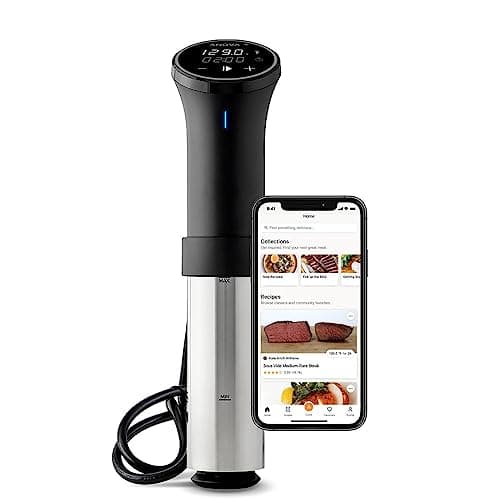 Anova Precision Cooker Anova's Precision Cooker is the category default: a 1,100-watt immersion circulator with a clip, a clear display, and a mature app. It clamps to any pot and holds temperature tightly, which is the entire job. 1100 watts · 1100W | Best overall sous vide | 4.4★★★★★ | $169.99Amazon |
| 02 | 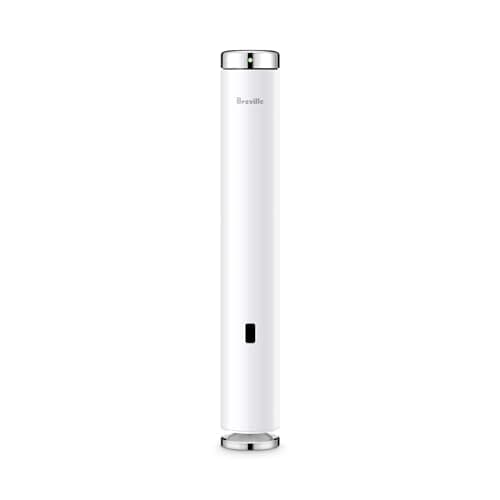 Breville Joule Turbo The Joule Turbo is the app-first circulator: at 1.65 inches across and 2.09 lb it's the smallest wand here, and its Turbo mode runs a cloud-computed variable-temperature curve that Breville states reaches precise results in half the time. You pick doneness by picture, not by number. Small | Best app experience | 4.4★★★★★ | $228.52Amazon |
| 03 | 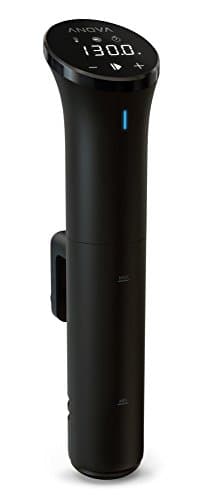 Anova Precision Cooker Nano 2.0 The Nano is the sensible middle: a 12.8-inch, 1.7 lb wand that stows in a kitchen drawer, runs from the unit itself or the free app, and carries Anova's 2-year warranty. It costs a fraction of the flagship and holds temperature just as tightly for a home-sized pot. 12.8" x 2.2" x 4.1" | Best value sous vide | 4.3★★★★★ | $71.99Amazon |
| 04 | 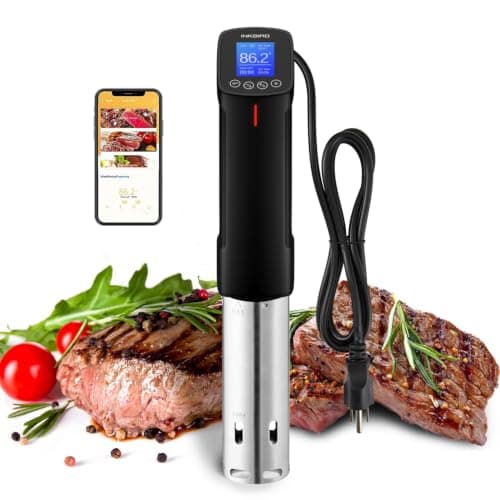 Inkbird ISV-100W The Inkbird undercuts the name brands while still giving you Wi-Fi and tight temperature control in a slim wand. It's the low-risk way to find out whether sous vide earns a place in your kitchen. 1 WIFI Sous Vide Machine · 100W | Best budget sous vide | 4.0★★★★★ | $95.99Amazon |
#ad · Live prices from the Amazon Product API, as of October 16, 2026. Where we have no verified live price, we show none — a gap beats a number that has rotted.
Side by side
What the circulators publish that an oven does not
The argument for sous vide over reverse sear is a single number in this column, and only two of the four machines publish it. No oven manufacturer publishes a thermostat tolerance at all, which is why this comparison is not symmetrical.
| Model | Key specs | Precision claim, as published | Best for | Price |
|---|---|---|---|---|
| Anova Precision CookerAN525-US00 | 1100 watts1100 W3.07 × 12.79 × 5.51 in2-yr warranty | Anova publishes 1,100 watts — the only wattage figure among the full-size cookers we track, and the only one we can compute a running cost from. Adjustable clamp, removable stainless skirt, 2-year warranty. No accuracy figure on this listing. | The default circulator | $169.99Check Price |
| Breville Joule TurboBSV600PSS1BNA1 | 1.65 in square1.65 × 1.65 × 11.97 in1-yr warranty | Turbo mode, which Breville says delivers precise results in half the time via cloud-side algorithms. Also Prime Time — a published window during which food stays at its prime. No accuracy figure and no wattage published. | The answer to "but it's slow" | $228.52Check Price |
| Anova Precision Cooker Nano 2.0AN400-US00 | 12.8" x 2.2" x 4.1"2.2 × 4.1 × 12.8 in2-yr warranty | Publishes the number this whole page turns on: ±0.1°C (±0.2°F) accuracy across 32–197°F. Fixed clamp, drawer-sized, 2-year warranty. No wattage published. | Cheapest published tolerance | $71.99Check Price |
| Inkbird ISV-100W | 1 WIFI Sous Vide Machine100 W2.362204722 × 2.362204722 × 16.141732267 in | Also publishes ±0.1°C (±0.2°F), over 77–210°F, with a 99-hour timer and a self-calibration function adjustable ±10°F so you can true it against a known thermometer. 1,000 W per the listing title. | Long holds and calibration | $95.99Check Price |
#ad · we may earn a commission · Specs read from each manufacturer's Amazon listing; prices pulled live from the Amazon Product API, as of October 16, 2026. Where a maker publishes no figure (wattage, warranty term) we leave the cell empty rather than estimate one.
The picks, in detail
Anova Precision Cooker
spec score /5
$229.0026% off
Price as of October 16, 2026. Prices change — Amazon's is the one that counts.
#ad · we may earn a commission from this link to Anova Precision Cooker
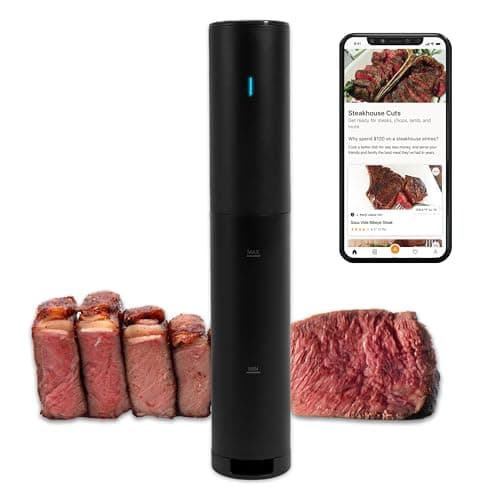
Anova's Precision Cooker is the category default: a 1,100-watt immersion circulator with a clip, a clear display, and a mature app. It clamps to any pot and holds temperature tightly, which is the entire job.
- Capacity
- 1100 watts
- Footprint (W×D×H)
- 3.07 × 12.79 × 5.51 in
- Power
- 1100 W
- Weight
- 1.92 lb
- Cost per use*
- ≈6¢
- Est. per year*
- ≈$13
- Warranty
- 2 year manufacturer
- Holds temperature precisely
- 1,100 W heats water quickly
- Mature, reliable app
- Needs a container and a bag/clip
- App-dependent for some features
- Not silent
*Cost-to-run computed from the manufacturer's stated 1100W at $0.17/kWh (US average), 20-min sessions, 4×/week. Your rate and use will vary.
Breville Joule Turbo
spec score /5
$249.959% off
Price as of October 16, 2026. Prices change — Amazon's is the one that counts.
#ad · we may earn a commission from this link to Breville Joule Turbo
The Joule Turbo is the app-first circulator: at 1.65 inches across and 2.09 lb it's the smallest wand here, and its Turbo mode runs a cloud-computed variable-temperature curve that Breville states reaches precise results in half the time. You pick doneness by picture, not by number.
- Capacity
- Small
- Footprint (W×D×H)
- 1.65 × 1.65 × 11.97 in
- Weight
- 2.09 lb
- Warranty
- 1 year limited product warranty
- Turbo mode cuts cook time roughly in half (per Breville)
- Smallest wand here — 1.65 in across, fits a drawer
- Visual Doneness and Prime Time make timing forgiving
- Leans hard on the app — no full standalone control
- 1-year limited warranty vs Anova's 2
- Premium price for a circulator
Anova Precision Cooker Nano 2.0
spec score /5
$149.0052% off
Price as of October 16, 2026. Prices change — Amazon's is the one that counts.
#ad · we may earn a commission from this link to Anova Precision Cooker Nano 2.0
The Nano is the sensible middle: a 12.8-inch, 1.7 lb wand that stows in a kitchen drawer, runs from the unit itself or the free app, and carries Anova's 2-year warranty. It costs a fraction of the flagship and holds temperature just as tightly for a home-sized pot.
- Capacity
- 12.8" x 2.2" x 4.1"
- Footprint (W×D×H)
- 2.2 × 4.1 × 12.8 in
- Weight
- 1.7 lb
- Warranty
- 2 year warranty
- Fits in a drawer — 12.8 in, 1.7 lb
- 2-year warranty
- Full control on the unit; app is optional
- Slower than 1,100 W wands on a big pot
- Best suited to smaller containers
- Some app content sits behind a subscription
Inkbird ISV-100W
spec score /5
Price as of October 16, 2026. Prices change — Amazon's is the one that counts.
#ad · we may earn a commission from this link to Inkbird ISV-100W
The Inkbird undercuts the name brands while still giving you Wi-Fi and tight temperature control in a slim wand. It's the low-risk way to find out whether sous vide earns a place in your kitchen.
- Capacity
- 1 WIFI Sous Vide Machine
- Footprint (W×D×H)
- 2.362204722 × 2.362204722 × 16.141732267 in
- Power
- 100 W
- Cost per use*
- ≈1¢
- Est. per year*
- ≈$1
- Warranty
- 365
- Much cheaper than premium wands
- Wi-Fi with a usable app
- Slim, easy to store
- Slower to heat large pots
- Less polished app
- Shorter brand track record
*Cost-to-run computed from the manufacturer's stated 100W at $0.17/kWh (US average), 20-min sessions, 4×/week. Your rate and use will vary.
The two methods, briefly
They are the same idea executed with different hardware: bring the inside of the meat to your target temperature slowly and gently, then apply violent heat to the outside for thirty seconds a side.
Reverse sear does the slow part in a low oven, typically 225 to 275°F, with a probe thermometer in the meat. You pull it a few degrees short of target, rest it, then sear in a ripping-hot pan or on a grill. Equipment: an oven, a rack, a thermometer.
Sous vide does the slow part in a water bath held at exactly the final temperature, with the meat sealed in a bag. There is no pulling short and no guessing, because the water cannot carry the meat past the setpoint. Then you dry it and sear. Equipment: a circulator, a pot and bags — see do you need a sous vide container for why the pot is probably one you own. The mechanism in full is on what is sous vide.
Where sous vide genuinely wins: a published tolerance
This is the whole case, and it is a documentation argument as much as a cooking one. Anova publishes ±0.1°C (±0.2°F) on the Nano 2.0 and Inkbird publishes the same on the ISV-100W. Those are stated specifications you can hold the manufacturer to.
Now try to find the equivalent figure for your oven. No oven maker publishes a thermostat tolerance. Domestic ovens cycle their elements around a setpoint, and the swing is wide enough that a 250°F oven spends much of its time somewhere else. On a high-heat roast that is irrelevant. On a 90-minute low-temperature cook where you are trying to stop at 130°F, it is the entire difference between the methods — and the reason reverse sear needs a thermometer in the meat while sous vide does not.
The second half of the same advantage: sous vide cannot overcook. If the bath is at 130°F, the meat asymptotes to 130°F and stays there. Breville sells this directly as Prime Time — a published window during which the food is at its prime, which exists precisely because nothing deteriorates while you wait. Inkbird publishes a timer that runs to 99 hours. A reverse sear, by contrast, is a race: the oven is hotter than your target, so the meat is always climbing and you have to intervene at the right moment.
Where reverse sear genuinely wins: the crust
Reverse sear produces a better sear, and the reason is moisture. Meat that has spent an hour in a dry 250°F oven comes out with a desiccated surface — the pellicle — which starts browning the instant it touches the pan. Meat that has spent an hour in a sealed bag comes out wet, and a wet surface has to boil off its water before it can brown. If you put a bag steak straight into a pan you will steam it grey.
This is fixable and you should know the fix: pat it thoroughly dry with paper towel, and if you have the patience, leave it uncovered on a rack in the fridge for twenty minutes. But it is an extra step, done at the hungriest moment of the process, and reverse sear does not need it.
Reverse sear also wins on three practical points. It uses no consumables — no bags. It has no equipment cost at all, which for an occasional steak cook is the only argument that matters. And it is faster end to end for a single thick steak: a 45 to 60 minute oven stage against one to two hours in a bath, before the sear.
What each costs to run
This is the comparison nobody makes, and it favours sous vide by a wide margin.
A reverse sear runs a full-size oven for 45 to 90 minutes. An oven has to hold four cubic feet of air plus forty pounds of steel at temperature, and it draws accordingly. A sous vide cook runs a 1,100-watt immersion heater — the Anova Precision Cooker's published figure — which draws its full load only while bringing the water up and then cycles briefly to hold it. The heated mass is a few quarts of water in a pot, insulated by the pot and, if you covered it, by foil.
So the counterintuitive result: the method that takes twice as long uses substantially less electricity, because thermal mass costs more than time. The full arithmetic, including what a 24-hour cook actually adds to a bill, is on what sous vide costs to run.
Which method for which food
- One thick steak, occasionally: reverse sear. Free, better crust, fast enough. This is the honest answer for most people and we would rather say it than sell a circulator.
- Four to six portions at once: sous vide. An oven cooks the edge pieces faster than the middle ones; a water bath does not care where in the pot a bag is.
- Chicken breast: sous vide, decisively. The window between safe and dry is a few degrees wide, which is exactly the window an oven's swing eats. Times and temperatures for every protein are in sous vide times and temperatures.
- Eggs: sous vide only. There is no oven method for a 63°C egg.
- Tough cuts — short rib, brisket, pork shoulder: sous vide. These need 24 to 48 hours at temperature, which no oven should be asked to do and which Inkbird's 99-hour timer exists for.
- Anything you need ready at an unpredictable time: sous vide. This is the Prime Time argument. A reverse sear has one correct moment.
- A whole roast you want to carve at the table: reverse sear. Bag size and bath volume stop being practical somewhere around a large joint, and the oven's dry surface is what you want on a roast anyway.
If you decide on sous vide
Buy the Anova Precision Cooker 3.0 as the default: 1,100 W published, an adjustable clamp that fits nearly any pot deep enough, a removable stainless skirt for descaling, and a 2-year warranty. Our Anova Precision Cooker review has the detail.
Buy the Joule Turbo if the speed objection is what has been stopping you: Breville's Turbo mode claims precise results in half the time, using cloud-side algorithms, and Prime Time gives you a stated eating window. At 1.65 inches square it is also the least intrusive device in the water. Treat the halved-time claim as Breville's, not ours — Joule Turbo review, and Anova vs Joule for the head-to-head.
Buy the Anova Nano 2.0 if you are testing whether you like the method. It publishes the ±0.2°F tolerance that is the entire argument of this page, fits in a drawer, and carries the same 2-year warranty. Note the fixed clamp — check your pot rim. Cheaper options are ranked in best budget sous vide machines.
Buy the Inkbird ISV-100W if long cooks and calibration matter: the same ±0.2°F over a wider 77–210°F range, a 99-hour timer, WiFi, and a ±10°F self-calibration adjustment — the only machine here that lets you true the reading against a thermometer you trust. It is 16.14 inches tall, so it needs a deep pot. Compared in Anova vs Inkbird.
The verdict
Reverse sear is the better free method and the better crust. If steak night is monthly and you own a thermometer, there is no argument for spending anything — do that, and do it well. Sous vide wins when precision has to be repeatable, when the timing has to be flexible, when there are several portions, or when the food has a narrow window — chicken breast, eggs, anything needing 24 hours. The deciding fact is documentary rather than culinary: two of the machines above publish a ±0.2°F tolerance, and your oven's manufacturer publishes none. The broader question of whether the whole method earns its counter space is in is sous vide worth it.
Frequently asked questions
Is sous vide better than reverse sear?
For precision and flexibility, yes; for crust and cost, no. Sous vide holds a published tolerance — Anova and Inkbird both state plus or minus 0.2°F — and cannot overcook, because the water never exceeds your target. Reverse sear costs nothing, uses an oven you own, and produces a better sear because the meat surface comes out dry rather than wet.
Why does reverse sear give a better crust than sous vide?
Moisture. An hour in a dry 250°F oven desiccates the meat surface, so it browns the moment it hits the pan. An hour in a sealed bag leaves the surface wet, and that water has to boil off before browning starts. Patting a bag steak thoroughly dry — ideally with twenty uncovered minutes in the fridge — closes most of the gap.
Can you overcook with reverse sear?
Yes, which is the structural difference. A reverse sear oven is hotter than your target temperature, so the meat is always climbing and you have to intervene at the right moment with a thermometer. In a sous vide bath set to 130°F the meat approaches 130°F and stops, so walking away is safe.
Which uses more electricity, sous vide or reverse sear?
Reverse sear, by a wide margin, even though it takes less time. An oven holds roughly four cubic feet of air and forty pounds of steel at temperature; a circulator like the 1,100-watt Anova Precision Cooker heats a few quarts of water and then cycles briefly to hold it. Thermal mass costs more than duration.
Do I need a sous vide machine, or is my oven accurate enough?
No oven manufacturer publishes a thermostat tolerance, and domestic ovens cycle widely around their setpoint. That is fine for a high-heat roast and not fine for a 90-minute cook where you need to stop at 130°F. If you want a stated number, the Anova Nano 2.0 and the Inkbird ISV-100W both publish plus or minus 0.2°F.
Which foods should I not reverse sear?
Chicken breast, where the window between safe and dry is a few degrees wide; eggs, which have no oven equivalent; and tough cuts like short rib or brisket that need 24 to 48 hours at temperature. Also any occasion where several portions must finish together, or where you cannot predict when people will eat.
Is sous vide slower than reverse sear?
For a single steak, yes — roughly one to two hours in the bath against 45 to 60 minutes in the oven, before searing. Breville's Joule Turbo claims to halve sous vide times using cloud-side algorithms, which is the maker's claim rather than our measurement. For several portions, sous vide is often faster overall because everything cooks at once.
Keep reading
Sous Vide
The Best Sous Vide Machines of 2026
Anova and Inkbird immersion circulators compared on wattage, precision, app and running cost.
Guide
What Is Sous Vide?
How sous vide works, what you need to start, the temperatures that matter, and what the technique genuinely cannot do.
Guide
Is Sous Vide Worth It?
What sous vide genuinely transforms, what it does not, and the three types of cook who should skip it.
Guide
Sous Vide Times and Temperatures Explained
Why temperature sets doneness and time sets texture, how thickness drives timing, and where to get safe pasteurization tables.
Guide
What Does Sous Vide Actually Cost to Run?
Worked electricity math for 2, 8 and 48-hour sous vide cooks, and the two habits that cut it most.
Roundup
The Best Budget Sous Vide Machines
Four budget circulators ranked on power, app access, size and warranty — and the three things extra money actually buys.
Guide
Do You Need a Special Sous Vide Container?
Why a stockpot you already own is usually the right sous vide vessel, and the clamp, height and depth specs that decide whether yours will work.
https://wattandwhisk.com/sous-vide/sous-vide-vs-reverse-sear