Stand Mixer Brands Compared
KitchenAid, Cuisinart, Hamilton Beach and Aucma do not publish the same specifications, which is the first thing worth knowing about them. Here is what each brand measures, what it stays quiet about, and who each one is for.
Disclosure:Watt & Whisk is reader-supported. When you buy through links on this page we may earn an Amazon Associates commission, at no extra cost to you. Prices are pulled live from Amazon and shown with the date checked. How this works.
KitchenAid sells output and an ecosystem: it publishes no wattage at all, instead rating its machines in dozens of cookies and pounds of dough, and it is the only brand here with a real attachment range. Cuisinart is the value pick on paper — a bigger 5.5-quart bowl, a stated 500 watts and a limited 3-year warranty for less money. Aucma publishes the biggest bowl and the highest wattage in the group and no warranty term whatsoever. Hamilton Beach is the lightest and cheapest way to own a planetary mixer at all. The brands cannot be ranked on one number because they do not publish the same one.
The short answer
Quick picks
| # | Product | Best for | Score | Price |
|---|---|---|---|---|
| 01 | 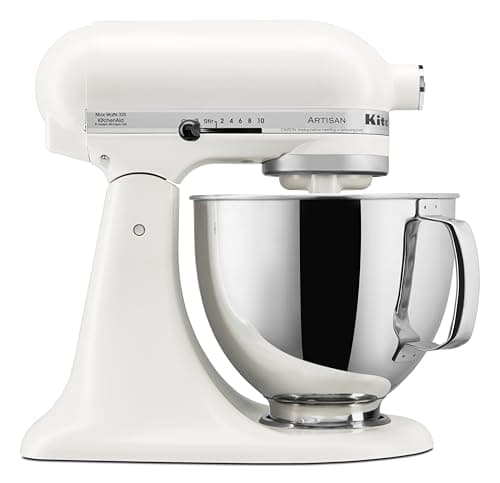 KitchenAid Artisan (5 Qt) The 5-quart tilt-head Artisan is the default for a reason: a metal body, a big color range, and the whole KitchenAid attachment ecosystem. It handles most home baking short of daily heavy bread. 5 Quart | Best overall stand mixer | 4.6★★★★★ | Check price → |
| 02 | 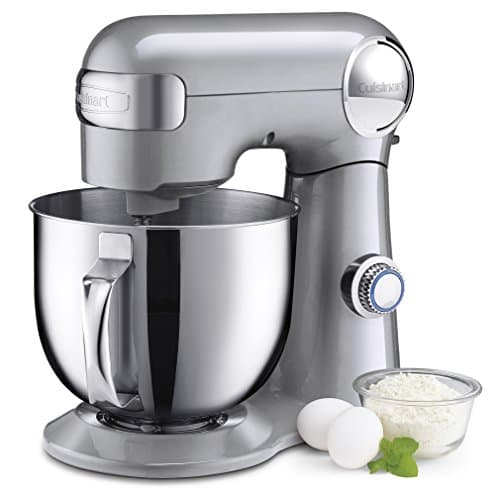 Cuisinart Precision Master SM-50 The 5.5-quart, 500-watt Precision Master gives you a bigger bowl and a stated higher wattage than a same-price KitchenAid. The trade-off is a smaller accessory ecosystem, but for straight mixing it's a lot of machine for the money. 5.5 Qt · 500W | Best big bowl for the money | 4.2★★★★★ | $214.99Amazon |
| 03 | 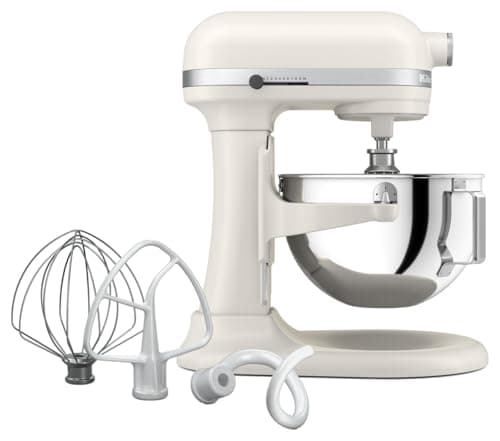 KitchenAid 5.5-Qt Bowl-Lift KSM55 This is the answer to the one thing the tilt-head Artisan genuinely struggles with. KitchenAid rates the bowl-lift KSM55 at twice the power in the bowl of a KSM150 tilt-head and lists it as kneading over 7 lb of bread dough, with a 3-point locking bowl that doesn't walk when the hook loads up. 5.5 Q | Best for bread dough | 4.6★★★★★ | $499.99Amazon |
| 04 | 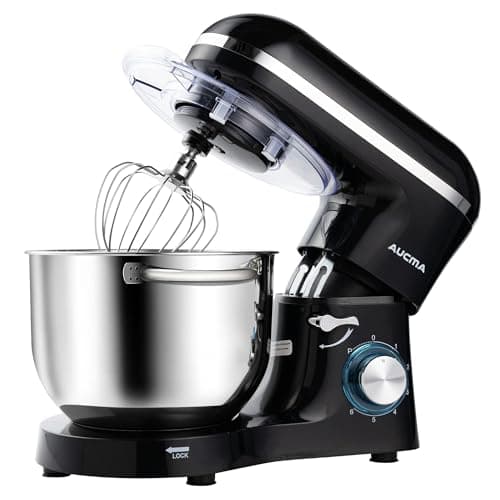 Aucma 6.5-Qt Stand Mixer The value play: a 6.5-quart stainless bowl and a stated 660-watt copper motor with 6 speeds and pulse, for less than a 4.5-quart KitchenAid Classic. You give up the brand's attachment ecosystem and resale value; you get a bigger bowl and a higher stated wattage for the money. 6.5QT · 660W | Best big bowl on a budget | 4.0★★★★★ | $129.19Amazon |
| 05 | 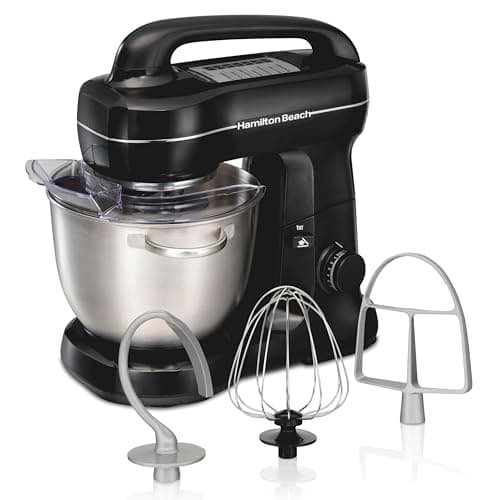 Hamilton Beach 4-Qt Stand Mixer A 300-watt, 7-speed planetary mixer with a 4-quart stainless bowl, dough hook, whisk, flat beater and splash guard included — for a fraction of a KitchenAid. At 8 lb with a molded carry handle it's also the only mixer here you can genuinely lift into a cupboard one-handed. 4 Quart · 300W | Best budget stand mixer | 4.0★★★★★ | $139.99Amazon |
#ad · Live prices from the Amazon Product API, as of November 12, 2026. Where we have no verified live price, we show none — a gap beats a number that has rotted.
The picks, in detail
KitchenAid Artisan (5 Qt)
spec score /5
No buyable offer at the last price check (November 12, 2026). We show nothing rather than a stale number.
#ad · we may earn a commission from this link to KitchenAid Artisan (5 Qt)
The 5-quart tilt-head Artisan is the default for a reason: a metal body, a big color range, and the whole KitchenAid attachment ecosystem. It handles most home baking short of daily heavy bread.
- Capacity
- 5 Quart
- Footprint (W×D×H)
- 8.7 × 14.1 × 13.9 in
- Weight
- 22.8 lb
- Warranty
- 1 Year Limited Warranty
- Huge attachment ecosystem (grinder, pasta, more)
- All-metal build; holds resale value
- 5-qt bowl suits most baking
- Struggles with repeated stiff bread dough
- Premium price
- Heavy to lift on and off the counter
Cuisinart Precision Master SM-50
spec score /5
$319.9533% off
Price as of November 12, 2026. Prices change — Amazon's is the one that counts.
#ad · we may earn a commission from this link to Cuisinart Precision Master SM-50
The 5.5-quart, 500-watt Precision Master gives you a bigger bowl and a stated higher wattage than a same-price KitchenAid. The trade-off is a smaller accessory ecosystem, but for straight mixing it's a lot of machine for the money.
- Capacity
- 5.5 Qt
- Footprint (W×D×H)
- 11.2 × 16.5 × 15.9 in
- Power
- 500 W
- Weight
- 17 lb
- Cost per use*
- ≈3¢
- Est. per year*
- ≈$6
- Warranty
- Limited 3-Year Warranty
- Bigger 5.5-qt bowl
- 500 W stated motor
- Often cheaper than KitchenAid
- Smaller attachment ecosystem
- Less iconic resale value
- Plastic trim in places
*Cost-to-run computed from the manufacturer's stated 500W at $0.17/kWh (US average), 20-min sessions, 4×/week. Your rate and use will vary.
KitchenAid 5.5-Qt Bowl-Lift KSM55
spec score /5
Price as of November 12, 2026. Prices change — Amazon's is the one that counts.
#ad · we may earn a commission from this link to KitchenAid 5.5-Qt Bowl-Lift KSM55
This is the answer to the one thing the tilt-head Artisan genuinely struggles with. KitchenAid rates the bowl-lift KSM55 at twice the power in the bowl of a KSM150 tilt-head and lists it as kneading over 7 lb of bread dough, with a 3-point locking bowl that doesn't walk when the hook loads up.
- Capacity
- 5.5 Q
- Footprint (W×D×H)
- 11.31 × 14.63 × 16.5 in
- Warranty
- 1 Year Replacement Plan - Stand Mixer - $19.95
- Listed at 2× the in-bowl power of a KSM150 tilt-head
- Rated to knead over 7 lb of bread dough
- 3-point locking bowl stays put under a heavy hook
- The priciest mixer we list
- 16.5 in tall with the bowl raised — check your cabinets
- Bowl-lift is slower to load than a tilt-head
Aucma 6.5-Qt Stand Mixer
spec score /5
$135.995% off
Price as of November 12, 2026. Prices change — Amazon's is the one that counts.
#ad · we may earn a commission from this link to Aucma 6.5-Qt Stand Mixer
The value play: a 6.5-quart stainless bowl and a stated 660-watt copper motor with 6 speeds and pulse, for less than a 4.5-quart KitchenAid Classic. You give up the brand's attachment ecosystem and resale value; you get a bigger bowl and a higher stated wattage for the money.
- Capacity
- 6.5QT
- Footprint (W×D×H)
- 9.3700787306 × 15.2362204569 × 12.3622047118 in
- Power
- 660 W
- Weight
- 11.68 lb
- Cost per use*
- ≈4¢
- Est. per year*
- ≈$8
- 6.5-qt bowl — the biggest here
- 660 W stated motor with pulse
- Whisk, dough hook and beater all dishwasher-safe
- No attachment ecosystem beyond the three included tools
- No published warranty on the listing
- Less proven long-term than the big brands
*Cost-to-run computed from the manufacturer's stated 660W at $0.17/kWh (US average), 20-min sessions, 4×/week. Your rate and use will vary.
Hamilton Beach 4-Qt Stand Mixer
spec score /5
$151.958% off
Price as of November 12, 2026. Prices change — Amazon's is the one that counts.
#ad · we may earn a commission from this link to Hamilton Beach 4-Qt Stand Mixer
A 300-watt, 7-speed planetary mixer with a 4-quart stainless bowl, dough hook, whisk, flat beater and splash guard included — for a fraction of a KitchenAid. At 8 lb with a molded carry handle it's also the only mixer here you can genuinely lift into a cupboard one-handed.
- Capacity
- 4 Quart
- Footprint (W×D×H)
- 10.9 × 14.5 × 14.4 in
- Power
- 300 W
- Weight
- 8 lb
- Cost per use*
- ≈2¢
- Est. per year*
- ≈$4
- Warranty
- One(1) Year Warranty
- All four attachments and a splash guard in the box
- 8 lb with a carry handle — actually storable
- Slow first speed keeps flour in the bowl
- 300 W is a cake-and-cookie motor, not a bread motor
- 4-qt bowl limits batch size
- No third-party attachment ecosystem
*Cost-to-run computed from the manufacturer's stated 300W at $0.17/kWh (US average), 20-min sessions, 4×/week. Your rate and use will vary.
Most brand comparisons in this category are really KitchenAid against everyone, settled on reputation. That is a shame, because the spec sheets are more interesting than the reputations, and they contain three inversions that a buyer would not guess: the cheapest brand publishes the highest wattage, the brand with the biggest bowl publishes no warranty, and within KitchenAid's own range the smaller mixer is the heavier one.
Every figure below is read off each machine's current manufacturer listing. We have not run these side by side and we are not going to imply we have — our method is on how we review. Blank cells are specs the maker does not publish, and we leave them blank rather than estimating.
What we compared them on
Four things, chosen because they are the only four that all or most of these brands actually state, and because each one changes a real decision.
Bowl capacity is the spec that decides whether a recipe fits, and it is the one every brand here publishes. Published wattage is the spec buyers rank on and the one that misleads most, for reasons below. Warranty term is the only published number that represents a commitment rather than a measurement — it is what the maker is willing to be held to. Footprint and weight decide whether the machine lives on the counter or in a cupboard, which in practice decides whether it gets used.
We deliberately did not rank on motor power claims across brands, and the next section is why.
The brands do not publish the same number
This is the central finding, and it undermines every cross-brand wattage table on the internet. KitchenAid publishes no wattage on any of its stand mixers. Not on the Artisan, not on the Classic, not on the 5.5-quart bowl-lift. What it publishes instead is output: 9 dozen cookies in a single batch for the Artisan, 8 dozen for the Classic, and for the bowl-lift KSM55, 11 dozen cookies, over 7 lb of bread dough or 6 lb of mashed potatoes — each figure footnoted to a 28-gram dough ball using the flat beater.
Cuisinart, Hamilton Beach and Aucma do the opposite. They publish input — 500, 300 and 660 watts respectively — and none of them publishes a dough or cookie rating at all. So there is no single number that ranks all four brands. A watts column that contains a figure for the Aucma and a blank for the KitchenAid is not a comparison; it is two different questions in one table.
KitchenAid does publish one comparative power claim, and it is internal: the bowl-lift KSM55 is rated at twice the in-bowl power of a KSM150 tilt-head, measured as peak horsepower in the bowl above speed 2. That is a useful number for choosing between two KitchenAids and useless for choosing between brands, because nobody else publishes peak in-bowl horsepower.
The reason this matters practically: a stand mixer is a torque problem, not a wattage one. Gear reduction determines how much of the motor's power arrives at the beater, and no brand here publishes a gear ratio. So a 300-watt machine with better reduction can out-knead a 660-watt one, and the spec sheet gives you no way to know. How many watts a stand mixer needs works through what the figure does and does not measure.
At a glance
Five machines, four brands, every figure from the maker's own listing. Note how many cells are empty in a category that is supposedly easy to compare.
| Spec | KitchenAid Artisan | KitchenAid KSM55 | Cuisinart SM-50 | Aucma SM-1518N | Hamilton Beach 63391 |
|---|---|---|---|---|---|
| Bowl capacity | 5 qt | 5.5 qt | 5.5 qt | 6.5 qt | 4 qt |
| Head design | Tilt-head | Bowl-lift | Tilt-head | Tilt-head | Tilt-head |
| Stated wattage | Not published | Not published | 500 W | 660 W | 300 W |
| Stated output rating | 9 dozen cookies | 11 dozen cookies, 7+ lb dough | Not published | Not published | Not published |
| Speeds | 10 | 11 | 12 | 6 + pulse | 7 |
| Published warranty | 1 yr limited | See note below | Limited 3 yr | Not published | 1 yr |
| Footprint (W × D) | 8.7 × 14.1 in | 11.31 × 14.63 in | 11.2 × 16.5 in | 9.37 × 15.24 in | 10.9 × 14.5 in |
| Weight | 22.8 lb | Not published | 17 lb | 11.68 lb | 8 lb |
| Published noise figure | ≤ 76 dB | ||||
| Attachment hub | Yes — 10+ attachments | Yes — 10+ attachments | Yes — 5 listed | No | No |
The warranty inverts against the price
Read the warranty row again, because it runs the opposite way to what the prices suggest. The two most expensive brands here publish the shortest terms and the mid-priced Cuisinart publishes the longest. Cuisinart states a limited 3-year warranty on the SM-50 and notes the product is BPA free. KitchenAid states 1 year limited on the Artisan and the Classic. Hamilton Beach states one year.
And Aucma publishes no warranty term at all — the listing has no entry in that field. That is the single most important line in this comparison, because the Aucma is otherwise the headline value: the biggest bowl here at 6.5 quarts and the highest stated wattage at 660 W, in a body narrower than the KitchenAid bowl-lift. The brand asking you to believe the largest unverified claims is the one making the smallest published commitment behind them.
The KitchenAid bowl-lift deserves its own footnote, because its listing's warranty field is not a warranty at all: instead of a manufacturer term it names a one-year replacement plan sold as a paid add-on, with a price attached, where a term should be. We are not going to read that as coverage or as no coverage; it is a listing that does not state the manufacturer term, and a buyer who cares about the warranty should confirm it before ordering. The Artisan and Classic listings from the same brand both clearly state 1 year limited.
A short published term is not automatically bad in this category, which is the one place KitchenAid's reputation is load-bearing: its machines are all-metal, its parts supply is stocked, the worm gear is designed to fail sacrificially, and independent repair is routine. A one-year warranty on a machine you can repair for a few dollars in year eight is worth more than a three-year warranty on a machine nobody stocks parts for. How long do stand mixers last has both halves of that argument with the published terms in full.
Capacity does not scale with footprint, and neither does weight
The second inversion is physical. You would expect a bigger bowl to mean a bigger, heavier machine, and across these four brands it does not.
The Aucma fits a 6.5-quart bowl into a 9.37 by 15.24-inch footprint and 11.68 lb. The KitchenAid KSM55 fits a smaller 5.5-quart bowl into a wider 11.31 by 14.63-inch one. The Cuisinart SM-50 has the same 5.5 quarts as the KSM55 and the largest footprint of the five at 11.2 by 16.5 inches. Meanwhile the KitchenAid Artisan is the narrowest machine here at 8.7 inches wide while weighing 22.8 lb — twice the Aucma and nearly three times the Hamilton Beach.
The inversion that is hardest to explain is inside KitchenAid's own range: the 4.5-quart Classic weighs 24.2 lb and the 5-quart Artisan weighs 22.8 lb, on an identical 8.7 by 14.1-inch footprint. The smaller-bowl machine is the heavier one. Both take the same attachments and publish the same 10 speeds, so the half-quart and the color range really are the difference — which is the argument in KitchenAid models compared.
Weight is not a proxy for quality, but it is a proxy for two real things: metal content, and whether the machine walks across the counter under load. At 8 lb the Hamilton Beach is light enough to carry with the built-in handle its listing advertises, which is a genuine feature for a cupboard-stored mixer and a genuine warning about stiff dough. What size stand mixer do I need matches bowl capacity to what you actually bake.
The ecosystem is the one thing only one brand has
On specifications, KitchenAid loses several categories outright. On ownership it wins one category so decisively that it frequently settles the purchase: the power hub.
KitchenAid states over 10 attachments across both the Artisan and the KSM55 — pasta rollers, meat grinders, spiralizers, ice cream bowls and more, all sold separately, all fitting a proprietary front hub that has not changed in decades. That is not a feature of one machine; it is a reason the machine is still useful after your baking habits change.
Cuisinart has a real but much thinner answer: its SM-50 listing states one power outlet for optional attachments and names five — pasta extruder, pasta roller and cutters, ice cream maker, meat grinder and spiralizer. That is a credible ecosystem, just a narrower one, and the aftermarket for bowls and parts is far smaller.
Aucma and Hamilton Beach have no attachment hub at all. Both ship the standard three tools — whisk, dough hook, flat beater — plus a splash guard, and that is the machine for its whole life. If there is any chance you will want to grind meat or roll pasta, those two brands are excluded on day one regardless of what the bowl size says. Our stand mixer attachments guide covers what each attachment actually does before you buy into a hub.
One brand publishes a number nobody else does
Aucma states its mixer operates at ≤ 76 dB. It is the only brand in this comparison to publish a noise figure, and it is a legitimately useful spec for an appliance that runs for ten minutes in an open-plan room. There is no published figure from KitchenAid, Cuisinart or Hamilton Beach to compare it against, so we cannot tell you whether 76 dB is good for the class — only that it is the one number available.
That is worth stating plainly as a pattern rather than a gotcha: across this whole category, makers publish the specs that flatter them. Aucma publishes watts and decibels and not a warranty. KitchenAid publishes cookie dozens and not watts. Cuisinart publishes a long warranty and 500 watts and no output rating. The table above is a map of each brand's confidence as much as its engineering, and a comparison table with no blanks in it would be a sign that somebody filled the gaps in with estimates.
It is not only omissions, either — listings carry outright errors, and a review that reproduces every bullet uncritically will eventually print one. Our Cuisinart 8-cup FP-8 review works through a live example in the next category over: a US-market machine whose own feature bullet claims 220 volts, which we flag rather than repeat.
Who each brand is actually for
KitchenAid is for the buyer who wants the machine to outlast the hobby. The published specs understate it and the ownership overstates nothing: all-metal construction, the only real attachment hub, stocked parts, routine repair, the strongest resale value in the category and by far the widest color range — which sounds like vanity and is actually the main reason these live on counters rather than in cupboards. The costs are a 1-year published warranty, no published wattage, the highest price here, and 22.8 lb to move. Buy the Artisan for the 5-quart bowl and the colors, the Classic to get into the same ecosystem for less, and the bowl-lift KSM55 if you knead stiff dough weekly.
Cuisinart is for the buyer who wants the most machine for the money and is honest with themselves about never buying an attachment. It beats both tilt-head KitchenAids on bowl size, speeds, published wattage and warranty, and it is 5.8 lb lighter than the Artisan. The costs are the largest footprint of the five, a much thinner parts aftermarket, and weaker resale. KitchenAid vs. Cuisinart settles that head-to-head properly.
Aucma is for the buyer whose constraint is bowl volume per dollar and who accepts an unpublished warranty to get it. 6.5 quarts and 660 stated watts in an 11.68-lb body is a real proposition for someone doubling bread recipes. The costs are no attachment hub, no published warranty term, a 6-speed control where everyone else gives 7 to 12, and a brand with no repair network to speak of. Treat it as an appliance with a finite life rather than an heirloom.
Hamilton Beach is for the buyer deciding between a cheap stand mixer and no stand mixer. Its listing is admirably direct about what it is: 300 watts, a 4-quart bowl, planetary action it describes as the same rotating action as the higher-priced brands, 7 speeds with a deliberately slow first speed, and a carry handle because the machine is expected to be put away. At 8 lb it is the lightest here by a wide margin. It is not a bread machine and the published wattage says so. Best budget stand mixers covers that end of the market, and hand mixer vs. stand mixer is the question to settle first if this is the tier you are shopping in.
The verdict
If you will ever buy an attachment, or you want the machine to be worth something in ten years, the choice is KitchenAid and the rest of the table is noise. If you will not, the Cuisinart Precision Master SM-50 is more machine for the money on every number both brands publish, and it is not close. Choose Aucma only if raw bowl volume is the binding constraint and you have genuinely accepted that no warranty term is published, and Hamilton Beach if the realistic alternative is mixing by hand.
Still deciding whether the category earns its counter space? Are stand mixers worth it is the honest version of that question, and the best stand mixers hub has the full field with live prices.
Frequently asked questions
Which stand mixer brand is best?
KitchenAid for longevity, attachments and resale value; Cuisinart for the most capability per dollar if you will never buy an attachment. Those are different questions, which is why the brands do not rank on one list. Aucma offers the biggest bowl and the highest stated wattage here but publishes no warranty term, and Hamilton Beach is the cheapest route to a planetary mixer at all.
Why does KitchenAid not publish a wattage?
KitchenAid lists no wattage on the Artisan, Classic or 5.5-quart bowl-lift. Instead it publishes output ratings - 9 dozen cookies for the Artisan, 11 dozen plus over 7 lb of bread dough for the KSM55 - because a mixer is a torque problem rather than a wattage one. Gearing decides how much motor power reaches the beater, and no brand publishes a gear ratio.
Is a 660-watt Aucma more powerful than a KitchenAid?
Unknowable from the spec sheets, because KitchenAid publishes no wattage and Aucma publishes no dough or cookie rating, so there is no shared number. Watts measure electrical input, not force at the beater, and neither brand publishes gear ratios. The one comparative power figure KitchenAid does publish is internal: the KSM55 bowl-lift at twice the in-bowl peak horsepower of a KSM150 tilt-head.
Which stand mixer brand has the longest warranty?
Cuisinart, at a limited 3 years on the SM-50. KitchenAid states 1 year limited on the Artisan and Classic, Hamilton Beach states one year, and Aucma publishes no warranty term at all. The KitchenAid bowl-lift listing shows a priced replacement plan in its warranty field rather than a manufacturer term, so confirm that one before ordering.
Which brand has the biggest bowl?
Aucma, at 6.5 quarts - and in a 9.37-inch-wide body that is narrower than the 5.5-quart KitchenAid bowl-lift. Cuisinart and the KitchenAid KSM55 both offer 5.5 quarts, the KitchenAid Artisan 5, and the Hamilton Beach 4.
Do Cuisinart mixers take KitchenAid attachments?
No. KitchenAid's power hub is a proprietary fitting and its range of 10-plus attachments only fits KitchenAid mixers. Cuisinart has its own outlet and names five optional attachments. Aucma and Hamilton Beach have no attachment hub at all, so those machines ship with the tools they will have for life.
Which stand mixer is quietest?
There is no way to answer that from published data. Aucma is the only brand in this group that states a noise figure, at 76 dB or less. KitchenAid, Cuisinart and Hamilton Beach publish nothing comparable, so there is no figure to rank 76 dB against.
Sources
Keep reading
Stand Mixers
The Best Stand Mixers of 2026
KitchenAid Artisan, KitchenAid Classic and Cuisinart compared on bowl size, build and attachments.
Comparison
KitchenAid vs. Cuisinart: Which Stand Mixer Should You Buy?
KitchenAid vs Cuisinart on bowl size, wattage, warranty, attachments and resale — and who each brand is actually for.
Comparison
KitchenAid Models Compared: Classic vs. Artisan vs. Bowl-Lift
Classic vs Artisan vs bowl-lift KSM55 — what actually changes between KitchenAid's models, and which one you need.
Guide
How Many Watts Does a Stand Mixer Need?
Why KitchenAid publishes no wattage, what 300 to 660 watts really buys you, and the published figure to shop on instead.
Roundup
The Best Budget Stand Mixers
Budget stand mixers ranked on bowl size, stated wattage, weight and warranty — plus what you actually give up.
Guide
How Long Do Stand Mixers Last?
Published warranty terms for every stand mixer we track, the sacrificial gear that ends most of them, and why that gear is good news.
Guide
What Size Stand Mixer Do I Need?
4 to 6.5 quarts mapped to real batch sizes, why bread is limited by torque not volume, and the footprint each costs.
https://wattandwhisk.com/stand-mixers/stand-mixer-brands-compared