Are Air Fryer Liners Safe?
Yes — with three conditions, two of which the packaging will not tell you. And if you are using liners to avoid touching a nonstick coating, there is a better fix.
Disclosure:Watt & Whisk is reader-supported. When you buy through links on this page we may earn an Amazon Associates commission, at no extra cost to you. Prices are pulled live from Amazon and shown with the date checked. How this works.
Liners are safe if they meet three conditions: they are weighted down by food, they are rated above your machine's published maximum temperature, and they do not cover the holes in the crisper plate. Break the first and a loose parchment sheet can lift in the airflow into the heating element, which is the one genuine fire risk here — so never preheat with an empty liner in the basket. Break the second and the paper scorches: your air fryer's maximum is printed in its own listing and it may be higher than the liner's rating. Our Ninja AF101 publishes a 105–400°F range, but the Cosori TurboBlaze publishes 90–450°F and the Ninja Crispi publishes 450°F — above what a lot of parchment is rated for. Break the third and you have turned a convection oven into a small covered roasting dish, because the perforated plate is the appliance. And if the real reason you are reaching for a liner is to keep food off a nonstick coating, a liner is a workaround: the fix is a machine with no coating to avoid. Prices below are pulled live from Amazon.
The short answer
Quick picks
| # | Product | Best for | Score | Price |
|---|---|---|---|---|
| 01 | 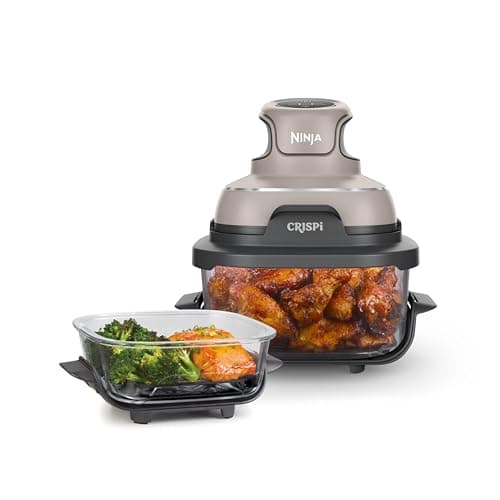 Ninja Crispi The Crispi is the cleanest materials story in air frying: you cook directly in borosilicate glass containers that Ninja lists as PFAS- and PTFE-free — no nonstick coating touching your food at all. A pod-style heater clips on top, and it stores nested. 4 QT | Best non-toxic / glass | 4.3★★★★★ | $152.99Amazon |
| 02 | 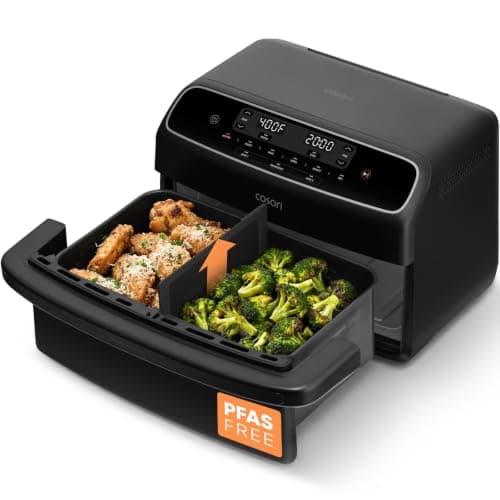 Cosori TWINFRY (9 Qt) The TWINFRY is the first machine we track that puts a stated PFAS-free ceramic coating on a family-sized dual basket. A removable divider turns two 4.5-quart zones into one 9-quart basket, so it cooks a main and a side together or a whole chicken on its own — with a 2-year warranty behind it. 9 QT | Best ceramic for a family | 4.3★★★★★ | $179.99Amazon |
| 03 | 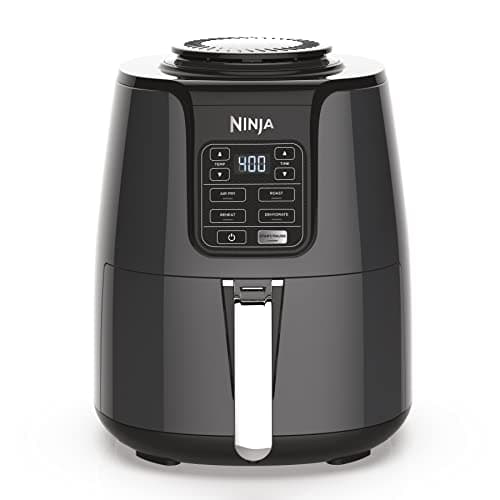 Ninja AF101 The 4-quart Ninja AF101 is the one we point most people to: a genuinely simple dial-and-button air fryer with a ceramic-coated basket, a 105–400°F range, and a footprint that fits a normal counter. It has been the reliable default since 2018 for good reason. 4 QT · 1550W | Best overall on value | 4.6★★★★★ | $55.77Amazon |
#ad · Live prices from the Amazon Product API, as of October 10, 2026. Where we have no verified live price, we show none — a gap beats a number that has rotted.
Side by side
Which machines need a liner at all
Read from each machine's own Amazon listing. A liner's job is usually to keep food off a coating or to catch drips — so the surface underneath, and the temperature the machine can reach, are the two facts that decide the answer.
| Model | Key specs | Cooking surface and published max temp | Best for | Price |
|---|---|---|---|---|
| Ninja CrispiFN101ST | 4 QT11.96 × 13.38 × 13.58 in1-yr warranty | CleanCrisp borosilicate glass containers, stated free of PFAS, PTFE and nonstick coatings. Published to 450°F. No coating to protect, and glass releases cleanly. | No liner needed, ever | $152.99Check Price |
| Cosori TWINFRY (9 Qt)CAF-TF901-KUS | 9 QT11.1 × 19 × 11.9 in2-yr warranty | Nonstick PFAS-free ceramic coating on both the basket and the crisper tray, dishwasher-safe. 9 qt with a removable divider. | Family capacity without PFAS | $179.99Check Price |
| Ninja AF101 | 4 QT1550 W12.25 × 15.1 × 15.25 in1-yr warranty | Aluminium basket and crisper plate with a nonstick ceramic coating, dishwasher-safe. Published range 105–400°F — the lowest ceiling here, so most parchment clears it. | Cheapest ceramic-coated basket | $55.77Check Price |
#ad · we may earn a commission · Specs read from each manufacturer's Amazon listing; prices pulled live from the Amazon Product API, as of October 10, 2026. Where a maker publishes no figure (wattage, warranty term) we leave the cell empty rather than estimate one.
The picks, in detail
Ninja Crispi
spec score /5
$179.9915% off
Price as of October 10, 2026. Prices change — Amazon's is the one that counts.
#ad · we may earn a commission from this link to Ninja Crispi
The Crispi is the cleanest materials story in air frying: you cook directly in borosilicate glass containers that Ninja lists as PFAS- and PTFE-free — no nonstick coating touching your food at all. A pod-style heater clips on top, and it stores nested.
- Capacity
- 4 QT
- Footprint (W×D×H)
- 11.96 × 13.38 × 13.58 in
- Warranty
- 1 year limited warranty
- Cooks in PFAS/PTFE-free borosilicate glass
- Nests to store; pod is tiny
- Glass containers double as meal prep
- Newer design, shorter track record
- Glass adds weight
- Not the cheapest per quart
Cosori TWINFRY (9 Qt)
spec score /5
Price as of October 10, 2026. Prices change — Amazon's is the one that counts.
#ad · we may earn a commission from this link to Cosori TWINFRY (9 Qt)
The TWINFRY is the first machine we track that puts a stated PFAS-free ceramic coating on a family-sized dual basket. A removable divider turns two 4.5-quart zones into one 9-quart basket, so it cooks a main and a side together or a whole chicken on its own — with a 2-year warranty behind it.
- Capacity
- 9 QT
- Footprint (W×D×H)
- 11.1 × 19 × 11.9 in
- Weight
- 17.2 lb
- Warranty
- 2 Years
- PFAS-free ceramic on the basket and the crisper plate
- Removable divider: two 4.5-qt zones or one 9-qt basket
- Sync and Match finish two foods together; 2-year warranty
- 19 inches along its longest edge — a real run of counter
- 17.2 lb, so it stays out rather than living in a cupboard
- Released July 2026, so there is no long-term durability record yet
Ninja AF101
spec score /5
Price as of October 10, 2026. Prices change — Amazon's is the one that counts.
#ad · we may earn a commission from this link to Ninja AF101
The 4-quart Ninja AF101 is the one we point most people to: a genuinely simple dial-and-button air fryer with a ceramic-coated basket, a 105–400°F range, and a footprint that fits a normal counter. It has been the reliable default since 2018 for good reason.
- Capacity
- 4 QT
- Footprint (W×D×H)
- 12.25 × 15.1 × 15.25 in
- Power
- 1550 W
- Weight
- 10.58 lb
- Cost per use*
- ≈9¢
- Est. per year*
- ≈$18
- Warranty
- 1 Year Manufacturers
- Ceramic-coated aluminum basket — no PTFE nonstick
- Dead-simple controls; nothing to learn
- Small enough for a normal counter (12 × 15 in)
- 4 qt is tight for a family of 4+
- No preset buttons or window
- Dial isn't the most precise
*Cost-to-run computed from the manufacturer's stated 1550W at $0.17/kWh (US average), 20-min sessions, 4×/week. Your rate and use will vary.
What a liner actually is
Four different products get sold as air fryer liners, and they do not behave the same way:
- Perforated parchment rounds. Paper with a silicone release coating, punched with holes so air can still pass. Disposable. The most common kind.
- Solid parchment or paper liners. The same material without the holes. Cheaper, worse, and the source of most of the problems on this page.
- Silicone liners and silicone baskets. Reusable, flexible, rated higher than paper, and considerably thicker.
- Aluminium foil. Not sold as a liner but used as one constantly.
All four are safe in the sense that matters — none of them off-gas anything harmful at air fryer temperatures when used as directed. The risks are mechanical: fire from a loose sheet, scorching above the rated temperature, and ruined cooking from blocked airflow.
Rule one: it must be weighted down
This is the only rule with a real safety consequence attached. An air fryer moves air fast — Cosori publishes a 3,600 rpm fan on the TurboBlaze and markets a five-speed fan system — and a loose, light sheet of paper in that airflow goes up. If it reaches the exposed heating element above the basket, it can ignite.
Two things follow:
- Put the food in before you switch the machine on. The food is what holds the liner down. A liner sitting in an empty basket has nothing holding it.
- Never preheat with an empty liner in the basket. This is the single most common way people get a scare, and it is entirely avoidable: preheat empty, then add the liner and the food together.
Trim liners so they do not run up the sides of the basket, either. A sheet with free edges standing proud of the food is the same problem in a smaller form, and the edges are what char first.
Rule two: check the liner's rating against your machine's maximum
Parchment and silicone both carry a maximum temperature, printed on the packaging. Air fryers publish a maximum too, and the mistake is assuming the appliance stays inside the paper's range. Across the machines we track:
- Ninja AF101 — a published 105°F to 400°F range. 400 is the lowest ceiling of any machine in our catalog, and most parchment clears it comfortably.
- Cosori TurboBlaze — a published 90°F to 450°F range, which Cosori markets as an upgrade. At the top of that range you are above what a good deal of parchment is rated for.
- Ninja Crispi — published to 450°F. Same issue, and the machine least likely to need a liner in the first place.
So the check is specific rather than general: read the number on your machine, read the number on the liner box, and do not use a liner above its rating. If you mostly cook at 375 or 400 it is a non-issue. If you use the top of a 450°F machine for wings or steak, buy silicone instead of paper, or skip the liner.
One thing not to do is reach for a figure you half-remember. The rating is on the packaging and the machine's range is on its listing; both are easy to check, and we are not going to print a parchment rating here as though all parchment shared one.
Rule three: do not block the holes
An air fryer is a small convection oven. Its whole mechanism is fast-moving hot air circulating around the food, and it does that by pulling air down through the perforated crisper plate — the full explanation is in how air fryers work.
Cover that plate with a solid sheet and you have removed the appliance from the appliance. The food steams in its own moisture instead of drying and browning, the bottom stays pale and soft, and cook times go out the window. This is not a safety problem; it is the reason people say their air fryer stopped crisping, which is the first thing we check in air fryer not crisping.
If you use a liner, use a perforated one, keep it to the flat base, and accept that even perforated liners cost you some browning underneath. Silicone liners cost more because they are thick enough to insulate the base as well as block some airflow. There is no version of this that is free.
Foil, specifically
Aluminium foil is safe in an air fryer in the sense that it will not burn, and it conducts heat rather than insulating, so it costs you less browning than paper does. Three caveats:
- It still blocks airflow if you cover the whole base. Same consequence as any solid liner.
- Acidic food reacts with it. Tomatoes, citrus, vinegar and wine marinades pit aluminium and pick up a metallic taste. Use parchment for those.
- It is lighter than parchment, not heavier. An unweighted scrap of foil in a 3,600 rpm airflow goes exactly where a sheet of paper goes.
Oven-style machines are a different case: in a Ninja SP101, Cuisinart TOA-70 or Breville BOV900, food sits on a rack or tray with air moving around it rather than through a basket floor, so a foil-lined tray underneath catches drips without blocking anything. That format difference is covered in best air fryer toaster ovens.
The real reason most people search this
A large share of the people asking whether liners are safe are not worried about the liner. They are worried about the basket — specifically about food touching a nonstick coating — and a liner is the cheapest-looking way to avoid it.
It is also a workaround, and a leaky one. A liner only covers the flat base; food still touches the walls, the crisper plate edges and anything you turn it against. If coating contact is the concern, the durable answer is a machine whose cooking surface you are happy to touch food:
- Ninja Crispi — borosilicate glass containers that Ninja states are free of PFAS, PTFE and nonstick coatings. There is nothing to protect, so there is no reason to line it. Our Crispi review covers the trade-offs, and the format argument is best glass air fryers.
- Cosori TWINFRY and Cosori TurboBlaze — PFAS-free ceramic coating on basket and crisper tray, which is a coating but not a fluoropolymer one. The field is best ceramic air fryers, and the format-level decision is glass vs. ceramic air fryers.
- Ninja Foodi DualZone XL DZ401 — Ninja states the nonstick cooking surface is 100% PFAS free.
What "PFAS-free" does and does not mean is what does PFAS-free mean, the honest read on coating safety is are air fryers toxic, and the full ranking is best non-toxic air fryers.
If your coating is already failing, a liner is not the answer to that either — see air fryer coating coming off.
When a liner is genuinely worth it
Three cases, and they are all about cleanup rather than safety:
- Anything with sugar in it. Teriyaki, barbecue sauce, honey glazes. Caramelised sugar welds to a basket and is the one mess that justifies the lost browning.
- Reheating pizza, pastry or anything crumb-heavy. Crumbs through a crisper plate are the most annoying thing to clean out of a basket.
- Fish. Not for the mess — for the smell, which survives a dishwasher cycle in a coated basket more often than you would like.
For everything else, cook directly on the plate and clean it properly: a hot soak and a soft brush beats a liner on results every time. The routine is how to clean an air fryer, and the foods that cause the trouble in the first place are in what not to cook in an air fryer.
Frequently asked questions
Are air fryer liners safe to use?
Yes, under three conditions: the liner is weighted down by food rather than sitting loose, it is rated above the maximum temperature your machine publishes, and it does not cover the holes in the crisper plate. None of the usual materials — parchment, silicone or foil — off-gas anything harmful at air fryer temperatures. The risks are mechanical, not chemical.
Can you preheat an air fryer with a liner in it?
No. This is the one genuinely unsafe thing you can do with a liner. An air fryer moves air very fast — Cosori publishes a 3,600 rpm fan on the TurboBlaze — and an unweighted sheet of paper can lift into the exposed heating element and ignite. Preheat empty, then add the liner and the food together.
Do air fryer liners stop food from crisping?
Yes, to a degree, and a solid liner stops it almost completely. An air fryer works by pulling hot air down through the perforated crisper plate, so covering that plate turns the machine into a small covered roasting dish. Use perforated liners only, keep them flat on the base, and expect less browning underneath even then.
Is parchment paper or silicone better in an air fryer?
Silicone if you cook at high temperatures, because it is rated higher than paper and it is reusable. Parchment if browning matters, because silicone liners are thick enough to insulate the base as well as block airflow. Check the rating on the packaging against your machine's published maximum — our Ninja AF101 tops out at 400°F, but the Cosori TurboBlaze and Ninja Crispi both publish 450°F.
Can you put aluminium foil in an air fryer?
Yes. Foil will not burn and it conducts heat rather than insulating, so it costs less browning than paper. But it still blocks airflow if it covers the whole base, it reacts with acidic food like tomatoes, citrus and vinegar marinades, and it is lighter than parchment — so an unweighted scrap lifts just as readily. Weight it down with food.
Do I need a liner to protect the nonstick coating?
A liner is a workaround rather than a fix, because it only covers the flat base while food still touches the walls and the crisper plate edges. If coating contact is the concern, buy a machine you are happy to cook directly in: the Ninja Crispi uses borosilicate glass containers Ninja states are free of PFAS, PTFE and nonstick coatings, and Cosori's ceramic-coated baskets are published as PFAS-free.
When is an air fryer liner actually worth using?
Three cases, all about cleanup rather than safety: anything with sugar in it, because caramelised glaze welds to a basket; reheating crumb-heavy food like pizza and pastry; and fish, because the smell outlasts a dishwasher cycle in a coated basket. For everything else, cook on the plate and clean it properly.
Keep reading
Air Fryers
The Best Air Fryers of 2026
Our ranked air-fryer picks, compared on capacity, footprint, materials and running cost — with live Amazon prices.
Roundup
The Best Non-Toxic Air Fryers of 2026
Glass and PFAS-free ceramic air fryers, ranked — with an honest take on coatings.
Guide
Are Air Fryers Toxic? The Honest, Sourced Answer
PTFE, PFOA, PFAS and acrylamide explained plainly — plus how ceramic and glass baskets avoid coatings.
Guide
Air Fryer Coating Coming Off: What To Do
What the FDA publishes about ingesting nonstick flakes, the five things that destroy a basket coating, and when to replace basket vs. machine.
Guide
How to Clean an Air Fryer
The five-minute routine, the monthly deep clean, and how to fix a smoking or smelly air fryer for good.
Guide
What You Should Not Cook in an Air Fryer
Wet batter, loose greens, cheese, rice and popcorn: what fails in an air fryer, why, and what to do instead.
https://wattandwhisk.com/air-fryers/are-air-fryer-liners-safe